Facebook Meta Ads Mistakes Agencies Still Make
Avoid costly Facebook Meta Ads mistakes with practical fixes for tracking, creative, targeting, reporting and agency delivery pressure.
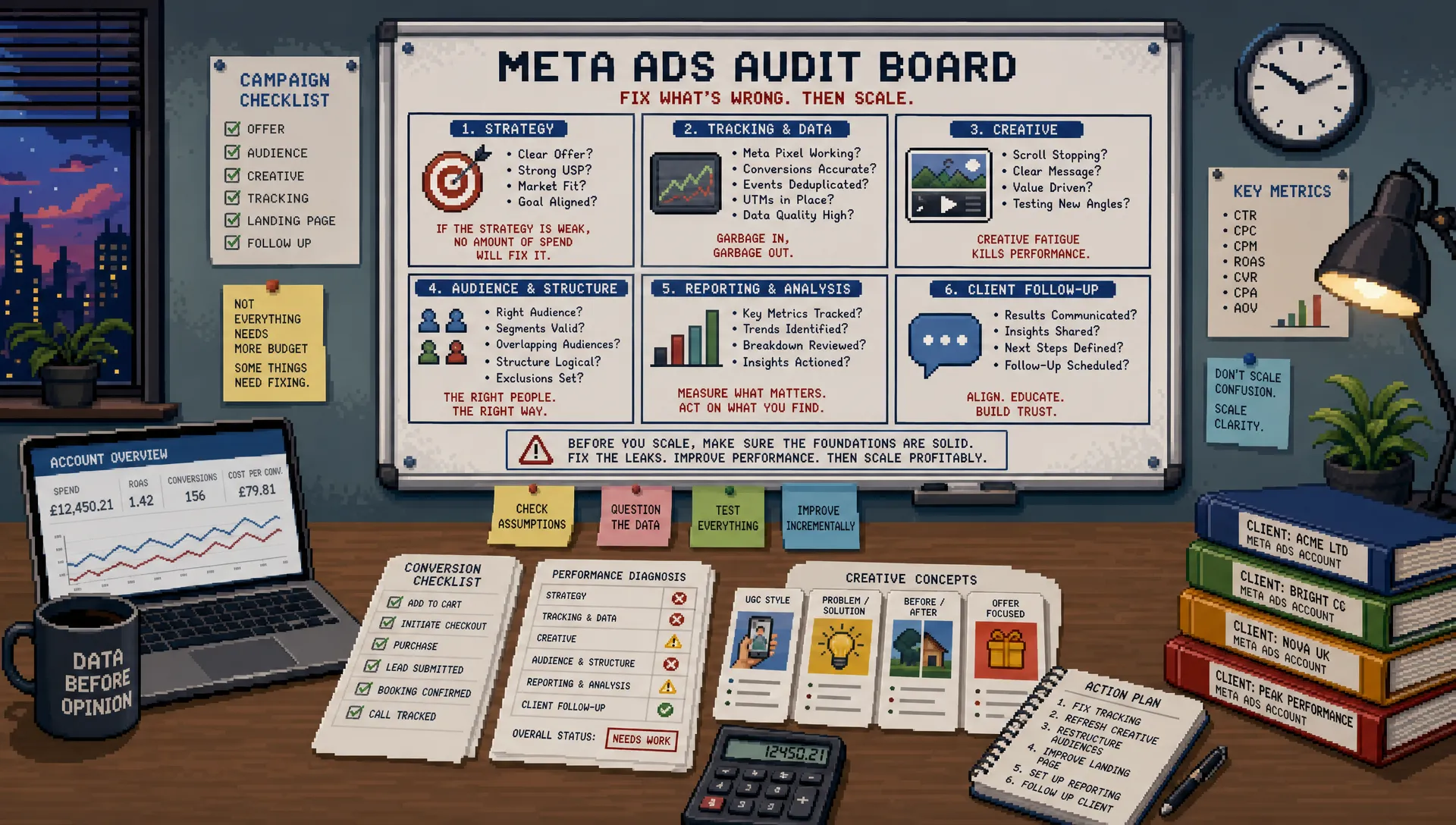
Most agencies do not make Facebook Meta Ads mistakes because they lack platform access or basic know-how. The costly mistakes are usually quieter: unclear strategy, weak conversion signals, stale creative, rushed reporting and a delivery process that depends too much on one overstretched person.
That matters because clients rarely judge paid social by how neatly an account is structured. They judge it by whether the work creates qualified demand, supports sales, and gives them confidence that budget is being handled properly. In 2026, Meta can automate more of the mechanics, but it still cannot fix a weak offer, poor tracking, thin creative or confused agency process.
If your agency sells paid media, these are the Facebook Meta Ads mistakes still worth auditing before they turn into churn, margin loss or awkward client calls.
Why agencies still get Meta Ads wrong
Meta Ads has become more automated, but not necessarily easier. Advantage+ tools, broader targeting and algorithmic delivery can reduce manual complexity, yet they also punish poor inputs. If the campaign is optimising towards the wrong event, using weak creative or sending traffic to an unconvincing landing page, automation simply finds more people likely to do the wrong thing.
There is also a strategic mismatch. Many clients still treat Facebook and Instagram ads like a direct response vending machine. Agencies then feel pressure to report short-term leads or purchases, even when the channel is really being used to create demand, test offers or warm audiences before search and sales activity convert them. If you are still deciding how Meta should sit beside search, this comparison of Google Ads vs Meta Ads for agency growth is a useful strategic reference.
Here is the pattern most often seen in struggling accounts:
| Mistake | What clients usually notice | Better agency habit |
|---|---|---|
| Weak brief | Campaigns launch, but the offer feels generic | Confirm audience, offer, proof and conversion goal before build |
| Poor tracking | Results look good in-platform, but CRM or GA4 disagrees | Validate Pixel, Conversions API, GA4 and UTMs before scaling |
| Thin creative | Frequency rises and performance drops quickly | Plan creative angles before the account build |
| Oversegmentation | Ad sets fight for limited data | Consolidate where possible and let the system learn |
| Shallow reporting | Clients see metrics, not business meaning | Connect spend, leads, sales quality and next actions |
Mistake 1: Treating Meta Ads like cheaper search traffic
One of the biggest agency errors is using Meta Ads as if it were Google Search with different placements. Search usually captures existing demand. Meta often creates or shapes demand by interrupting people who were not actively looking.
That changes the job of the campaign. A search ad can succeed with direct intent, a relevant keyword and a strong landing page. A Meta ad often needs a sharper hook, a more obvious problem statement and a faster reason to care. If the creative only says what the company does, it may not earn attention in a feed full of entertainment, opinions, friends and short-form video.
For agencies, the fix is to define the role of the campaign before launch. Is it there to generate cold leads, retarget visitors, validate a new offer, promote a local event, build a remarketing pool or support a broader sales funnel? Each role needs different creative, conversion events and reporting expectations.
Mistake 2: Launching from an incomplete client brief
Rushed launches are common in agencies. A client approves budget late, access is missing, creative is half ready and someone is expected to build the campaign by the end of the day. The problem is not speed itself. The problem is speed without the right inputs.
A Meta campaign brief should answer commercial questions, not just media questions. Who is the buyer? What pain point is strongest? What proof can we use? What objections usually block the sale? What happens after a lead submits a form? Which locations, exclusions, products or margins matter most?
Without those answers, the media buyer ends up guessing. That usually leads to generic copy, loose targeting, vague landing page alignment and reporting that cannot explain why performance is happening. If the bottleneck is the launch process itself, tighten the handover using the workflow ideas in this guide to faster Meta campaign launches.
Mistake 3: Treating tracking as an admin task
Tracking is not a technical afterthought. It is the foundation of every optimisation decision. Agencies still launch campaigns where the Pixel fires inconsistently, conversion events are duplicated, UTMs are missing, GA4 is not aligned with Meta naming conventions, or the CRM never confirms whether leads became opportunities.
Meta's Conversions API documentation explains how server-side event sharing can help improve signal quality alongside browser-based tracking. That does not mean every account needs an over-engineered setup, but agencies should know what signal quality they are relying on before telling a client that performance is good or bad.
A sensible agency QA process checks whether key events fire, whether events match the intended optimisation goal, whether UTMs are consistent, whether consent requirements are respected and whether reported results make sense against backend data. When accounts are already under pressure, measurement should be one of the first things audited, which is why tracking discipline also appears in these PPC ads best practices for agencies under pressure.
Mistake 4: Over-tweaking audiences instead of improving creative
A common agency habit is to respond to weak performance by adjusting audiences repeatedly. Interests are added, exclusions are tightened, lookalikes are split and age ranges are trimmed. Sometimes that helps, but often it just fragments data and distracts from the real issue: the ad is not persuasive enough.
Meta's delivery system is now strong at finding likely responders when the goal, budget and creative are sound. That makes creative quality even more important. Agencies should test different angles, not just different assets. A new colour or crop is rarely as meaningful as a new promise, pain point, testimonial, offer or objection-handling hook.
Good creative testing asks what the buyer needs to believe before they act. For a B2B lead generation campaign, that might be trust, urgency and proof. For ecommerce, it might be desirability, price confidence and social validation. For local services, it might be convenience, availability and reputation.
Mistake 5: Using too many ad sets for too little data
Oversegmentation is one of the easiest mistakes to justify internally because it looks strategic. Separate ad sets for each persona, age bracket, interest group, placement and location can make a media plan look thorough. In practice, it often leaves each ad set with too little budget and too few conversion events to learn properly.
This is especially damaging for smaller agency clients. A limited monthly budget spread across too many ad sets creates slow learning, unstable results and constant false conclusions. One ad set looks better for three days, then another wins the next week, but neither has enough data to prove anything.
Consolidation is not laziness. It is often the better choice when budgets are modest and conversion volume is limited. Use segmentation where it reflects a real commercial difference, such as different products, geographies, languages, offers or funnel stages. Avoid splitting audiences just because the platform allows it.
Mistake 6: Resetting learning with constant significant edits
Another mistake is making large changes too often. Budget swings, objective changes, bid strategy changes, creative replacements and audience edits can all affect delivery. Meta's own guidance on the learning phase explains that ad sets need enough optimisation events to stabilise and that significant edits can move an ad set back into learning.
Agencies under client pressure often feel they need to be seen doing something every day. The danger is that constant intervention prevents the campaign from gathering useful signals. There is a difference between monitoring and meddling.
A better approach is to agree testing windows before launch. For example, decide how long an initial test should run, what minimum spend or event volume is needed before judging it, and which metrics would trigger action sooner. That gives the agency a defensible reason to avoid panic edits while still protecting client budget.

Mistake 7: Optimising for cheap leads instead of qualified pipeline
Lead campaigns can look brilliant in Ads Manager while disappointing the sales team. Low cost per lead is not a win if the leads are uncontactable, unqualified or attracted by an offer that does not match the real service.
This happens when agencies optimise only to the easiest conversion event. Instant forms, top-funnel downloads and broad offers can generate volume quickly, but the follow-up quality matters. If the client has a slow sales process, weak CRM discipline or no qualification feedback loop, the campaign will be judged on surface metrics.
Agencies should push for lead quality signals wherever possible. That might mean importing offline conversions, reviewing call outcomes, separating spam from genuine enquiries, or reporting qualified lead rate beside cost per lead. Even a simple weekly check with the client can reveal whether a low-cost campaign is actually helping the business.
Mistake 8: Reporting platform metrics without interpretation
Clients do not need a screenshot tour of Ads Manager. They need to know what changed, why it matters and what happens next. Many agencies still report impressions, clicks, CTR, CPM and CPL without connecting those numbers to commercial context.
Platform metrics are useful, but they should sit inside a story. If CPM rose, did the audience become more competitive or did creative fatigue increase? If CTR improved, did conversion rate also improve? If leads got cheaper, did lead quality hold? If Meta shows more conversions than GA4, what attribution difference explains the gap?
| Reporting area | Weak agency reporting | Stronger agency reporting |
|---|---|---|
| Spend | We spent this amount | Spend is pacing correctly or needs adjustment because of performance and opportunity |
| Creative | This ad had the highest CTR | This angle is attracting better intent or only cheaper clicks |
| Leads | CPL decreased | CPL decreased, but qualification rate stayed stable or changed |
| Attribution | Meta says X conversions | Meta, GA4 and CRM show different views, and this is the likely reason |
| Next steps | We will keep optimising | We will test this offer, pause this angle and validate lead quality by this date |
The best reports reduce uncertainty. They make the agency look in control even when performance is not perfect.
Mistake 9: Ignoring the landing page and sales follow-up
Meta Ads performance does not stop at the ad click. Agencies can build a strong campaign and still lose because the landing page is slow, the message does not match the ad, the form is too long, the offer lacks proof or the sales team takes two days to call new leads.
This is awkward because agencies do not always control the full funnel. Still, paid media teams should flag the risk clearly. If a campaign sends traffic to a weak page, document it. If leads are not followed up quickly, raise it. If the client cannot tell you which leads became sales opportunities, explain how that limits optimisation.
The agency does not need to become the client's operations department. But it does need to protect the integrity of its media work by identifying post-click problems early.
Mistake 10: Scaling spend without scaling creative and delivery capacity
Many Meta Ads accounts do not fail because the original test was poor. They fail because the agency tries to scale the same small set of ads, the same audience assumptions and the same internal process beyond what they can support.
Scaling requires more than increasing budgets. It usually requires more creative concepts, more landing page alignment, stronger tracking, clearer client communication and faster response times. If the person managing Meta is also handling Google Ads, client calls, reporting and urgent fixes, quality will eventually slip.
This is where agencies need to be honest about capacity. Hiring a full-time specialist may not make sense for every workload, but relying on a generalist forever can also become expensive through mistakes, missed opportunities and churn.
A simple audit framework for agencies
Before the next client review, ask five questions about every active Meta account:
- Is the campaign objective aligned with the actual business outcome?
- Are tracking and UTMs clean enough to trust the data?
- Is creative testing based on buyer psychology, not just visual variations?
- Is the account structure simple enough for the available budget and conversion volume?
- Does reporting explain what the client should do next?
If the answer to any of these is unclear, the account is carrying risk. The good news is that most of these problems are fixable without rebuilding everything. Agencies usually need clearer process, better QA and senior judgement at the right moments.
Frequently Asked Questions
What is the biggest Facebook Meta Ads mistake agencies make? The biggest mistake is usually weak measurement combined with unclear strategy. If the campaign is optimising towards the wrong event or the agency cannot connect Meta results to lead quality or revenue, every optimisation decision becomes less reliable.
Are Facebook Ads and Meta Ads the same thing? Facebook Ads is often used as a familiar phrase, but Meta Ads now covers advertising across Meta placements such as Facebook, Instagram, Messenger and other inventory. Agencies should plan for the full Meta ecosystem rather than thinking only about Facebook feed ads.
Should agencies use broad targeting on Meta Ads? Broad targeting can work well when the account has strong creative, enough budget and reliable conversion signals. It is not a universal fix. Agencies should avoid unnecessary segmentation, but still separate campaigns where there are real differences in offer, funnel stage, geography or commercial value.
How often should Meta Ads creative be refreshed? There is no single rule. Refresh frequency depends on spend, audience size, frequency, performance trends and creative fatigue. A small account may not need new assets every week, while a scaling account may need a steady pipeline of new hooks, formats and proof points.
Can white-label Meta Ads support help agencies avoid these mistakes? Yes, especially when the agency has client demand but not enough senior paid media capacity. White-label support can help with setup, tracking checks, optimisation and delivery without forcing the agency to hire before workload is consistent.
Need senior Meta Ads support without hiring?
If your agency is stretched, Meta Ads mistakes become more likely. Rushed launches, unclear tracking, thin creative testing and shallow reporting are often symptoms of capacity pressure, not lack of care.
PPC Ghost provides on-demand, white-label PPC support for agencies, including Meta Ads, Google Ads, Microsoft Ads and GA4 or tracking support. You keep the client relationship, while senior execution happens quietly in the background, with flexible pay-as-you-go support and no long-term recruitment commitment.