How a Google PPC Specialist Improves Account Performance
Learn how a Google PPC specialist improves account performance by fixing tracking, reducing waste and scaling campaigns with stronger intent.
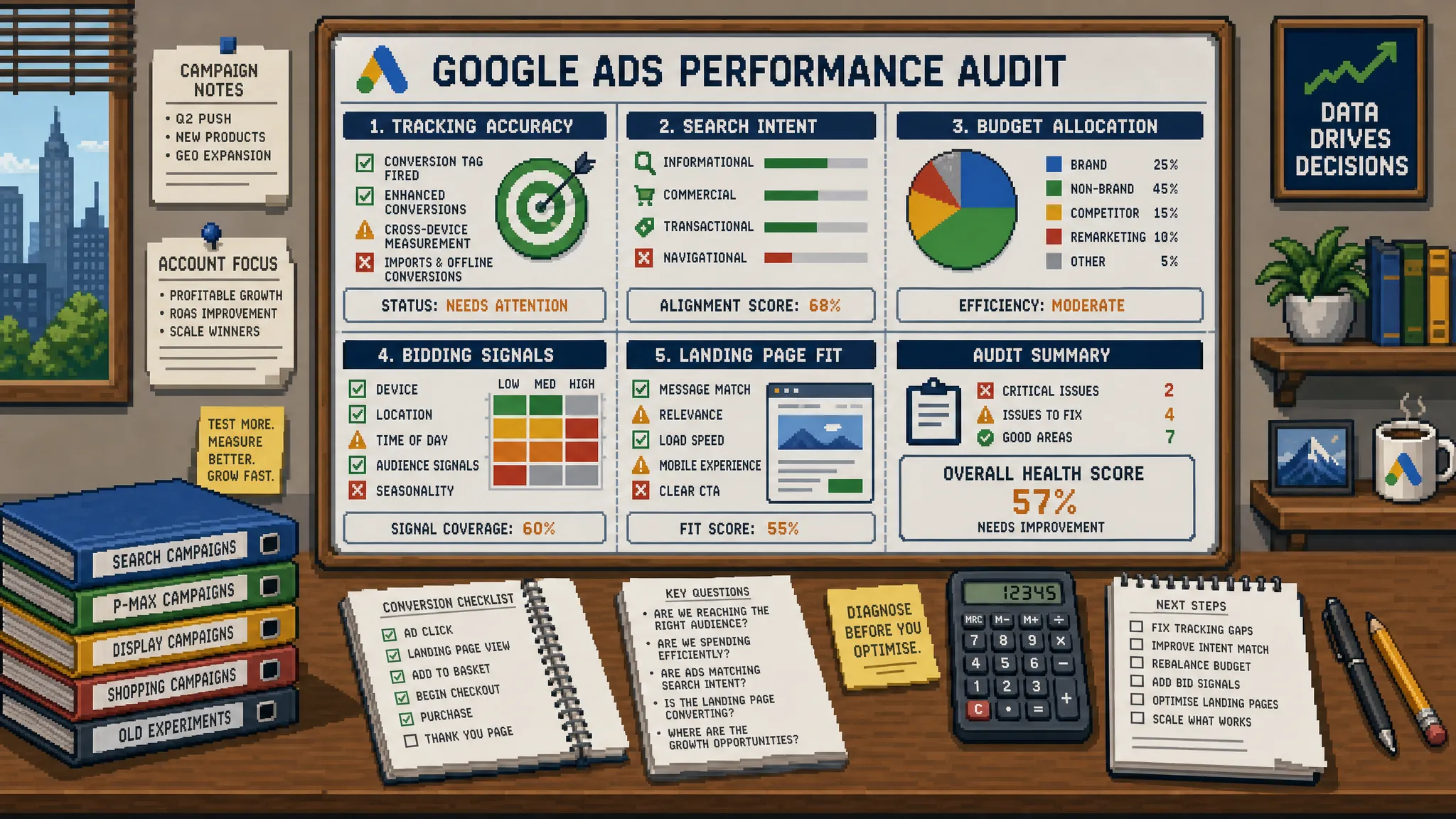
A Google Ads account can look busy while underperforming. Campaigns run, budgets spend, reports show clicks and conversions, yet the account may still be leaking profit through weak tracking, poor intent matching, over-reliance on automation or unclear commercial goals.
That is where a Google PPC specialist makes a measurable difference. The job is not simply to change bids or add a few keywords. A strong specialist improves account performance by finding the constraints that stop spend from becoming revenue, then fixing them in the right order.
For agencies, this matters even more. When a client asks why cost per lead has risen or why revenue has flattened, generic optimisation is rarely enough. You need senior judgement, clean diagnostics and fast execution that protects the client relationship.
Account performance improves when diagnosis comes before optimisation
Many underperforming Google Ads accounts are not broken in one obvious place. They are usually affected by several smaller issues that compound over time. Conversion tracking may be slightly inaccurate. Search terms may have drifted away from buyer intent. Budgets may still be allocated to legacy campaigns that no longer support the client’s commercial priorities.
A Google PPC specialist starts by diagnosing the account as a commercial system, not just a media platform. That means looking beyond clicks, impressions and surface-level conversion numbers. The key question is: which parts of the account are helping the business grow, and which parts only look active?
A proper diagnosis normally reviews:
- Conversion actions and attribution settings
- Campaign objectives and budget allocation
- Search terms, match types and negative keywords
- Bidding strategies and learning limitations
- Landing page relevance and conversion friction
- Lead or sale quality compared with reported platform results
- Change history, seasonality and competitor pressure
This sequence matters. If tracking is wrong, bid strategies learn from poor signals. If campaign structure is messy, budget goes to mixed intent. If landing pages do not match the ad promise, better keyword targeting only solves part of the problem.
| Diagnostic area | What a specialist checks | Performance risk if ignored |
|---|---|---|
| Measurement | Whether primary conversions reflect real business value | Campaigns optimise towards weak or false outcomes |
| Search intent | Whether queries match the client’s best-fit buyers | Spend goes to irrelevant or low-quality traffic |
| Budget allocation | Whether spend follows profit potential | Strong campaigns are underfunded while weak ones keep spending |
| Bidding | Whether automated strategies have enough clean data | Algorithms scale inefficiently or fail to leave learning periods |
| Landing pages | Whether page content supports the ad and query intent | Clicks increase without a matching rise in conversions |
Fixing measurement before scaling spend
Accurate measurement is the foundation of account performance. Without it, every optimisation is partly guesswork.
Google Ads can only optimise towards the conversion actions it is given. Google’s own guidance on conversion tracking explains that it helps advertisers understand what happens after someone interacts with an ad. In practice, the quality of that setup determines whether campaign data is useful or misleading.
A specialist will usually check whether the account is counting the right actions as primary conversions. For example, a contact form submission may be valuable, but a newsletter signup or page view should not carry the same weight. If phone calls, forms, purchases and offline outcomes are all mixed together without proper context, the account can optimise for volume rather than value.
For lead generation clients, the issue is often lead quality. An account may show a falling cost per conversion while the sales team complains that enquiries are poor. A specialist investigates whether the problem is traffic intent, form friction, geography, offer positioning or conversion importing. Better performance does not always mean more conversions. Sometimes it means fewer, better conversions at a healthier cost.
This is one reason strong PPC execution supports client retention. When reports connect ad spend to commercial outcomes, agencies can explain performance with more confidence. PPC Ghost has covered this wider agency benefit in its article on how a Google Ads PPC agency supports client retention.
Cutting wasted spend without cutting growth
The quickest visible improvement often comes from reducing wasted spend. But this has to be done carefully. Cutting aggressively without understanding intent can shrink the account, damage lead flow and make future scaling harder.
A specialist looks for waste in the places where Google Ads accounts commonly drift. Search terms may include informational queries that never convert. Broad match may be useful in one campaign but too loose in another. Locations may include areas the client does not serve. Display expansion or partner traffic may be active without a clear reason. Budgets may still support campaigns built for an old offer.
The skill is knowing what to remove, what to isolate and what to test. A junior operator might simply add negatives or reduce bids. A senior Google PPC specialist asks whether the waste is caused by account structure, keyword coverage, weak conversion data, poor audience signals or the wrong bid strategy.
For example, if high spend comes from broad queries with poor conversion quality, the answer may be to tighten search themes, add negatives and rebuild ad groups around clearer intent. If spend is being lost to irrelevant locations, the fix may be location exclusion and reporting by region. If budget is trapped in a campaign with weak marginal returns, the answer may be reallocation rather than more optimisation inside the same campaign.
For a practical companion to this approach, see PPC Ghost’s guide to PPC Google Ads tips that cut wasted spend fast.
Rebuilding campaign structure around buyer intent
Account structure should make performance easier to manage. In many older accounts, it does the opposite. Campaigns are often grouped by historical habit, internal naming conventions or old service lines rather than how customers search and buy.
A specialist improves structure by separating different levels of intent. Brand searches behave differently from non-brand searches. Emergency or high-urgency queries behave differently from research-led queries. Competitor terms behave differently from category terms. High-margin services may need different budgets and targets from low-margin services.
This does not mean building an overly complex account. Modern Google Ads increasingly relies on automation, and excessive segmentation can limit data. The goal is to create enough separation to control budget, messaging and measurement while still giving bidding systems enough conversion data to learn.
Good structure answers practical questions quickly. Which campaigns attract the most valuable customers? Which search themes deserve more budget? Which services are too expensive to promote at current conversion rates? Which areas need a different landing page or offer?
When structure reflects intent, optimisation becomes faster and clearer. The account stops being a collection of campaigns and becomes a controlled growth system.
Improving bidding by giving automation better signals
Automated bidding is powerful, but it is not a substitute for strategy. Smart Bidding can only work with the conversion data, budget constraints and campaign structure available to it. If those inputs are weak, automation may simply spend faster in the wrong direction.
A Google PPC specialist improves bidding by matching the strategy to the account’s data maturity and commercial goal. Target CPA may work well for lead generation when conversion quality is consistent. Target ROAS may be more suitable for ecommerce or accounts with reliable conversion values. Maximise conversions can be useful, but it can also chase cheap conversions if value is not properly defined.
The specialist also knows when not to interfere. Constant bid strategy changes can reset learning and make performance harder to interpret. Instead of reacting to every short-term fluctuation, a senior operator looks at trend windows, volume, conversion lag and external context.
| Bidding issue | Common symptom | Specialist response |
|---|---|---|
| Too little data | Campaigns struggle to stabilise | Consolidate structure or adjust expectations |
| Poor conversion quality | CPA looks healthy but sales feedback is weak | Refine conversion actions and import better value signals |
| Over-controlled bidding | Performance fluctuates after frequent changes | Reduce unnecessary edits and review over longer windows |
| Budget limitations | Strong campaigns stop showing during valuable periods | Reallocate spend based on marginal opportunity |
| Wrong target | Volume collapses or spend becomes inefficient | Reassess CPA or ROAS targets against actual economics |
The best specialists do not fight Google’s automation. They manage it. They define the commercial goal, clean the signals, set guardrails and monitor whether the system is moving in the right direction.
Turning ads and landing pages into a conversion system
Clicks do not convert in isolation. A person searches, sees an ad, forms an expectation, lands on a page and decides whether to act. If any step feels inconsistent, conversion rates suffer.
A specialist reviews ad copy and landing pages together. The ad should reflect the searcher’s intent, the client’s strongest value proposition and the landing page’s actual content. If the ad promises speed, pricing clarity or sector expertise, the page should prove it quickly. If the query suggests urgency, the call to action should not be buried under generic content.
This is especially important in competitive markets where several advertisers offer similar services. Small improvements in message match can lift conversion efficiency without increasing spend. Better headlines, clearer proof points, stronger calls to action and relevant assets can help the account win more value from the same traffic.
Audience insight can also improve messaging. Search term data shows what people type into Google, but wider market conversations can reveal objections, frustrations and language that do not appear neatly in keyword tools. For example, agencies researching customer pain points can use tools such as Redditor AI to identify relevant Reddit conversations that may inspire ad angles, landing page copy and objection handling.
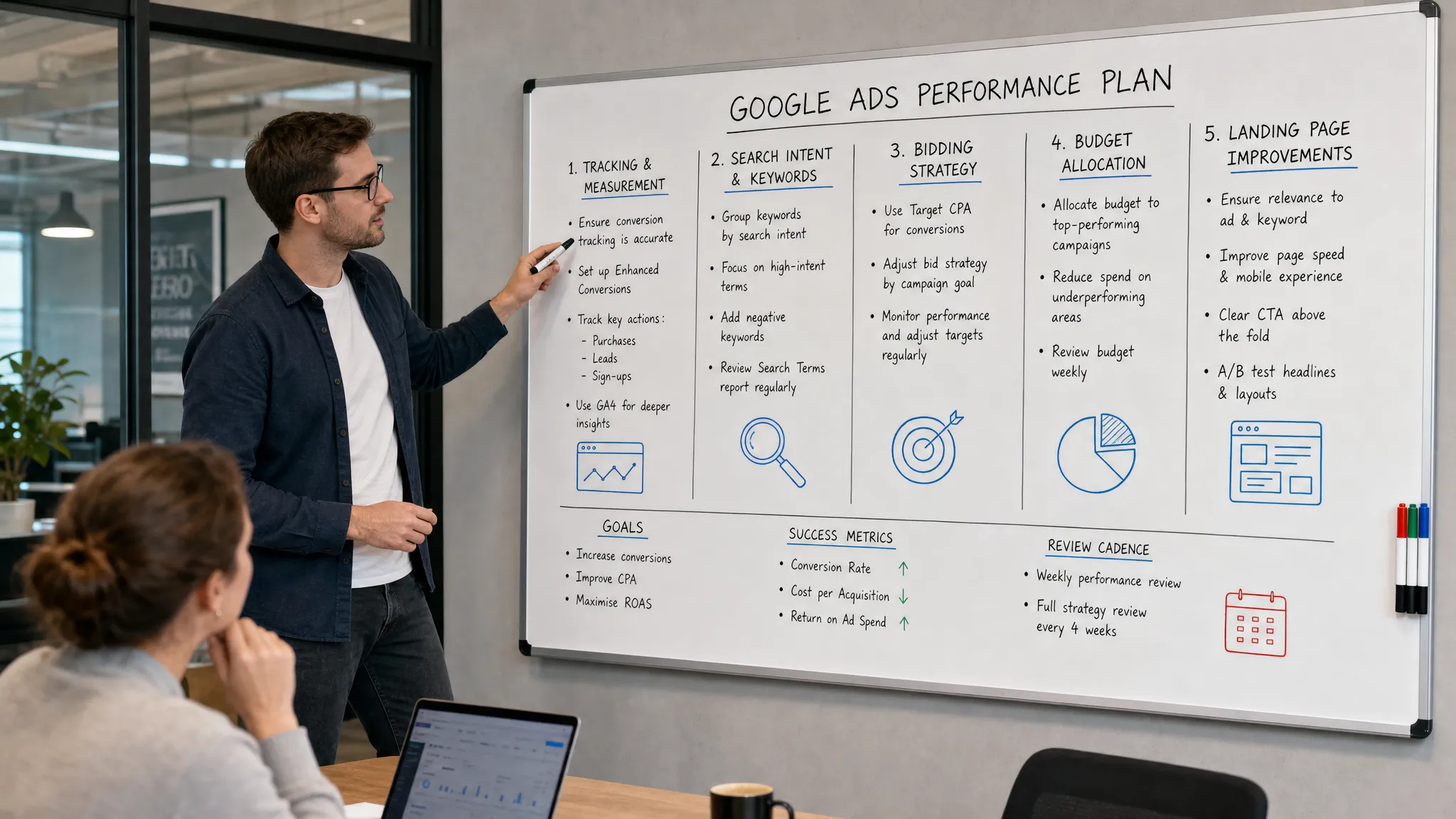
Managing Performance Max and automation with discipline
Performance Max, broad match and responsive search ads can all support growth, but they need active management. A common mistake is treating automation as a black box. Another is trying to control every detail so tightly that the system cannot learn.
A Google PPC specialist finds the middle ground. In Performance Max, that might mean reviewing asset quality, audience signals, search term insights, product feed quality, brand suitability and final URL settings. In search campaigns, it might mean using broad match only where conversion data is strong enough, then monitoring query quality closely.
The specialist also decides when automation is not the answer. If tracking is unreliable, lead quality is unknown or the client’s sales cycle is complex, launching broader automated campaigns may create noise rather than growth. In those cases, account performance improves by slowing down, cleaning the foundations and scaling only when the data can support it.
Reporting on commercial performance, not vanity metrics
Better reporting does not directly improve performance, but it improves decision-making. That makes it a critical part of the specialist’s role.
Clients often receive reports full of impressions, clicks and average CPC. Those numbers have a place, but they do not explain whether the account is making progress. A specialist focuses reporting on the metrics that connect to business outcomes: qualified leads, revenue, cost per acquisition, conversion value, search impression share, lost impression share due to budget or rank, and performance by service, location or audience segment.
This helps agencies avoid two common problems. The first is over-celebrating activity that does not produce commercial value. The second is panicking over short-term movement that is normal in paid search. Senior reporting explains what changed, why it changed and what should happen next.
For agency teams, this can reduce client pressure. When performance is explained clearly, clients are less likely to assume the account is being neglected. They can see the logic behind budget decisions, tests and trade-offs.
How performance improvements differ by account stage
Not every account needs the same kind of help. A specialist adapts the work to the account’s maturity, risk and growth potential.
| Account stage | Main performance problem | What a specialist prioritises |
|---|---|---|
| Newly launched account | Limited data and uncertain intent | Clean structure, clear conversion setup and controlled testing |
| Messy legacy account | Years of changes without a coherent strategy | Audit, simplify and rebuild around commercial priorities |
| Scaling account | Growth has slowed despite higher spend | Find new intent pockets, improve conversion value and refine budgets |
| Lead quality problem | Platform conversions look good but sales outcomes disappoint | Improve tracking, qualify traffic and align reporting with sales feedback |
| Agency capacity issue | Account needs senior attention but internal team is stretched | Provide focused expert support without recruitment delays |
This is why account performance is not improved by one universal checklist. The right action depends on what is holding the account back. Sometimes the priority is tracking. Sometimes it is waste reduction. Sometimes it is offer positioning, landing page relevance or client reporting.
When an agency should bring in a Google PPC specialist
Agencies often wait too long before adding specialist support. By the time performance has declined for several months, the client relationship may already be under pressure.
Bringing in a specialist makes sense when spend is rising without better results, reporting is hard to defend, junior teams are stuck, tracking is unreliable or a major client needs rapid senior attention. It can also be useful when the agency wants to accept more paid media work without hiring full-time staff.
This is where an on-demand, white-label model can be valuable. PPC Ghost provides senior PPC execution for agencies that need Google, Meta, Microsoft Ads or tracking support without recruitment delays or long-term contracts. The agency keeps the client relationship, while the technical work gets handled by a senior specialist in the background.
If you are weighing up whether senior support would outperform a junior-led setup, PPC Ghost’s article on why a PPC specialist agency beats junior account teams gives a useful comparison.
Frequently Asked Questions
What does a Google PPC specialist do? A Google PPC specialist plans, audits, manages and improves Google Ads accounts. The role includes tracking checks, keyword and search term analysis, bidding strategy, campaign structure, budget allocation, ad testing, landing page feedback and performance reporting.
How quickly can a specialist improve account performance? Some improvements, such as removing obvious waste or fixing broken tracking, can happen quickly. Larger gains usually take longer because bidding systems need clean data, tests need time to run and conversion quality has to be validated.
Is a Google PPC specialist only useful for struggling accounts? No. Specialists are also useful for accounts that are performing well but need to scale. In those cases, the focus is usually on finding new profitable demand, improving conversion value and preventing growth from becoming inefficient.
What is the difference between a PPC specialist and a general digital marketer? A generalist may understand several channels, while a PPC specialist goes deeper into paid search mechanics, bidding, conversion tracking, search intent, account structure and performance diagnosis. That depth matters when spend is significant or client pressure is high.
Can agencies use a PPC specialist without the client knowing? Yes, if the arrangement is white-label. A white-label PPC specialist works behind the scenes so the agency can deliver senior-level execution while keeping ownership of the client relationship.
Need senior Google Ads support without hiring?
If your agency needs expert PPC execution but does not want recruitment costs, long contracts or another junior account handler, PPC Ghost can help.
Get on-demand, white-label support from a senior specialist across Google Ads, Meta Ads, Microsoft Ads and tracking. Your agency stays client-facing, while the performance work happens quietly in the background.
Visit PPC Ghost to explore flexible PPC support for UK agencies.