How Paid Media Agencies Can Scale Without Hiring
Learn how paid media agencies can scale without hiring by using better systems, flexible PPC support, pricing discipline and senior execution.
Scaling a paid media agency used to mean one thing: hire another PPC manager, hope they ramp quickly, then protect their utilisation at all costs. That model still works when demand is predictable, margins are strong and the role you need is clear. For many paid media agencies, though, growth is not that neat.
One month you need a senior Google Ads specialist to rescue a lead generation account. The next, your bottleneck is Meta creative testing, Microsoft Ads expansion, GA4 tracking or simply too many campaign builds landing in the same week. Hiring a full-time employee for every spike creates fixed cost before you have fixed demand.
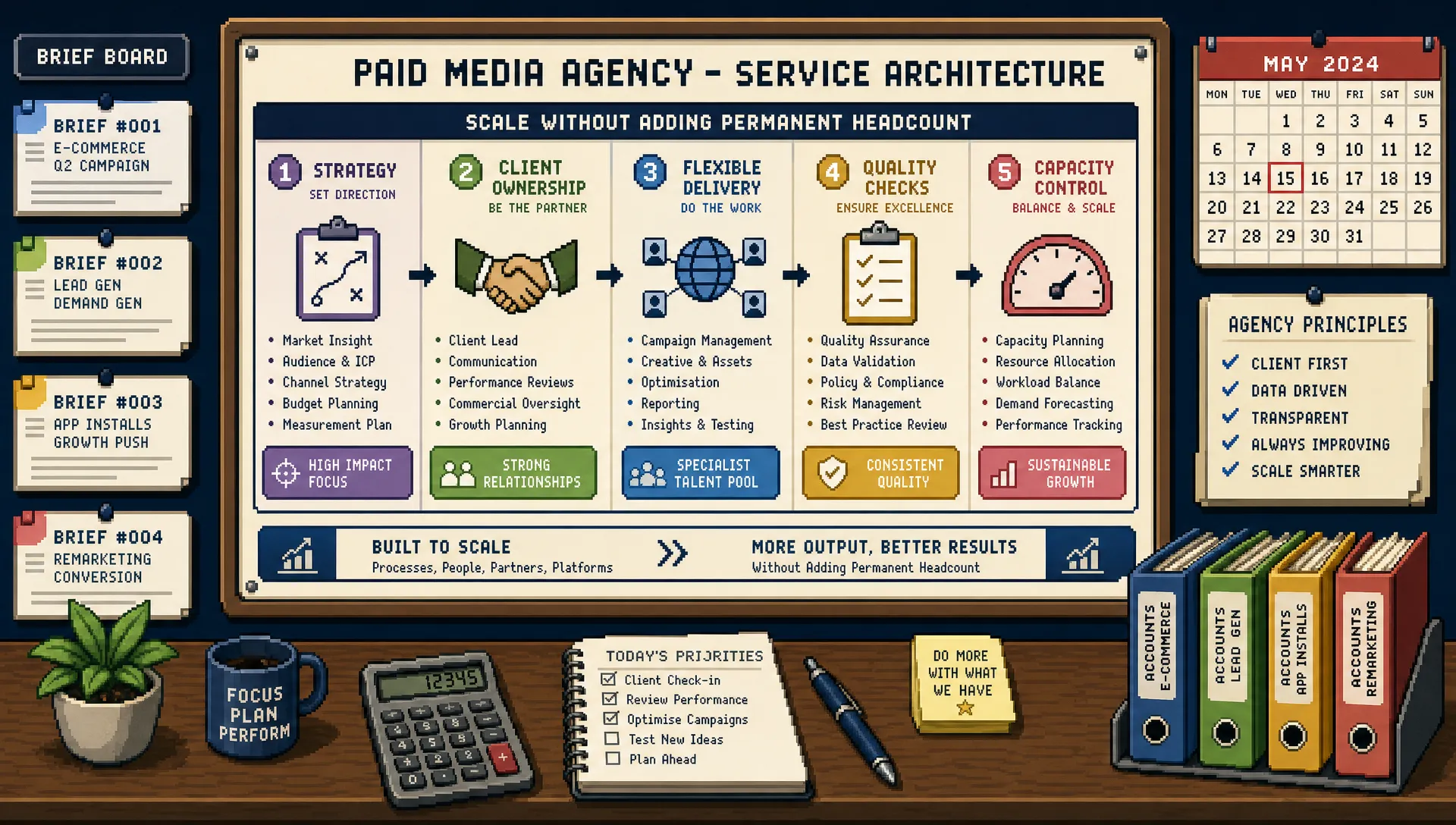
Scaling without hiring is not about doing more with less until the team burns out. It is about building an operating model where strategy, client relationships and commercial direction stay in-house, while variable delivery work can flex up or down safely. Done properly, it gives your agency more capacity, more specialist depth and better margin control without recruitment delays.
Why hiring is not always the best scaling move
Hiring feels like the obvious answer because capacity problems are visible. People are working late. Launch dates slip. Reports go out too close to client calls. Senior staff spend too much time inside accounts and not enough time improving strategy or retaining clients.
But the real issue is often not headcount. It is a mismatch between workload, skill level and timing.
A full-time hire works best when you have a stable volume of recurring work that matches one person’s skill set. Paid media delivery rarely behaves that way. Campaign launches are front-loaded. Audits require senior judgement. Tracking issues arrive without warning. Meta Ads performance can depend on creative iteration speed. Google Ads optimisation may need deep diagnostic work for a few hours, not another permanent seat on payroll.
Hiring also introduces hidden costs. Recruitment takes time, onboarding takes senior attention and junior staff need quality control before their work is client-ready. If your sales pipeline slows, that new hire can quickly move from growth investment to margin pressure.
A no-hire scaling model gives you optionality. You can increase delivery capacity when client demand rises, bring in specialist help when the account requires it and keep your internal team focused on the work only they should own.
Find the bottleneck before adding capacity
Before you outsource, automate or restructure anything, map where the agency is actually getting stuck. Agencies often assume the bottleneck is campaign management, when the real constraint is briefing, approval, tracking, reporting or senior review.
A simple delivery map can reveal where capacity is leaking.
| Bottleneck | What it looks like | No-hire response |
|---|---|---|
| Sales handover | New clients arrive with vague goals, weak budgets or missing access | Create a paid media onboarding checklist and standard discovery questions |
| Tracking | Campaigns launch late because GA4, pixels, tags or conversions are unclear | Use a specialist tracking support block before media goes live |
| Campaign builds | Multiple launches land in the same week and senior staff become production resources | Flex campaign build work to a white-label PPC specialist |
| Optimisation | Accounts are touched reactively rather than managed to a clear testing plan | Introduce weekly account triage and prioritisation rules |
| Reporting | Reports take too long and do not lead to action | Standardise dashboards, commentary formats and insight templates |
| Quality assurance | Mistakes appear because work is rushed or reviewed inconsistently | Add a pre-launch QA checklist and senior review stage |
The goal is to separate genuine strategic workload from repeatable execution. If your account directors are spending their best hours checking UTM tags, naming campaigns or building routine reports, hiring is not the only solution. You may simply need a better system and more flexible specialist execution.
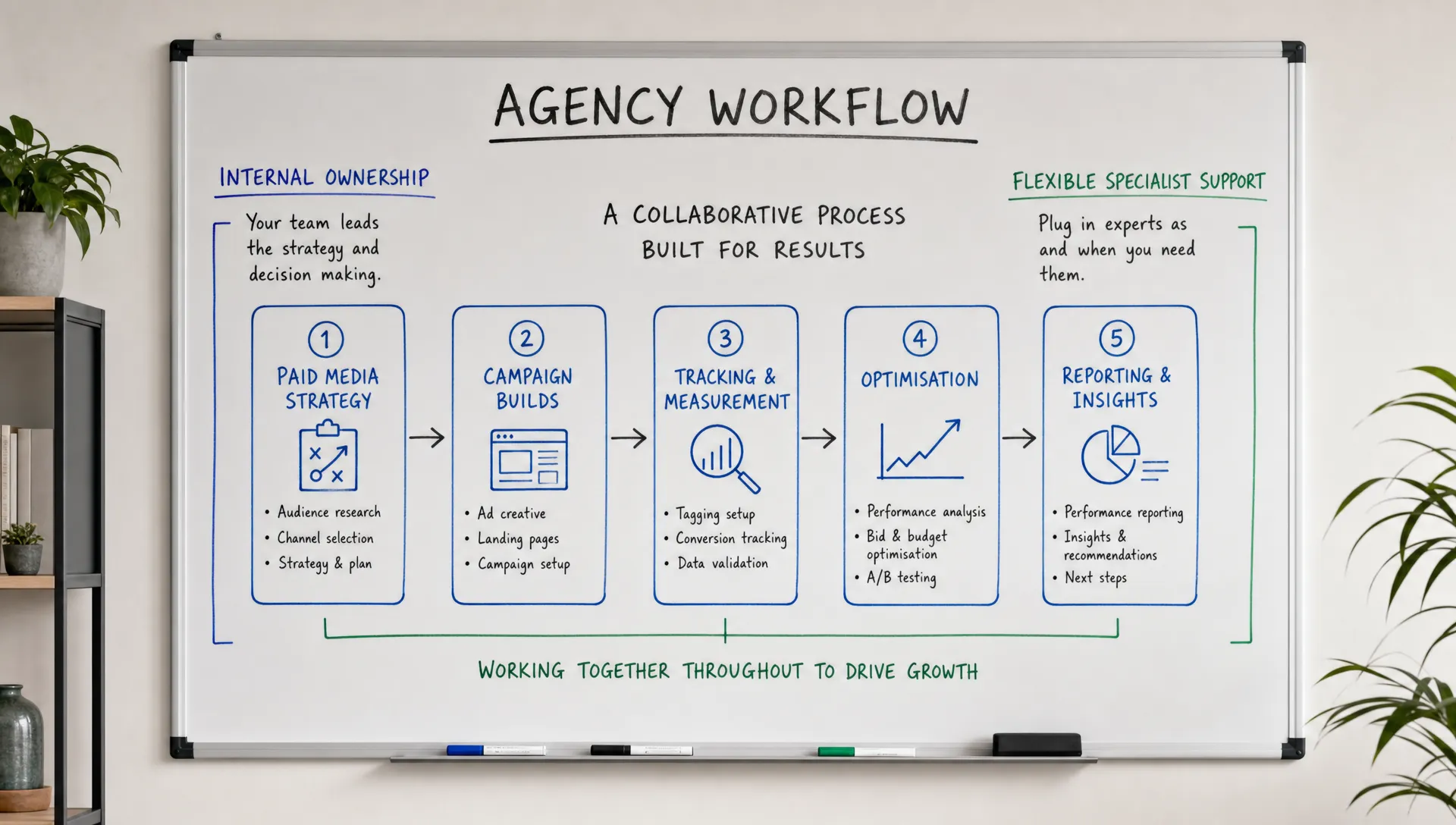
Keep ownership of strategy, flex the delivery layer
The strongest no-hire scaling models are not built around random outsourcing. They are built around clear ownership.
Your agency should usually keep ownership of:
- Client relationship and commercial context
- Channel strategy and budget recommendations
- Positioning, messaging and client communication
- Final approval on key decisions
- Retention, upsell and account direction
The flexible layer can cover work such as campaign builds, audits, account clean-ups, tracking support, testing implementation, overflow optimisation and channel-specific execution. This is where white-label support becomes powerful, because it lets your agency add capacity without introducing another visible supplier into the client relationship.
If you want a deeper breakdown of this model, PPC Ghost has covered why white-label PPC management helps agencies scale by adding senior delivery capacity without the commitment of a full-time hire.
The key is to avoid treating external support as a panic button. Instead, make it part of your delivery architecture. Define what can be delegated, what must stay internal and what quality standards apply before any work reaches the client.
Productise your paid media delivery
Custom work kills scale. Paid media agencies often sell every client a slightly different version of the service, then wonder why delivery becomes hard to resource. If every account has different reporting, naming conventions, optimisation rhythms and approval processes, capacity planning becomes guesswork.
Productising does not mean offering cookie-cutter strategy. It means standardising the repeatable parts so senior thinking can go where it matters.
Useful paid media service modules include:
- Paid media audit and action plan
- New Google Ads or Meta Ads account launch
- GA4 and conversion tracking clean-up
- Monthly optimisation and testing sprint
- Landing page and funnel review
- Microsoft Ads expansion project
- Account rescue or restructure project
Each module should have a defined input, output, turnaround expectation and quality checklist. That makes it easier to brief internal staff, external specialists or white-label partners. It also makes pricing cleaner, because you are no longer absorbing unlimited bespoke work inside a vague retainer.
For agencies struggling with scope creep, aligning delivery modules with Google Ads agency pricing models that protect margin can make growth much easier to manage.
Use senior specialists for the work juniors cannot safely absorb
One common scaling mistake is to protect margin by pushing more work onto junior account teams. That can work for basic production tasks when the process is clear, but it becomes risky when accounts need diagnosis, restructuring or commercial judgement.
Paid media is less forgiving than many agency services. A weak campaign build can waste spend immediately. Poor conversion tracking can make weeks of optimisation meaningless. Over-segmented Meta campaigns can slow learning. Bad search query management can damage lead quality before the client even sees a report.
Senior specialists are valuable because they reduce the time between problem and diagnosis. They know which issues are urgent, which are noise and which client requests need reframing. That is why no-hire scaling should not only be about cheaper capacity. It should be about accessing the right level of expertise at the right time.
PPC Ghost is designed around this principle: senior-only, white-label PPC execution for agencies that need on-demand support across Google, Meta, Microsoft Ads and tracking work, without recruitment or long contracts. Used well, that kind of support lets your internal team stay lean while still delivering work at a higher technical level.
Build a quality control system that survives pressure
Scaling without hiring only works if quality stays consistent. The moment external support creates confusion, duplicated work or errors, the model becomes more trouble than it is worth.
Quality control should be built into the workflow, not added at the end when everyone is already rushing. At minimum, create a shared standard for access, briefs, campaign naming, tracking requirements, budget pacing, QA and reporting commentary.
A strong paid media QA process usually checks:
- Campaign objective, budget and location settings
- Conversion actions and attribution settings
- Tracking links, UTMs and landing pages
- Audience exclusions and brand safety controls
- Ad copy, creative, extensions and policy risks
- Bidding strategy, budgets and launch timing
- Reporting notes and optimisation rationale
This does not need to become a bureaucratic 40-page manual. A short checklist used consistently is better than a detailed process nobody follows. The point is to make quality repeatable, especially when the agency is busy.
When accounts are under pressure, prioritisation matters too. Not every issue deserves the same level of urgency. If you need a practical approach, this guide to PPC ads best practices for agencies under pressure explains how to triage work by commercial risk and measurement quality.
Automate the admin, not the judgement
Automation can help paid media agencies scale, but only if it is aimed at the right problems. Automating reporting exports, pacing alerts, recurring checks and data pulls can save hours. Automating strategic decisions without context can create new problems faster than it solves old ones.
Good automation removes repetitive friction. It should help the team spot anomalies, prepare for reviews and spend less time moving data between systems. It should not replace the thinking behind budget allocation, offer testing, creative direction or account restructuring.
In practice, agencies can often gain capacity by standardising:
- Report templates and commentary sections
- Budget pacing checks
- Conversion tracking checks
- Launch checklists
- Naming conventions
- Recurring optimisation routines
The best use of automation is to create a cleaner operating rhythm. Your team should know what is checked daily, what is reviewed weekly, what is analysed monthly and what triggers senior intervention. This gives you more control without adding headcount.
Protect margin with variable delivery cost
Hiring turns capacity into fixed cost. A no-hire scale model turns some delivery into variable cost, which can be healthier for agencies with uneven demand.
This is especially useful when projects are lumpy. A new client launch may require 15 to 25 hours of concentrated setup work, then settle into a smaller optimisation rhythm. A tracking clean-up may need specialist input for a short period. A Meta Ads account may need a focused testing sprint rather than permanent extra resource.
| Scaling option | Best for | Margin risk |
|---|---|---|
| Full-time hire | Stable recurring workload with clear utilisation | High if pipeline slows or role is too broad |
| Junior delivery team | Repeatable tasks with strong supervision | Medium if senior review time increases |
| Freelancer | Project work or overflow support | Medium if availability and quality vary |
| White-label specialist | Senior execution, overflow and specialist gaps | Lower when scope and pricing are controlled |
| Automation | Admin, reporting and recurring checks | Low, but only when setup is maintained |
The commercial principle is simple: do not take on fixed delivery cost until the revenue is stable enough to justify it. If demand is inconsistent, flexible support can protect cash flow while allowing you to accept growth opportunities.
Pay-as-you-go PPC support can also make sales easier. Instead of saying no to a client because the team is full, you can price the work properly, protect margin and bring in the capacity required to deliver.
Know when you should hire anyway
Scaling without hiring is not a religion. Sometimes hiring is the right move. If you have consistent workload, a clear role, strong management capacity and predictable revenue, a permanent employee may be the most efficient option.
You should consider hiring when the same type of work appears every week, the required skill level is well understood and the agency can keep the person productively utilised without forcing unnecessary upsells. Hiring also makes sense when the role is central to your agency’s positioning or client experience.
However, if the need is urgent, specialist, short-term or uncertain, hiring can be too slow and too risky. In those situations, no-hire scaling gives you room to grow before making a permanent commitment.
A useful test is this: would you still need this exact role if your biggest new client paused next month? If the answer is no, flexible delivery support may be the safer first step.
A 30-day plan to scale without hiring
You do not need a full operational rebuild to start. A focused 30-day plan can create meaningful capacity quickly.
| Timeframe | Action | Outcome |
|---|---|---|
| Week 1 | Map every stage of paid media delivery and identify the top three bottlenecks | Clear view of where capacity is actually constrained |
| Week 2 | Create standard briefs, QA checklists and service modules for repeatable work | Easier delegation and fewer delivery errors |
| Week 3 | Decide which tasks stay internal and which can flex to specialist support | Cleaner ownership and faster turnaround |
| Week 4 | Test the model on one launch, audit or optimisation sprint | Proof of process before wider rollout |
Start with one contained project. Do not try to outsource an entire client relationship overnight. Choose a campaign build, account audit, tracking clean-up or overflow optimisation task where the scope is clear and the quality standard is easy to define.
Once that works, you can expand the model. Over time, your agency becomes less dependent on individual heroics and more capable of handling growth in a controlled way.
Frequently Asked Questions
Can a paid media agency really scale without hiring? Yes. Agencies can scale without hiring by standardising delivery, improving workflow, automating repetitive admin and using flexible specialist support for overflow or technical work. Hiring may still be useful later, but it does not need to be the first response to every capacity problem.
Is white-label PPC support suitable for client-facing agencies? Yes, when roles are clear. Your agency can retain the client relationship, strategy and communication while a white-label specialist supports delivery behind the scenes. This is especially useful for agencies that want more execution capacity without introducing another visible supplier.
What paid media tasks are easiest to delegate? Campaign builds, audits, account clean-ups, tracking checks, reporting preparation, optimisation sprints and platform-specific support are often good candidates. Strategic direction and client communication usually stay with the agency unless there is a clear reason to involve external expertise.
How do agencies protect quality when using external PPC support? Quality depends on clear briefs, access checklists, shared naming conventions, pre-launch QA and a defined review process. The more repeatable your standards are, the easier it is to scale without mistakes.
When should an agency hire instead of using flexible support? Hiring makes sense when demand is consistent, the role is clearly defined and the agency can maintain strong utilisation. Flexible support is usually better for urgent, specialist, seasonal or unpredictable workload.
Scale paid media delivery without adding payroll
If your agency is winning work but delivery capacity is becoming the constraint, hiring is not your only option. You can protect client relationships, keep strategy in-house and flex senior PPC execution when you need it.
PPC Ghost provides white-label paid media support for agencies that need senior Google Ads, Meta Ads, Microsoft Ads and tracking expertise on demand. No recruitment, no long contracts and no need to stretch your internal team beyond what is sustainable.
Use flexible specialist support before capacity pressure turns into missed opportunities, rushed work or avoidable client churn.