What a Google Ads Service Agency Should Handle for You
Learn what a Google Ads service agency should handle, from tracking and builds to optimisation, reporting and client-ready PPC delivery.
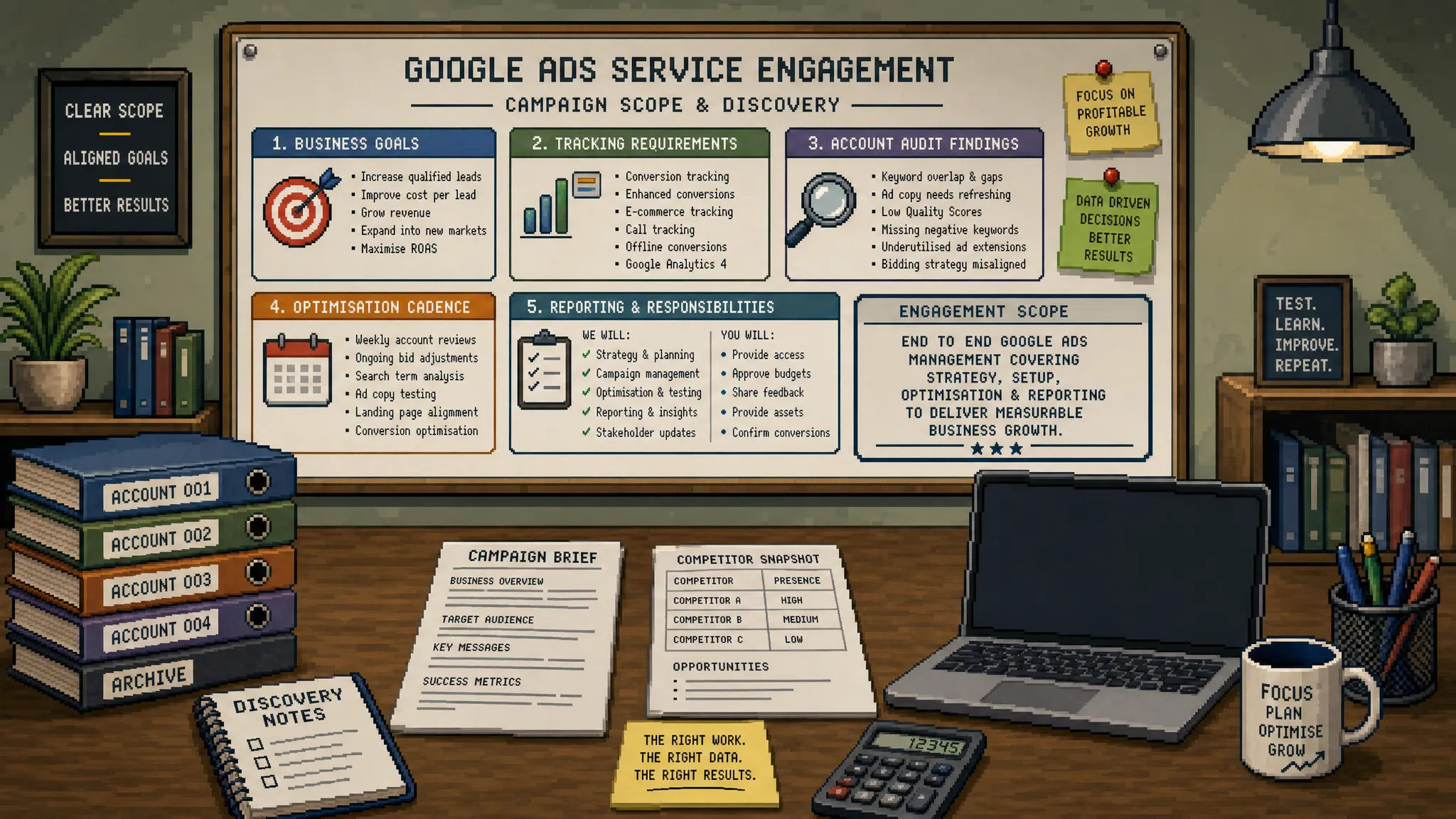
Outsourcing Google Ads can either create breathing room or create a new layer of uncertainty. The difference usually comes down to scope. A strong Google Ads service agency should not simply build campaigns, send a report and wait for the next request. It should take responsibility for the PPC work that protects client budget, improves decision-making and gives your agency confidence when clients ask difficult questions.
For digital agencies, this matters even more. You are not just buying Google Ads execution. You are buying delivery reliability, senior judgement and a cleaner way to scale without hiring every time client demand spikes.
So, what should a Google Ads service agency actually handle for you?
Start with the commercial brief, not the campaign build
A good partner should begin by understanding the business case behind the account. Too many campaigns are built around keywords, locations and budgets before anyone has agreed what success really means. That creates a familiar problem: the account may generate conversions, but nobody knows whether those conversions are profitable or useful.
The agency should clarify the client’s commercial context before recommending structure, bidding or campaign types. That does not mean they need to run the whole business strategy, but they should ask enough questions to avoid managing the account in a vacuum.
A useful PPC brief usually covers:
- The client’s core products or services and which ones matter most commercially
- Target locations, service areas and any regions to exclude
- Lead quality requirements, not just lead volume targets
- Average order value, margins or estimated customer value where available
- Sales cycle length and what happens after a lead is submitted
- Budget range, seasonality and tolerance for testing
- Compliance, brand language or industry restrictions that could affect ads
This is where a senior PPC specialist adds value early. They can translate vague goals such as get more enquiries into measurable targets, such as reducing wasted spend on low-intent queries, increasing qualified form submissions or improving revenue from shopping campaigns.
Audit the account before making major changes
If the client already has a Google Ads account, a service agency should audit before rebuilding. That audit should not be a cosmetic checklist. It should identify what is working, what is wasting spend and what needs fixing before optimisation can be trusted.
Inherited accounts often contain old campaigns, unclear conversion actions, broad match keywords with poor query control, duplicated assets and bidding strategies that were set up for a different business objective. Making changes without understanding that history can create unnecessary disruption.
| Area to review | What the agency should check | Why it matters |
|---|---|---|
| Conversion actions | Primary and secondary goals, duplicate conversions, imported events and form tracking | Poor tracking can make good campaigns look bad or bad campaigns look good |
| Campaign structure | Search, Performance Max, Shopping, Display, YouTube and brand segmentation where relevant | Structure affects budget control, reporting and optimisation decisions |
| Search terms | Query quality, irrelevant spend, recurring negatives and intent patterns | Search term data often reveals the fastest savings |
| Budget allocation | Spend by campaign, location, device, audience and product or service area | Budget should follow commercial opportunity, not historic settings |
| Bidding | Strategy choice, learning status, conversion volume and target settings | Automation needs clean data and realistic targets to perform |
| Ads and assets | Messaging, relevance, approvals, asset coverage and landing page alignment | Ads need to match intent and give the system enough creative options |
| Policy and access | Disapprovals, account permissions, billing setup and change history | Operational issues can delay delivery and damage client confidence |
Many ROI problems are not caused by one obvious mistake. They come from several small issues compounding over time. If an account has been underperforming for months, it is worth reviewing the common Google AdWords management mistakes that hurt ROI before assuming the only answer is more budget.
Own tracking and measurement quality
A Google Ads service agency should be able to discuss tracking in detail. In 2026, Google Ads performance is heavily influenced by the quality of conversion data being passed back into the platform. If tracking is unreliable, bidding, reporting and optimisation all become weaker.
At a minimum, the agency should check that Google Ads conversion tracking is installed correctly, that GA4 events are mapped sensibly and that the account is not optimising towards low-value actions by mistake. Google’s own guidance on setting up conversion tracking makes it clear that advertisers need defined actions before they can measure what happens after an ad click.
The agency should also separate meaningful conversions from softer engagement signals. A phone call, qualified lead form, booked consultation or completed purchase should not be treated the same as a page view or button click. Secondary conversions can still be useful for analysis, but they should not automatically steer bidding unless they reflect genuine value.
For lead generation clients, the strongest setups often include some form of lead quality feedback. That might mean importing offline conversions from a CRM, tracking qualified calls or separating booked appointments from raw enquiries. The exact setup depends on the client’s systems, but the principle is simple: the account should optimise towards outcomes the business actually values.
Build campaign structure around intent
Campaign structure is not just an admin decision. It determines how budget is controlled, how performance is read and how quickly the agency can diagnose problems.
A good Google Ads service agency should build around search intent, product or service priority, location needs and available conversion volume. For some clients, that may mean tightly controlled search campaigns split by service category. For ecommerce, it may involve Shopping, Performance Max and feed optimisation. For local service businesses, it may require location-specific campaigns and careful call tracking. For mature accounts, it may mean consolidating campaigns so automated bidding has enough data to work effectively.
The agency should also know when not to overcomplicate the account. An account with limited spend does not need dozens of tiny campaigns that never collect enough data. Equally, a high-spend account should not be so consolidated that the client loses visibility over which services, locations or product lines are driving performance.
Keyword strategy should go beyond adding obvious terms. The agency should manage match types, search term reviews, negative keywords, brand protection, competitor exposure and query intent. Broad match may be useful in the right account, especially with strong conversion data, but it should not be used as a substitute for strategic thinking.
Manage bidding, budgets and risk
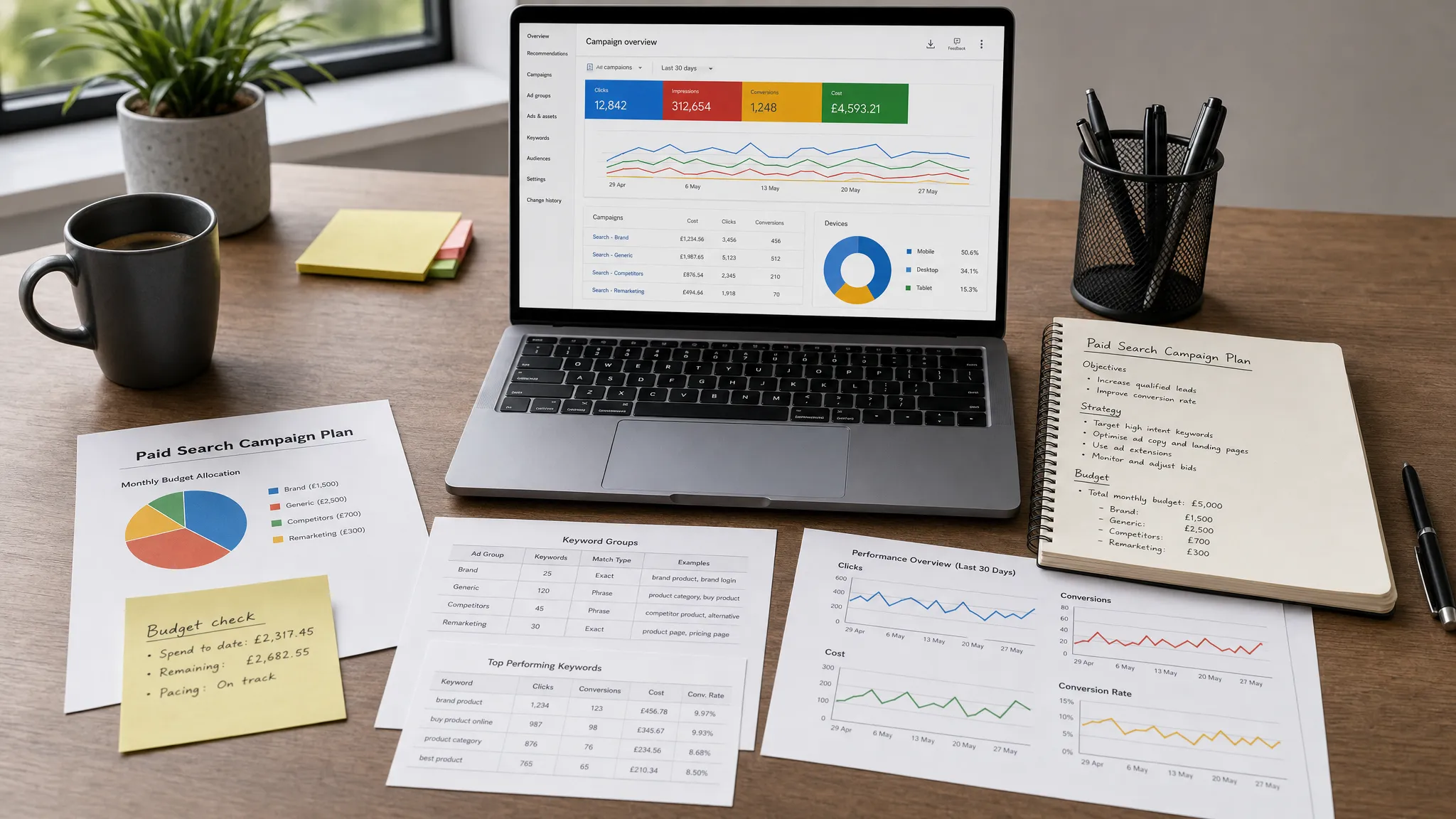
Budget management is one of the clearest signs of whether a PPC partner is truly paying attention. A service agency should not simply spend the amount allocated. It should understand where budget is being used well, where it is being wasted and when the client needs a recommendation to scale, hold or reduce spend.
Bidding strategy should be chosen based on conversion volume, business goals and account maturity. Google’s documentation on Smart Bidding explains how automated bidding uses signals at auction time, but automation still needs sensible inputs. Targets that are too aggressive can restrict volume. Targets that are too loose can waste money. Campaigns with weak tracking can push the algorithm in the wrong direction.
A good agency should monitor the trade-off between efficiency and growth. A lower CPA is not always better if it comes from cutting high-value opportunities. A higher ROAS is not always better if it is achieved by over-investing in brand demand that would have converted anyway. The job is to manage performance in context, not chase isolated dashboard metrics.
Optimise on a clear cadence
Google Ads management should have rhythm. That does not mean changing campaigns every day for the sake of activity. It means the agency should have a clear optimisation cadence based on spend level, account volatility and the amount of data available.
Some changes need quick action, such as broken tracking, policy disapprovals, overspending, poor search terms or landing page errors. Other decisions need enough data to avoid overreacting. A senior PPC specialist knows the difference.
| Stage | Typical work a service agency should handle | Expected output |
|---|---|---|
| Pre-launch | Tracking checks, campaign build, audience setup, ads, assets and QA | Campaigns are ready to launch with fewer avoidable errors |
| Early launch | Search term checks, budget pacing, disapprovals, first conversion checks | Fast fixes before small issues become expensive |
| Ongoing management | Bid adjustments, negatives, creative tests, asset reviews and budget shifts | Continuous improvement based on evidence |
| Monthly review | Performance analysis, commercial insights, next actions and risks | A clear story your agency can explain to the client |
| Quarterly planning | Wider account review, growth opportunities and structural changes | Better strategic direction, not just maintenance |
The key is that optimisation should be based on a hypothesis. For example, the agency might test whether separating high-intent services improves CPA, whether a new landing page increases conversion rate or whether excluding low-quality locations protects budget. Random tinkering is not optimisation.
Produce reporting clients can actually use
Reporting is one of the most underestimated responsibilities of a Google Ads service agency. Clients rarely need more charts. They need to understand what happened, why it happened and what should happen next.
A good report should connect PPC activity to commercial outcomes. It should explain spend, conversions, CPA, ROAS, lead quality and trend changes in plain English. It should also show what was done during the period, what was learned and what decisions are required from the client or agency.
Strong reporting usually includes:
- Spend versus budget and any pacing concerns
- Conversion volume, cost per conversion and revenue metrics where available
- Lead or sale quality signals, not just platform-reported conversions
- Key changes made in the account and why they were made
- Risks, blockers, next tests and recommended priorities
For agencies, this is not just operational. Better PPC reporting can protect trust and reduce churn. The connection between delivery quality and client confidence is explored in more detail in this article on how a Google Ads PPC agency supports client retention.
Work discreetly within your agency process
If you are outsourcing on behalf of clients, the service agency should fit into your delivery model without creating confusion. That means respecting white-label boundaries, using agreed communication channels and avoiding anything that makes the client wonder who is actually managing the work.
For white-label support, the agency should not contact your client directly unless you have agreed that arrangement. It should avoid adding its own branding to documents, reports or dashboards. It should keep change notes clear enough for your team to understand and should be comfortable working behind the scenes.
This is especially important when your agency owns the strategy and client relationship, but needs senior PPC execution. The right partner gives you capability without forcing you to recruit, train or manage another full-time specialist. If discretion is a priority, it is worth knowing what to look for in a white label Google Ads agency before handing over access.
Know what should stay with your agency
A Google Ads service agency should handle the paid media execution, but it should not replace your agency’s ownership of the client relationship. The best arrangements are clear about who owns which decisions.
| Your agency should usually retain | The Google Ads partner should usually handle |
|---|---|
| Client relationship and commercial positioning | Google Ads account audits, builds and optimisation |
| Brand strategy and wider marketing direction | Keyword strategy, campaign structure and bidding recommendations |
| Final approval on offers, promotions and messaging | Ad copy drafts, asset recommendations and testing plans |
| Website ownership and development priorities | Landing page feedback based on conversion performance |
| Pricing, contracts and account growth conversations | PPC performance insight and delivery recommendations |
This split keeps accountability clean. Your agency remains the strategic owner, while the PPC partner provides the specialist delivery needed to keep accounts moving.
Signs your Google Ads service agency is not handling enough
If you are unsure whether your current provider is adding value, look beyond surface-level activity. The issue is not always a lack of changes. Sometimes the account is busy, but the work is not commercially useful.
Warning signs include:
- Tracking problems are mentioned but never fixed
- Reports describe results but do not explain causes or next actions
- Search term waste continues month after month
- All conversions are treated equally, regardless of lead quality
- Automated bidding is used without clear targets or data checks
- Budget increases are recommended without explaining the expected return
- The agency cannot clearly explain what changed in the account and why
A service agency does not need to rebuild everything every month. It does need to show judgement, ownership and a clear link between activity and business outcomes.
Choose the right support model for the workload
Not every agency needs a permanent PPC hire. Some need overflow support during busy periods. Some need a senior specialist to rescue problem accounts. Others need ongoing white-label management so they can sell PPC confidently without carrying recruitment risk.
The right model depends on workload consistency, client budgets, internal skills and how much strategic support your team needs. For occasional delivery gaps, project-based or on-demand support can be more efficient than hiring. For a growing PPC portfolio, a regular white-label partner can create consistency without adding headcount.
What matters most is that the scope is explicit. Define whether the service agency is responsible for audits, builds, tracking, optimisation, reporting, client call support, forecasting or only specific tasks. Ambiguity is where outsourcing relationships usually break down.
Frequently Asked Questions
What does a Google Ads service agency do? A Google Ads service agency manages paid search activity such as audits, campaign builds, tracking checks, keyword strategy, bidding, optimisation and reporting. For agencies, it can also provide white-label delivery behind the scenes.
Should a Google Ads service agency handle GA4 and conversion tracking? Yes, at least to the level required for reliable PPC measurement. They should be able to check Google Ads conversions, GA4 events, imported goals and lead quality signals, although complex website or CRM development may require additional technical support.
How often should Google Ads campaigns be optimised? Optimisation frequency depends on spend, data volume and account volatility. High-spend or newly launched accounts usually need closer monitoring, while smaller stable accounts may need fewer changes but still require regular checks and clear reporting.
Should the agency manage landing pages too? They should provide conversion-focused feedback on landing pages, such as relevance, message match, form friction and mobile experience. Whether they design or build landing pages depends on their service scope and your agency’s internal capabilities.
Can a Google Ads service agency work white-label? Yes, but the process must be clear. A white-label partner should work anonymously, avoid client-facing branding, respect your communication rules and provide outputs your agency can confidently present as part of its own delivery.
Need senior Google Ads support without hiring?
If your agency needs expert PPC delivery without recruitment, long contracts or visible outsourcing, PPC Ghost provides white-label Google Ads, Meta Ads and Microsoft Ads support for agencies. You get senior-only execution, flexible pay-as-you-go support and discreet delivery while your agency keeps the client relationship.