How to Hire Freelance PPC Support Without the Risk
Hire freelance PPC support safely with a practical vetting, access, QA and onboarding process built for agencies protecting client trust.
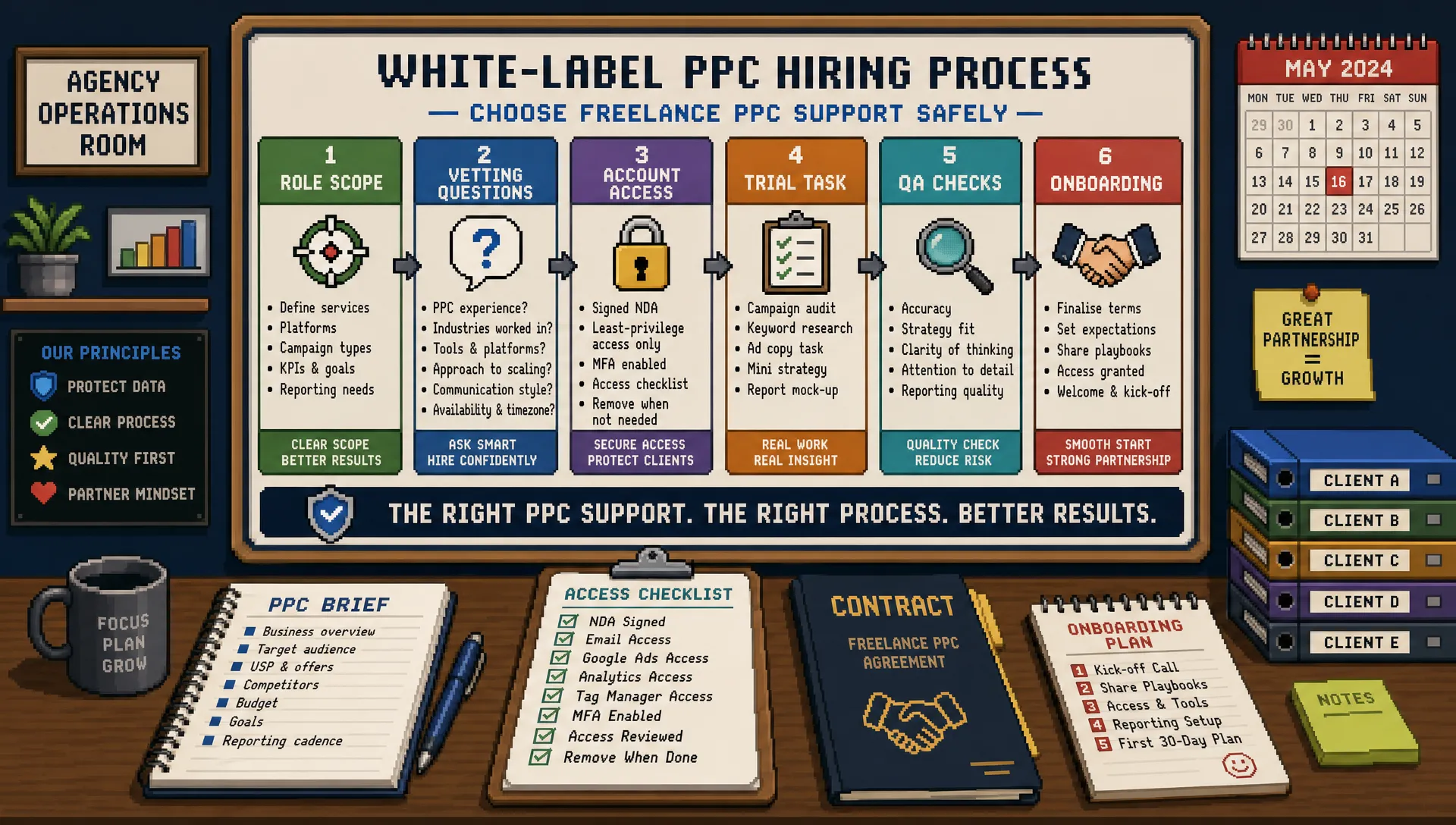
Hiring freelance PPC support should not feel like handing your client accounts to a stranger and hoping for the best. The right setup can give your agency senior execution capacity, faster delivery and more breathing room, without adding payroll, recruitment delays or awkward client conversations.
The risk usually comes from rushing. Agencies often look for help when a campaign is already underperforming, a strategist is at capacity, or a new client has landed with a tight launch date. Under pressure, it is easy to hire based on availability rather than fit.
A safer approach is to treat freelance PPC hiring as an operational process. You define the role clearly, vet for judgement, protect account access, agree quality controls and start with a contained piece of work before expanding the relationship.
This guide walks through how to hire freelance PPC support without exposing your agency to quality, confidentiality or delivery risk.
Start by defining what you actually need
Before you look for a freelancer, separate the problem into one of three categories: capacity, capability or continuity.
Capacity means your team already knows what needs doing, but there are not enough hours to execute it. This might include search term reviews, campaign builds, asset uploads, Meta ad testing or budget pacing.
Capability means you need expertise that is missing internally. For example, a senior Google Ads specialist may be needed to diagnose a lead quality issue, rebuild a messy account structure, improve GA4 tracking or support Microsoft Ads expansion.
Continuity means you need cover when someone is on leave, a hire has left, or a client needs steady optimisation while your internal team focuses elsewhere.
Those three needs require different levels of trust. A capacity gap can often start with tightly scoped execution. A capability gap needs deeper strategic judgement. Continuity support needs consistency, documentation and a working style that fits your agency.
If your agency is already feeling the strain of delivery bottlenecks, it may help to look at how paid media PPC support helps agencies scale faster before deciding what type of support to hire.
Know the risks before you hire
Freelance PPC support is not risky by default. It becomes risky when the agency does not put boundaries around the work.
The biggest danger is not that a freelancer lacks platform knowledge. It is that they make decisions without context. A change that looks logical inside Google Ads can be commercially wrong if it ignores sales quality, client politics, margin targets or historic account decisions.
Use the table below to map the common risks and the controls that reduce them.
| Risk | What it looks like | Control to put in place |
|---|---|---|
| Quality inconsistency | Optimisations are made without clear reasoning | Require change notes, QA checks and approval rules |
| Confidentiality issues | The freelancer appears client-facing without agreement | Use an NDA and define white-label communication rules |
| Weak commercial judgement | Work focuses on platform metrics rather than business outcomes | Brief on margins, lead quality, revenue targets and client priorities |
| Poor tracking decisions | Conversions are changed without validation | Separate tracking access from media access and require documentation |
| Access risk | Too many permissions are granted too early | Use least-privilege access and remove access when work ends |
| Delivery drift | Deadlines slip because the freelancer is overbooked | Agree turnaround times, capacity limits and escalation points |
| Handover gaps | Your team cannot understand what changed | Require summaries, naming conventions and shared documentation |
This risk map helps you hire with intention. Instead of asking, “Can this person run PPC?”, ask, “Can this person work safely inside our agency operating model?”
Vet for judgement, not just platform familiarity
Certifications and platform experience matter, but they should never be the whole assessment. Google’s Skillshop certifications can show that someone understands the platform basics, yet PPC performance depends on diagnosis, prioritisation and restraint.
A strong freelance PPC specialist should be able to explain why they would make a change, what they would check first and what they would avoid touching. That is especially important when they are stepping into live accounts with existing history.
Ask questions that reveal thinking rather than jargon. For example:
- “A lead generation account has stable conversion volume but rising CPL. What would you check before changing bids?”
- “When would you avoid restructuring a Google Ads account, even if the setup looks messy?”
- “How do you decide whether a conversion tracking issue is a media problem, analytics problem or CRM problem?”
- “What information do you need from the agency before making recommendations?”
- “How would you explain a performance drop to an account manager who is not a PPC specialist?”
Good answers will mention context. They may ask about conversion definitions, budget changes, auction competition, landing pages, lead quality, seasonality, consent settings, CRM feedback and recent account edits.
Be cautious if every answer immediately jumps to a tactic. “Increase budget”, “switch to Performance Max”, “use broad match” or “rebuild the account” may be valid in some cases, but they are not universal solutions.
For a deeper due diligence framework, the same principles used to vet a Google Ad company before you outsource can also be adapted to freelance support.
Set the white-label rules early
If the freelancer will work behind the scenes, make that explicit before any account access is shared. White-label PPC support only works when everyone understands who communicates with the client, who owns the strategy and how the work is presented.
At minimum, agree whether the freelancer can join internal calls, whether they can appear on client calls, what name or email they use, and whether they can refer to the work publicly. Many agencies prefer fully anonymous support, where the agency remains the visible delivery partner and the freelancer simply executes in the background.
This is not only about protecting ego or brand perception. It also protects the client relationship. Clients expect consistency. If a new specialist suddenly appears without context, it can raise questions about who is actually managing their account.
A simple white-label agreement should cover confidentiality, non-solicitation, client communication, file ownership, platform access, data handling and what happens when the relationship ends. If the freelancer will handle customer data or analytics data, UK agencies should also be mindful of data protection responsibilities. The ICO provides guidance on controllers and processors that can help clarify obligations.
Protect account access with a least-privilege approach
Do not give full access on day one unless there is a clear reason. PPC accounts often contain billing data, tracking settings, conversion actions, audience lists, customer match data and links to other platforms. The safest approach is to provide the minimum access needed for the task.
For an audit, read-only access may be enough. For campaign builds, standard access may be required, but billing and admin permissions are rarely necessary. For GA4 or GTM work, permissions should be scoped carefully because a small tracking change can affect reporting across multiple teams.
Access should also be time-bound. If the project is complete, remove access. If the freelancer becomes an ongoing partner, review permissions periodically. This is not a sign of mistrust. It is good operational hygiene.
Create a simple access log with the freelancer’s name, email address, platforms accessed, permission level, client accounts involved, date granted and date removed. This is especially useful when your agency is juggling multiple freelancers, contractors or white-label partners.
Start with a contained paid task
A trial project is one of the best ways to reduce risk, but it should be paid and scoped. Free audits often attract shallow recommendations because the freelancer is incentivised to impress quickly rather than understand deeply.
The goal of a trial is not to get cheap work. It is to test communication, judgement, pace and documentation before handing over more responsibility.
| Trial task | What it tests | Typical output |
|---|---|---|
| Account health check | Diagnostic ability and commercial awareness | Prioritised findings with risk levels |
| Search term and query review | Attention to waste and intent quality | Negative keyword recommendations and rationale |
| Campaign build from brief | Structure, naming and execution quality | Draft build, QA notes and launch checklist |
| Tracking review | Technical accuracy and caution | Conversion map, issue list and recommended fixes |
| Weekly optimisation cycle | Working rhythm and documentation | Change log, insights and next actions |
Keep the first task narrow enough to review properly. If you ask for a full account rebuild, you will struggle to tell whether the freelancer is good or simply fast. A smaller task gives you clearer signals.
After the trial, assess more than the output. Did they ask useful questions? Did they flag risks? Did they explain trade-offs? Did they meet the deadline? Did your team understand what they had done without needing a long follow-up call?
Build a QA process before work goes live
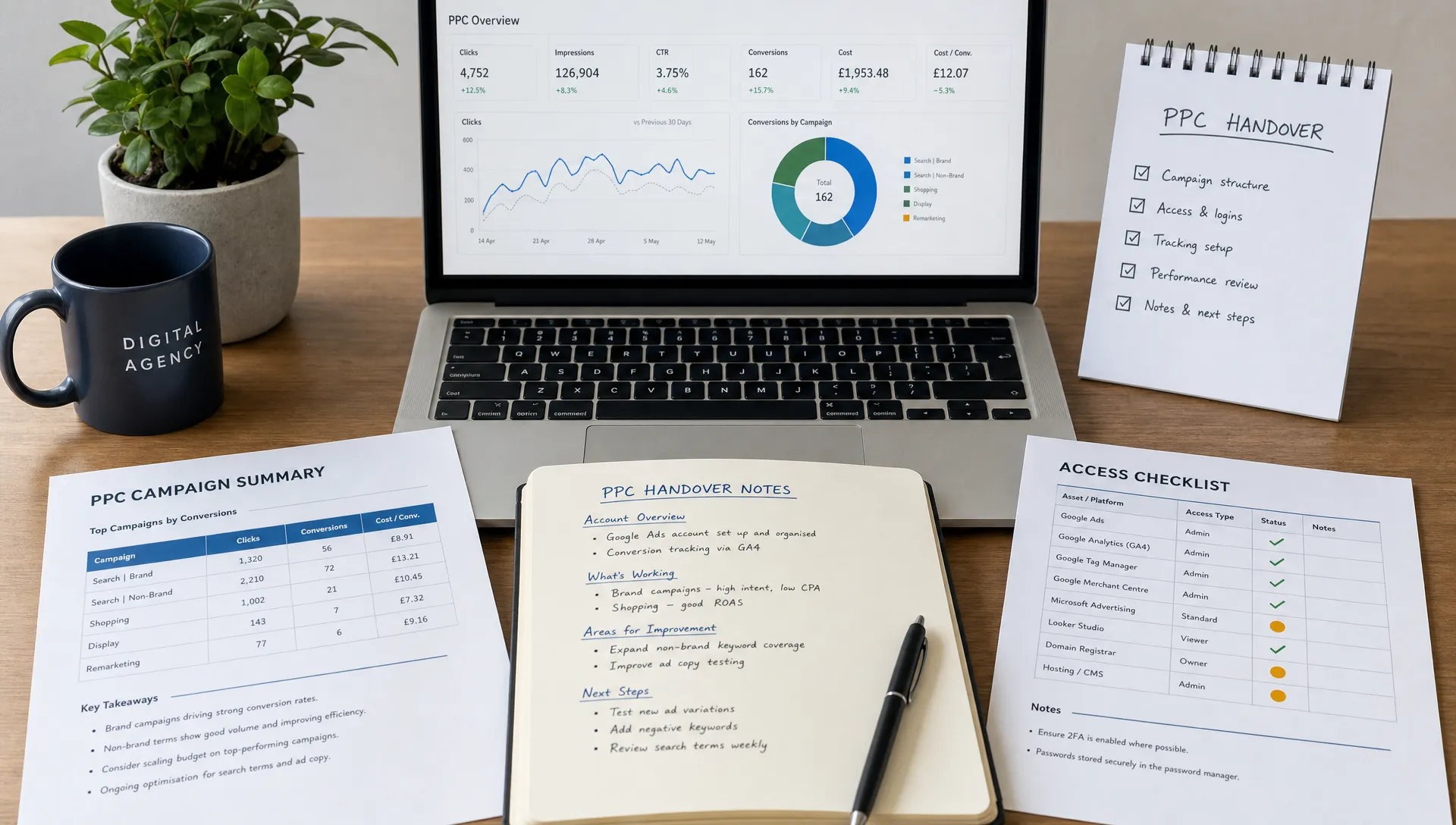
Freelance PPC support should never bypass your agency’s quality control. Even senior specialists benefit from a second pair of eyes, especially when they are new to your clients.
Your QA process does not need to be complicated. It just needs to be consistent. For campaign launches, check naming conventions, budgets, locations, language settings, conversion goals, tracking templates, ad copy, final URLs, exclusions and approval status. For optimisation work, check whether the changes match the brief and whether any major edits could disrupt learning or reporting.
It is also useful to define which changes need approval. For example, a freelancer may be allowed to add negative keywords, update ad copy drafts or adjust non-critical settings without formal sign-off. Larger actions, such as changing bidding strategy, replacing conversion goals, pausing core campaigns or restructuring an account, should usually need approval from your agency lead.
When accounts are under pressure, QA becomes even more important. If a client is unhappy, the temptation is to move quickly. But rushed PPC changes can create more instability. The guidance in PPC ads best practices for agencies under pressure is useful when deciding what to protect first.
Agree the operating rhythm
Many freelance PPC relationships fail because the work is technically good but operationally messy. The freelancer replies at odd times, the agency does not know what has been done, and account managers are left translating half-finished notes into client updates.
Set a rhythm before the work starts. Decide where tasks live, how briefs are submitted, how deadlines are confirmed and how completed work is documented. This might be inside your project management tool, a shared document, email or Slack, depending on how your agency runs.
The important point is that nothing lives only in someone’s head. If the freelancer makes a change, your team should be able to see what changed, why it changed and what to monitor next.
For ongoing support, a weekly cadence usually works well. The freelancer can review performance, make agreed optimisations, document changes and flag decisions that need agency input. For urgent support, such as launch fixes or tracking issues, agree a faster route so priorities do not get lost in normal task queues.
Choose a pricing model that matches the risk
There is no single best pricing model for freelance PPC support. The right structure depends on how predictable the work is and how much flexibility your agency needs.
Hourly pricing works well for ad hoc support, troubleshooting and undefined tasks. Fixed project pricing suits campaign builds, audits or tracking reviews where the scope is clear. Day rates can work for intense delivery sprints. Retainers are useful when you need predictable monthly capacity, but they can become inefficient if the workload fluctuates.
| Pricing model | Best for | Risk to manage |
|---|---|---|
| Hourly | Flexible support, fixes, overflow | Hours can creep without clear priorities |
| Fixed project | Audits, builds, defined deliverables | Scope changes need to be controlled |
| Day rate | Sprints, launches, urgent capacity | Days must be planned to avoid wasted time |
| Retainer | Ongoing optimisation and continuity | Unused capacity can reduce value |
| Pay-as-you-go | Agencies with variable demand | Requires clear task scoping each time |
The commercial mistake agencies make is focusing only on the freelancer’s rate. A cheaper freelancer who needs heavy supervision may cost more in management time than a senior specialist who gets it right quickly.
Look at total delivery cost. That includes briefing time, QA time, rework, client risk and opportunity cost. Senior freelance PPC support often pays for itself when it prevents wasted spend, protects client confidence and frees internal strategists to focus on growth.
Watch for red flags
Some red flags are obvious, such as poor communication or vague experience. Others are more subtle.
Be cautious if a freelancer wants admin access before understanding the task. Be cautious if they guarantee results without seeing the account. Be cautious if they criticise all previous work without asking why decisions were made. Be cautious if they cannot explain how they document changes.
A lack of curiosity is one of the biggest warning signs. Strong PPC specialists ask about the business model, client goals, lead quality, sales process, seasonality, budgets and historical constraints. Weak ones focus only on platform mechanics.
Also pay attention to availability claims. A freelancer who says yes to everything may be overstretched. It is better to work with someone who is honest about capacity than someone who accepts the work and misses the deadline.
Use a 30-day onboarding plan
If the trial goes well, expand gradually. A 30-day onboarding plan gives both sides enough structure to build trust without creating unnecessary friction.
| Period | Focus | What success looks like |
|---|---|---|
| Days 1 to 7 | Access, context and first task | Freelancer understands accounts, goals and agency workflow |
| Days 8 to 14 | Controlled execution | Small optimisations are completed with clear notes and QA |
| Days 15 to 21 | Broader ownership | Freelancer handles a defined workstream with fewer clarifications |
| Days 22 to 30 | Review and decide | Agency confirms fit, scope, cadence and future capacity |
By the end of 30 days, you should know whether the freelancer can work safely inside your agency. You should also know what type of tasks they are best suited for. Some specialists are excellent at audits and strategy, while others are strongest at builds, tracking, optimisation or urgent fixes.
The goal is not to make the freelancer act exactly like an employee. The goal is to create a reliable extension of your delivery team, with clear boundaries and senior judgement.
Frequently Asked Questions
Is freelance PPC support safe for client accounts? Yes, if you use proper controls. Start with a clear scope, least-privilege access, white-label rules, QA checks and documented changes. Risk usually comes from unclear processes rather than the freelance model itself.
Should a freelance PPC specialist speak directly to clients? Only if your agency wants that. Many agencies prefer fully white-label support, where the freelancer works behind the scenes and the agency remains the client-facing partner.
What should I ask before hiring freelance PPC support? Ask about diagnostic process, tracking checks, account access, documentation, turnaround times, white-label experience and examples of how they handle underperforming accounts. Focus on judgement, not just platform tactics.
Is it better to hire a freelancer or a full-time PPC specialist? It depends on demand. If you have consistent long-term workload, hiring may make sense. If workload fluctuates or you need senior expertise quickly, freelance PPC support can be more flexible and lower risk.
How do I know if a freelancer is senior enough? Senior specialists tend to ask better questions, explain trade-offs clearly, protect tracking quality, avoid unnecessary disruption and document decisions. They do not rush into major changes without context.
Need low-risk PPC support behind the scenes?
If your agency needs senior PPC delivery without recruitment, contracts or client-facing complexity, PPC Ghost provides white-label PPC support for UK agencies across Google Ads, Meta Ads, Microsoft Ads and GA4/tracking work.
You stay in control of the client relationship. PPC Ghost works quietly behind the scenes, on demand, with flexible pay-as-you-go support when your team needs extra capacity or specialist execution.