PPC Reporting Tips Agencies Can Use to Prove ROI
Improve PPC reporting with practical tips for agencies to prove ROI, explain performance clearly, and keep clients confident in paid media.
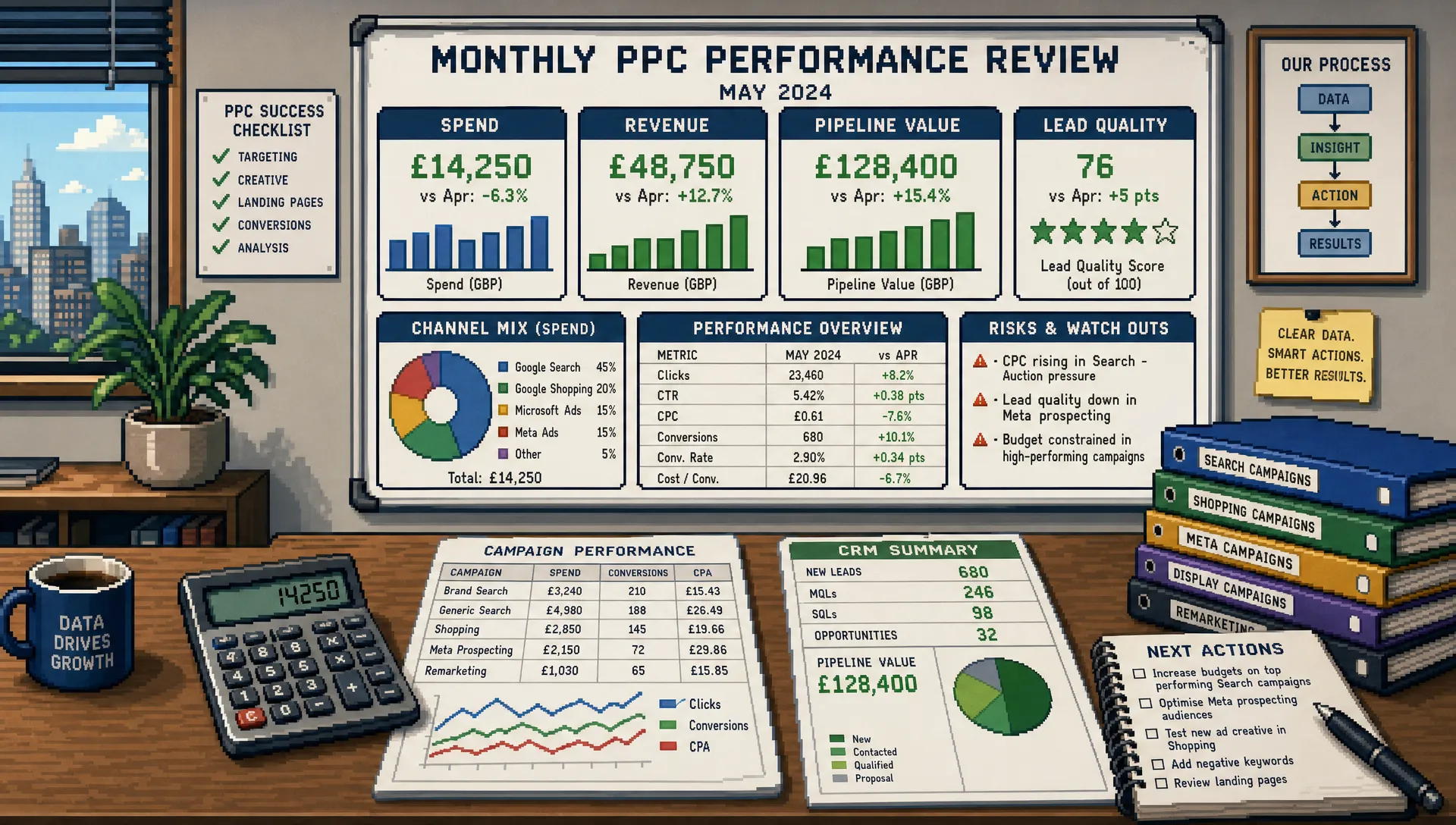
Most PPC reports fail for one simple reason: they explain activity instead of proving value. A client can see clicks, impressions and spend in a dashboard. What they need from an agency is interpretation: did paid media generate profitable demand, what changed, what should happen next, and where is budget at risk?
That is why strong PPC reporting is not just a delivery task. It is a client retention tool. When reports connect spend to revenue, pipeline, lead quality and decision making, clients feel more confident increasing budgets. When reports bury them in platform metrics, even good performance can look uncertain.
The tips below are designed for agencies that need to prove ROI clearly, especially when managing Google Ads, Meta Ads or Microsoft Ads for clients with limited time and high commercial expectations.
Why proving ROI is harder than exporting a dashboard
A platform report can tell you what happened inside an ad account. It cannot automatically tell you whether the business made money.
That gap matters because PPC ROI is affected by factors outside the ad platform, including website conversion rate, sales close rate, average order value, gross margin, CRM hygiene, call handling and attribution rules. A campaign can produce cheap leads that never become opportunities. Another can look expensive at lead level but generate larger deals.
Good PPC reporting accepts that complexity without hiding behind it. The aim is not to pretend attribution is perfect. The aim is to show the clearest possible line between ad spend and commercial outcome, then explain the confidence level behind the numbers.
This is also where agencies can differentiate. A client may not remember every optimisation you made, but they will remember whether you helped them understand the commercial impact of their media spend.
Start every PPC report with the decision it supports
Before building charts, ask what decision the client needs to make after reading the report. A PPC report should support choices such as increasing budget, pausing a poor offer, investing in a landing page, changing lead qualification, or reallocating spend across channels.
If the report does not lead to a decision, it becomes a record of activity. Useful reporting starts with business questions.
| Client question | Useful PPC reporting response | Risk if ignored |
|---|---|---|
| Are we getting profitable enquiries? | Show cost per qualified lead, opportunity rate and estimated pipeline value. | The client judges performance on raw form fills. |
| Can we scale spend? | Show impression share, budget constraints, marginal CPA and conversion rate trends. | Spend increases before the account is ready. |
| Which campaigns deserve more budget? | Compare campaigns by commercial outcome, not just click volume. | Budget moves towards vanity metrics. |
| What changed this month? | Explain performance drivers, tests, tracking changes and external factors. | The client sees volatility but not the cause. |
| What happens next? | Provide clear actions, owners and expected impact. | The report feels passive and backward looking. |
This approach makes reporting more strategic. It also makes account reviews easier because the report is built around commercial priorities rather than platform navigation.
Define ROI before the campaign is judged
Agencies often get into trouble because ROI is discussed only after performance is challenged. By then, the client may have one definition, the agency may have another, and the ad platforms may be optimising towards something else entirely.
Agree the ROI model before judging success. For e-commerce, return on ad spend is usually important, but profit matters more than revenue alone. A campaign with a strong ROAS can still be weak if margins are low, discounting is heavy or fulfilment costs are high.
For lead generation, ROI usually needs more than cost per lead. A sensible reporting model may include cost per qualified lead, cost per sales opportunity, pipeline value, close rate and customer acquisition cost. If closed revenue is unavailable, pipeline value and lead quality can still provide a more honest view than counting every form submission equally.
For local or service businesses, PPC reporting may need to include call duration, booked appointments, show-up rate, job value or enquiry type. The key is to get as close as possible to the commercial event that matters.
A simple starting framework is:
- E-commerce ROI: Revenue, ROAS, gross margin, profit after media spend and repeat purchase value where available.
- Lead generation ROI: Leads, qualified leads, opportunities, pipeline value, closed revenue and cost per acquisition where available.
- Service business ROI: Calls, bookings, appointment quality, conversion to sale and average job value.
The exact model depends on the client, but the principle is always the same: report against the outcome the business actually values.
Protect tracking before debating performance
No reporting format can rescue unreliable tracking. If conversion tags are duplicated, consent settings are unclear, GA4 events are misconfigured or the CRM is not passing back lead quality, ROI reporting will quickly lose credibility.
Agencies should make tracking quality visible in the report. If data is clean, say so. If it is partial, state the limitation and explain what is being done to improve it. This prevents uncomfortable situations where a client later discovers that a key conversion was counted incorrectly.
Google’s own guidance on setting up conversion tracking reinforces how important it is to define valuable actions properly. For agencies, that means separating primary conversions from softer engagement actions such as page views, low-intent downloads or accidental clicks.
If tracking problems are already affecting performance decisions, it is worth reviewing common Google Ads management mistakes that hurt ROI, especially around conversion quality and account structure.
Build the report in layers
Not every stakeholder needs the same level of detail. A founder, marketing manager and finance lead may all read the same report but look for different things. A layered report helps each person find what they need quickly.
| Report layer | Purpose | What to include |
|---|---|---|
| Executive summary | Give the commercial headline fast. | Spend, revenue or pipeline, ROI indicator, wins, risks and next steps. |
| Commercial scorecard | Prove business impact. | CPA, ROAS, qualified leads, opportunity value, closed revenue and target comparison. |
| Channel analysis | Explain platform performance. | Google Ads, Meta Ads and Microsoft Ads results with context. |
| Campaign insights | Show what drove the outcome. | Best and worst campaigns, search terms, audiences, creatives and landing pages. |
| Action plan | Turn reporting into momentum. | Optimisations completed, actions planned, owner and expected impact. |
This format stops the report becoming either too shallow or too technical. The senior stakeholder gets the answer quickly, while the marketing contact still has enough detail to trust the work.
Show trends, not isolated snapshots
Single-period reporting can be misleading. A cost per lead may look high this month because the client increased spend, demand softened, a promotion ended or a tracking issue was fixed. Without context, the number can create unnecessary panic.
Use trend views wherever possible. Compare current performance against the previous period, a three-month average and the same period last year if seasonality is relevant. Annotate major changes, such as new landing pages, budget increases, offer changes, tracking updates, sales promotions or competitor activity.
This does not mean hiding poor performance behind excuses. It means helping the client distinguish between normal fluctuation, strategic trade-offs and genuine problems that need action.

Translate PPC metrics into commercial language
Clients rarely care about CTR, CPC or impression share in isolation. They care when those metrics explain revenue, leads, wasted spend or future opportunity.
A good report does not remove platform metrics. It translates them.
| Platform metric | Weak explanation | Stronger commercial explanation |
|---|---|---|
| CTR increased | Ads got more clicks. | Messaging is more relevant, which helped improve traffic quality and may support lower acquisition costs. |
| CPC increased | Clicks became more expensive. | Competition rose in the most valuable auctions, so we are monitoring whether higher CPC is justified by lead quality. |
| Impressions decreased | Reach dropped. | We reduced exposure to lower-intent queries, which lowered wasted spend and protected budget for stronger traffic. |
| CPA improved | Leads are cheaper. | Cost per enquiry improved, and we are checking whether qualification rate has held steady. |
| ROAS fell | Revenue dropped. | Revenue per pound spent decreased, partly due to lower average order value, so product mix needs review. |
This style of explanation builds trust because it shows how technical changes affect business outcomes.
Include lead quality in every lead generation report
For lead generation clients, raw lead volume is one of the most dangerous metrics in PPC reporting. It can reward campaigns that produce easy conversions but poor prospects.
Instead, agencies should push for a simple lead quality feedback loop. Even a basic monthly export from the CRM can transform reporting. If the client can mark leads as qualified, unqualified, duplicate, spam, opportunity or closed, the agency can optimise towards business value rather than form completions.
This is especially important for Meta Ads, where lead forms can generate high volume but mixed intent, and for broad match Google Ads campaigns, where the algorithm needs strong conversion signals. If qualified lead data is available, include it prominently. If it is not available, make that a reporting recommendation rather than silently relying on incomplete data.
A practical PPC report for lead generation should show:
- Total leads and cost per lead.
- Qualified leads and cost per qualified lead.
- Qualification rate by campaign or channel.
- Opportunity value or estimated pipeline where available.
- Notes on lead quality themes from sales feedback.
That final point matters. Sales team comments often explain what the numbers cannot. If sales says leads are from the wrong locations, too small, too early-stage or asking for unsupported services, that belongs in the report.
Report what you stopped wasting
ROI is not only created by generating more revenue. It is also created by preventing unnecessary spend.
Clients often undervalue this because avoided waste is less visible than new conversions. Agencies should make it visible. If you excluded irrelevant search terms, reduced spend in poor locations, paused low-quality placements, fixed duplicated conversions or shifted budget away from weak campaigns, report the commercial reason.
For example, instead of saying negative keywords added, explain that spend was being pulled away from low-intent searches and redirected towards queries with stronger conversion signals. This is much easier for a client to understand and defend internally.
If wasted spend is a recurring issue across accounts, these PPC Google Ads tips that cut wasted spend fast are a useful companion to a reporting review because they focus on the same commercial principle: protect budget before scaling.
Make channels comparable without flattening the differences
Many agencies report Google Ads, Meta Ads and Microsoft Ads in one dashboard. That is useful, but it can also create confusion if the channels are judged as though they work in exactly the same way.
Search campaigns often capture existing demand. Paid social may create or warm demand. Microsoft Ads can perform differently because of audience mix, device usage and competition levels. Attribution windows also vary, and platform-reported conversions may not match GA4 or CRM numbers.
A strong report explains each channel’s role before comparing results. Use a shared scorecard for spend, conversions, revenue or pipeline, but include notes on attribution and funnel position. This helps prevent unfair comparisons, such as judging Meta only by last-click conversions or judging brand search without considering demand already created elsewhere.
The goal is not to make every channel look equally good. The goal is to show how each channel contributes to the client’s commercial objective.
Use a monthly PPC reporting template clients can scan quickly
A reliable structure makes reporting faster for the agency and easier for the client. It also reduces the chance of missing important context when account managers are busy.
A useful monthly PPC report structure is:
- Commercial summary: What happened, whether the account is on track, and the main reason.
- Performance versus target: Spend, CPA, ROAS, qualified leads, revenue or pipeline compared with agreed goals.
- Key wins: Improvements that had a measurable or strategic impact.
- Key risks: Tracking issues, rising costs, weak conversion rates, budget constraints or lead quality concerns.
- Optimisations completed: Changes made during the period and why they mattered.
- Tests and learnings: Creative, keyword, audience, bidding or landing page tests with outcomes.
- Next actions: What will happen next, who owns it and what impact is expected.
This template works because it balances evidence with interpretation. The client sees both the numbers and the thinking behind them.
Be honest about uncertainty
Overclaiming is one of the fastest ways to damage trust in PPC reporting. If attribution is partial, conversion lag is significant or offline sales data is missing, say so plainly.
Clients do not expect perfect data. They do expect professional judgement. A report that says the data suggests a strong improvement, but closed revenue confirmation is still pending, is more credible than one that claims certainty where none exists.
You can also use confidence labels. For example, high confidence where revenue is tracked directly, medium confidence where qualified pipeline is available, and low confidence where only top level lead data exists. This gives clients a clearer view of both performance and measurement maturity.
For agencies under pressure, this honesty is protective. It sets realistic expectations, highlights where the client needs to contribute data, and prevents the PPC team from being judged on incomplete information.
Turn reporting into retention
The best PPC reporting does more than explain last month. It makes the client feel that the account is under control.
That means showing the commercial picture, identifying risks early, recommending specific actions and linking paid media performance to business outcomes. It also means avoiding the common trap of sending a dashboard without narrative. Dashboards show data. Agencies need to show judgement.
If your agency is growing and reporting quality is becoming harder to maintain, adding senior support can help protect both performance and client confidence. This is one of the reasons agencies use white-label PPC management to scale without immediately hiring in-house.
Frequently Asked Questions
What should a PPC report include? A PPC report should include spend, conversions, revenue or pipeline, ROI indicators, target comparison, key changes, tracking notes, lead quality insights and next actions. The best reports prioritise commercial interpretation over raw platform data.
How do agencies prove PPC ROI for lead generation? Agencies prove PPC ROI for lead generation by connecting ad spend to qualified leads, sales opportunities, pipeline value and closed revenue where available. Cost per lead is useful, but cost per qualified lead is usually a better indicator of value.
Should PPC reporting use GA4 or ad platform data? It often needs both. Ad platform data helps explain campaign optimisation and platform learning, while GA4 and CRM data can provide a broader view of user behaviour and business outcomes. The report should explain any differences between sources.
How often should agencies send PPC reports? Most clients benefit from monthly reports, supported by shorter weekly updates if spend is high, performance is volatile or a launch is underway. The reporting rhythm should match the speed of decision making required.
What if tracking is incomplete? Report the available data, clearly state the limitations and prioritise tracking fixes. Incomplete tracking should not stop reporting, but it should change how confidently ROI is presented.
Need senior PPC reporting support behind the scenes?
If your agency needs help turning PPC performance into clear client-facing insight, PPC Ghost provides white-label PPC delivery for agencies, including Google Ads, Meta Ads, Microsoft Ads, GA4 and tracking support.
You keep the client relationship. PPC Ghost works anonymously in the background, adding senior paid media capacity on demand so your agency can prove value, protect budgets and deliver clearer reporting without recruitment or long-term contracts.