PPC Pricing Models Compared for Growing Agencies
Compare PPC pricing models for growing agencies, from retainers and percentage fees to hybrid and white-label support, with margin tips.
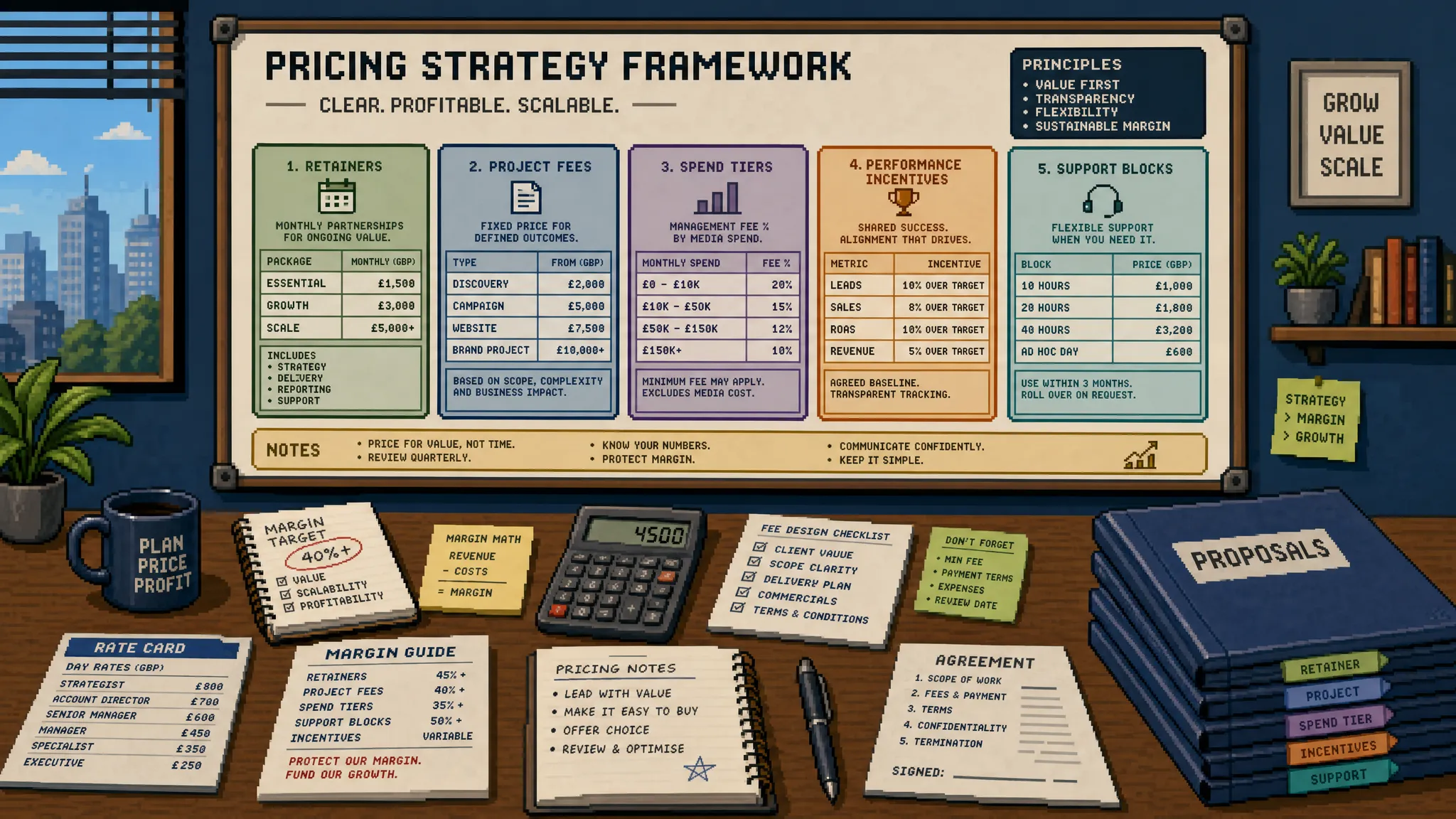
Growing agencies often hit the same awkward moment: PPC demand is increasing, but the pricing model that worked for the first few clients starts to strain delivery, margins and client expectations.
At the beginning, quoting a simple monthly fee can feel sensible. As accounts become larger, more complex or more urgent, that same fee can quietly turn into unpaid strategy, rushed tracking fixes, extra reporting and senior time that was never priced properly.
Good PPC pricing is not just about what a client will accept. It has to protect three things at once: campaign performance, agency margin and operational capacity. The right model gives clients clarity while making sure your team, or your white-label partner, can do the work properly.
This guide compares the main PPC pricing models for growing agencies, with a practical view of when each one works, where it breaks and how to choose a structure that scales.
First principle: separate ad spend from PPC management fees
Before comparing models, one point matters more than anything else: media spend and management fees are different costs.
Media spend is the money paid to platforms such as Google Ads, Meta Ads or Microsoft Ads. It goes into the auction and is affected by competition, targeting, seasonality, Quality Score, creative quality, landing page experience and conversion rates.
Your PPC management fee pays for the work around that spend: strategy, builds, optimisation, reporting, testing, account hygiene, tracking support, client communication and commercial judgement.
Bundling everything into one figure can look simple, but it often creates confusion. If the client thinks the full fee is going into ads, every performance discussion becomes harder. If the agency absorbs platform spend and charges the client afterwards, cash flow and credit risk can become a problem.
For a deeper breakdown of the cost components behind Google Ads specifically, this guide to Google PPC pricing for agencies in 2026 is a useful companion. In this article, the focus is on choosing the right commercial structure for agency delivery.
The main PPC pricing models compared
There is no universal best model. The right choice depends on account complexity, client maturity, available internal resource and how much performance risk the agency is willing to take.
| PPC pricing model | How it works | Best fit | Main agency risk |
|---|---|---|---|
| Percentage of ad spend | Management fee is based on a percentage of monthly media spend | Larger or growing accounts where spend broadly reflects workload | Low-spend accounts can be underpriced, while spend increases may not always mean more work |
| Flat monthly retainer | Client pays a fixed management fee each month | Stable accounts with predictable scope | Scope creep can erode margin if deliverables are not defined |
| Hourly or day rate | Work is billed based on time used | Audits, troubleshooting, overflow support and consultancy | Clients may focus on time rather than outcomes |
| Project-based fee | A fixed price is charged for a defined deliverable | Account builds, restructures, tracking projects and migrations | Poorly scoped projects can expand beyond the fee |
| Performance-based fee | Payment is linked to leads, sales, revenue or ROAS | Mature accounts with clean tracking and strong operational control | Attribution, website issues and sales quality can distort incentives |
| Hybrid model | Combines retainer, project, spend tier or performance elements | Growing agencies managing varied account types | Can become confusing if the fee logic is not explained clearly |
| White-label or pay-as-you-go support | Agency uses external PPC expertise as needed under its own brand | Agencies scaling delivery without hiring too early | Margin depends on how well client pricing covers specialist support |
Percentage of ad spend
Percentage-based PPC pricing is one of the easiest models for clients to understand. If the client spends more, the management fee increases. In theory, this aligns your fee with the scale of the account.
It can work well when spend is a reasonable proxy for complexity. For example, a multi-market ecommerce account with high budgets, multiple campaigns, product feeds and aggressive testing usually requires more oversight than a small local lead generation account.
The problem is that spend does not always equal effort. A low-spend account with messy tracking, poor conversion data and constant client questions can take more time than a larger, stable account with a clean structure. Equally, a high-spend account may not require proportionally more work every month once the foundations are strong.
If you use this model, it is usually safer to include a minimum monthly fee, clear spend tiers or a review point when the account changes materially. Otherwise, the agency can end up managing commercially important work for a fee that does not cover senior thinking.
Flat monthly retainer
A flat retainer is popular because it gives both sides predictability. The client knows what they will pay each month, and the agency can forecast revenue and delivery capacity more easily.
This model works best when the scope is well defined. You should be clear about which platforms are included, how many campaigns are being managed, what reporting cadence is covered, how meetings are handled and whether tracking support is included.
The danger is scope creep. A client starts with Google Search, then asks for Performance Max, Meta Ads, remarketing, landing page input, GA4 troubleshooting and a weekly reporting call. If the fee stays the same, the account may become unprofitable even if the client is happy.
A good retainer should include a trigger for review. That trigger might be a new platform, a major campaign expansion, a significant spend increase, extra markets or a new reporting requirement. The point is not to nickel-and-dime the client, but to make sure the commercial agreement reflects the real work.
Hourly or day rate
Hourly and day-rate pricing is useful when the scope is uncertain or short term. It works particularly well for audits, emergency fixes, second opinions, overflow cover and tactical consulting.
For agencies, the advantage is that time is protected. If an account needs five hours of tracking diagnosis, you are not pretending it can be absorbed into a tiny retainer. For clients, the advantage is transparency.
The downside is perception. Some clients become focused on how many hours were used rather than what was achieved. This can be frustrating in PPC, where a senior specialist might identify a major issue in 30 minutes that a junior team could miss for weeks.
Hourly pricing is strongest when paired with clear outcomes. Instead of selling time alone, describe the work as a defined diagnostic session, an audit sprint, a campaign review or an optimisation block. That keeps the conversation focused on business value rather than the stopwatch.
Project-based pricing
Project fees are ideal when the deliverable has a clear beginning and end. Common examples include account builds, campaign restructures, tracking implementation, migration support, audit reports and launch plans.
This model protects both sides when the project is scoped carefully. The client knows the cost upfront, and the agency can price based on the complexity of the deliverable rather than an open-ended monthly commitment.
The key word is carefully. A project fee should define what is included, what is excluded, what access is required, what assumptions have been made and how many revisions or follow-up calls are covered.
Project pricing is also useful before a retainer starts. If a new account is disorganised, charging a one-off setup or recovery fee before monthly management begins can stop the first month of the retainer being swallowed by unpaid repair work.
Performance-based pricing
Performance-based pricing sounds attractive because it links fees to results. In theory, the agency earns more when the client earns more.
In practice, this model is difficult unless the account has clean tracking, reliable attribution and a strong connection between advertising performance and commercial outcomes. A PPC specialist can improve targeting, structure, bidding, testing and measurement, but they cannot fully control stock levels, pricing, sales team follow-up, website speed, offer strength or market demand.
That does not mean performance incentives are useless. They can work as part of a hybrid model, especially when there is a base management fee that covers delivery and a bonus linked to agreed outcomes. The important thing is to define the metric carefully.
Leads are not always equal. Revenue can be affected by factors outside the ad account. ROAS can be distorted by tracking gaps or discounting. Before agreeing to a performance component, make sure both agency and client understand what success means and who controls the levers.
Hybrid pricing
For many growing agencies, hybrid pricing is the most practical option. It allows you to combine predictability with flexibility.
A hybrid model might include a setup fee followed by a monthly retainer. It might use a flat retainer up to a certain spend level, then increase when the account moves into a higher complexity tier. It might include separate project fees for tracking, feed work or landing page input.
This approach reflects how PPC work actually happens. Not every month is the same, not every client needs the same level of support, and not every task belongs inside the base management fee.
The risk is overcomplication. If the proposal feels like a puzzle, the client may lose trust. Keep the structure simple enough to explain in one conversation. A good hybrid pricing model should make commercial sense without needing a spreadsheet tour.
White-label and pay-as-you-go PPC support
As agencies grow, pricing is not only a client-facing problem. It is also a resourcing problem.
Hiring a full-time PPC specialist too early can create fixed cost pressure. Relying on junior account teams can reduce quality and increase risk. Asking one internal expert to cover every urgent account can lead to bottlenecks and burnout.
White-label PPC support gives agencies a way to increase delivery capacity without committing to recruitment before demand is consistent. The agency keeps the client relationship, while a specialist supports execution, optimisation or strategy behind the scenes.
This model is especially useful when your agency wants to offer PPC but does not yet have enough recurring work to justify another hire. It also helps when the workload spikes because of launches, audits, pitch wins, staff absence or sudden client issues.
If this is where your agency is heading, it is worth understanding why white-label PPC management helps agencies scale. The main commercial benefit is flexibility: you can price client work with senior delivery in mind, while avoiding permanent salary costs until the pipeline supports them.
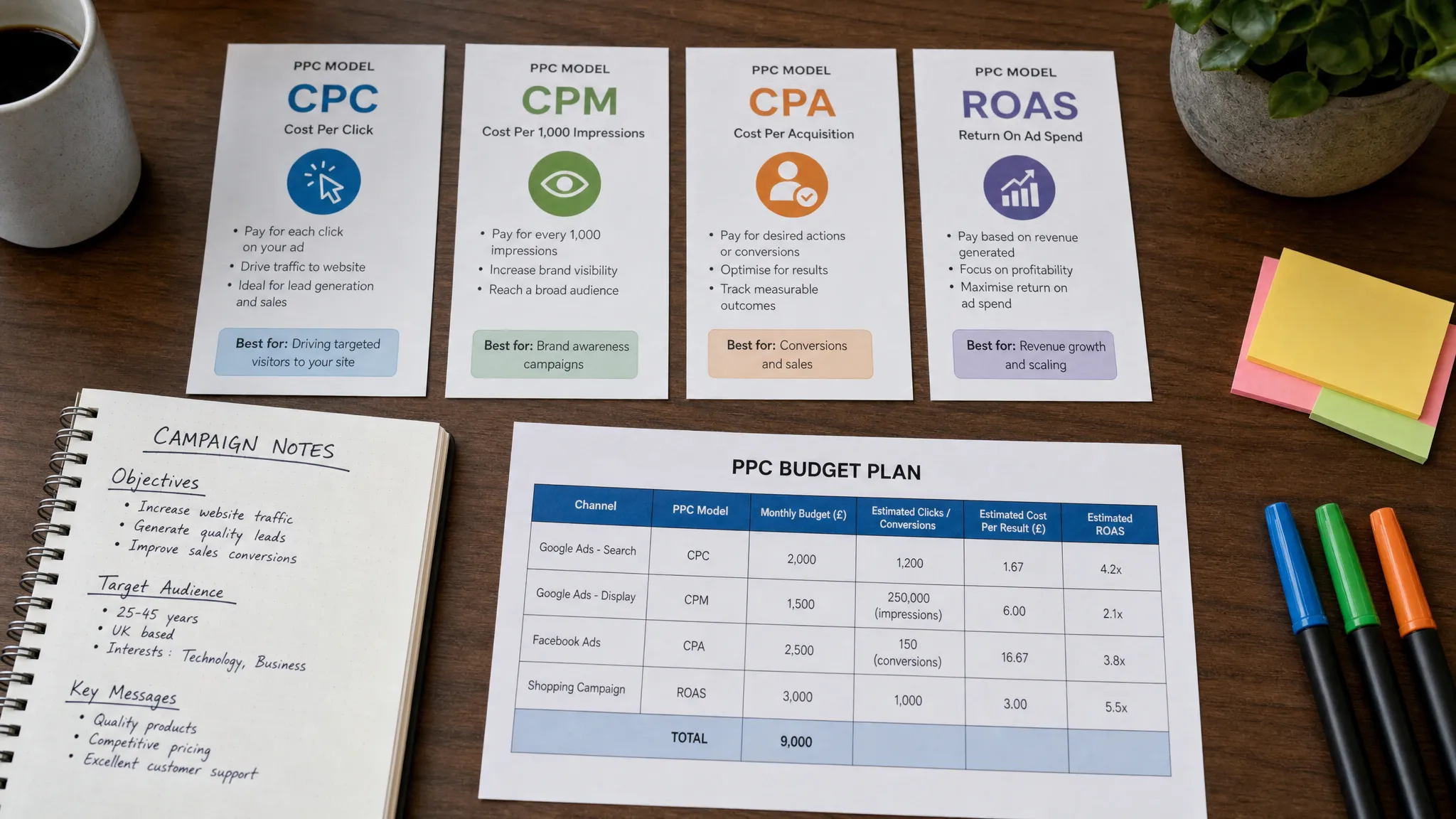
How growing agencies should choose a PPC pricing model
The best pricing model depends on what you are really selling. Are you selling ongoing management, a defined fix, strategic oversight, extra capacity or measurable growth?
| Agency situation | Strong pricing option | Why it fits |
|---|---|---|
| Testing PPC as a new service | White-label or pay-as-you-go support | Keeps delivery flexible while demand is still uncertain |
| Managing small local lead gen clients | Flat retainer with a sensible minimum | Protects time even when media spend is modest |
| Taking over a messy account | Project fee followed by retainer | Separates cleanup work from ongoing optimisation |
| Running higher-spend ecommerce campaigns | Hybrid retainer with spend or complexity tiers | Reflects scale, tracking demands and testing workload |
| Covering short-term internal capacity gaps | Day rate or defined support block | Solves the immediate delivery problem without changing client contracts |
| Working with mature clients focused on growth | Retainer plus agreed performance incentive | Covers core work while rewarding meaningful upside |
A useful rule of thumb is this: price the work, not just the platform.
Two Google Ads accounts can require completely different levels of effort. One may need simple Search optimisation and monthly reporting. Another may involve Performance Max, Shopping feeds, offline conversion imports, consent mode questions, landing page advice and board-level reporting.
If the scope is materially different, the price should be different too.
Pricing is also a communication problem
Many PPC pricing issues happen because the fee is explained too late or too vaguely. If the client only sees a single line that says PPC management, they may assume the work is simple.
A better proposal explains what the fee protects. It covers senior judgement, proactive optimisation, measurement integrity, platform knowledge, commercial prioritisation and the discipline to say no to wasteful activity.
This matters even more when proposals, reports and scopes are produced quickly. If your agency uses AI to draft client-facing documents, AI detection and humanisation tools can help review copy so pricing explanations feel clear, credible and genuinely human before they reach a prospect.
Clear communication also makes future fee reviews easier. If the client already understands that more platforms, more campaigns or more reporting means more work, an increase feels like a logical adjustment rather than a surprise.
What to include in every PPC pricing scope
Regardless of the model, your pricing should be supported by a clear scope. This is where many agencies protect or lose margin.
A strong PPC scope should clarify:
- Platforms included, such as Google Ads, Meta Ads or Microsoft Ads.
- Account setup, restructure or migration responsibilities.
- Conversion tracking, GA4 and tag management expectations.
- Reporting frequency and format.
- Meeting cadence and stakeholder access.
- Landing page, creative or feed support boundaries.
- Response times for urgent requests.
- Review points for changes in spend, scope or account complexity.
This is not bureaucracy for its own sake. It prevents the agency from absorbing unpaid work and gives the client a better service because expectations are realistic from the start.
When accounts are already under pressure, scope clarity becomes even more important. Senior judgement is often needed to decide what to fix first, what to ignore and where spend is being wasted. That is one reason a PPC specialist agency can outperform junior account teams when the margin for error is low.
Common PPC pricing traps that hurt agency margin
Many agencies do not undercharge because they lack confidence. They undercharge because they price the visible work and forget the hidden work.
| Pricing trap | Why it hurts | Better approach |
|---|---|---|
| Pricing only by ad spend | Spend does not always reflect workload | Add complexity, tracking and stakeholder demands to the pricing decision |
| Offering unlimited reporting calls | Meetings can consume senior optimisation time | Define cadence and charge for additional sessions where needed |
| Including tracking by default | GA4, tags and consent issues can become technical projects | Separate basic checks from implementation or repair work |
| Treating every platform as equal | Meta, Google and Microsoft Ads require different workflows | Price multi-platform accounts as broader engagements |
| No review clause | Scope grows while fees stay static | Set review triggers before work begins |
| Discounting setup work | The first month becomes unprofitable | Charge a setup, audit or restructure fee where the account needs it |
The goal is not to make pricing complicated. It is to stop important work being invisible.
If your agency is serious about PPC growth, every new client should be reviewed for delivery complexity before the price is finalised. That review does not need to be long, but it should consider tracking quality, historical performance, platform mix, data volume, conversion journey, stakeholder demands and commercial urgency.
A practical recommendation: build a pricing menu, not one universal fee
Growing agencies usually do better with a small set of pricing options rather than one rigid model.
For example, you might offer an audit or setup project for accounts that need diagnosis, a managed monthly retainer for stable ongoing work, a hybrid growth plan for larger or multi-platform clients, and white-label support for overflow or specialist delivery.
This gives your sales team flexibility without forcing them to invent pricing from scratch. It also helps delivery teams because the work sold is closer to the work required.
Most importantly, a menu makes it easier to protect senior time. PPC is not just button-pushing. The value is often in diagnosing what matters, prioritising the right tests, avoiding wasted spend and knowing when a platform recommendation is not in the client’s best interest.
A pricing model that does not account for that judgement will eventually punish the agency for doing good work.
Frequently Asked Questions
What is the best PPC pricing model for a growing agency? The best model is usually a hybrid structure that combines a clear monthly retainer with project fees, spend tiers or specialist support where needed. It gives clients predictability while helping the agency protect margin as scope changes.
Should PPC management fees be based on a percentage of ad spend? Percentage pricing can work for larger accounts, but it should not be the only factor. Account complexity, tracking quality, platform mix and reporting expectations can affect workload as much as spend does.
How do agencies stop PPC retainers becoming unprofitable? Define scope clearly, set review triggers, charge separately for major setup or tracking work, and avoid unlimited meetings or reporting requests. Retainers should be reviewed when platforms, spend or deliverables change.
Can white-label PPC support fit inside my agency pricing? Yes, if you price client work with delivery cost and margin in mind. White-label support can help agencies access senior PPC expertise without hiring, but the client fee still needs to cover the real cost of specialist work.
Should GA4 and tracking support be included in PPC pricing? Basic tracking checks can be included, but implementation, repair work, consent issues and complex GA4 setup should often be scoped separately. Tracking problems can take significant specialist time and should not be hidden inside a low management fee.
Need senior PPC capacity without hiring?
If your agency is winning PPC work but does not want the cost, risk or delay of recruitment, PPC Ghost provides on-demand white-label PPC support for agencies. Get senior help across Google Ads, Meta Ads, Microsoft Ads and tracking support while your agency keeps the client relationship and the credit.