How Paid Media PPC Support Helps Agencies Scale Faster
See how paid media PPC support helps agencies scale faster with senior execution, flexible capacity and stronger delivery without hiring.
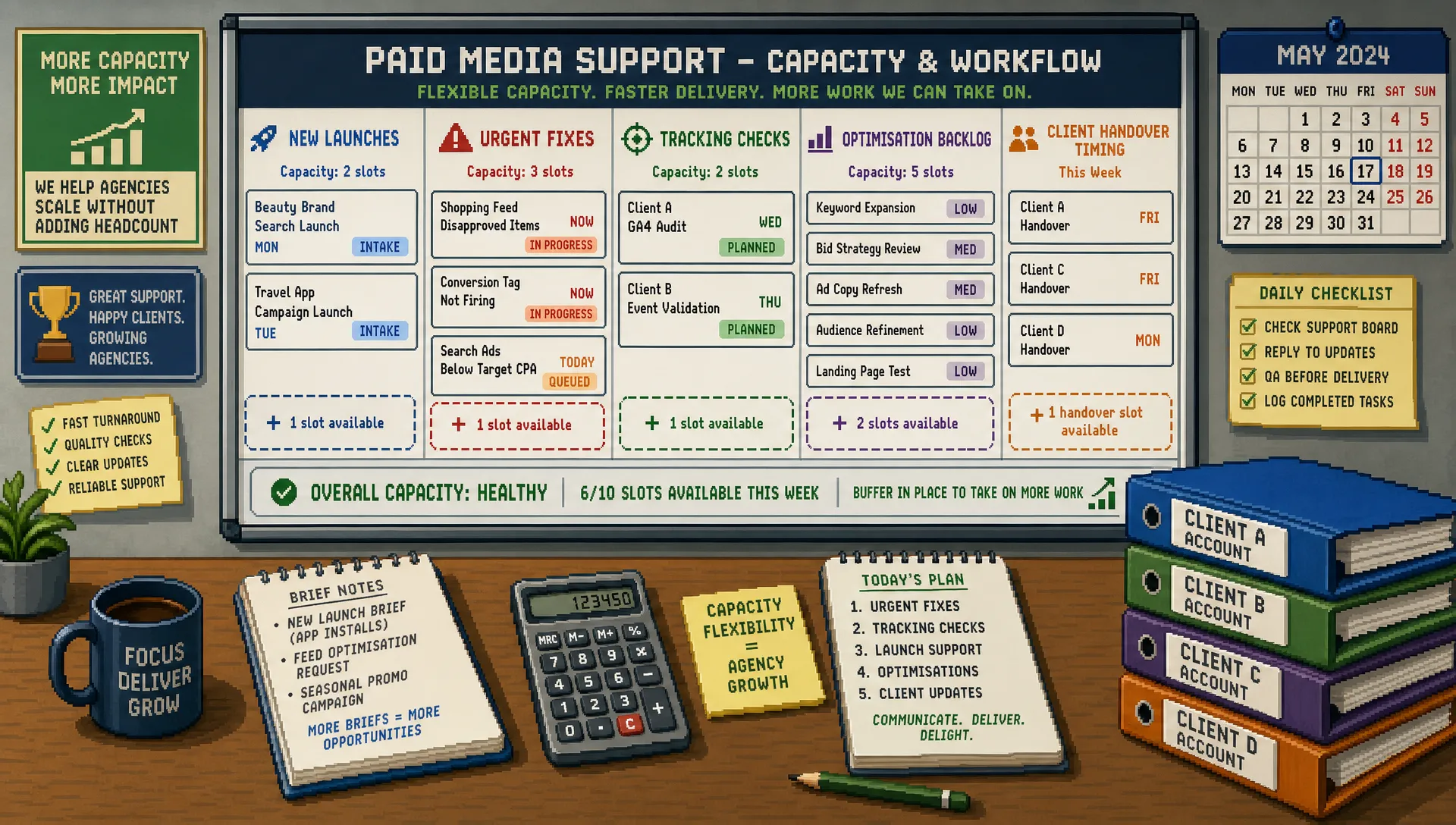
Agency growth rarely fails because demand disappears. More often, it stalls because delivery capacity cannot keep up with sales, strategy and client expectations.
Paid search, paid social and tracking work all create pressure at the same time. A new client needs a launch plan. An existing account needs wasted spend cut quickly. Another client wants Meta Ads tested before the next campaign window. Meanwhile, your account managers still need to run meetings, write updates and keep stakeholders confident.
That is where paid media PPC support changes the scaling equation. Instead of hiring slowly, overloading junior teams or turning down work, agencies can add specialist execution capacity exactly when it is needed. Used well, it helps an agency take on more revenue without letting quality, margins or client trust slip.
Why PPC becomes a bottleneck as agencies grow
PPC delivery is not just campaign setup. A healthy paid media operation includes conversion tracking, audience checks, feed reviews, search term analysis, budget pacing, creative testing, landing page feedback, reporting context and constant optimisation.
As client numbers rise, this work compounds. Ten PPC accounts do not simply require twice as much work as five. They usually create more complexity because each account has different goals, budgets, reporting expectations, tracking setups and stakeholder demands.
The wider market adds pressure too. According to IAB UK’s Digital Adspend report, UK digital advertising spend reached £35.5 billion in 2024, up 13% year on year. More budget moving into digital channels means more opportunity for agencies, but also more competition and higher expectations from clients.
For many agencies, the breaking point is not sales. It is the gap between what the agency can win and what the internal team can confidently deliver.
What paid media PPC support actually means
Paid media PPC support is external specialist help that plugs into an agency’s delivery workflow. It can cover Google Ads, Meta Ads, Microsoft Ads, GA4, tracking checks, account audits, campaign builds, optimisation tasks and reporting input.
The best version does not replace the agency’s strategy or client relationship. It strengthens the agency behind the scenes by giving account teams access to experienced execution without needing to recruit, train and manage another full-time employee.
This can be fully white label, where the specialist remains invisible to the client, or it can be used as a silent technical layer supporting internal teams. For agencies that want to understand the model in more depth, this guide on why white-label PPC management helps agencies scale explains the broader operational benefits.
In practical terms, PPC support helps agencies move from a fixed-capacity model to a flexible delivery model. That shift is often what allows growth to happen safely.
How PPC support helps agencies scale faster
Scaling faster does not mean saying yes to everything. It means increasing delivery capacity while keeping standards high enough to protect retention, reputation and profit.
Paid media PPC support helps by removing the most common operational constraints that slow agencies down.
| Scaling constraint | How PPC support helps | Agency impact |
|---|---|---|
| Recruitment takes too long | Adds specialist capacity without waiting for a hire | Faster onboarding of new clients |
| Senior talent is expensive | Gives access to experienced execution only when needed | Better margin control |
| Junior teams need oversight | Reduces technical errors and speeds up diagnosis | Stronger campaign quality |
| Workload arrives in spikes | Covers launches, audits and urgent fixes on demand | Less pressure on internal teams |
| Channel knowledge is uneven | Adds support across Google, Meta, Microsoft Ads and tracking | More complete paid media delivery |
| Client teams lack time | Handles behind-the-scenes execution | Account managers stay focused on clients |
This is especially useful for agencies that already have strong client relationships but need more reliable hands-on PPC delivery. Growth becomes less dependent on whether one internal specialist has enough hours in the week.
It creates capacity without permanent overhead
Hiring can be the right move when demand is predictable and long term. The problem is that agency demand is often uneven. One quarter may be full of new campaign launches, while the next may involve more maintenance, reporting and strategic work.
A full-time hire creates a permanent cost before the agency knows whether the workload will remain consistent. If the hire is too junior, senior team members still need to review the work. If the hire is too senior, the agency may struggle to keep them fully utilised across quieter periods.
On-demand PPC support gives agencies a middle ground. You can increase delivery capacity during busy periods, reduce support when work slows and avoid the pressure of filling someone’s week for the sake of utilisation.
This is not just about cost control. It also protects team morale. Overloaded account managers and strategists tend to make slower decisions, miss details and become reactive. External PPC support absorbs execution pressure so internal teams can stay focused and commercially sharp.
It speeds up campaign launches
Launch delays are expensive. They frustrate clients, compress testing windows and make the agency look less organised than it really is.
Most launch delays come from predictable issues: incomplete briefs, missing access, unclear conversion goals, messy account structures, weak naming conventions, unapproved creative or tracking uncertainty. A senior PPC specialist can spot these problems early and keep the setup moving.
Good PPC support can help agencies build a repeatable launch process. That means campaign structures are cleaner, tracking is checked earlier and account managers are not chasing technical details at the last minute.
For agencies under pressure, speed only matters if quality remains intact. The goal is not simply to launch faster. The goal is to launch with fewer avoidable mistakes, fewer measurement gaps and a clearer optimisation path from day one.
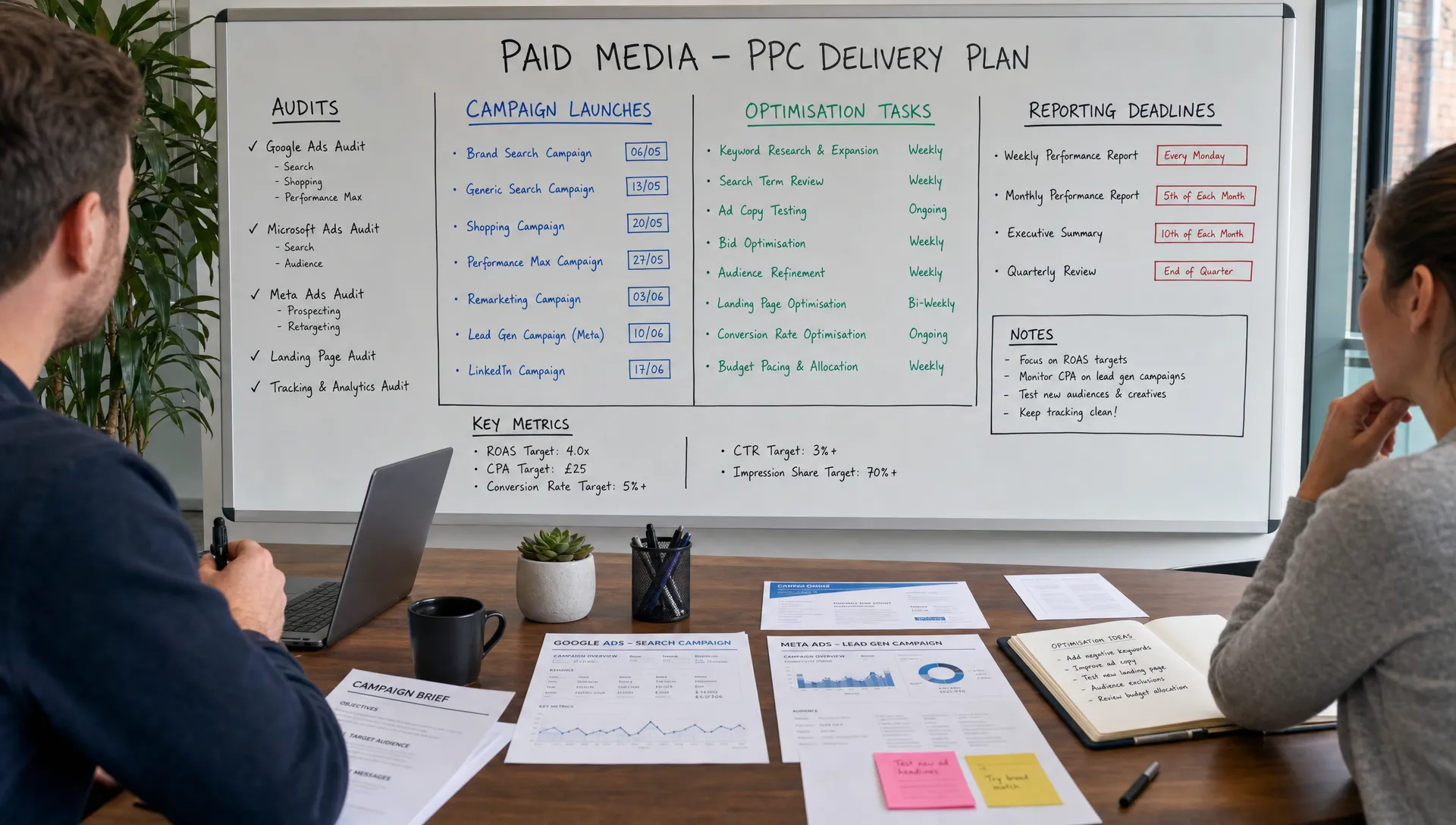
It protects quality while account teams stay client-facing
Many agencies rely on account managers to bridge the gap between client communication and technical execution. That works up to a point, but it becomes risky when the account manager is also expected to diagnose tracking problems, review search terms, build campaigns and explain performance swings.
Senior PPC support allows each role to do what it does best. The account manager owns the relationship, context and communication. The PPC specialist handles the technical checks, optimisation work and delivery detail.
That separation improves quality because paid media accounts get deeper specialist attention. It also improves client experience because the agency’s communication becomes more confident and timely.
This is one reason specialist support often outperforms a junior-only delivery model. If your agency is debating whether to add junior headcount or bring in senior backup, this article on why a PPC specialist agency beats junior account teams gives useful context.
It improves margins by matching cost to workload
Agency scaling is not only about revenue. It is about profitable revenue.
If every new PPC client requires more fixed headcount, margins can tighten quickly. Recruitment fees, salaries, training time, management overhead and idle capacity all affect profitability. Even when client retainers look healthy, delivery inefficiency can quietly erode the margin.
Flexible paid media PPC support helps agencies match cost to active workload. If you need an audit, campaign build, tracking review or optimisation sprint, you can resource that specific need. If client work pauses, the cost does not continue in the same way a permanent salary does.
This model can also make pricing easier. Agencies can separate strategic account management from specialist execution, then scope PPC work more accurately. For a deeper view of how agencies should think about PPC costs, this guide to Google PPC pricing for agencies breaks down spend, management and delivery considerations.
It helps agencies expand beyond one channel
Clients rarely think in platform silos. They want leads, sales, pipeline, bookings or revenue. That often means combining Google Ads with Meta Ads, Microsoft Ads or better analytics.
For a growing agency, multi-channel delivery creates a skills challenge. A team may be strong in Google Search but less confident in Meta campaign structure. Another team may understand paid social but struggle with GA4 events, conversion imports or Microsoft Ads opportunities.
Paid media PPC support can fill those gaps without forcing the agency to become an expert in every channel overnight. It lets agencies offer broader paid media support while still maintaining delivery standards.
This is particularly valuable when an existing client asks for a new channel test. Instead of delaying the opportunity or assigning it to someone learning under pressure, the agency can bring in specialist help and move faster.
Where agencies should use PPC support first
Not every task needs to be outsourced. The best approach is to use external PPC support where it creates the most leverage.
| Use case | Why it works well for external PPC support |
|---|---|
| New account audits | A fresh senior review can identify tracking gaps, wasted spend and structure issues quickly |
| Campaign builds | Builds are time-intensive and benefit from clean setup standards |
| Tracking and GA4 checks | Measurement problems affect every optimisation decision |
| Search term and spend reviews | Wasted spend can often be reduced quickly with focused analysis |
| Meta Ads launches | Creative, audience and campaign structure decisions need careful setup |
| Microsoft Ads expansion | Existing Google learnings can often be adapted to find incremental demand |
| Reporting input | Specialist notes help account managers explain performance with more confidence |
The highest-return tasks are usually the ones that unblock revenue, reduce risk or save internal time. Agencies do not need to outsource everything. They need to outsource the work that creates bottlenecks.
How to integrate PPC support without losing control
Some agencies worry that external support will make delivery harder to manage. That usually happens when there is no operating rhythm. With the right process, support should make delivery clearer, not messier.
Start by deciding what stays internal. Most agencies should keep client strategy, commercial ownership and relationship management in-house. External support should strengthen execution, provide specialist input and help the agency deliver what it has already promised.
Then define how work moves through the system. A simple but effective model includes:
- Clear briefs with goals, budgets, deadlines and platform access confirmed upfront.
- Shared account standards for naming, campaign structure, tracking and reporting notes.
- Defined review points before campaigns go live or major changes are pushed.
- A single internal owner who prioritises requests and avoids conflicting instructions.
- Short feedback loops so learnings from the specialist improve future briefs.
This gives the agency control while still benefiting from external expertise. Over time, the agency also becomes more efficient because repeated PPC tasks are documented and standardised.
Common mistakes that slow agencies down
Paid media PPC support works best when it is treated as a scaling system, not just emergency cover.
One common mistake is waiting until an account is already in trouble. External support can help with urgent fixes, but it is more valuable when used before problems damage performance or client confidence.
Another mistake is providing weak briefs. A senior specialist can diagnose technical issues, but they still need commercial context. The brief should explain the client’s goal, what has already been tried, what success looks like and any constraints around budget, geography, landing pages or approvals.
Agencies also lose value when they separate the PPC specialist from the wider account process. The specialist does not need to join client calls, especially in a white-label setup, but they should have enough context to make commercially sensible decisions.
Finally, agencies should avoid measuring support only by task completion. A campaign build delivered quickly is useful, but the bigger question is whether the work improved launch quality, reduced wasted spend, protected margin or helped retain the client.
Signs your agency is ready for paid media PPC support
You do not need to wait until the team is overwhelmed. In fact, the best time to add support is usually before delivery quality starts to suffer.
Your agency may be ready if:
- You are turning down paid media work because delivery capacity is limited.
- Senior team members are spending too much time on repetitive account tasks.
- Account managers are handling technical PPC work outside their comfort zone.
- Campaign launches are being delayed by access, tracking or setup issues.
- You want to offer Google Ads, Meta Ads or Microsoft Ads without hiring for every channel.
- Client retention depends on improving optimisation speed and reporting confidence.
- You need flexible capacity but are not ready for another full-time hire.
If several of these apply, paid media PPC support is not a luxury. It is an operational layer that can help the agency grow more safely.
What good paid media PPC support should feel like
The right support should reduce friction. You should not feel as if you are managing another complicated supplier. You should feel as if an experienced specialist has quietly increased your agency’s capacity.
Good support is responsive, commercially aware and comfortable working behind the scenes. It should respect your agency’s client relationship, follow your preferred standards and provide clear notes that your team can use in client communication.
It should also be honest about priorities. Not every account needs a rebuild. Not every performance issue is caused by bidding. Not every tracking problem can be fixed inside the ad platform. Senior PPC support should help your agency make better decisions, not just complete tasks.
This is where a senior-only model matters. Experienced specialists can usually diagnose faster, explain trade-offs more clearly and avoid the avoidable mistakes that create client frustration.
Frequently Asked Questions
What is paid media PPC support? Paid media PPC support is specialist help with paid search, paid social, tracking, audits, campaign builds, optimisation and reporting input. For agencies, it usually works as behind-the-scenes delivery support that strengthens internal capacity.
How does PPC support help agencies scale faster? It removes delivery bottlenecks by giving agencies access to experienced execution without waiting for recruitment. This helps agencies launch campaigns faster, handle more accounts and protect quality as workload increases.
Is paid media PPC support the same as white-label PPC? Not always. White-label PPC is a type of PPC support where the specialist works anonymously behind the agency brand. Some agencies use support fully white label, while others use it as internal specialist backup.
Which PPC tasks should agencies outsource first? Agencies usually get the most value from outsourcing audits, campaign builds, tracking checks, optimisation sprints, wasted spend reviews and channel expansion work. These tasks often create the biggest delivery bottlenecks.
Can PPC support replace hiring? It can reduce or delay the need to hire, especially when workload is variable. For some agencies, external support remains a flexible long-term model. For others, it bridges the gap until demand is consistent enough for a permanent hire.
Scale paid media delivery without adding headcount
If your agency is winning opportunities but struggling to deliver paid media work fast enough, the answer may not be another slow recruitment process.
PPC Ghost provides on-demand, white-label PPC support for agencies that need senior execution without contracts, recruitment headaches or unnecessary overhead. Support covers Google Ads, Meta Ads, Microsoft Ads, GA4 and tracking, with flexible pay-as-you-go delivery for UK agencies.
Use paid media PPC support to protect your team, strengthen your delivery and scale faster without letting quality slip.