Google Ads Agency Pricing Models That Protect Margin
Compare Google Ads agency pricing models that protect margin, avoid scope creep and help agencies price PPC retainers with confidence.
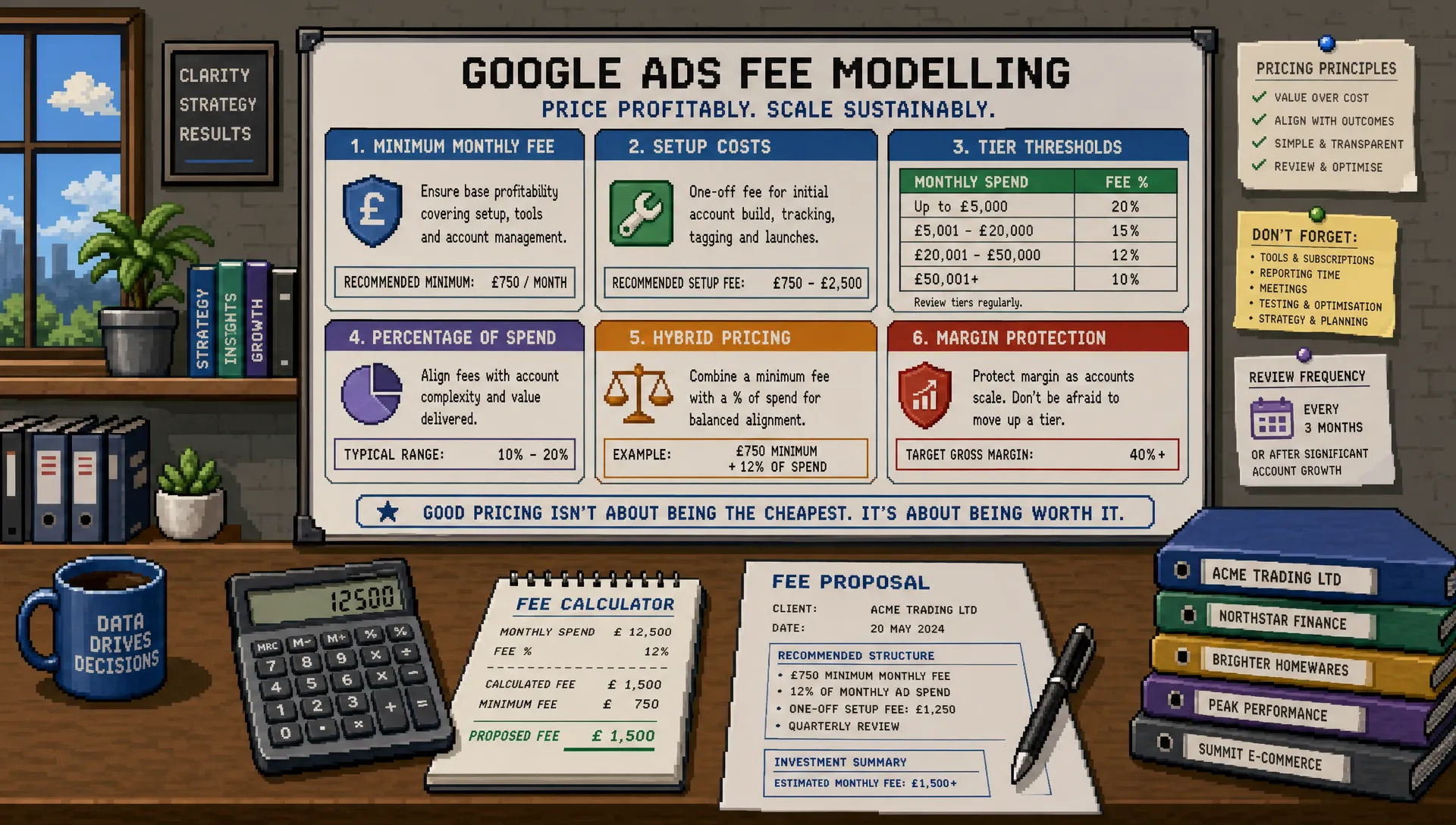
Google Ads agency pricing is rarely just a rate card problem. It is a margin problem, a capacity problem and, if the scope is vague, a client management problem too.
Many agencies underprice PPC because they anchor fees to media spend alone. That looks simple in a proposal, but it ignores the real work behind profitable Google Ads management: commercial discovery, tracking checks, campaign build, search term control, conversion quality, testing, reporting, client calls and senior oversight.
The right pricing model should do three things at once. It should feel fair to the client, reflect the complexity of the account and protect your agency from quietly delivering senior PPC work at junior margins.
Why Google Ads agency pricing often damages margin
The biggest mistake is assuming that higher ad spend always means higher complexity. Sometimes it does. A £50,000 per month account usually carries more commercial risk than a £3,000 per month account, and the client may expect faster response times, deeper reporting and more strategic input.
But spend is not the only driver of work.
A small B2B account with multiple services, long sales cycles, CRM tracking gaps and impatient stakeholders can take more time than a larger ecommerce account with clean conversion data and a simple product range. If your pricing only follows ad spend, you can end up overcharging simple accounts and undercharging the awkward ones.
This is why agencies should separate Google Ads media spend from management fees, setup costs and tracking work. If you need a broader breakdown of what sits inside PPC pricing, PPC Ghost has a useful guide on Google PPC pricing for agencies, but this article focuses specifically on models that protect delivery margin.
The core principle is simple: price the work, not just the budget.
Start with your minimum profitable fee
Before choosing between retainers, percentage of spend or hybrid pricing, work out the minimum fee at which an account is worth servicing.
A margin-safe minimum fee starts with delivery cost. That means the real cost of the people, tools and management time required to deliver the account properly.
Use this formula as a starting point:
Minimum monthly fee = delivery cost ÷ (1 - target gross margin)
For example, if an account requires £900 of internal delivery cost per month and your target gross margin is 50%, your minimum monthly fee is £1,800. If you charge £1,200, the account may still generate revenue, but it is not supporting a healthy agency model.
Delivery cost should include more than the time spent inside Google Ads. It should also include account management, reporting, quality assurance, internal review, tool costs, holiday cover and the cost of switching attention between clients.
| Cost area | What agencies often forget | Margin-safe pricing response |
|---|---|---|
| Onboarding | Audits, access issues, GA4 checks, conversion clean-up | Charge a setup fee or higher first-month fee |
| Strategy | Senior thinking before platform execution | Include strategy in the retainer scope |
| Reporting | Commentary, screenshots, Looms, client-specific formats | Limit reporting cadence or charge for custom reporting |
| Meetings | Prep time, follow-up notes, stakeholder education | Define meeting frequency in the proposal |
| Tracking | GA4, tag issues, form testing, call tracking checks | Scope separately if implementation is complex |
| Rebuilds | Restructuring poor legacy accounts | Treat as a project, not standard management |
This calculation is not just finance admin. It is the foundation of profitable Google Ads agency pricing.
The main Google Ads agency pricing models
There is no single best model for every agency. The right choice depends on client size, complexity, internal capacity, positioning and how much risk you want to carry.
| Pricing model | How it works | Best fit | Margin risk |
|---|---|---|---|
| Fixed monthly retainer | Client pays a set fee for agreed management scope | Stable accounts with predictable workload | Scope creep if deliverables are vague |
| Tiered retainer | Fee increases at spend, complexity or service thresholds | Growing accounts and agencies that need structure | Poor tier design can create awkward jumps |
| Percentage of ad spend | Fee is calculated as a percentage of media spend | Larger budgets where workload broadly follows spend | Low-spend accounts become unprofitable |
| Hybrid model | Base retainer plus a percentage of spend above a threshold | Accounts with variable spend or scaling plans | Needs clear thresholds and definitions |
| Setup plus monthly management | One-off build or audit fee followed by retainer | New accounts, rebuilds and messy handovers | Setup must not become unlimited repair work |
| Project pricing | Fixed fee for audit, rescue, migration or tracking work | One-off problems or pre-retainer work | Hard to profit if discovery is weak |
| Performance pricing | Fee linked to leads, revenue or agreed outcomes | Mature accounts with clean tracking and aligned sales data | Dangerous if tracking or sales process is unreliable |
The strongest agencies often use a blend rather than one universal model. They may have a minimum retainer, tiers for increasing complexity, a setup fee for new accounts and project pricing for work that sits outside normal monthly management.
Fixed retainers: simple, but only if scope is controlled
A fixed retainer is the easiest model for clients to understand. They know what they pay each month, and your agency can forecast recurring revenue with confidence.
The weakness is that fixed retainers punish you when the scope expands without the fee changing. One extra campaign here, one additional landing page test there, one more stakeholder call per month, and suddenly a profitable account becomes a time sink.
To protect margin, fixed retainers need clear boundaries. Define what is included, what is excluded and what triggers a fee review. This is especially important if your agency positions Google Ads as a managed service rather than a simple platform task.
A strong retainer scope usually defines:
- The advertising channels included, such as Google Ads only or Google Ads plus Microsoft Ads
- The expected meeting and reporting cadence
- The number of campaigns, markets or service lines covered
- Whether conversion tracking implementation is included or advisory only
- The level of landing page, creative or copy support included
- The process for urgent requests, rebuilds and additional projects
If the client expects professional PPC management, make sure the retainer reflects what that actually involves. This guide to what professional Google Ads management should include is a useful reference when shaping your own scope.
Tiered retainers: the most agency-friendly model
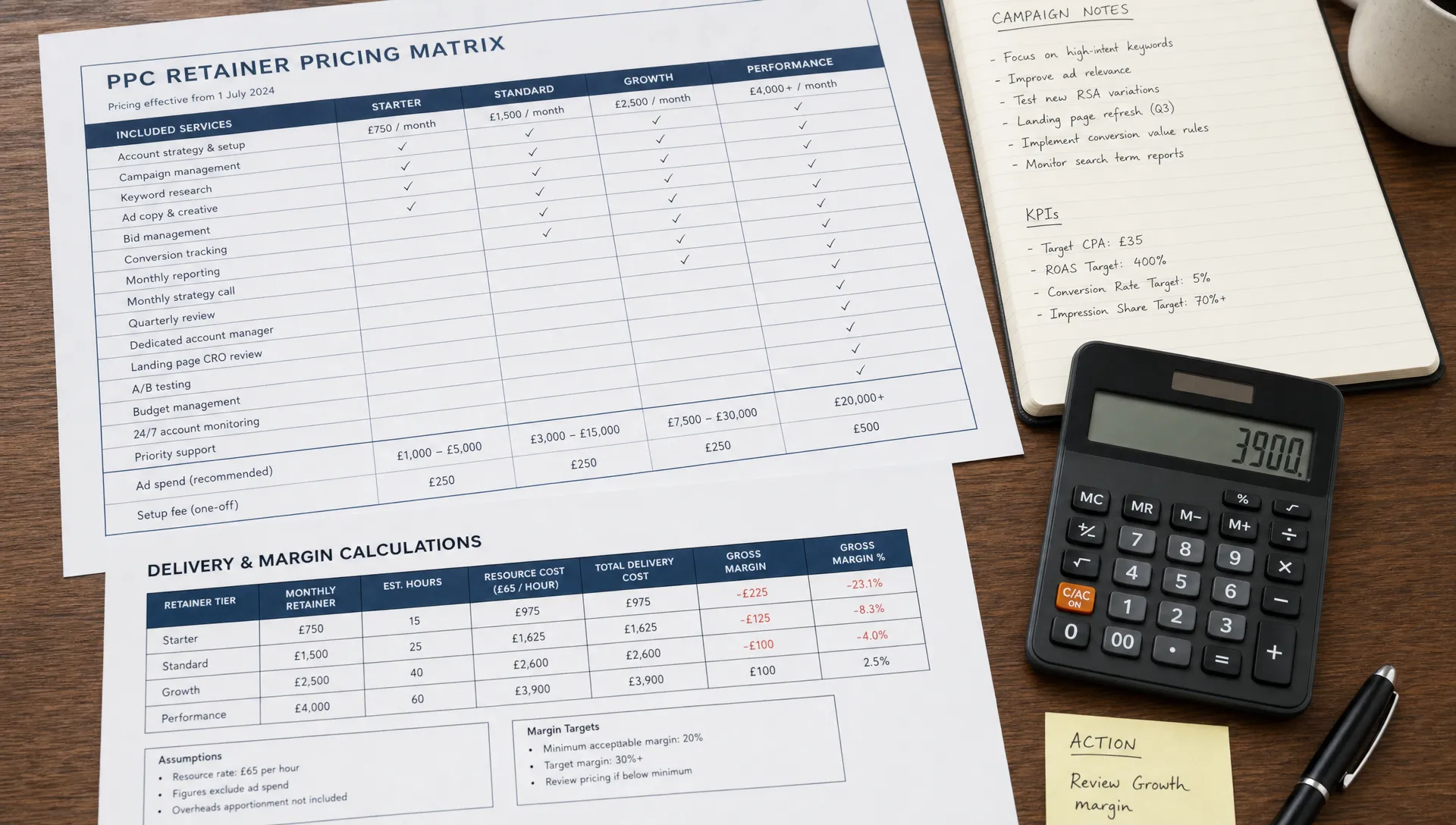
Tiered retainers are often the most practical Google Ads agency pricing model because they give clients clarity while allowing the fee to increase as workload and risk increase.
A tiered structure might be based on monthly ad spend, number of campaigns, number of locations, number of product categories, conversion tracking complexity or stakeholder requirements. Spend can still be part of the model, but it should not be the only variable.
For example, a simple tiering structure could look like this:
| Tier driver | Lower complexity | Higher complexity |
|---|---|---|
| Monthly spend | Smaller budgets with limited testing | Larger budgets with more optimisation pressure |
| Campaign structure | One market or core offer | Multiple markets, services or product groups |
| Conversion tracking | Standard form or purchase tracking | Offline conversions, CRM imports or call tracking |
| Reporting needs | Standard monthly commentary | Custom dashboards, board reports or weekly analysis |
| Stakeholders | One main contact | Multiple departments or approval layers |
The benefit is that you can explain fee increases as operational reality, not arbitrary upselling. If the account adds more locations, markets or campaigns, it moves into a higher service tier because the work has changed.
The key is to avoid tiers that only track spend. A £10,000 per month account and a £20,000 per month account might need the same workload if they share the same structure and conversion journey. Equally, a £4,000 per month account can demand a higher fee if tracking, compliance or lead quality analysis is unusually complex.
Percentage of spend: useful, but risky on its own
Percentage of spend pricing is common because it feels intuitive. If the client spends more, your fee increases. If they spend less, your fee decreases.
This can work well when media spend is a reliable proxy for workload. It also creates upside when budgets scale. However, it has two serious weaknesses.
First, low-spend clients can become unprofitable. A small account still needs onboarding, tracking checks, search term reviews, reporting and client communication. If the percentage fee produces a tiny management charge, your agency absorbs the difference.
Second, percentage of spend can create a perceived conflict of interest. A client may wonder whether you are recommending more spend because it benefits performance or because it increases your fee. Good agencies can manage this through transparency, but the concern is real.
A safer version is to use a minimum management fee, then apply a percentage only above a certain spend threshold. This protects your baseline delivery cost while allowing revenue to scale with larger accounts.
Hybrid pricing: protect the base, share the upside
Hybrid pricing combines a fixed base retainer with a variable component. It is often the best model for agencies managing accounts that may scale quickly or fluctuate seasonally.
The base retainer covers the non-negotiable work: account management, optimisation, reporting, tracking review and senior oversight. The variable component reflects the additional responsibility that comes with higher spend, more testing and greater commercial exposure.
A hybrid model is especially useful when the client has ambitious growth plans but is not ready to commit to a large fixed fee from day one. It lets your agency support early-stage growth without locking itself into an underpriced retainer once the account becomes more demanding.
To make hybrid pricing work, define the trigger points clearly. For example, your proposal might state that the base fee covers spend up to an agreed level, with an additional management percentage or tier increase once spend exceeds that level for a set period.
Avoid vague language such as “fees may increase as required”. Clients prefer clear rules, and clear rules protect your margin.
Setup fees: essential for messy accounts
Many agencies lose money in the first 30 to 60 days of a Google Ads engagement. That is when the heaviest work often happens: account audits, conversion tracking checks, restructuring, keyword research, negative keyword clean-up, asset review, audience work and reporting setup.
If you fold all of that into a normal monthly retainer, you are effectively financing the client’s onboarding.
A setup fee is not a penalty. It is a fair charge for concentrated upfront work. It also separates transformation work from ongoing management, which makes your pricing easier to defend.
Setup fees are especially important when:
- The account has poor historical structure
- Conversion tracking cannot be trusted
- The client is moving from another agency or freelancer
- There are multiple products, services, locations or markets
- GA4, Google Tag Manager or CRM data needs investigation
Google’s own documentation on conversion tracking shows how central measurement is to campaign optimisation. If tracking is broken, management becomes guesswork. That work should be scoped and priced properly.
Project pricing: profitable when the outcome is specific
Not every client needs a monthly retainer immediately. Some need an audit, a rescue project, a tracking review or a rebuild before they decide on ongoing management.
Project pricing works well when the deliverable is specific. For example, “Google Ads audit and action plan”, “account restructure”, “conversion tracking review” or “90-day PPC rescue plan” are easier to price than “help us improve Google Ads”.
The margin risk comes from loose discovery. If you do not understand the size and condition of the account before quoting, the project can expand beyond the fee.
Before pricing a project, confirm the account size, number of campaigns, conversion actions, markets, landing pages, ecommerce or lead generation setup, tracking stack and reporting expectations. If access is not available before quoting, price a paid diagnostic first.
Project work can also be a strong bridge into a retainer. It lets the client experience your thinking before committing, while giving your agency a paid way to understand the account properly.
Performance pricing: attractive, but rarely safe as the main model
Performance pricing sounds appealing. The agency gets paid based on results, so the client sees less risk and the agency gets upside.
In reality, it only works when the measurement environment is mature and both sides agree on what counts as a valuable outcome. For ecommerce, that might mean revenue or profit contribution. For lead generation, it may require agreed lead quality rules, CRM visibility and sales team follow-up data.
Without clean data, performance pricing can become a dispute. The agency may generate leads that the client fails to follow up. The client may reject leads based on criteria that were never agreed. Tracking may miss conversions or double count them.
For most agencies, performance fees are safer as a bonus layer, not the foundation of the agreement. Keep a base fee that covers delivery cost, then add performance incentives only where attribution and commercial rules are clear.
How to choose the right pricing model by client type
The best pricing model depends on the risk profile of the account. A simple local lead generation campaign does not need the same commercial structure as a multi-market ecommerce account.
| Client situation | Recommended model | Why it protects margin |
|---|---|---|
| New account build | Setup fee plus monthly retainer | Separates upfront build work from ongoing optimisation |
| Small local lead gen | Minimum fixed retainer | Prevents low spend from creating an unprofitable fee |
| Scaling ecommerce | Hybrid retainer plus spend-based tier | Covers base work while sharing upside as spend grows |
| Messy inherited account | Paid audit or rebuild project first | Avoids unlimited repair work inside a standard retainer |
| Multi-location business | Tiered retainer based on locations and campaigns | Aligns fee with operational complexity |
| Client with unreliable tracking | Diagnostic project before management | Prevents performance accountability without measurement |
| Seasonal advertiser | Hybrid or flexible tier model | Allows workload and budget to expand during peak periods |
The more uncertain the account, the more you should avoid a simple fixed monthly fee at the start. Use discovery, diagnostics or setup pricing to reduce unknowns before locking in ongoing management.
Build margin protection into your proposal language
A profitable pricing model can still fail if the proposal leaves too much room for interpretation.
Your proposal should make the commercial rules visible. It should state what the fee covers, what sits outside scope and when pricing will be reviewed. This is not about being difficult. It is about preventing resentment on both sides.
Useful margin protection clauses include:
- A minimum monthly management fee regardless of ad spend
- A setup or onboarding fee for new accounts and rebuilds
- A pricing review when spend, campaign count or markets increase
- A defined meeting and reporting schedule
- Separate pricing for complex tracking, CRM or landing page work
- Clear turnaround times for urgent requests
- A change request process for work outside the agreed scope
- A pause and restart policy if the client stops activity for a period
The tone matters. Position these terms as quality controls. Clients are more likely to accept boundaries when they understand that proper management requires focus, time and senior attention.
Use external delivery capacity without destroying margin
Pricing is only half of the margin equation. Delivery capacity matters too.
If your agency hires a full-time PPC specialist too early, you take on fixed salary cost before there is enough retained work to support it. If you rely on junior generalists, quality can suffer and senior leaders get pulled into rescue work. If you outsource without control, you risk quality, communication and client trust.
White-label PPC support can help when used strategically. It turns some delivery cost into variable cost, which can protect margin during growth, seasonal peaks or temporary capacity gaps. The key is to use senior support that fits your agency’s standards and remains invisible to the end client.
For agencies weighing this route, PPC Ghost explains how white label PPC management helps agencies scale without immediately adding headcount.
The goal is not to make pricing cheaper. It is to make delivery more resilient, so your agency can sell profitable PPC work without overcommitting internal capacity.
A margin-safe pricing structure agencies can adapt
A practical Google Ads agency pricing structure usually has four layers.
First, set a minimum monthly fee. This ensures every client covers baseline management, reporting and communication. If the account cannot support that fee, it may not be a good fit.
Second, charge separately for setup, audits and rebuilds. These are high-effort activities that should not be hidden inside month-one management.
Third, use tiers or hybrid pricing when complexity increases. Tie fee reviews to objective triggers such as spend thresholds, number of campaigns, new markets, extra reporting requirements or tracking complexity.
Fourth, reserve project pricing for work outside the retainer. That could include landing page strategy, GA4 troubleshooting, CRM conversion imports, feed work, one-off audits or urgent account recovery.
This structure gives clients clarity and gives your agency room to grow profitably. It also makes sales conversations easier because you are not inventing a fee from scratch each time.
Frequently Asked Questions
What is the best Google Ads agency pricing model? The best model is usually a minimum retainer with tiered or hybrid pricing as spend and complexity increase. This protects baseline delivery cost while allowing the agency fee to grow when the workload grows.
Should agencies charge a percentage of Google Ads spend? Percentage of spend can work for larger accounts, but it is risky on its own. A minimum fee is important because small accounts still require strategy, tracking checks, optimisation and reporting.
Should Google Ads setup be charged separately? Yes, in most cases. Setup, audits, tracking reviews and rebuilds are concentrated pieces of work. Charging separately prevents the agency from absorbing heavy onboarding costs inside a normal monthly retainer.
How can agencies stop PPC scope creep? Define the number of channels, campaigns, meetings, reports and tracking responsibilities included in the fee. Add clear triggers for repricing when spend, complexity or stakeholder expectations increase.
Is performance-based Google Ads pricing a good idea? It can work as a bonus layer when tracking, attribution and lead quality rules are clear. It is risky as the main pricing model because many performance factors sit outside the agency’s control.
Protect your PPC margin without hiring too early
If your agency is selling Google Ads, Meta Ads or Microsoft Ads but does not want the cost or risk of another full-time hire, PPC Ghost provides senior white-label PPC execution on demand.
You keep the client relationship and the credit. PPC Ghost supports delivery behind the scenes with flexible, pay-as-you-go PPC expertise for agencies that need reliable capacity without long contracts or recruitment delays.
Visit PPC Ghost to explore white-label PPC support that helps protect your margin while you scale.