How to Vet a Google Ad Company Before You Outsource
Learn how to vet a Google ad company before outsourcing, with checks for tracking, expertise, access, proof, pricing and white-label fit.
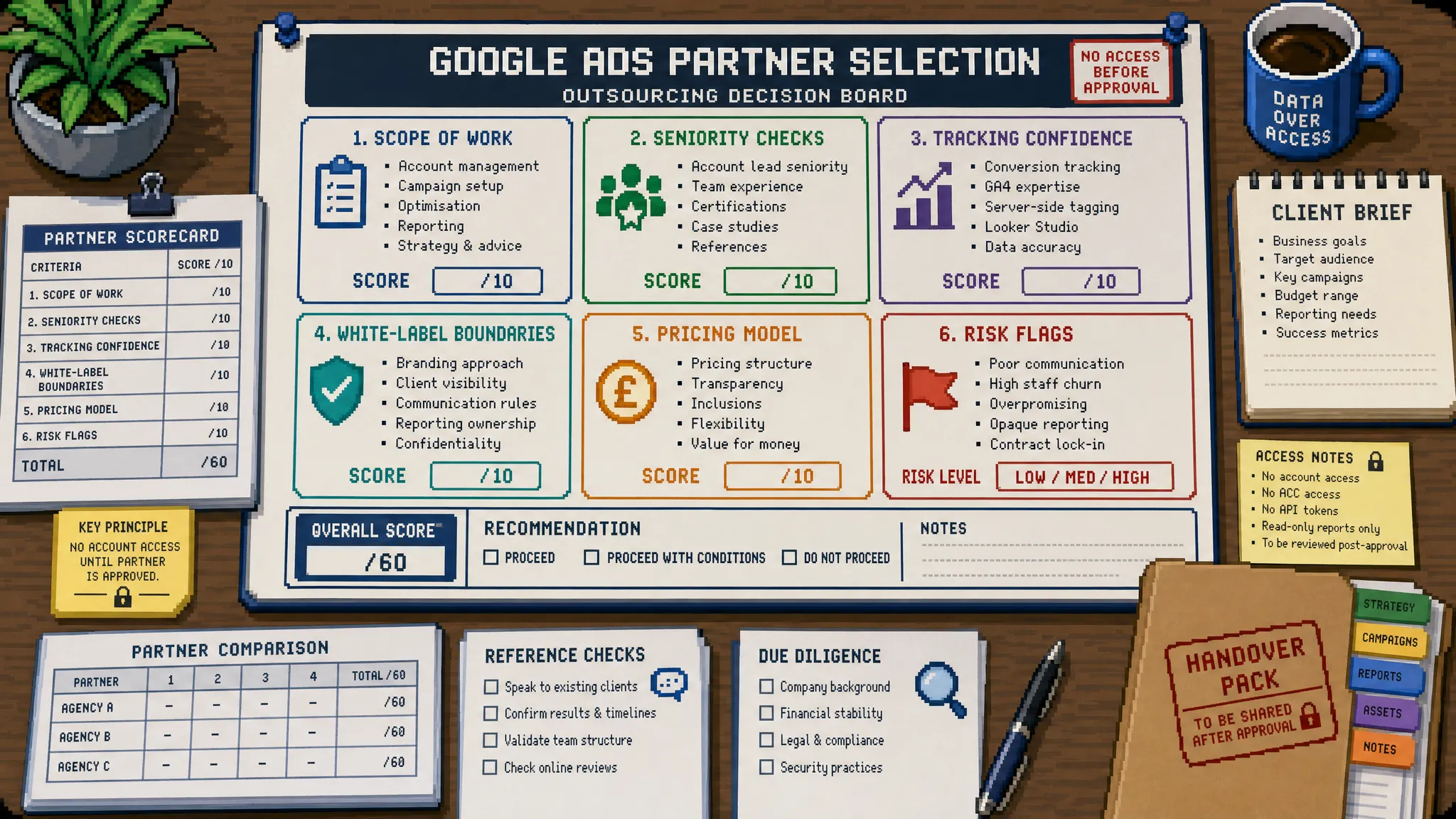
Outsourcing Google Ads can be a smart way to add specialist capacity without hiring. It can also expose your agency to missed deadlines, poor tracking, weak optimisation and uncomfortable client conversations if you choose the wrong partner.
The safest approach is not to ask, “Can this Google ad company run campaigns?” Most can say yes. The better question is, “Can they protect our client relationship, make commercially sound decisions and work in a way that fits our agency?”
This guide gives you a practical vetting process before you hand over access, budget or client trust.
Start by defining what you are really outsourcing
Not every outsourcing need is the same. Before you speak to suppliers, write down the exact problem you want solved. This makes it easier to filter out providers who look impressive but do not match the job.
You may need a Google Ads partner for overflow delivery, a one-off account rescue, campaign builds, GA4 and conversion tracking support, strategic input, or discreet white-label execution. Each scenario requires a different type of person.
For example, if your internal team already has strategy covered, you may prioritise fast, accurate build work and reliable QA. If performance is declining and the client is frustrated, you need senior diagnostic ability, not just someone who can add keywords and launch ads.
If you are unsure whether the issue is capacity, expertise or campaign complexity, it may help to compare your situation against the common signs you need a Google AdWords expert on demand. The earlier you identify the real gap, the easier it is to choose the right external support.
Use a vetting checklist, not a sales call
A polished proposal can hide a lot. The best way to vet a Google ad company is to use the same questions with every provider and compare the quality of their answers.
| Vetting area | What to ask | Strong answer | Red flag |
|---|---|---|---|
| Seniority | Who will actually work on the account? | A named senior specialist or clear delivery lead | Senior people sell, juniors deliver |
| Diagnosis | How would you audit an underperforming account? | They ask about goals, tracking, budgets, search terms and lead quality | They jump straight to “new campaign structure” |
| Tracking | How do you validate conversions? | They mention GA4, Google Tag Manager, CRM feedback and test conversions | They assume existing data is correct |
| Commercial thinking | How do you judge success? | They discuss CPA, ROAS, margin, lead quality and sales cycle | They focus mainly on clicks and impressions |
| Access | Who owns the ad account and data? | The client or agency retains ownership | They insist on owning the account |
| Communication | How will updates be handled? | Clear response times, notes and escalation process | Vague promises like “we keep you posted” |
| White-label fit | Can you work anonymously? | They understand agency-client boundaries | They want direct client contact by default |
| Pricing | What is included and excluded? | Scope is specific and transparent | Cheap headline fee with unclear extras |
The goal is not to find a perfect answer to every question. It is to see how the provider thinks when detail matters.
Ask who will actually touch the account
Many agencies are reassured by a confident senior person on the first call, then disappointed when the work is handed to someone less experienced. This is especially risky with Google Ads, where small decisions around match types, conversion goals, bidding, exclusions and budget allocation can have a significant impact.
Ask direct questions:
- Who will complete the audit, build or optimisation work?
- How many years of hands-on Google Ads experience do they have?
- Will the same person stay involved after launch?
- Is work reviewed before it goes live?
There is nothing wrong with a team model, but you need to know where judgement sits. If the company cannot explain who is accountable for performance decisions, be cautious.
For agency outsourcing, seniority matters even more because the external partner is indirectly representing your brand. You need someone who can spot risk before the client does.
Test how they diagnose wasted spend
A strong Google Ads specialist should be able to explain how they find wasted spend before they suggest new spend. If their first instinct is to increase budget, rebuild everything or push Performance Max without context, they may be more platform-led than commercially led.
Ask them how they would review an account where costs are rising but results are flat. A good answer might include search term analysis, conversion action review, landing page relevance, auction insights, negative keyword gaps, campaign segmentation, audience signals, device performance and location performance.
They should also ask about what happens after the conversion. A lead that looks cheap in Google Ads may be worthless if the sales team rejects it, the form attracts poor-fit enquiries, or the keyword intent is too broad.
If you want to benchmark the type of practical thinking to look for, this guide to PPC Google Ads tips that cut wasted spend fast covers the kind of efficiency-focused approach a credible partner should understand.
Check tracking before you discuss scaling
No amount of campaign optimisation can compensate for broken measurement. Before outsourcing, ask the provider how they check whether conversion data is trustworthy.
Google’s own guidance on conversion tracking makes clear that tracking is central to understanding valuable customer actions. In practice, that means your outsource partner should be comfortable asking questions about GA4, Google Tag Manager, primary and secondary conversion actions, consent settings, call tracking, enhanced conversions and CRM feedback where relevant.
You do not need every account to have an advanced measurement setup from day one. You do need a provider who knows when the data is too weak to support confident decisions.
A useful vetting question is: “What would make you hesitate before moving an account to automated bidding?”
A strong specialist will usually mention conversion volume, conversion quality, attribution reliability, sales cycle length and whether the tracked actions match the actual business goal. A weak one may simply say automated bidding is always best practice.
Look for commercial judgement, not just platform activity
Google Ads work can look busy without being valuable. New ads, new keywords and frequent bid changes do not automatically mean progress.
A reliable partner should want to understand the economics behind the account. For lead generation, they should ask about close rates, lead quality, average order value and the difference between a marketing-qualified and sales-qualified lead. For ecommerce, they should care about margin, repeat purchase behaviour, stock availability and profitability, not only ROAS.
This is where many outsourcing relationships fail. The provider optimises inside the ad platform, while the agency is judged on business outcomes. Your vetting process should test whether the company can bridge that gap.
A simple question works well: “If Google Ads shows more conversions but the client says lead quality is worse, what would you investigate first?”
The answer will tell you whether they understand real client pressure.
Validate proof without being distracted by big numbers
Case studies can be useful, but they need context. A claim such as “300% more leads” means little unless you know the starting point, budget, timeframe, industry and conversion definition.
Ask for examples that show the thinking behind the improvement. What was wrong? What did they change? How did they confirm the result was meaningful? What trade-offs did they make?
Sector experience can matter, especially in regulated or high-trust industries. If your agency serves healthcare, finance, legal or professional services clients, the provider needs to understand that messaging, compliance sensitivity and lead handling can shape campaign performance. For example, a specialist such as Louisville Web Lab’s healthcare marketing agency shows how vertical focus can connect Google Ads with patient acquisition, websites, reviews and automation rather than treating ads as a standalone channel.
That does not mean you always need a niche-only supplier. It means you should check whether the Google Ads company can adapt its strategy to the client’s market, buying journey and risk profile.
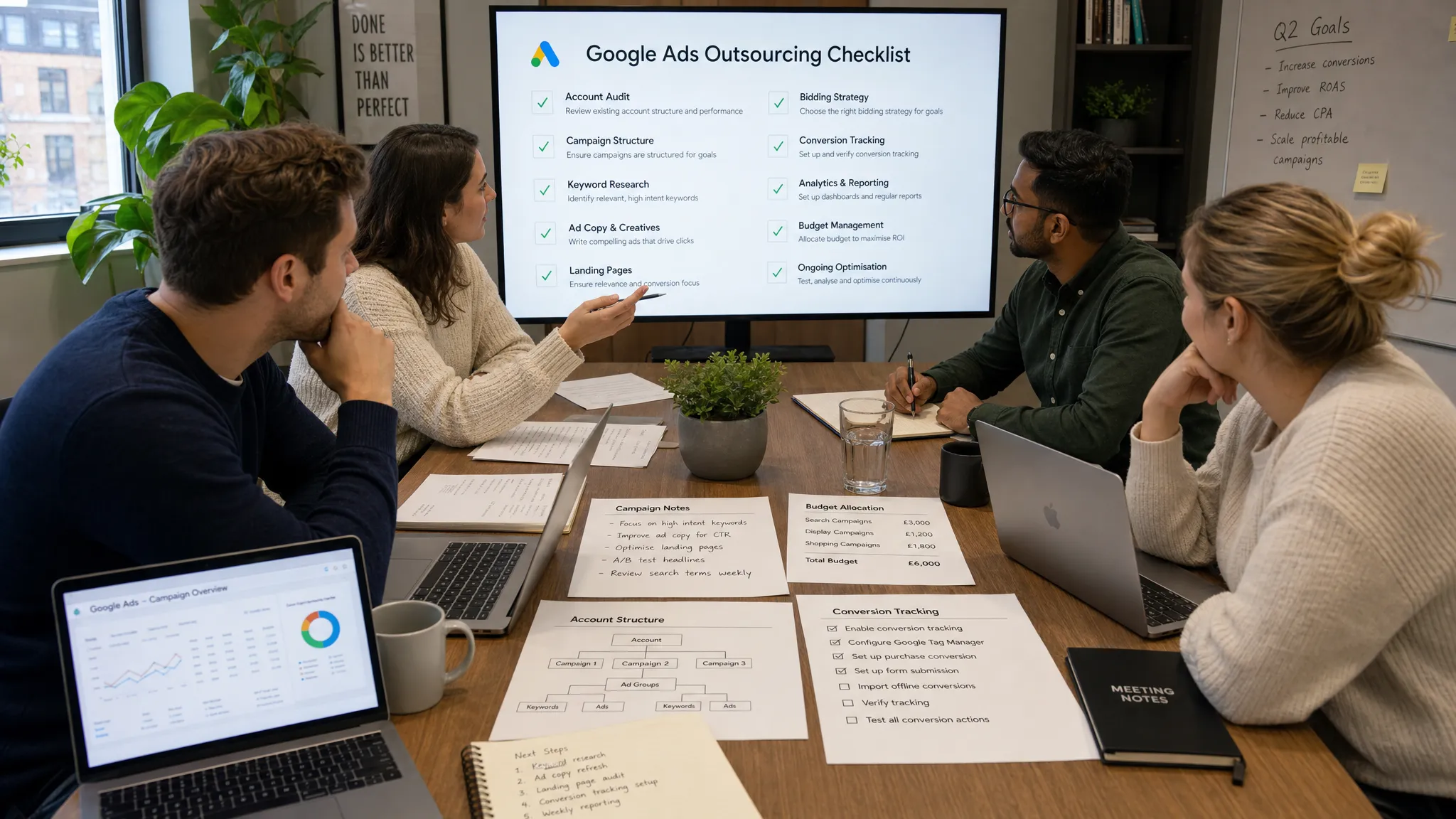
Confirm white-label fit before the first task
If you are outsourcing on behalf of your agency, capability is only half the equation. The partner also has to fit your operating model.
White-label work requires discretion, clean documentation and respect for the client relationship. The provider should be comfortable working behind the scenes, using your preferred communication process and giving you the information you need to present confidently.
Clarify these points early:
- Will they join client calls, or only support your internal team?
- Can they provide notes in a format your account managers can use?
- How will urgent client questions be handled?
- Are they comfortable working under your agency brand?
- What happens if the client asks highly technical questions?
If the partner pushes for direct client ownership too early, that may not suit a white-label relationship. For a deeper evaluation of this specific model, see what to look for in a white label Google Ads agency before you commit.
Run a small paid test before handing over everything
The best vetting process includes a real task. Free audits can be useful, but they often favour salesmanship. A small paid test shows you how the provider actually works.
The test should be narrow enough to complete quickly, but meaningful enough to reveal judgement. You might ask for a tracking review, an account audit, a campaign build plan, a search terms analysis, or a QA review before launch.
A good test brief should include:
- The client goal and current concern
- Account access level and deadline
- What output you expect
- Any brand, compliance or reporting requirements
- How you will judge the work
Pay attention to more than the final document. Did they ask good questions? Did they spot issues you missed? Did they explain recommendations clearly? Did they meet the deadline? Was their work easy for your team to use?
Those behaviours predict the future relationship better than a sales deck.
Protect access, ownership and data
Before you outsource, agree how access will work. This is not just an admin detail. It protects your agency, your client and the provider.
The client or agency should normally retain ownership of the Google Ads account, GA4 property, Google Tag Manager container and related assets. External partners can be granted appropriate access without taking control of the underlying account.
| Access issue | Safer practice |
|---|---|
| Google Ads access | Use user permissions or a manager account rather than shared logins |
| GA4 and GTM | Grant role-based access that matches the task |
| Passwords | Avoid password sharing wherever possible |
| Client data | Confirm confidentiality and data handling expectations |
| Account ownership | Make sure the client or agency can remove access if needed |
| Change control | Agree whether changes need approval before going live |
For UK agencies, it is also sensible to consider GDPR responsibilities when sharing access to analytics, CRM data or lead information. You do not need to turn vetting into a legal exercise, but you should make sure the provider treats data access seriously.
Understand pricing before you compare providers
The cheapest Google ad company is rarely the safest choice. The most expensive one is not automatically the best either. What matters is whether pricing matches the level of thinking, turnaround and responsibility required.
Common pricing models include project fees, monthly retainers, percentage of ad spend, hourly support and pay-as-you-go delivery. Each can work, but each creates different incentives.
For example, a percentage of spend may be simple to understand, but it can become awkward if your main goal is to reduce waste. A fixed project fee can be ideal for an audit or campaign build, but less suitable for ongoing optimisation if the scope is vague. Pay-as-you-go support can work well when your agency needs flexible senior help without a long commitment.
Ask what is included, what is excluded, how urgent requests are handled and whether there are minimum terms. If the provider avoids detail, expect friction later.
Watch for red flags
Some warning signs appear before the work begins. Take them seriously.
Be cautious if a provider guarantees specific results without seeing the account, dismisses tracking concerns, refuses to explain their process, insists that one campaign type solves everything, avoids naming who will do the work, or pushes for account ownership.
Other red flags include slow replies during the sales process, unclear pricing, overuse of jargon, no quality assurance process, reluctance to work white-label, and poor understanding of your client’s commercial model.
A good outsource partner should make you feel clearer, not more dependent on them.
Use a simple scoring system
When comparing several providers, score them against the same criteria. This helps remove emotion from the decision and gives your team a shared basis for choosing.
| Criteria | Score out of 5 | Notes |
|---|---|---|
| Hands-on senior expertise | Who is actually doing the work? | |
| Tracking and measurement ability | Can they validate the data? | |
| Commercial understanding | Do they think beyond platform metrics? | |
| White-label fit | Can they protect your agency relationship? | |
| Communication quality | Are updates clear and timely? | |
| Proof and relevant experience | Do examples show real thinking? | |
| Flexibility and turnaround | Can they match your delivery needs? | |
| Pricing transparency | Is scope clear and fair? |
You do not need the highest score in every category. You need the strongest fit for the risk you are outsourcing.
Frequently Asked Questions
What should I ask a Google ad company before outsourcing? Ask who will work on the account, how they audit performance, how they validate tracking, what results they optimise for, how access is managed, what is included in the price and whether they can work white-label if needed.
Should my agency outsource Google Ads or hire in-house? Hiring can make sense if you have consistent demand, management capacity and enough work for a full-time specialist. Outsourcing is often better when demand fluctuates, you need senior help quickly, or you want to avoid recruitment and long-term overheads.
Can a Google Ads provider work anonymously for my agency? Yes, if they offer white-label support and agree clear boundaries. Confirm whether they will communicate only with your internal team, how notes will be provided and how client-facing questions will be handled.
How do I know if conversion tracking is good enough? Tracking is more reliable when key actions are clearly defined, tested and aligned with business value. If the account tracks weak goals, duplicate conversions or unqualified leads, optimisation decisions may be misleading.
Is a Google Partner badge enough to trust a provider? No. A badge can be a useful signal, but it does not replace vetting. You still need to check hands-on expertise, commercial thinking, communication, tracking ability and whether the provider suits your agency model.
Need a vetted white-label PPC partner?
If you want senior Google Ads support without recruitment, contracts or handing the client relationship to another agency, PPC Ghost provides on-demand white-label PPC execution for agencies.
You can use PPC Ghost for Google Ads, Meta Ads, Microsoft Ads, GA4 and tracking support, with flexible pay-as-you-go delivery and discreet white-label processes. If you need a senior specialist who can plug into your workflow and help your agency deliver with confidence, start with PPC Ghost.