Google AdWords Advertising Tactics That Still Work
Google AdWords advertising tactics that still work in 2026, from intent-led structure and tracking to ads, bidding and agency workflows.
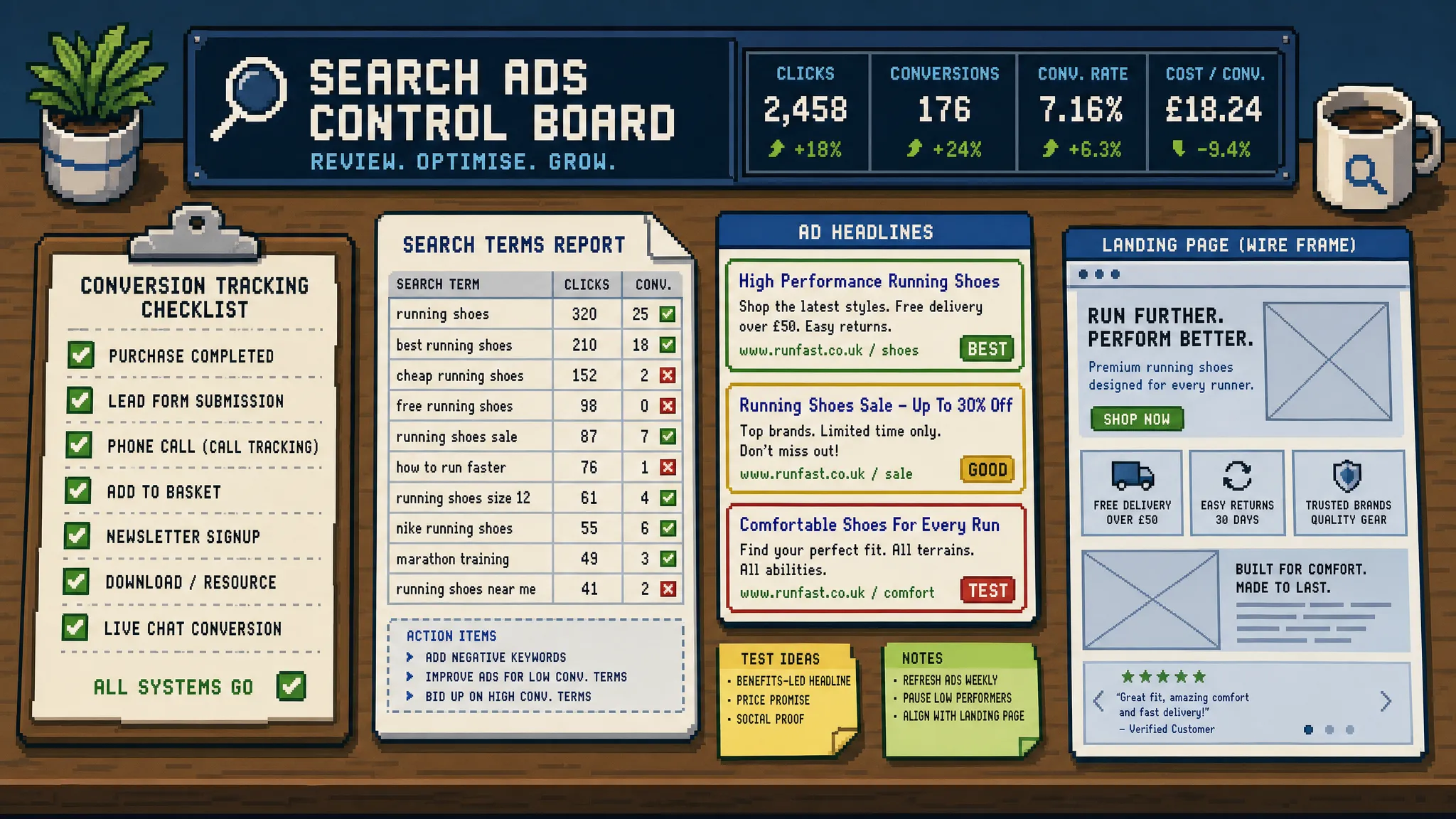
Google AdWords advertising has changed beyond recognition since the days of manual bids, expanded text ads and exact match that actually meant exact. The platform is now Google Ads, automation is everywhere, and machine learning influences everything from bidding to creative rotation.
Yet the tactics that still make accounts profitable are surprisingly familiar. They are not hacks. They are the fundamentals that give Google better signals, help clients understand what is happening, and stop agencies from handing control to automation without context.
For UK agencies, the question is not whether old AdWords tactics still work. The better question is which ones still deserve a place in a modern paid search process, and how they should be adapted for 2026.
What still works is not nostalgia
The most reliable Google AdWords advertising tactics share one thing: they improve the quality of the input. Better campaign structure, cleaner conversion tracking, stronger search term analysis and sharper landing pages all help the system make better decisions.
Automation can optimise faster than a human can manually adjust every bid, but it cannot decide what a qualified lead is, whether a search term reflects commercial intent, or whether the landing page matches the promise in the ad. That is where senior PPC judgement still matters.
| Tactic that still works | Why it still matters | Modern adjustment |
|---|---|---|
| Intent-led campaign structure | Keeps budgets, data and reporting aligned with business value | Use fewer, cleaner campaigns rather than over-segmented legacy builds |
| Search term mining | Reveals wasted spend and customer language | Use it for negatives, new keyword themes and landing page copy |
| Accurate conversion tracking | Feeds bidding algorithms with the right success signals | Separate primary conversions from soft engagement actions |
| Strong ad messaging | Improves relevance and click quality | Write responsive search ads around clear angles, not just keyword repeats |
| Smart Bidding guardrails | Lets automation scale without losing commercial control | Set realistic targets, monitor lead quality and avoid constant resets |
| Landing page alignment | Converts paid traffic more efficiently | Match page intent to query intent, not just to the client’s homepage |
Structure campaigns around commercial intent
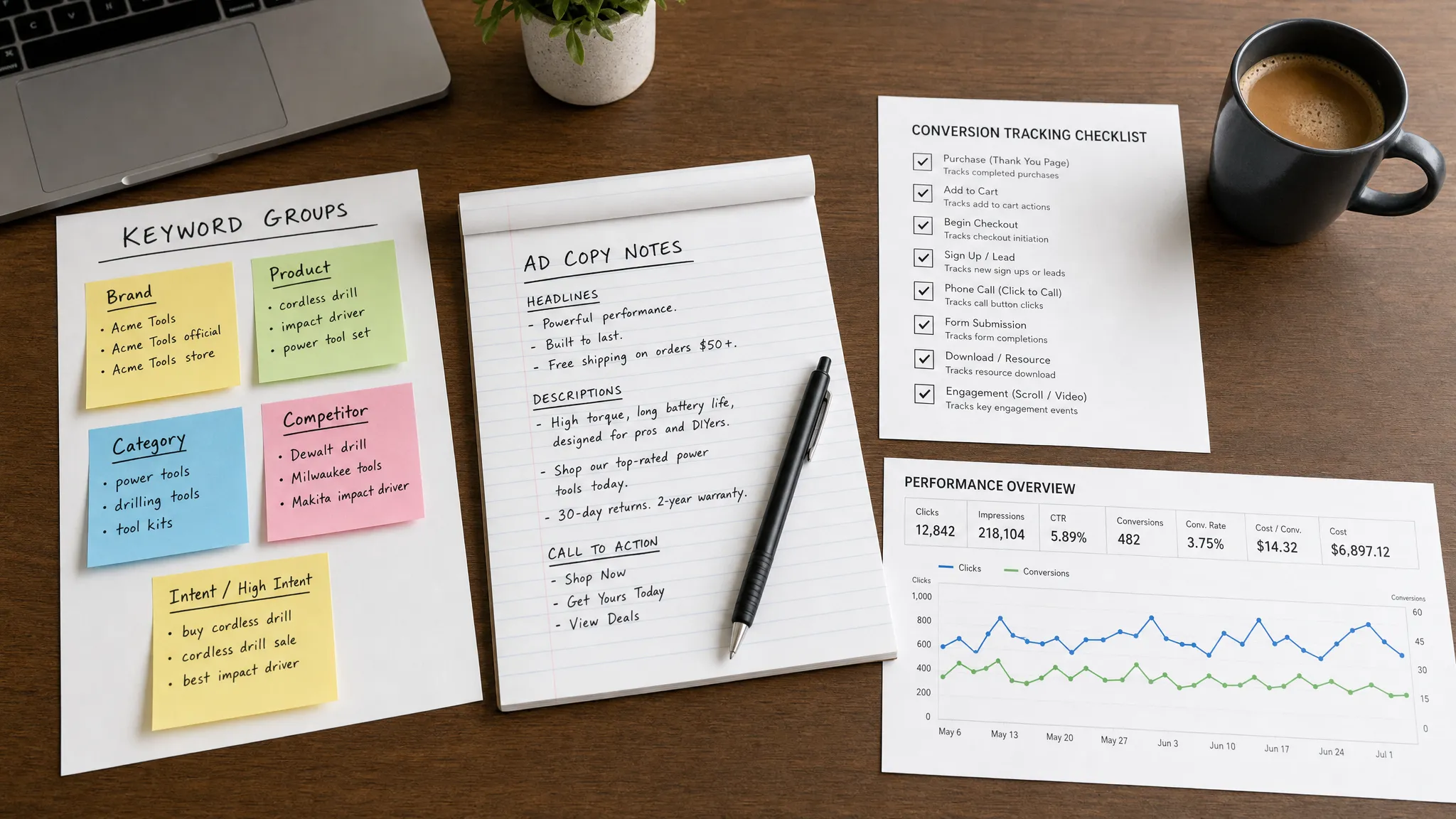
Old AdWords accounts often became bloated because managers built campaigns around every keyword variation. That level of granularity is rarely helpful now. Match types are broader, responsive search ads need data, and Smart Bidding performs better when it has enough conversion volume to learn from.
But structure still matters. A messy account teaches the algorithm the wrong priorities and makes client reporting harder. The best modern structure is not the most complicated one. It is the one that separates intent, budget control and performance accountability.
Useful campaign buckets often include:
- Brand demand, where the client is defending existing visibility and measuring high-intent traffic.
- Non-brand high-intent search, where the user is actively comparing services, prices, providers or solutions.
- Competitor search, where legal, brand and cost considerations need careful management.
- Research or upper-funnel search, where the budget should be controlled separately from direct-response terms.
- Remarketing or audience-led campaigns, where previous engagement changes the user’s level of intent.
This approach makes it easier to answer the questions clients actually ask: What are we spending on new demand? Are competitor campaigns profitable? Is brand activity inflating the overall return? Which search themes produce qualified enquiries?
If you cannot answer those questions quickly, the account structure is working against you.
Use match types according to risk, not habit
Exact and phrase match still have a role, especially in accounts with limited budget, strict lead-quality requirements or early-stage tracking. Broad match can also work well, but only when the account has enough clean conversion data and the right bidding strategy behind it.
Google’s own guidance on keyword matching options makes it clear that match types are now based more on meaning and intent than exact wording. That shift makes old-school keyword control less precise, but it does not make keyword strategy irrelevant.
The practical rule is simple: the less data and budget you have, the more control you need. The more reliable conversion data you have, the more room you have to test broader matching.
| Match approach | Best used when | Watch-out |
|---|---|---|
| Exact match | Budgets are tight or intent is very specific | It may still match close variants, so search terms need reviewing |
| Phrase match | You want controlled reach around a proven theme | It can expand further than clients expect |
| Broad match with Smart Bidding | The account has strong conversion volume and clean tracking | Poor tracking can scale poor-quality traffic quickly |
| Dynamic Search Ads | The website has strong page structure and clear service pages | Weak websites can trigger irrelevant queries |
The tactic that still works is not clinging to exact match forever. It is matching the level of automation to the level of trust you have in the account data.
Mine search terms as customer research
Search term reports used to be a negative keyword exercise. They still are, but the bigger opportunity is insight. The language people use in search often exposes what they care about more clearly than client briefs do.
A good search term review answers several questions:
- Which queries show purchase or enquiry intent?
- Which phrases indicate job seekers, students, suppliers or irrelevant users?
- Which locations, service modifiers or problem statements appear repeatedly?
- Which terms deserve their own ad group, landing page or budget?
- Which enquiries are cheap but commercially weak?
This is where agencies can move beyond platform management and become more strategic. A client may think they sell boiler repair, but search terms might reveal that emergency boiler repair near me produces better lead quality than cheap boiler repair. That difference affects keywords, ad copy, landing pages and even sales team expectations.
Search terms are also one of the best sources of copywriting insight. If the same objection or urgency signal appears repeatedly, it should probably appear in the ad or on the landing page.
Make conversion tracking stricter than client reporting
Most underperforming Google Ads accounts do not have a bidding problem first. They have a measurement problem. The algorithm is only as good as the conversions it is asked to pursue.
A common agency mistake is treating every lead action as equal. A form submission, phone click, live chat start, PDF download and newsletter sign-up may all matter to the client, but they should not all be used as primary optimisation goals.
Google’s conversion tracking guidance explains the mechanics, but the commercial decision sits with the agency and client. Which action represents genuine pipeline? Which one is only a micro-conversion? Which leads are sales-qualified? Which calls last long enough to count?
For lead generation, the strongest setups often include:
- Primary conversions for high-value actions such as qualified forms, booked consultations or meaningful phone calls.
- Secondary conversions for useful but softer signals such as brochure downloads or page engagement.
- Offline conversion imports where sales teams can feed back qualified leads, closed deals or revenue.
- Consistent UTMs so Google Ads, GA4, CRM data and client reports can be reconciled.
This is one of the AdWords-era tactics that has become even more important, not less. In the manual bidding era, bad tracking mainly damaged reporting. In the Smart Bidding era, bad tracking actively trains the account to chase the wrong users.
Write responsive search ads with real angles
Responsive search ads changed the craft of paid search copy, but they did not remove it. You still need to understand the searcher’s problem, the client’s offer and the reason someone should click this ad instead of the next one.
The weak approach is to fill every headline slot with keyword variations and hope the platform finds a winner. The stronger approach is to give the system distinct message angles to test.
| Ad component | Stronger test | Weaker test |
|---|---|---|
| Headline | Same-day emergency plumber in Manchester | Plumbing services Manchester |
| Proof point | Rated 4.8 by local homeowners | Trusted service provider |
| Offer | Free fixed-price quote today | Contact us today |
| Reassurance | Gas Safe registered engineers | Professional team |
| Call to action | Book a callout in 60 seconds | Learn more |
Ad Strength can be a useful prompt, but it is not the same as business performance. A high-scoring ad can still attract the wrong clicks. A lower-scoring ad with sharper qualification can sometimes produce better enquiries.
Pinning can still be useful when legal wording, brand positioning or offer clarity matters, but over-pinning can limit testing. Use it deliberately, not by default.
Use ad assets to earn more qualified attention
Ad assets, previously called extensions, remain one of the simplest ways to improve visibility and pre-qualify clicks. They give the searcher more reasons to choose the ad, and they can send people to more relevant parts of the site.
Sitelinks are especially useful for separating intent. A searcher comparing pricing may need a pricing or packages page. A searcher looking for proof may need case studies. A searcher ready to enquire may need the contact page.
Callouts, structured snippets, call assets, lead form assets, image assets and location assets can all support performance when they are relevant. The key is to avoid treating them as a one-time setup task. Assets should be reviewed like ads because they influence both click-through rate and click quality.
For agencies, assets are also a quick way to show visible progress in an account. If a client’s ads are eligible to appear with richer information, stronger service categories and clearer proof points, the account immediately looks more professional on the results page.
Let Smart Bidding work, but set boundaries
Smart Bidding is no longer optional for many serious Google Ads accounts. Strategies such as Maximise Conversions, Target CPA and Target ROAS can outperform manual management when the data is reliable and the goal is clear.
The mistake is assuming Smart Bidding means set and forget. It does not. It means the human role changes from adjusting individual bids to managing inputs, constraints and interpretation.
The guardrails that still matter include:
- Do not set a target CPA that is far below what the account has historically achieved.
- Avoid judging a bid strategy too early, especially after major structural or tracking changes.
- Segment campaigns when different services have very different margins or lead values.
- Watch lead quality, not just conversion volume.
- Avoid making frequent target changes that reset learning and muddy the test.
Google’s page on Smart Bidding explains how auction-time signals are used, but the commercial context still comes from the advertiser. A low CPA is not a win if the sales team cannot close the leads.
Keep Quality Score useful, not sacred
Quality Score still works as a diagnostic tool. It can point to issues with expected click-through rate, ad relevance or landing page experience. It can also help explain why one keyword is more expensive or less competitive than expected.
But chasing a perfect score can waste time. Google describes Quality Score as a diagnostic indicator, not the live auction score used at every moment. That distinction matters.
Use Quality Score to find obvious mismatches. If a high-value keyword has poor ad relevance, the ad group may be too broad. If landing page experience is weak, the page may load slowly, lack useful content or fail to match the query. If expected click-through rate is poor, the offer may not stand out.
Once those issues are fixed, move back to the metrics that matter most: qualified leads, revenue, cost per opportunity, margin and client retention.
Connect PPC with SEO and landing page learning
One of the most durable Google AdWords advertising tactics is using paid search data outside the ad account. PPC tells you which queries convert now. SEO can help build long-term visibility around the same themes. Landing page testing can improve both channels.
For local and service-led clients, this is especially powerful. Paid search can expose the terms that generate booked calls, while organic work can build durable visibility around those same services and locations. Agencies that partner with specialists for monthly rolling SEO support can use PPC query data to prioritise content, local landing pages and technical fixes that support the wider acquisition strategy.
The reverse is also true. SEO pages that already rank and convert well can become strong landing page candidates for paid search, provided the intent matches and the page has a clear enquiry path.
This is where agencies can protect client budgets. Instead of forcing every paid click to a generic homepage, use real search behaviour to shape pages that answer the user’s question faster.
Treat Performance Max as an expansion layer
Performance Max is not an AdWords-era tactic, but the principles that make it work are. Clean conversion tracking, strong creative assets, audience insight, structured product or service information, and clear commercial goals all matter.
The danger is using Performance Max as a dumping ground for budget that no one wants to manage. That usually leads to vague reporting and uncomfortable client conversations.
For lead generation, Performance Max often works best when it is treated as an expansion layer rather than a replacement for Search. Search still gives you clearer query intent and easier message control. Performance Max can help find additional demand, but it needs careful monitoring, strong assets and alignment with the client’s conversion goals.
If the account already has weak tracking, poor landing pages and no lead-quality feedback, Performance Max will not magically fix the problem. It may simply scale the confusion.
Build a boring optimisation cadence
The best PPC processes are often boring. They happen consistently, they are documented, and they are not driven by panic every time performance moves.
A simple cadence helps agencies manage accounts without overreacting:
| Frequency | What to review | Why it matters |
|---|---|---|
| First 7 to 14 days after launch | Tracking, search terms, disapprovals, budget pacing and early lead quality | Catches setup problems before they burn too much spend |
| Weekly | Search terms, negatives, asset performance, conversion anomalies and budget shifts | Keeps the account clean without constant tinkering |
| Fortnightly | Ad tests, landing page fit, bid strategy performance and audience insights | Gives changes enough time to produce usable data |
| Monthly | Commercial results, service-level performance, search themes and next tests | Connects PPC activity to client goals and agency margin |
If the immediate issue is inefficient spend, a focused audit process can help. PPC Ghost has a separate guide on cutting wasted Google Ads spend that goes deeper into budget leakage and quick account checks.
The important point is that optimisation should be planned. Constant fiddling makes it harder to tell whether performance changed because of the market, the algorithm, the landing page, the offer or the latest account edit.
Tactics that usually need retiring
Some older AdWords habits still appear in agency accounts, but they often create more work than value now.
Single keyword ad groups are not automatically wrong, but using them as the default structure is rarely necessary. They can fragment data and make responsive search ads harder to test properly.
Manual bid adjustments can still have a place in certain contexts, but trying to manually control every keyword bid in a data-rich account can fight against auction-time bidding signals.
Over-segmented campaigns by device, match type or micro-location can make reporting look precise while starving campaigns of data. Segmentation should exist for a reason, such as budget control, different economics or a genuinely different message.
Blindly applying every Google recommendation is another habit to avoid. Recommendations can be useful, but they are not a substitute for strategy. Agencies should evaluate whether a suggestion supports the client’s commercial goal before applying it.
The modern PPC skill is knowing what to simplify, what to control and what to let the system optimise.
Frequently Asked Questions
Is Google AdWords advertising the same as Google Ads? Google AdWords was rebranded as Google Ads, but many clients and business owners still use the older phrase. In practice, they usually mean paid advertising on Google Search and related Google properties.
Do exact match keywords still work? Yes, exact match keywords still work, but they are broader than they were in the early AdWords years. They are most useful when budget is limited, intent is very specific, or the agency needs tighter control before expanding.
Should agencies still use broad match? Broad match can work well when conversion tracking is accurate, Smart Bidding has enough data, and the account has strong negative keyword discipline. It is risky when the account is new, poorly tracked or unclear on lead quality.
Are single keyword ad groups still useful? They can be useful in rare cases where a keyword is extremely valuable and needs dedicated messaging or reporting. As a default structure, they are usually less effective than tight intent-based ad groups.
How often should Google Ads accounts be optimised? Most accounts benefit from weekly hygiene checks and deeper monthly reviews. New launches may need closer attention during the first 7 to 14 days, especially for tracking, search terms and budget pacing.
What is the most important tactic that still works? Clean conversion tracking is the foundation. Without accurate primary conversions and lead-quality feedback, bidding, reporting and optimisation decisions are all built on weak data.
Need senior Google Ads support without hiring?
If your agency needs extra PPC capacity, PPC Ghost provides white-label Google Ads, Meta Ads and Microsoft Ads support for UK agencies. You get senior-only execution, GA4 and tracking support, flexible pay-as-you-go delivery, and no long-term recruitment commitment.
Whether you need a second pair of eyes on a tricky Google Ads account or same-day support for a client launch, PPC Ghost helps you deliver the work while your agency keeps the credit.