How to Pick a PPC Agency UK Clients Will Trust
Learn how to choose a PPC agency UK clients can trust, from proof and tracking to reporting, communication and white-label delivery.
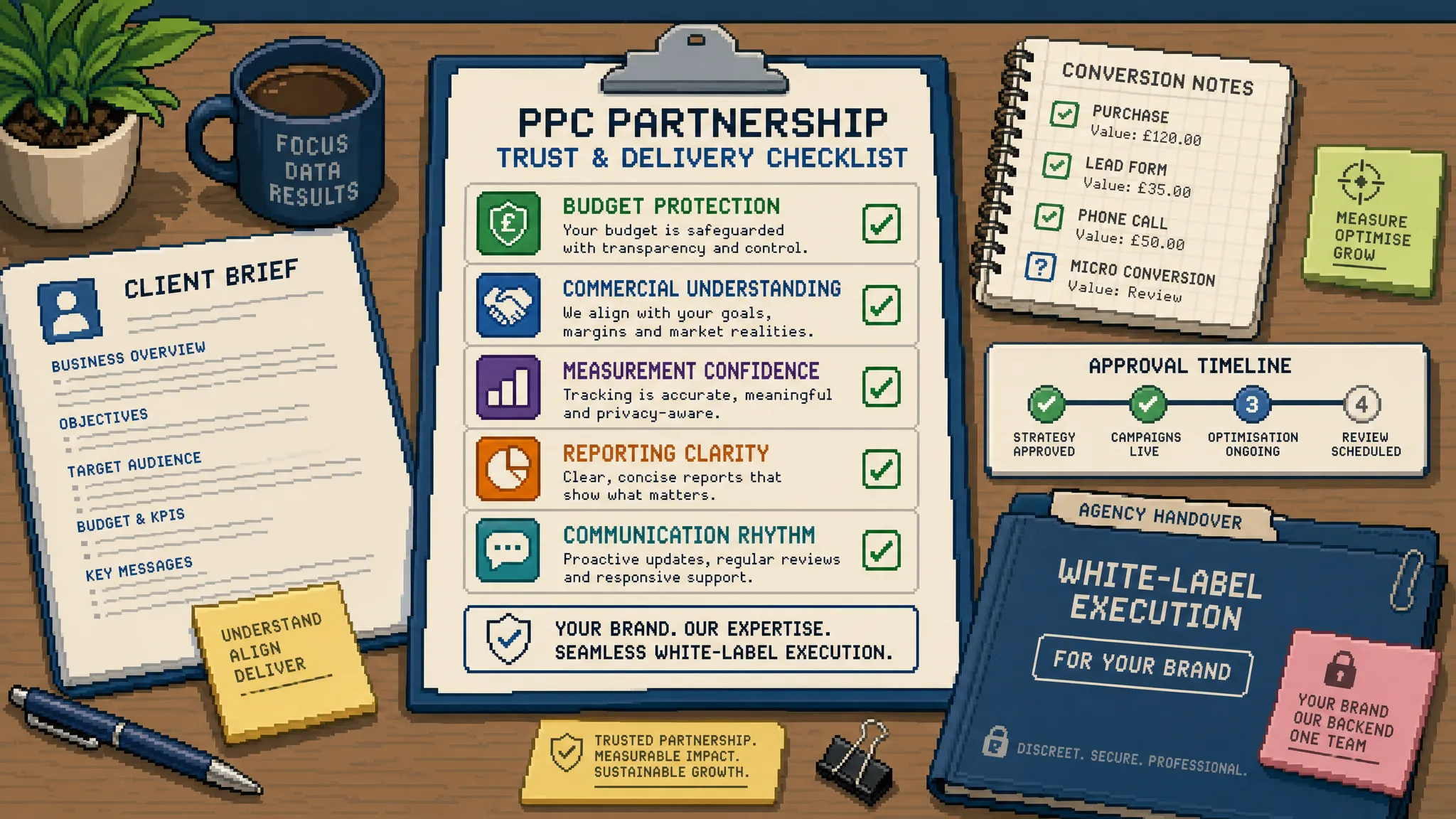
Most PPC decisions are sold on performance, but they are retained on trust. A client might sign because they want more leads, more sales or a lower cost per acquisition, but they stay when they believe their budget is being handled carefully and the agency is telling them the truth.
That matters even more if you are a digital agency choosing a PPC delivery partner behind the scenes. Your client will not judge the subcontractor. They will judge you. If campaign launches are late, tracking is messy, reports are vague or spend is wasted, your agency relationship takes the hit.
Searching for PPC agency UK support can quickly become confusing because many providers appear to offer the same thing: Google Ads, Meta Ads, reporting and optimisation. The difference is rarely the platform list. The difference is how they think, communicate, manage risk and protect client confidence.
Here is how to pick a PPC agency UK clients will trust, whether you are hiring them directly or using them as a white-label specialist for your own agency.
Trust starts before the first campaign goes live
Clients do not trust a PPC agency because it uses impressive acronyms. They trust it because the agency makes risk feel controlled.
Before a campaign goes live, a trustworthy PPC partner should be able to explain what they are trying to achieve, what could go wrong, how performance will be measured and what decisions will be made first. That early clarity is often more valuable than a polished pitch deck.
From a client’s perspective, trust usually comes down to four questions:
- Will they protect my budget?
- Do they understand my business model?
- Can they explain performance in plain English?
- Will they tell me bad news early enough to act on it?
If the answer to any of those is unclear, the relationship is already fragile. A good PPC agency should reduce uncertainty, not hide behind dashboards.
Clarify the role you actually need
Not every PPC problem needs the same type of provider. Some businesses need a full-service agency to handle strategy, creative, landing pages and media buying. Some agencies need senior PPC execution behind their own brand. Others need a short-term specialist to fix tracking, restructure an account or cover capacity.
Choosing the wrong model can damage trust even if the PPC work itself is competent.
| Option | Best fit | Main trust risk to manage |
|---|---|---|
| In-house PPC hire | You have steady PPC demand and enough management capacity | Recruitment time, training and fixed cost |
| Traditional PPC agency | The client wants direct strategic ownership and full media management | Fit, responsiveness and commercial understanding |
| PPC freelancer | You need flexible specialist help on a defined scope | Availability, process and continuity |
| White-label PPC specialist | Your agency wants expert delivery under your own brand | Confidentiality, communication and handover quality |
For UK agencies, the white-label model can be especially useful when clients expect PPC capability but you do not want to recruit, train and manage a full-time paid media hire. The key is to choose someone who understands that they are not just managing campaigns. They are protecting your client relationship.
Look for commercial thinking, not just platform knowledge
A PPC agency can know Google Ads inside out and still make poor decisions if it does not understand the economics of the client’s business.
Before talking about keywords, audiences or bidding strategies, a strong PPC partner should ask about margin, average order value, lead quality, sales cycle, capacity, location coverage and what counts as a valuable enquiry. For lead generation clients, they should want to know which enquiries turn into revenue. For ecommerce clients, they should care about profit, repeat purchase behaviour and product availability, not only return on ad spend.
This is where many client relationships go wrong. The PPC account can look busy, impressions can rise and conversions can increase, but the client still feels disappointed because the work is not tied to commercial reality.
A trustworthy agency will challenge vague goals. If a client says they want more leads, the agency should ask what type of leads. If they want cheaper conversions, the agency should ask whether cheaper leads are actually closing. If they want scale, the agency should explain what trade-offs may appear as budgets increase.
That kind of commercial conversation builds confidence because it shows the PPC partner is thinking like a business owner, not just an ad buyer.
Make measurement a non-negotiable
No client will trust PPC for long if they cannot trust the numbers.
A proper measurement setup should cover the basics: GA4, Google Ads conversions, Meta Pixel or Conversions API where appropriate, Microsoft UET if Microsoft Ads is in use, UTMs, form tracking, call tracking and clear conversion definitions. For UK clients, the setup should also consider consent requirements, cookie banners and the practical impact of privacy settings on attribution.
The goal is not to pretend attribution is perfect. It is to make sure everyone knows what is being counted, what is not being counted and how decisions will be made despite imperfect data.
| Measurement area | Why it matters for trust |
|---|---|
| Primary conversions | Prevents campaigns optimising towards weak or misleading actions |
| GA4 events and goals | Gives the client a wider view of user behaviour beyond ad platforms |
| CRM or lead quality feedback | Connects media spend to real sales outcomes |
| UTM consistency | Keeps reporting clean across channels and tools |
| Consent and cookie behaviour | Sets realistic expectations about attribution gaps |
| QA before launch | Reduces the risk of paying for traffic before tracking works |
Ask how the agency tests forms, thank-you pages, email notifications, phone calls and booking flows. For example, if your team needs to test signup journeys or lead capture workflows without cluttering client inboxes, programmable temp inboxes for automated QA workflows can make verification cleaner and easier to document.
A trustworthy PPC partner should be comfortable saying: this is tracked, this is partially tracked and this still needs fixing. That honesty is far better than presenting unreliable data with false confidence.
Demand reporting your clients can actually use
Client trust is often won or lost in reporting.
A weak report dumps numbers into a template and leaves the client to interpret them. A strong report explains what happened, why it happened, what changed, what the agency recommends next and what support is needed from the client.
For most UK clients, a useful PPC report should answer these questions:
- Did spend stay under control?
- Which campaigns created meaningful enquiries or revenue?
- What changed since the last reporting period?
- What has been tested and what was learned?
- What should happen next?
The best PPC agencies do not overcomplicate reporting to look clever. They make performance understandable enough for a managing director, marketing manager or account director to make decisions.
If you are using a white-label partner, reporting matters even more. The work must be easy for your team to understand, reframe and present under your own agency brand. If the PPC specialist sends technical notes that only another PPC specialist can decode, you will struggle to maintain authority with the client.
Check communication rhythm and ownership
Fast replies are helpful, but reliable communication is more important than constant communication.
Before choosing a PPC agency, ask who owns the account, how often updates are shared, how urgent issues are handled and what happens if the main contact is unavailable. Clients need to know that someone is watching the account and that important changes will not disappear into a ticket queue.
A good PPC communication rhythm usually includes regular performance updates, clear notes after major changes, early warnings when results move in the wrong direction and a simple escalation path for urgent issues.
This does not mean every client needs daily commentary. In fact, too much noise can reduce confidence. The right rhythm depends on spend level, campaign maturity and commercial risk. A new launch or struggling account needs closer attention. A stable account may need fewer updates, but the updates should still be thoughtful.
For agency owners, the key question is simple: will this PPC partner make your account management team feel more in control or less in control?
Assess seniority and quality control
Many PPC mistakes are not dramatic. They are small oversights that quietly waste money: the wrong location setting, a weak conversion action, duplicated audiences, poor exclusions, unhelpful match types, missing UTMs or budget pacing that does not match the client’s priorities.
That is why senior oversight matters.
A trustworthy PPC agency should be clear about who is doing the work and who is checking it. Junior support is not automatically a problem, but unsupervised junior delivery on sensitive client accounts is a risk. If the pitch is led by a senior expert but the account is handed to someone with little experience, client confidence can decline quickly.
Ask about quality control. Do they use launch checklists? Do they document major changes? Do they review search terms, placements, conversion data and budget pacing on a set cadence? Do they have a process for spotting tracking issues before they distort optimisation decisions?
Senior PPC expertise is not just about knowing more tactics. It is about knowing which actions matter now, which can wait and which could cause unnecessary disruption.
Evaluate channel fit across Google, Meta and Microsoft Ads
A PPC agency UK clients can trust should not push every platform by default.
Google Ads is often the starting point for high-intent search demand, but it is not always the whole answer. Meta Ads can be powerful for demand generation, retargeting and creative-led offers. Microsoft Ads can be valuable for certain B2B, professional services and older demographic segments. Shopping and Performance Max may be important for ecommerce, but they require strong feed quality and conversion data.
The right agency will explain the role of each channel in the customer journey. They should also explain what they would not recommend yet.
That restraint matters. Clients trust agencies that can say no. If the client has limited budget, poor landing pages or unclear conversion tracking, launching three platforms at once may create more noise than progress. A focused PPC plan is often more credible than an overextended one.
Look for UK-specific judgement
UK PPC work has its own practical details. Search behaviour, location targeting, language, seasonality, competition and compliance expectations can differ from other markets.
A strong UK-focused PPC partner should understand how regional targeting affects lead quality, why London CPCs may behave differently from smaller local markets, how bank holidays and school holidays can affect demand, and how UK spelling, pricing and terminology influence ad copy.
They should also be alert to regulated sectors. Finance, healthcare, legal, recruitment, housing and other sensitive industries may require extra care around claims, policies and data handling. The PPC agency does not need to act as the client’s legal adviser, but it should know when ad copy, landing pages or tracking choices need extra scrutiny.
This local judgement reassures clients because it shows the agency is not applying a generic playbook to every account.
Ask better questions before you commit
A sales call can be polished and still tell you very little. The best way to assess a PPC agency is to ask questions that reveal how they think under real conditions.
| Question to ask | What a strong answer sounds like |
|---|---|
| How would you approach the first 30 days? | They mention tracking, account review, priorities, quick wins and risk control before aggressive scaling |
| How do you decide campaign structure? | They connect structure to intent, budget, conversion data and reporting needs |
| What do you do when lead quality is poor? | They look beyond CPL and investigate search terms, audiences, forms, CRM feedback and sales alignment |
| How do you handle tracking problems? | They document the issue, explain impact, fix what they can and avoid over-optimising on bad data |
| What will reporting include? | They focus on decisions, performance context, actions taken and next steps |
| What is outside your scope? | They give clear boundaries rather than promising everything |
The strongest answers are usually specific without being overconfident. Be wary of any agency that promises results without seeing the account, the offer, the website or the tracking setup.
Red flags that weaken client confidence
Some warning signs appear before any contract is signed. Others show up during onboarding. Either way, they should not be ignored.
Watch out for these red flags:
- Guaranteed performance claims without context
- No interest in margin, lead quality or sales outcomes
- Vague reporting focused only on clicks and impressions
- Reluctance to discuss tracking limitations
- No clear launch or QA process
- Overuse of jargon when simple language would do
- Poor responsiveness during the sales process
- A one-size-fits-all strategy across every client
One red flag does not always mean the agency is wrong for you, but patterns matter. If a PPC partner is unclear before they win the work, they are unlikely to become clearer once the account is live.
If you are an agency, judge the handover experience
When you use a PPC partner behind your own brand, the technical work is only half the relationship. The handover experience is just as important.
Your team needs clear updates, sensible deadlines, client-ready notes and enough context to answer questions confidently. If every PPC change requires translation, your account managers will feel exposed. If the partner misses details, requests access late or communicates in a way that does not match your agency’s tone, your client may sense the disconnect.
A good white-label PPC partner should feel like an extension of your agency. They should protect confidentiality, keep you visible as the client owner and give you the confidence to speak about the account without pretending to be a platform specialist.
PPC Ghost is built for agencies that need senior, white-label PPC delivery on demand across Google Ads, Meta Ads and Microsoft Ads, with GA4 and tracking support available when needed. The model is designed for flexible scaling without recruitment hassle, long-term contracts or handing client credit to an outside provider.
That kind of support is especially useful when your agency has won the trust of a client but needs specialist PPC capacity to keep delivery strong.
Use a simple vetting process
You do not need a complicated procurement process to choose well. You do need enough structure to compare providers fairly.
- Define the client risk first: Note the budget, commercial importance, tracking quality, urgency and internal capacity before you approach anyone.
- Shortlist by fit, not visibility: A well-ranked or well-known agency is not automatically the right match for your client, sector or delivery model.
- Share a realistic brief: Give enough context for the provider to show how they think, including goals, current problems and constraints.
- Ask for an account view or sample thinking: You are looking for judgement, prioritisation and clarity, not free labour.
- Review their measurement approach: If they are casual about tracking, be cautious about trusting their optimisation.
- Test communication early: Slow, vague or confusing replies during evaluation are a useful warning sign.
- Start with a contained scope if needed: A pilot, audit or initial campaign build can reveal fit before a larger commitment.
This process helps you choose based on behaviour, not promises.
Frequently Asked Questions
What makes a PPC agency trustworthy to UK clients? A trustworthy PPC agency links campaign activity to commercial goals, explains performance clearly, protects tracking quality, communicates early and avoids overpromising. UK clients also value local market understanding, realistic expectations and transparent reporting.
Should a small agency hire a PPC agency or use a white-label PPC specialist? If you want to keep the client relationship under your own brand, a white-label PPC specialist is often the better fit. It gives you access to expert delivery without hiring in-house or introducing another agency directly to the client.
How quickly should a PPC agency deliver results? Some improvements, such as fixing wasted spend or tracking errors, can happen quickly. Stronger commercial results usually need enough time for data, testing and learning. A good agency should explain what can improve immediately and what needs a longer optimisation cycle.
What should I ask before choosing a PPC partner? Ask how they approach the first 30 days, how they check tracking, how they report, who actually works on the account, how they handle poor lead quality and what is outside scope. Their answers should be practical and specific.
Is the cheapest PPC agency a bad choice? Not always, but cheap PPC support can become expensive if it wastes media spend, damages tracking or weakens client trust. Focus on value, seniority, process and commercial judgement rather than management cost alone.
Can PPC Ghost work behind an agency brand? PPC Ghost is designed for white-label PPC delivery, helping agencies access senior paid media support while the agency remains client-facing.
Need PPC delivery your clients can trust?
If your agency needs senior PPC support without recruitment, fixed contracts or handing the client relationship to another provider, PPC Ghost can help.
Get white-label Google Ads, Meta Ads, Microsoft Ads and tracking support on demand, delivered by a senior specialist while your agency stays front and centre. Start by visiting PPC Ghost and share what you need help with.