White Label PPC Pricing Models Agencies Should Know
White label PPC pricing models explained for agencies, including retainers, hourly rates, ad spend fees and pay-as-you-go support.
Pricing is one of the hardest parts of outsourcing PPC delivery because it affects everything: your margin, your client promise, your workload, and how confidently you can sell paid media retainers.
The challenge is that white label PPC pricing is not one single model. Some providers charge by the hour, some by account, some by spend, and some use flexible pay-as-you-go arrangements. None of these are automatically right or wrong. The best model depends on how your agency sells, how complex your client accounts are, and how much control you want over the final client relationship.
For agencies, the goal is simple: buy senior PPC delivery in a way that protects profit, avoids recruitment pressure, and keeps the client experience smooth. This guide breaks down the main white label PPC pricing models agencies should know, when each one works, and what to watch before you agree to anything.
What white label PPC pricing actually covers
White label PPC pricing is the amount your agency pays a third-party PPC specialist or delivery partner to manage paid media work under your brand. The client usually does not see this supplier relationship. Your agency owns the client relationship, sets the retail fee, and takes credit for the work.
It is important to separate three different costs:
| Cost type | What it covers | Who usually pays it |
|---|---|---|
| Media spend | The actual ad budget spent on Google, Meta, Microsoft Ads or another platform | Client, usually directly or via agency billing |
| White label delivery fee | Strategy, setup, optimisation, reporting, tracking support and account management delivery | Agency |
| Agency margin | The difference between what the client pays you and what you pay your delivery partner | Agency retains |
A common mistake is to treat ad spend and PPC management as the same thing. They are separate. A client spending £5,000 per month on Google Ads is not paying £5,000 for management. That money goes into the ad platform. Your management fee, and your white label partner’s fee, sit around that spend.
If you want a deeper breakdown of how PPC costs are structured, including management fees and setup costs, PPC Ghost has a useful guide to Google PPC pricing for agencies in 2026.
The main white label PPC pricing models
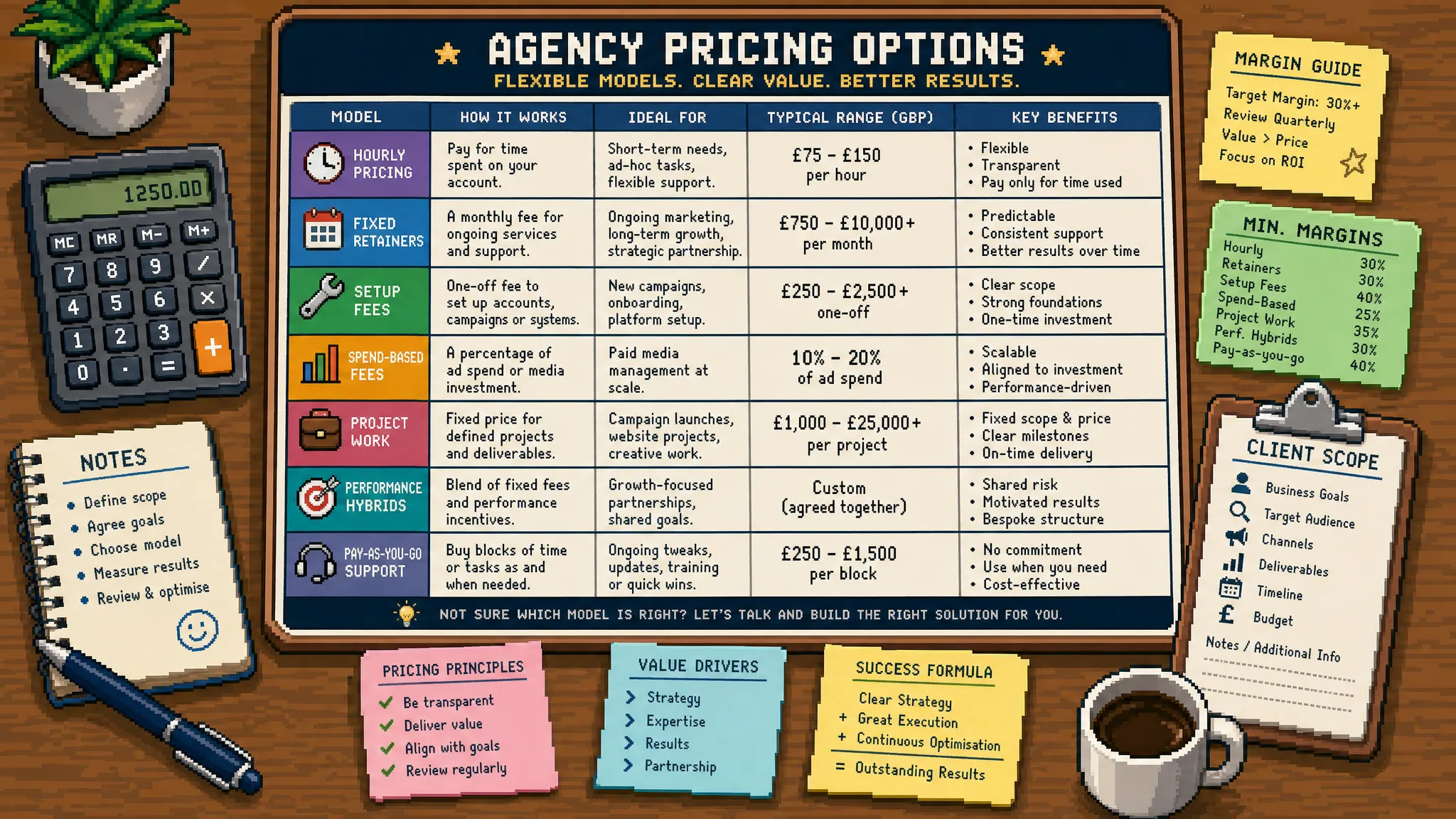
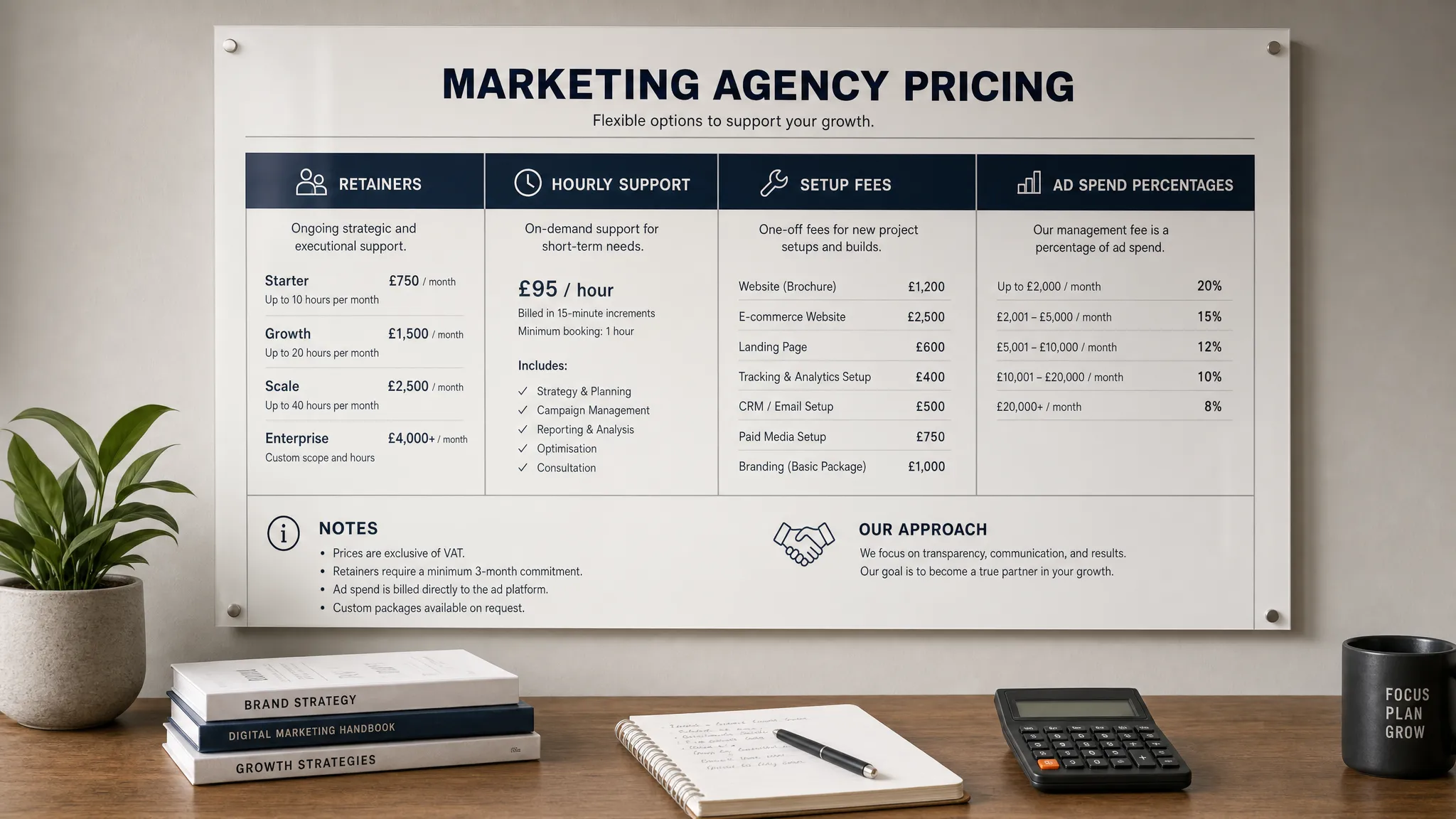
Most white label PPC providers use one of the following pricing structures, or a blend of several. Understanding the incentives behind each model helps you avoid margin surprises later.
1. Hourly pricing
Hourly pricing is straightforward: you pay for the time used. This can work well for audits, troubleshooting, tracking fixes, overflow support, and small ad hoc tasks.
The benefit is flexibility. If a client needs a one-off account review or urgent conversion tracking support, you are not locked into a monthly commitment. It can also be useful when the scope is unclear and you want to test a provider before giving them recurring work.
The downside is unpredictability. If the account is messy, hours can climb quickly. You may also find it harder to package hourly costs into a fixed client retainer unless you have strong internal scoping.
Hourly pricing is usually best when the work is irregular, diagnostic, or short term. It is less ideal for ongoing PPC management where clients expect consistent delivery and your agency needs predictable margins.
2. Fixed monthly retainer
A fixed monthly retainer is one of the most common white label PPC pricing models. Your agency pays a set monthly fee for ongoing management of an account, platform, or agreed scope.
This model is attractive because it is easy to resell. If your agency charges the client £1,500 per month for PPC management and your white label partner charges £900, you can forecast your gross margin clearly.
Retainers typically work best when the account scope is stable. For example, one Google Ads account, an agreed number of campaigns, monthly optimisation, standard reporting, and occasional client-facing notes provided to the agency.
The risk is scope creep. If the client starts requesting landing page reviews, extra reporting, multiple stakeholder calls, Meta Ads support, feed troubleshooting, and tracking rebuilds, a simple retainer can become unprofitable for either your agency or your delivery partner.
A good retainer agreement should define what is included, what is not included, and how additional work is priced.
3. Percentage of ad spend
Percentage of ad spend pricing means the management fee is calculated as a proportion of the client’s media budget. For example, the PPC delivery fee might increase as spend increases.
This model can make sense because larger budgets often require more responsibility, tighter monitoring, and more sophisticated optimisation. An account spending £50,000 per month usually carries more commercial risk than one spending £2,000 per month.
However, spend-based pricing has limits. High spend does not always mean high complexity. A simple branded search account with a large budget may be easier to manage than a smaller ecommerce account with dozens of product categories, poor tracking, and aggressive ROAS targets.
For agencies, the main issue is alignment. Percentage-based pricing can work well when client fees are also spend-based. It can become awkward if your agency sells fixed retainers but your supplier cost rises whenever the client scales spend.
4. Setup fee plus monthly management
Many PPC accounts need a serious setup phase before ongoing optimisation can start. This may include account restructuring, conversion tracking checks, GA4 review, keyword research, campaign buildout, audience setup, creative testing plans, or Microsoft Ads import planning.
A setup fee plus monthly management model separates the initial workload from the recurring optimisation fee. This is often fairer for everyone.
It helps agencies avoid undercharging for the first month, which is commonly the most labour-intensive stage. It also gives the white label PPC partner enough time to build the account properly rather than rushing straight into “ongoing management” before the foundations are ready.
This model is especially useful for new client launches, messy inherited accounts, tracking rebuilds, or multi-platform setups across Google, Meta and Microsoft Ads.
5. Per-platform or per-account pricing
Some providers charge based on the number of ad platforms or accounts involved. For example, Google Ads may be one fee, Meta Ads another, and Microsoft Ads another.
This structure is easy to understand and useful for agencies that sell platform-specific packages. It also recognises that each platform has its own setup, optimisation rhythm, reporting needs, and technical quirks.
The downside is that pricing can grow quickly when clients have multiple brands, regions, accounts or platforms. If your agency works with franchise businesses, multi-location companies, or ecommerce groups with separate accounts, you need to clarify whether pricing is per client, per ad account, per platform, or per market.
6. Project-based pricing
Project-based pricing applies to defined work with a clear start and finish. Examples include a PPC audit, a GA4 tracking review, a campaign restructure, a feed review, or a short-term performance rescue project.
This model is useful when your agency needs specialist help without committing to ongoing management. It is also a good way to create a paid discovery step before a client signs a larger PPC retainer.
For project pricing to work, the scope needs to be specific. A vague “fix the account” brief can quickly become difficult to price. A better scope might be “audit the Google Ads account, review conversion tracking, identify wasted spend, and provide a prioritised 30-day action plan.”
Agencies under delivery pressure often use project-based support to stabilise an account before deciding whether to retain the work in-house, outsource it fully, or move to a hybrid model.
7. Performance-based pricing
Performance-based pricing links payment to outcomes such as leads, revenue, ROAS, CPA improvement or pipeline value. It sounds appealing because the supplier appears to share risk.
In practice, pure performance pricing is difficult in PPC. The delivery partner rarely controls the full funnel. Landing page quality, sales follow-up, pricing, product-market fit, CRM hygiene, seasonality and client approvals all affect results.
For that reason, performance pricing is usually safest as a hybrid. For example, there may be a base management fee plus a bonus for agreed outcomes. Even then, attribution rules must be clear.
Agencies should be cautious with any provider promising guaranteed results based only on PPC activity. Paid media can drive qualified traffic and improve conversion efficiency, but it cannot fully control whether a business closes deals. If your agency also needs help creating more sales opportunities outside paid media, a specialist B2B customer acquisition partner can complement PPC by supporting pipeline generation through outbound systems.
8. Pay-as-you-go pricing
Pay-as-you-go pricing is designed for flexibility. Instead of hiring a full-time PPC manager or committing to a rigid contract, your agency buys senior PPC support only when needed.
This model suits agencies that have fluctuating workloads. One month you may need Google Ads cover for a new client onboarding. The next month you may need Meta Ads support, tracking troubleshooting, or account optimisation while your internal team is stretched.
The main advantage is control. You can scale delivery up or down without recruitment, long notice periods, or paying for unused capacity. For small and mid-sized agencies, this can be the difference between saying yes to profitable work and turning clients away.
The key is to make sure pay-as-you-go does not become chaotic. You still need clear briefing, agreed turnaround times, defined deliverables, and a consistent process for feedback and approvals.
Quick comparison of white label PPC pricing models
No single model fits every agency. The table below summarises where each option tends to work best.
| Pricing model | Best for | Main advantage | Main risk |
|---|---|---|---|
| Hourly | Audits, fixes, overflow tasks | Flexible and low commitment | Harder to forecast total cost |
| Fixed monthly retainer | Ongoing account management | Predictable margin | Scope creep if not defined |
| Percentage of ad spend | Larger budgets or spend-based client retainers | Scales with account size | Spend does not always equal complexity |
| Setup plus monthly | New builds and inherited accounts | Separates launch effort from management | Needs clear setup deliverables |
| Per-platform or per-account | Multi-channel packages | Easy to package and explain | Can become costly across many accounts |
| Project-based | Audits, restructures, tracking reviews | Clear start and finish | Poor fit for open-ended work |
| Performance-based hybrid | Mature accounts with clean tracking | Aligns incentives | Attribution and external factors can cause disputes |
| Pay-as-you-go | Variable agency workload | Flexible scaling | Requires disciplined briefing and process |
How agencies should choose the right model
The best pricing model depends on your agency’s commercial model, not just the provider’s rate card.
If you sell fixed monthly retainers to clients, fixed white label retainers or clearly scoped pay-as-you-go support will usually be easiest to manage. If you sell percentage-of-spend retainers, a spend-linked supplier fee may align better. If you often inherit messy accounts, setup fees and project pricing can protect your first-month margin.
Think about four questions before choosing a model:
- How predictable is the client workload each month?
- How much PPC strategy does the agency need from the partner?
- Does the client account require tracking, reporting or landing page input?
- Can your client fee absorb the supplier cost while leaving a healthy margin?
Agencies that are actively growing should also think about capacity planning. White label support is not only about saving money. It is also about avoiding the delay and risk of hiring too early. If that is your main challenge, this article on why white label PPC management helps agencies scale explores the operational side in more detail.
Protecting your agency margin
A white label PPC partner should make delivery easier, not quietly erode your profit. Before agreeing to any pricing model, map the numbers clearly.
A simple margin calculation looks like this:
| Item | Example |
|---|---|
| Client monthly PPC management fee | £1,500 |
| White label PPC delivery cost | £900 |
| Internal project management time | £150 equivalent cost |
| Gross contribution before overhead | £450 |
This example is not a recommended price, but it shows the logic. Your agency margin is not just the difference between client fee and supplier fee. You also need to account for internal time spent on client communication, approvals, reporting calls, sales, finance and account management.
Many agencies underprice PPC because they forget these internal costs. Even if a white label specialist does the technical work, your team may still manage client expectations and commercial decisions.
A healthy pricing setup should give you enough room to:
- Pay for senior PPC execution
- Cover internal account management time
- Handle occasional client requests without panic
- Reinvest in sales and operations
- Make the service worth selling in the first place
If the margin only works when everything goes perfectly, the pricing model is too fragile.
What affects white label PPC pricing?
White label PPC pricing varies because PPC accounts vary. Two clients with the same ad spend can require completely different levels of work.
A lead generation account with one campaign, clear conversion tracking, and a simple landing page may be relatively efficient to manage. An ecommerce account with Shopping campaigns, Performance Max, product feed issues, seasonal promotions, Meta retargeting, and disputed revenue tracking is far more demanding.
Common pricing factors include account complexity, monthly ad spend, number of platforms, campaign volume, conversion tracking quality, reporting requirements, meeting expectations, turnaround speed, and the seniority of the person doing the work.
Seniority matters. A cheaper supplier may look attractive until your agency has to rewrite strategy, catch errors, or explain poor decisions to the client. In white label work, the risk is not only performance. It is reputational. The client sees the work as yours.
That is why selection criteria matter as much as price. If you are comparing providers, this guide on what to look for in a white label Google Ads agency is a useful companion to pricing research.
Pricing red flags agencies should avoid
Low prices are not always bad, and premium prices are not always justified. The real issue is whether the model is transparent, commercially viable, and matched to the work.
Be cautious if a white label PPC provider is vague about who will work on the account, refuses to define scope, bundles media spend and management in a confusing way, or promises guaranteed outcomes without asking about tracking, funnel quality or sales process.
Another warning sign is a model that leaves no room for strategy. PPC management is not only changing bids and writing ads. It often involves diagnosing conversion issues, prioritising budgets, improving campaign structure, interpreting data, and knowing when not to make unnecessary changes.
You should also clarify confidentiality. In a true white label arrangement, the provider should be comfortable working behind the scenes, avoiding direct client contact unless agreed, and supporting your agency’s brand rather than trying to own the relationship.
How PPC Ghost approaches agency-friendly PPC support
For agencies that need flexible delivery without hiring, PPC Ghost provides white-label PPC expertise on demand. The focus is senior-only execution across Google, Meta and Microsoft Ads, with support for tracking and GA4 where needed.
The model is designed for agencies that want to scale without recruitment hassle, long-term contracts, or handing client credit to an external supplier. Because support is white label and anonymous, your agency remains the visible expert while specialist PPC work happens behind the scenes.
This kind of arrangement is especially useful when you have a new PPC opportunity, a stretched internal team, an inherited account that needs attention, or a client that requires faster turnaround than your current capacity allows.
Frequently Asked Questions
What is the most common white label PPC pricing model? Fixed monthly retainers are common for ongoing management because they are predictable and easy for agencies to resell. However, many agencies also use setup fees, project pricing, or pay-as-you-go support depending on workload.
Should white label PPC pricing be based on ad spend? It can be, especially for larger accounts, but ad spend should not be the only factor. Complexity, tracking quality, number of platforms, reporting needs and commercial risk can all affect the real workload.
How much margin should an agency keep on white label PPC? There is no universal figure, but your margin should cover internal account management, client communication, sales costs, overhead and profit. If the margin disappears as soon as the client asks for extra support, the model needs rethinking.
Is pay-as-you-go PPC support better than a retainer? Pay-as-you-go support is often better for fluctuating workloads, urgent fixes, audits or overflow delivery. Retainers are usually better when the account needs consistent monthly optimisation and reporting.
What should be included in a white label PPC quote? A good quote should define the platforms covered, account scope, setup work, reporting expectations, tracking support, turnaround times, communication process and what counts as additional work.
Final thoughts
White label PPC pricing should help your agency sell paid media with confidence. The right model gives you access to senior expertise, protects delivery quality, and leaves enough margin for the relationship to be commercially worthwhile.
The wrong model creates hidden costs, unclear expectations, and stressful client conversations.
Before choosing a partner, decide how you want to package PPC for your clients, how much flexibility you need, and how much internal time your team will still spend managing the account. Once those numbers are clear, it becomes much easier to choose between retainers, project pricing, spend-based fees, and pay-as-you-go support.
If your agency needs discreet, senior PPC execution without recruitment or long-term contracts, PPC Ghost can support Google Ads, Meta Ads, Microsoft Ads and tracking work on a flexible white-label basis.