What a Google Ads Expert Fixes in Underperforming Accounts
See what a Google Ads expert fixes in underperforming accounts, from tracking and wasted spend to bidding, structure and reporting.
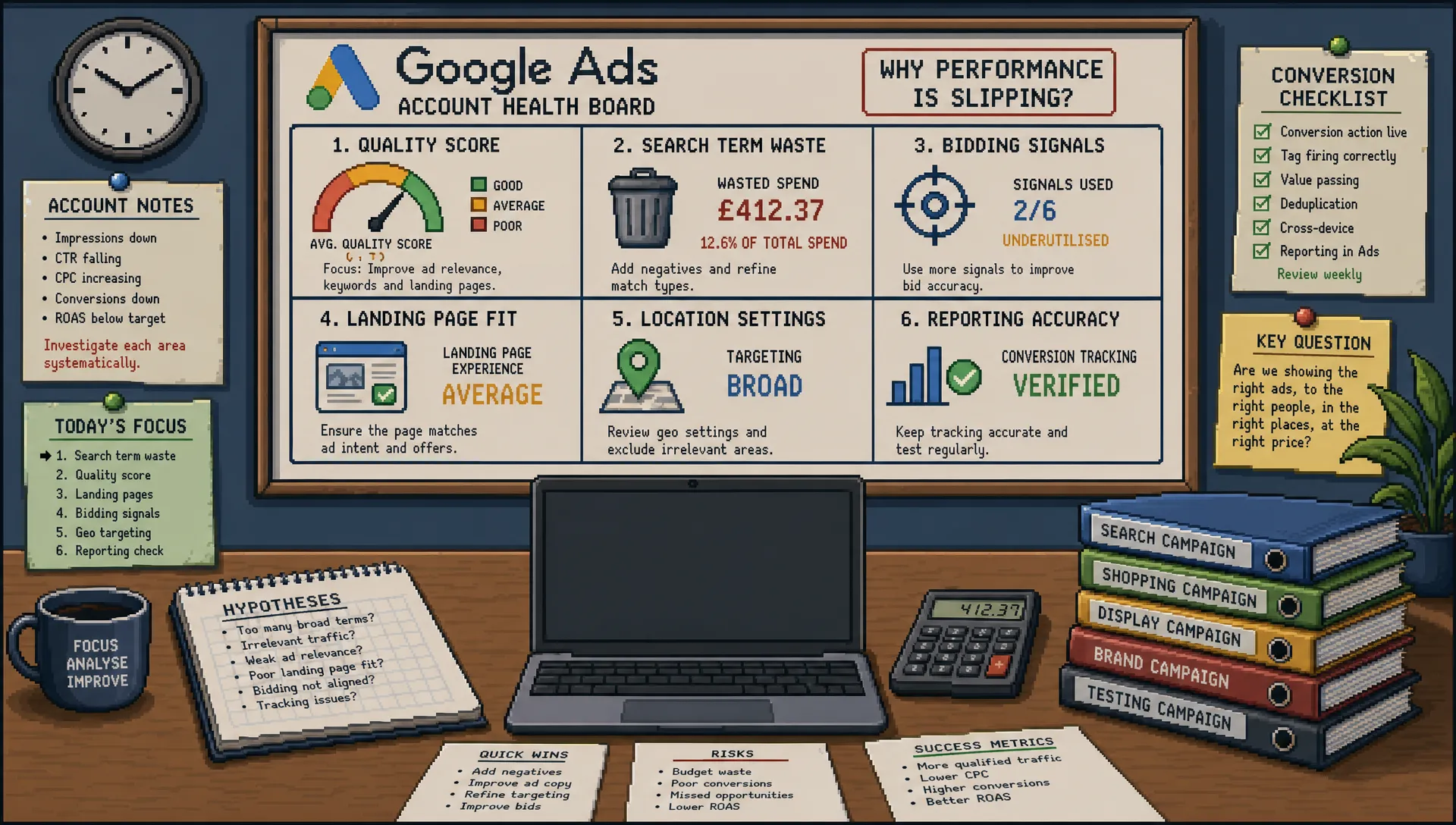
An underperforming Google Ads account is rarely broken because of one obvious setting. More often, performance slips because several small issues compound: loose tracking, vague conversion goals, broad queries, unclear budgets, weak landing page alignment, and bidding strategies that are being asked to optimise for the wrong signals.
That is why a good Google Ads expert does not begin by randomly changing bids or rewriting ads. They diagnose the account like a commercial system. The question is not simply, “Why is CPA high?” It is, “Are we measuring the right outcomes, buying the right traffic, and giving the algorithm enough clean data to make profitable decisions?”
For agencies, this distinction matters. A client may describe the problem as “Google Ads is not working”, but the real problem could sit in analytics, campaign structure, landing pages, sales follow-up, or reporting. The expert’s job is to identify what is actually limiting performance, then fix the highest-impact issues first.
If you are deciding whether to bring in specialist help, this breakdown shows what a Google Ads expert typically fixes inside underperforming accounts and why those fixes matter.
They fix unreliable conversion tracking first
Conversion tracking is the first place to look because every other decision depends on it. If the account is feeding Google Ads incomplete, duplicated, or low-quality conversion data, even a beautifully structured campaign can optimise in the wrong direction.
Google’s own documentation explains that conversion tracking helps measure what happens after someone interacts with an ad, such as purchases, calls, form submissions or app actions. In practice, underperforming accounts often track too much, too little, or the wrong thing entirely.
A specialist will usually check whether primary and secondary conversions are configured correctly, whether GA4 events match the real business objective, and whether form submissions, phone calls, ecommerce revenue, CRM imports, and offline conversions are being counted accurately.
Common problems include thank-you page fires that trigger on refresh, contact form events firing before a valid submission, calls counted after only a few seconds, and micro-conversions being treated as equal to revenue-driving enquiries. This can make the account look healthier than it is, while giving Smart Bidding weak data.
The fix is not always technical complexity. Sometimes it is simply separating meaningful conversions from softer engagement signals. A brochure download, a newsletter sign-up, and a qualified demo request should not automatically carry the same weight. When the account starts optimising towards commercial outcomes rather than vanity actions, performance decisions become much clearer.
For a deeper look at what should be included before ongoing optimisation begins, PPC Ghost has a useful breakdown of what professional Google Ads management should include.
They separate real business goals from platform metrics
Many underperforming accounts have been optimised around surface-level numbers for too long. Click-through rate, impressions, average CPC, and even cost per lead can all be misleading if they are disconnected from lead quality and revenue.
A Google Ads expert will ask uncomfortable but necessary questions. Which leads actually convert into customers? Which products or services have the strongest margins? Are branded campaigns inflating account-wide results? Does the sales team reject certain enquiries because they are low intent or outside the service area?
This step is especially important for agencies managing client accounts across multiple sectors. A low CPA may look good in a report, but if the leads are poor, the client will still feel the channel is failing. Likewise, a higher CPA can be profitable if those conversions produce stronger lifetime value.
The expert’s job is to make the account reflect the client’s commercial reality. That may mean importing offline conversion data, assigning values to different lead types, splitting budgets by service priority, or changing reporting so the client sees revenue indicators rather than isolated media metrics.
They reduce wasted spend in search terms and match types
Search campaigns often leak budget through poor query control. This is one of the fastest areas to diagnose, particularly in accounts that have expanded into broad match without the right safeguards.
A specialist reviews the search terms report to see what users actually typed before clicking. Google’s search terms report guidance makes clear that advertisers can use this data to understand how searches are triggering ads. In an underperforming account, that report often reveals irrelevant research queries, competitor confusion, job seekers, support searches, freebie hunters, or locations the business cannot serve.
The fix is not to block everything aggressively. Overuse of negatives can choke scale. The expert looks for patterns and separates poor-fit traffic from useful discovery. They may add negative keywords, tighten match types, split high-intent terms into dedicated campaigns, or rebuild ad groups around clearer themes.
This is where experience matters. A junior operator might pause keywords simply because they look expensive. A senior specialist asks whether those keywords are expensive because they are wrong, because tracking is weak, because the landing page underconverts, or because the bidding strategy has insufficient data.
If wasted spend is the immediate pressure point, PPC Ghost has also covered practical PPC Google Ads tips that cut wasted spend fast.
They rebuild messy campaign structures
Poor structure makes every optimisation harder. Many accounts have grown organically over years, with legacy campaigns, duplicated keywords, overlapping targeting, old experiments, mixed match types, unclear naming conventions, and budgets spread too thinly across too many initiatives.
A Google Ads expert looks for structural clarity. They want to understand which campaigns serve which business objective, how budget is prioritised, how brand and non-brand are separated, how Search, Performance Max, Shopping, Display, YouTube, and remarketing activity interact, and whether the structure gives Google enough data to optimise effectively.
A common issue is over-segmentation. Years ago, very granular builds were often the default. Today, overly fragmented campaigns can starve bidding strategies of data. The opposite problem is also common, where everything is consolidated so heavily that high-margin services, low-margin services, brand demand, and exploratory traffic all compete inside the same budget pot.
The right structure depends on spend, conversion volume, product range, geography, and business priorities. The expert’s role is to simplify without losing control.
| Problem area | What it looks like in the account | What an expert usually fixes |
|---|---|---|
| Tracking | Duplicated leads, missing revenue, weak GA4 events | Cleans up primary conversions and validates key actions |
| Search terms | Budget spent on irrelevant or low-intent queries | Adds negatives, restructures keywords, improves intent matching |
| Campaign structure | Too many legacy campaigns or unclear budget allocation | Rebuilds around commercial priorities and data volume |
| Bidding | Smart Bidding optimising to poor signals or constant changes | Aligns bidding strategy with clean data and realistic targets |
| Reporting | Platform metrics look fine, but the client is unhappy | Connects media performance to lead quality and business outcomes |
They stop bidding strategies fighting bad data
Smart Bidding can be powerful, but it is not magic. It depends on the signals it receives and the constraints placed around it. If conversion data is unreliable, targets are unrealistic, or campaigns are constantly edited, automated bidding can become unstable.
A specialist will review bidding strategy history, target CPA or target ROAS settings, budget limitations, conversion volume, attribution settings, and recent change history. They will also look at whether campaigns are learning from enough meaningful conversions to support the selected strategy.
Underperformance often appears after well-intentioned but excessive changes. Targets are adjusted too frequently. Budgets are raised and cut without allowing learning periods. Campaigns are moved from manual CPC to Maximise Conversions to target CPA and back again within a short window. Each change may make sense in isolation, but together they create noise.
A Google Ads expert brings discipline. They decide which campaigns need tighter control, which need more data, which should be allowed to stabilise, and which are being asked to hit targets the funnel cannot support.
They identify landing page and offer mismatches
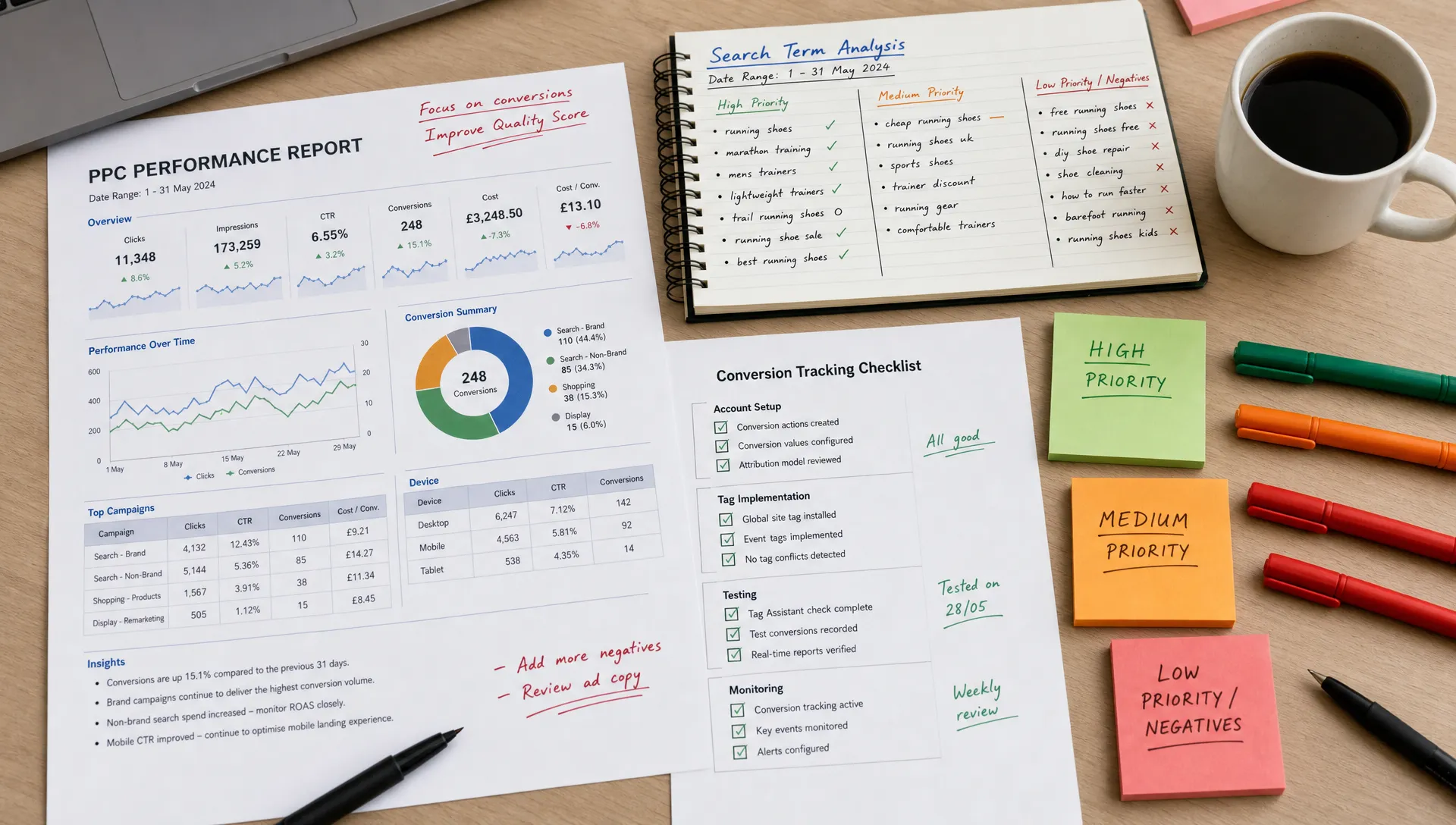
Not every Google Ads problem is inside Google Ads. Sometimes the account is buying relevant traffic, but the landing page does not convert it.
A specialist will check whether the search intent matches the page experience. If an ad promises emergency support, the landing page should not open with a generic brand story. If the keyword suggests comparison intent, the page may need proof, pricing context, service details, or stronger differentiation. If the campaign targets local searches, the page should make service areas and contact options obvious.
This is particularly important in lead generation. A form that asks for too much information too early can suppress conversion rates. A weak mobile experience can waste high-intent traffic. Slow-loading pages, unclear calls to action, vague headlines, hidden contact details, and poor trust signals all reduce the return from paid clicks.
The expert may not be the web developer, but they should be able to diagnose the conversion problem and brief the fix clearly. In agency environments, this can prevent PPC being blamed for issues that sit in messaging, UX, or client-side follow-up.
They improve ad copy, assets, and message relevance
Ad copy is often neglected once campaigns are live. In underperforming accounts, ads may be technically approved but commercially weak. They repeat generic claims, fail to qualify the audience, or send every searcher to the same page regardless of intent.
A Google Ads expert reviews whether responsive search ads contain enough meaningful variation, whether headlines align with search themes, whether assets support the buying journey, and whether calls to action match the user’s stage of awareness.
The goal is not only to increase click-through rate. A higher CTR can be harmful if it attracts the wrong audience. Strong ad copy should both attract and filter. It should make the offer clear, highlight relevant proof points, and discourage poor-fit clicks where appropriate.
For example, a B2B service campaign might need to qualify by sector, location, urgency, or budget. An ecommerce campaign might need to surface delivery terms, pricing benefits, returns information, or product range. The best ads reduce friction before the user even reaches the landing page.
They clean up location, device, audience, and schedule settings
Settings can quietly damage performance for months. Location targeting may include people “interested in” a location rather than people actually in it. Ads may serve outside profitable areas. Mobile traffic may dominate spend even when the landing page performs poorly on mobile. Campaigns may run overnight even though call handling is only available during office hours.
A specialist reviews these controls carefully because they often reveal easy wins. They may adjust location options, exclude irrelevant regions, review device performance, analyse hour-of-day trends, and apply audience observations to understand which segments perform better.
This is not about over-controlling the account. Modern Google Ads often needs enough freedom to learn. The art is knowing which constraints protect budget and which constraints restrict growth.
They audit Performance Max rather than treating it as a black box
Performance Max can be valuable, but it can also hide inefficiencies if no one is actively auditing inputs and outputs. Underperforming accounts may rely heavily on Performance Max while failing to check asset quality, audience signals, feed health, final URL expansion, brand inclusion or exclusion settings, search term insights, and new customer acquisition goals.
A Google Ads expert will ask what role Performance Max should play. Is it supporting ecommerce revenue? Expanding lead generation? Covering remarketing and prospecting together? Cannibalising brand demand? Competing with Search campaigns? Spending against products or services the client does not prioritise?
The fix might involve segmenting asset groups, improving creative inputs, refining product feeds, excluding unsuitable URLs, separating budget by margin or category, or rebalancing spend back towards Search where intent control is stronger.
The key is not to reject automation. It is to manage automation with clear commercial guardrails.
They prioritise fixes instead of changing everything at once
One of the biggest differences between an expert and a reactive account manager is sequencing. Underperforming accounts can contain dozens of issues, but changing everything at the same time makes it impossible to understand what worked.
A senior specialist prioritises by likely commercial impact. Tracking and measurement usually come first. Then wasted spend, budget allocation, campaign structure, bidding, ad relevance, landing pages, and reporting. The exact order depends on the account, but the principle is consistent: stabilise the foundations before scaling.
This is especially useful for agencies under client pressure. When a client is frustrated, there is a temptation to make visible changes quickly. But visible activity is not the same as effective optimisation. A clear action plan, with rationale behind each fix, gives the agency a stronger client conversation and reduces the risk of panic-led decisions.
If you are seeing several warning signs at once, rising spend, unclear tracking, poor lead quality, and unstable performance, it may be time to look at signs you need a Google AdWords expert on demand.
They make reporting more honest and useful
Reporting can hide underperformance just as easily as it can reveal it. A report that focuses on impressions, clicks, CTR, and average CPC may look positive while the client’s pipeline is weak. Conversely, a report may look alarming because CPA rose, even though lead quality and revenue improved.
A Google Ads expert fixes reporting by making it commercially useful. That means segmenting brand and non-brand performance, separating new customer acquisition from remarketing, showing conversion quality where possible, and explaining what changed rather than dumping screenshots into a deck.
Good reporting should answer three questions:
- What happened?
- Why did it happen?
- What are we doing next?
For agencies, this is often as important as the optimisation itself. Clients do not just need performance, they need confidence that someone competent is in control of their media spend.
What an expert can often fix quickly versus what takes longer
Some fixes can produce fast improvements, particularly if the account is wasting budget on obvious mismatches. Others need time because Google Ads performance depends on data collection, learning periods, sales cycles, and landing page improvements.
Quick wins often include removing duplicated conversions, excluding irrelevant search terms, correcting location targeting, pausing clearly wasteful campaigns, reallocating budget from poor performers, and fixing obvious ad or landing page mismatches.
Longer-term improvements usually involve rebuilding campaign structure, importing offline conversions, improving landing pages, gathering enough data for Smart Bidding, developing better creative, and aligning paid media with sales feedback.
The right expectation is not that every underperforming account can be transformed overnight. It is that an expert can quickly identify what is fixable now, what needs testing, and what requires wider business input.
Frequently Asked Questions
What does a Google Ads expert check first in an underperforming account? They usually start with conversion tracking, because unreliable data affects bidding, reporting, budget decisions, and optimisation priorities. If the account is measuring the wrong outcomes, every other fix becomes less reliable.
Can a Google Ads expert reduce wasted spend quickly? Often, yes. Search term waste, poor location settings, duplicated conversions, and weak budget allocation can sometimes be identified quickly. However, sustainable improvement also depends on tracking quality, landing pages, offer strength, and sales feedback.
Is poor Google Ads performance always caused by campaign settings? No. The issue may sit outside the ad account, such as weak landing pages, slow follow-up, poor lead handling, unclear pricing, low trust signals, or a mismatch between the offer and search intent.
How do I know if an agency should use a white-label PPC specialist? If your team lacks senior PPC capacity, needs fast support, or wants expert execution without recruiting, a white-label specialist can help protect client performance while your agency keeps the relationship.
Should underperforming campaigns be paused immediately? Not always. Some campaigns look poor because tracking is wrong or because they support assisted conversions. A specialist will review the data and commercial context before deciding whether to pause, restructure, or optimise.
Need a senior Google Ads expert behind the scenes?
Underperforming accounts do not need guesswork. They need senior diagnosis, clean tracking, sharper structure, disciplined bidding, and a clear plan the client can understand.
PPC Ghost provides on-demand, white-label PPC support for digital agencies, including Google Ads, Meta Ads, Microsoft Ads, GA4 and tracking support. It is built for agencies that need senior-only expertise, flexible scaling, and pay-as-you-go support without recruitment or long-term contracts.
If an account is drifting, wasting spend, or putting client trust at risk, bringing in a specialist can help you stabilise performance while your agency stays front and centre.