Google PPC Pricing Explained for Agencies in 2026
Google PPC pricing explained for agencies in 2026, including media spend, management fees, setup costs and margin-friendly pricing models.
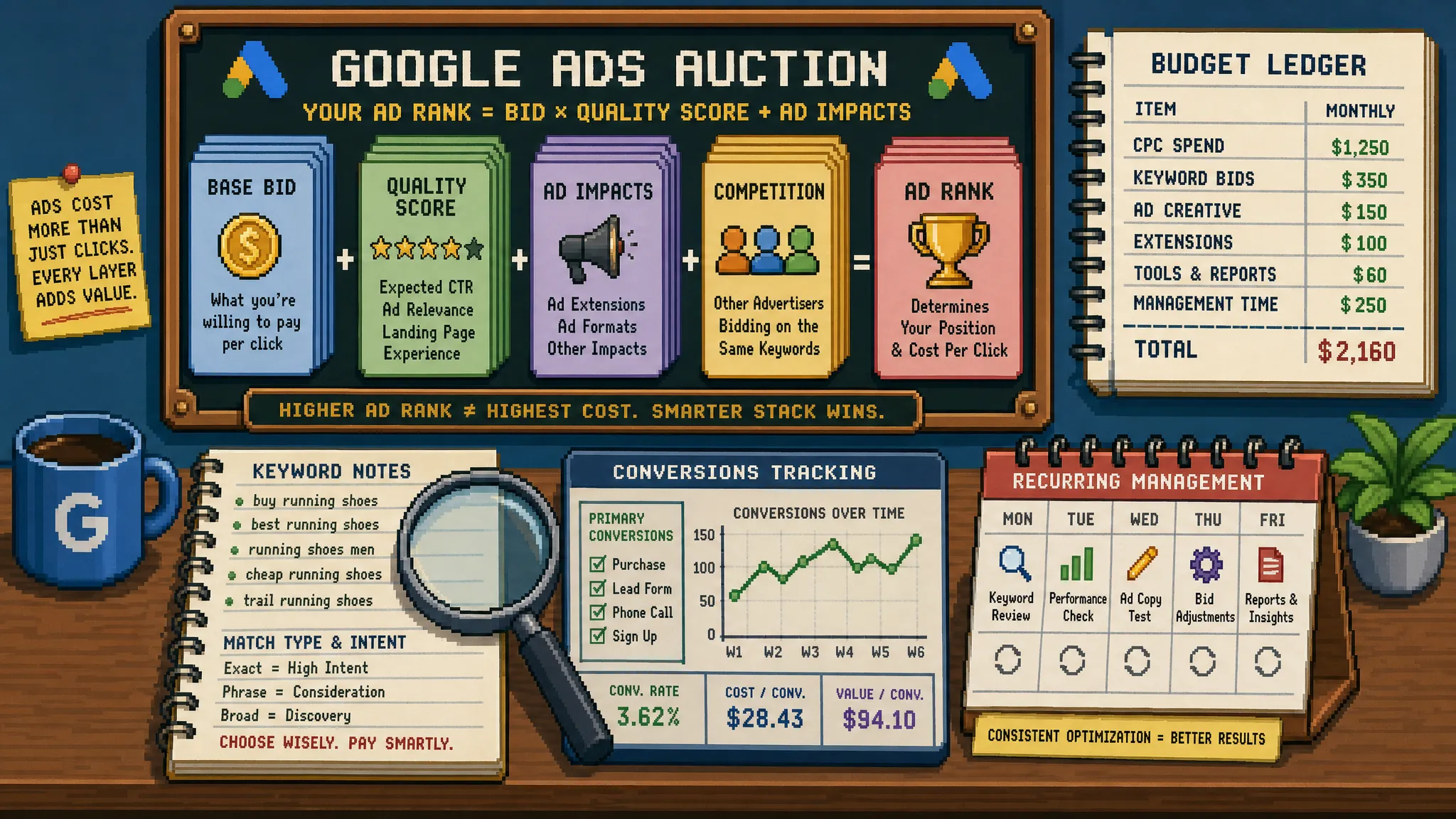
Google Ads is often described as a self-serve platform, but agency teams know the real commercial question is rarely simple: what should the client actually pay, and what should the agency charge to manage it profitably?
For agencies, Google PPC pricing has two sides. There is the media budget paid to Google, which is controlled by auctions, bids and competition. Then there is the management cost, which covers strategy, build, optimisation, tracking, reporting, communication and quality control. Confusing those two numbers is one of the fastest ways to underprice work, overpromise results or erode delivery margin.
In 2026, the core pricing principle has not changed: Google Ads is still an auction, not a fixed-rate media channel. What has changed is the level of specialist input needed to make the platform work well. Automation, Performance Max, broad match, consent requirements and GA4 measurement all make pricing more nuanced for agencies selling PPC as part of a wider digital service.
The short answer: what Google PPC pricing includes
Google PPC pricing is best explained as a stack of costs, not a single fee. A client may ask how much Google Ads costs, but your quote should separate platform spend from delivery work.
| Cost layer | Paid to | What it covers | Agency pricing note |
|---|---|---|---|
| Media spend | Clicks, impressions, views or conversions generated through Google Ads campaigns | This is usually billed directly to the client or passed through transparently | |
| Initial setup | Agency or PPC partner | Account structure, campaign build, conversion actions, audiences, assets, QA and launch | Often underpriced because it is treated as admin rather than specialist work |
| Ongoing management | Agency or PPC partner | Optimisation, budget control, search term reviews, bid strategy checks, testing and reporting | Should reflect complexity, not only ad spend |
| Tracking and analytics | Agency, PPC partner or developer | GA4 events, Google Ads conversions, GTM checks, call tracking and consent-related checks | Essential for automated bidding and performance reporting |
| Feed, creative or landing page input | Agency, client or specialist | Product feed health, ad assets, landing page feedback and conversion rate improvements | May sit outside PPC management unless scoped |
| White-label delivery | Specialist partner | Senior PPC execution behind the agency brand | Useful when demand is variable or hiring is not justified |
The key message for clients is simple: Google charges for media access, but the agency charges for making that media spend work.
How Google actually charges for PPC
Google Ads does not publish one universal price per click. Advertisers enter auctions, and the price paid depends on the competitive environment and the quality of the ad experience. Google explains Ad Rank as being influenced by factors such as bid, ad quality, auction competition, user context and the expected impact of assets.
That means two advertisers can target similar keywords and pay different effective costs. One account may have stronger relevance, better landing pages and cleaner conversion data. Another may have poor structure, broad targeting and weak ads. The first account is often able to buy better traffic more efficiently, even if the headline budget is the same.
Most agency conversations focus on cost per click, but CPC is only one part of the model. A £3,000 monthly budget at £2 per click can buy around 1,500 clicks before other variables are considered. The same budget at £10 per click buys around 300 clicks. If the higher-cost traffic converts at a much better rate and creates higher-value leads, it may still be the stronger commercial option.
This is why agencies should avoid promising cheap clicks as the main value proposition. The better question is whether the account can buy profitable demand at a sustainable cost per lead, cost per sale or return on ad spend.
Why Google PPC pricing varies so much by client
Google Ads pricing changes because auctions change. For agencies, the bigger issue is that delivery effort also changes. A small lead generation account in one town is not the same as a multi-location ecommerce account with Shopping, Performance Max, remarketing, offline conversion imports and monthly stakeholder reporting.
The main pricing drivers usually include:
- Industry competition: Legal, finance, insurance, SaaS and home improvement keywords can attract higher competition than low-intent or niche categories.
- Search intent: Bottom-of-funnel searches tend to cost more because advertisers are closer to revenue.
- Geography: Targeting a dense, competitive city can behave very differently from targeting a smaller regional area.
- Account history: A clean account with reliable data is easier to optimise than one with messy conversions and years of poor structure.
- Tracking quality: Automated bidding depends on conversion data, so weak tracking can increase wasted spend and management time.
- Campaign mix: Search, Shopping, Performance Max, Demand Gen, Display and YouTube all require different levels of setup and review.
- Client expectations: Fast growth, detailed reporting, frequent calls and aggressive testing all increase the cost to serve.
For practical waste reduction once an account is live, agencies should also review search terms, match types, location settings and conversion quality regularly. This is where a structured audit process, like the one covered in PPC Google Ads tips that cut wasted spend fast, becomes commercially valuable.
Common agency pricing models for Google Ads
There is no single correct agency pricing model. The right structure depends on client budget, scope, reporting needs, risk and how your agency delivers the work. The important thing is that your fee covers the real labour involved and leaves enough margin for account management, senior review and unexpected issues.
| Pricing model | How it works | Best fit | Watch out for |
|---|---|---|---|
| Percentage of ad spend | Agency charges a percentage of the monthly media budget | Larger budgets where workload broadly scales with spend | Can undercharge small but complex accounts and overcharge simple high-spend accounts |
| Fixed monthly retainer | Client pays a set monthly management fee | Stable accounts with predictable scope | Needs clear limits on calls, reporting, testing and campaign types |
| Hybrid model | Fixed minimum fee plus a percentage of spend above a threshold | Agencies that manage mixed budget sizes | Requires simple wording so clients understand it |
| Setup fee plus monthly management | One-off build fee followed by retainer | New accounts, rebuilds and tracking-heavy launches | Setup scope must include QA and tracking, not only campaign creation |
| Project or audit fee | Fixed fee for audit, rebuild or one-off optimisation | Clients not ready for retained management | Can create scope creep if recommendations turn into implementation |
| Performance-based pricing | Fee linked to leads, revenue or performance goals | Mature accounts with reliable tracking and shared commercial data | Risky when sales quality, pricing, fulfilment or CRM handling sit outside the agency |
| White-label delivery cost | Agency pays a specialist partner to execute under the agency brand | Agencies needing flexible senior PPC capacity | Your client-facing price still needs to protect agency margin |
For many agencies, the safest option is a fixed minimum retainer or hybrid model. Pure percentage pricing can look attractive, but it often fails at the lower end. For example, 15% of a £1,500 media budget is only £225. That rarely covers strategy, build, conversion checks, optimisation, reporting and communication at a professional standard.
A practical pricing framework for agencies in 2026
Instead of asking what other agencies charge, start with the cost to serve. Your Google Ads fee should be based on the time and expertise needed to deliver the outcome, plus the commercial margin your agency requires.
A simple internal formula is:
Minimum management fee = delivery hours x internal cost rate + tools and overhead + profit margin
If you use a white-label PPC partner, replace internal delivery cost with the partner cost and add your required agency margin. This keeps pricing grounded in commercial reality rather than guesswork.
A useful agency lens is to group clients by budget and complexity. The figures below are not a market rate card. They are a scoping framework to help you think clearly about pricing pressure.
| Monthly media budget | Typical pricing issue | Agency response |
|---|---|---|
| Under £2,000 | Percentage fees often do not cover the work | Use a fixed minimum fee and keep scope tight |
| £2,000 to £10,000 | Enough spend for meaningful testing, but workload can vary heavily | Price based on campaign mix, tracking and reporting depth |
| £10,000 to £50,000 | More optimisation, stakeholder management and experimentation | Consider hybrid pricing or a higher retainer with defined deliverables |
| £50,000+ | Governance, forecasting, budget pacing and senior strategy become more important | Scope senior review, reporting cadence and strategic planning explicitly |
This approach protects both sides. The client sees that pricing is connected to work and accountability. The agency avoids treating every PPC account as the same job with a different media budget.
Setup pricing: the part agencies often forget
Many agencies lose money before the first campaign even launches. Google does not usually charge a separate setup fee to create an Ads account, but proper setup is still work. It can involve keyword research, account structure, campaign settings, negative keyword planning, ad copy, assets, audience strategy, budget allocation, conversion actions and QA.
Tracking setup deserves particular attention. Google's conversion tracking guidance makes clear that conversion actions help advertisers understand what happens after someone interacts with an ad. In practice, tracking quality affects both reporting and automated bidding. If conversions are duplicated, missing or poorly defined, the account can optimise towards the wrong signals.
For ecommerce clients, setup can also include Merchant Center checks, product feed issues, Shopping structure and value-based reporting. For lead generation, it may involve call tracking, form tracking, CRM stages or offline conversion imports. These tasks should not be hidden inside a small management fee unless the client relationship is large enough to justify it.
A strong proposal separates setup from ongoing management. That makes the work visible, reduces friction later and gives your team room to launch properly rather than rushing a half-built account.
How to explain Google PPC pricing to clients
Clients do not need every technical detail, but they do need to understand why one quote is higher than another. A clear explanation builds trust and protects your agency from being compared only on price.
A simple client-friendly explanation could be:
Your Google Ads budget is the amount paid into the auction to buy traffic. Our management fee covers the strategy, build, tracking checks, optimisation and reporting needed to spend that budget effectively. We price management separately because two accounts with the same media spend can require very different levels of work.
This framing helps reposition PPC management from button-clicking to risk management and growth support. It also gives you a better way to discuss scope. If the client wants weekly calls, landing page feedback, feed support and detailed board reporting, the price should reflect that. If they only need a lean campaign build and monthly optimisation, the scope can be lighter.
Pricing mistakes that damage agency margin
The most common Google Ads pricing mistakes are not technical. They are commercial. Agencies often know how to run campaigns, but they quote as if delivery time, QA and communication will always be predictable.
Watch out for these margin leaks:
- Charging only as a percentage of spend: This can punish you on low-budget accounts that still require senior attention.
- Including tracking without scoping it: GA4, GTM, consent checks and CRM issues can become time sinks if responsibilities are unclear.
- Offering unlimited changes: Campaign changes, reporting requests and extra calls should have boundaries.
- Ignoring urgency: Same-week launches and rescue projects require capacity, so they should be priced accordingly.
- Selling cheap CPCs: Low cost per click is not the same as profitable acquisition.
- Failing to price senior review: Junior execution without experienced oversight can create expensive mistakes.
The best agencies make pricing part of the qualification process. If the client has unrealistic expectations, poor tracking, no landing page control and a tiny management budget, the issue is not just PPC performance. It is delivery risk.
How white-label PPC support changes the pricing equation
Hiring a full-time PPC specialist can make sense when demand is consistent. It is harder to justify when your pipeline is lumpy, clients pause activity or only a few accounts need senior Google Ads expertise. That is where white-label PPC delivery can improve the commercial model.
Instead of carrying recruitment costs, training time and unused capacity, agencies can bring in specialist support when needed. The agency keeps the client relationship, brand and strategy ownership, while the PPC partner handles the execution behind the scenes.
For pricing, this gives agencies more flexibility. You can quote the client based on value and scope, then use an external senior specialist only when the work requires it. It is particularly useful for launches, audits, rebuilds, overflow periods and accounts that need tracking or Google Ads expertise beyond the current in-house team.
The key is to protect your margin. White-label delivery should not be treated as a pass-through cost unless that is your business model. It should sit inside a profitable service package that your agency owns.
Frequently Asked Questions
How much does Google PPC cost in 2026? There is no single Google PPC cost. The client controls the media budget, while actual costs depend on auction competition, targeting, quality, bid strategy and conversion performance. Agencies should quote management separately from ad spend.
Does Google charge a setup fee for PPC campaigns? Google does not usually charge a separate fee simply to create campaigns, but professional setup takes time. Agencies should price account builds, tracking checks, campaign structure, ad assets and launch QA as real specialist work.
Should agencies charge a percentage of Google Ads spend? Percentage pricing can work for larger budgets, but it often underprices smaller accounts. Many agencies use a fixed minimum retainer or hybrid model so that the fee reflects workload as well as media spend.
What is a good minimum Google Ads management fee? A good minimum fee is one that covers delivery time, senior review, reporting, client communication, tools, overhead and profit. If the fee does not cover those basics, the account is likely to become unprofitable or under-serviced.
Is Google PPC more expensive than Meta Ads? It depends on the market and objective. Google Search often captures higher-intent demand, which can mean higher CPCs. Meta often plays a stronger role in demand generation. Agencies should compare cost per qualified lead, sales value and profitability rather than CPC alone.
Can agencies outsource Google Ads management white-label? Yes. White-label PPC support lets agencies deliver Google Ads expertise under their own brand without hiring. It works best when scope, communication, confidentiality and margin are clear from the start.
Need white-label Google Ads support without hiring?
If Google PPC pricing is putting pressure on your agency margin, the answer is not always another full-time hire. Sometimes you need senior PPC execution only when client demand requires it.
PPC Ghost provides on-demand, white-label PPC support for UK agencies across Google, Meta and Microsoft Ads, with GA4 and tracking support available too. It is built for flexible scaling, same-day turnaround and pay-as-you-go delivery, so your agency can keep the client relationship while a senior specialist handles the PPC work behind the scenes.
When you need expert Google Ads delivery without recruitment, contracts or extra headcount, PPC Ghost can help your agency stay profitable and responsive.