Meta Ads Instagram Tactics That Improve Lead Quality
Improve Meta Ads Instagram lead quality with practical tactics for targeting, creative, forms, tracking and follow-up that agencies can use.
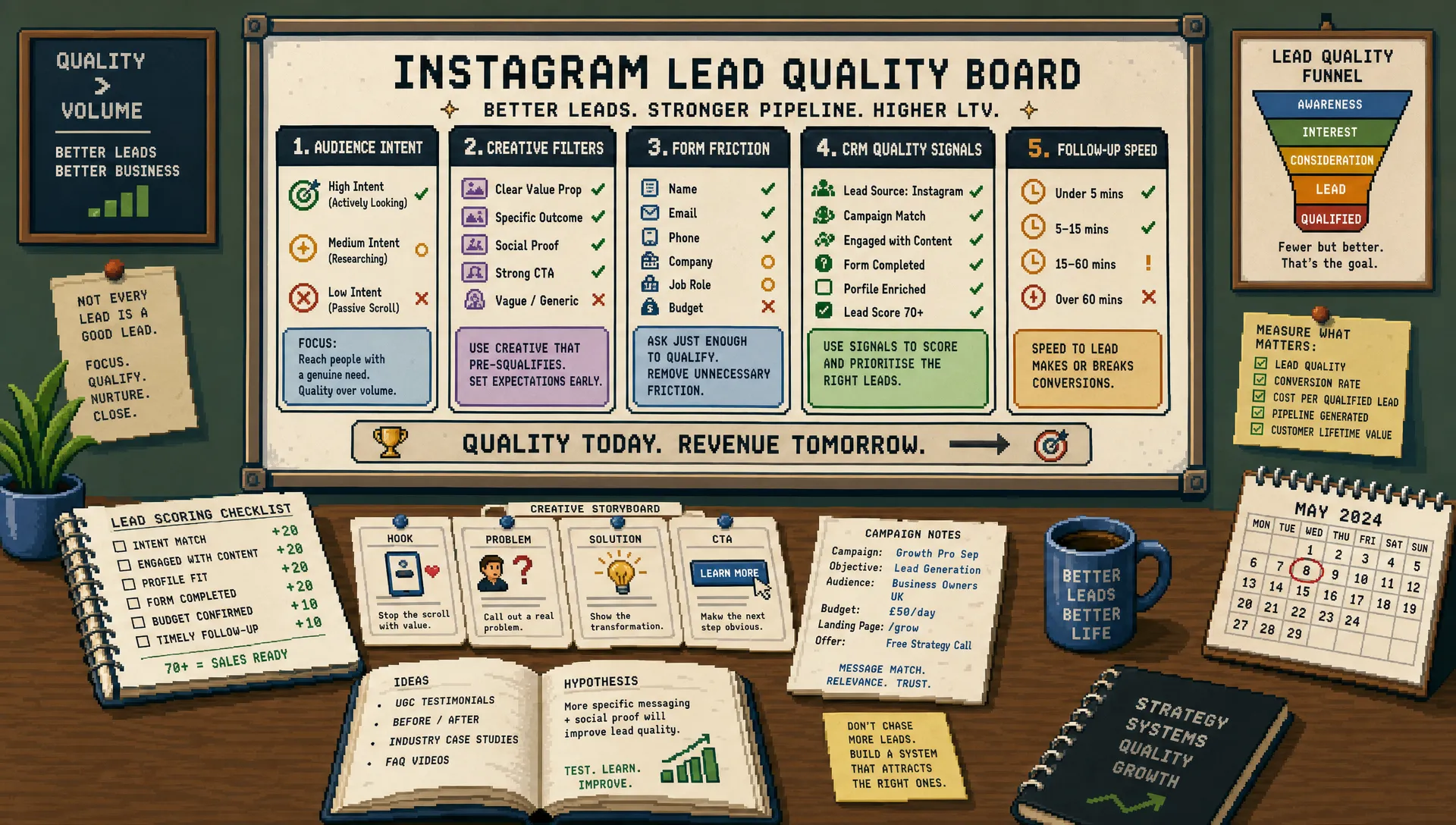
Instagram can be brilliant for lead generation, but cheap leads are not always good leads. For agencies, the real problem is often not volume. It is explaining why a campaign delivered plenty of form submissions, yet the client says the sales team cannot convert them.
That gap is where lead quality work matters. Meta Ads Instagram campaigns improve when the strategy moves beyond audience tweaks and starts shaping the full journey: who sees the ad, what promise attracts them, what friction qualifies them, what signal Meta optimises towards, and how quickly the business follows up.
The aim is not to make every lead harder to submit. The aim is to remove accidental leads, curiosity clicks and poor-fit enquiries while keeping enough conversion volume for Meta to learn. If your agency already knows the basics but wants better commercial outcomes from Instagram lead generation, these tactics will help.
Start by defining what a quality lead actually means
Before changing campaigns, agree what counts as quality. Many Instagram lead gen campaigns fail because the agency optimises for completed forms while the client judges success by booked calls, qualified opportunities or revenue.
A quality lead definition should be simple enough for Meta Ads reporting, CRM review and client conversations. If the sales team uses vague feedback such as poor quality or not serious, translate that into specific criteria.
| Quality signal | What it tells you | How to use it in Meta Ads decisions |
|---|---|---|
| Fit | Whether the person matches the target customer profile | Compare qualified rate by creative, audience, placement and form version |
| Intent | Whether the person has an active need, not just casual interest | Add questions about timing, problem severity or next step preference |
| Budget or capacity | Whether they can realistically buy | Use budget ranges only when commercially appropriate and compliant |
| Contactability | Whether sales can reach them | Track invalid numbers, fake emails and no-answer rates |
| Sales outcome | Whether the lead becomes a call, opportunity or sale | Feed post-lead quality data back into optimisation and reporting |
This step also protects the agency. If you only report cost per lead, the client may assume you are chasing volume at the expense of revenue. If you report cost per qualified lead, booked call rate and opportunity rate, the conversation becomes much more useful.
If you are trying to fix wider account issues at the same time, it is worth reviewing the common Facebook Meta Ads mistakes agencies still make, especially around tracking, briefs and reporting.
Build Instagram campaigns around intent, not just demographics
Instagram targeting has changed. Interest stacks and demographic assumptions are less reliable than they used to be, especially when Meta has enough conversion data to find patterns itself. That does not mean targeting is irrelevant. It means the campaign structure should reflect intent levels rather than endless micro-segments.
For most lead gen accounts, a practical structure is to separate cold prospecting, warm engagement and high-intent retargeting. Cold campaigns can use broader targeting with strong creative filters. Warm campaigns can reach people who watched videos, engaged with Instagram content or visited key website pages. High-intent campaigns can focus on people who viewed pricing, service pages, booking pages or previous lead forms but did not complete.
The goal is to stop treating all Instagram users as equal. Someone who watched 75% of a detailed explainer Reel is different from someone who liked a lifestyle image. Someone who visited a pricing page is different again.
| Intent layer | Typical signal | Best use in Instagram lead gen |
|---|---|---|
| Cold | Broad audience, lookalike or Advantage+ style targeting | Use creative to educate and filter fit |
| Warm | Engaged with Instagram profile, watched video or clicked previous ads | Use proof, objections and clearer offers |
| High intent | Visited key pages or started a form | Use direct response messaging and stronger calls to action |
Do not over-segment so heavily that each ad set starves. Lead quality improves when Meta has both clear signals and enough data. The mistake is giving the system a weak conversion event, vague creative and tiny audiences, then expecting it to find ideal prospects.
Use creative that attracts and repels
Good Instagram creative does two jobs. It attracts the right people and quietly repels the wrong ones. If the ad is too broad, too exciting or too incentive-led, it may generate cheap leads from people who are unlikely to buy.
For example, an ad that says Get a free consultation will usually attract more leads than an ad that says Book a 20-minute consultation for homeowners planning a kitchen renovation in the next 3 months. The second message may reduce volume, but it is more likely to filter for context and timing.
High-quality Instagram lead creative often includes:
- A clear audience callout, such as who the service is for and who it is not for.
- A specific problem or outcome, rather than a generic benefit.
- A visible next step, such as book a call, request a quote or check eligibility.
- Proof that supports trust, such as a case study angle, testimonial concept or before and after context where permitted.
- Friction that signals seriousness, such as mentioning a process, timeline or qualification requirement.
This does not mean every ad should sound restrictive. It means the offer should match the stage of the buyer. A top-of-funnel Reel might educate and retarget viewers later. A bottom-of-funnel Story ad should be much clearer about what happens after the lead is submitted.
Instagram is especially sensitive to creative mismatch. Reels, Stories and Feed placements each create different user behaviour. A Reel can build attention cheaply, but the viewer may not be ready to enquire immediately. A Story ad can drive fast action, but accidental taps and low-context leads are more common. Feed ads give more room for explanation, but only if the first line and visual stop the scroll.
Match the lead capture method to the buying decision
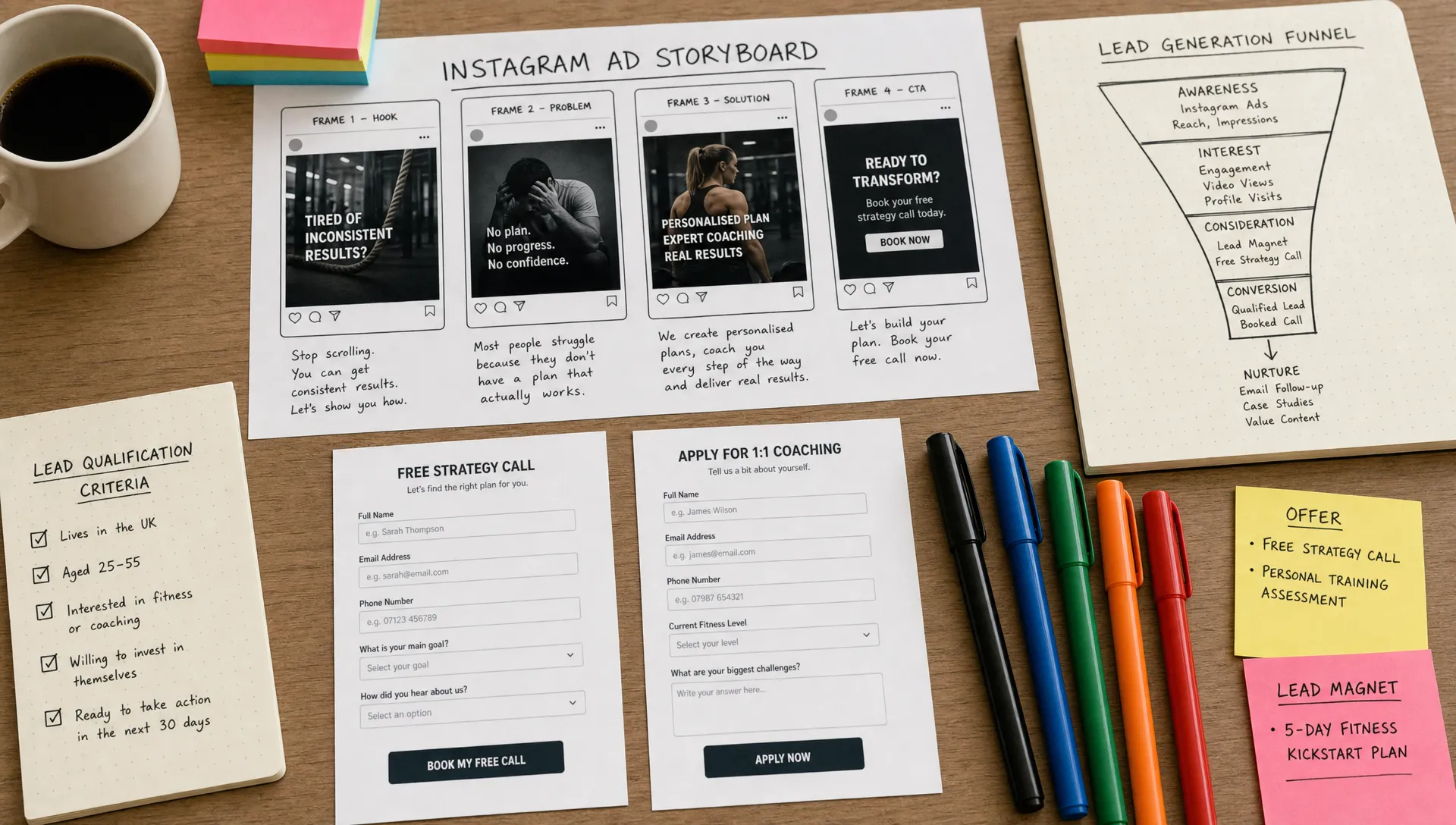
Instant forms are convenient, especially on mobile, but they can also make it too easy for the wrong person to submit. Landing pages add friction, which can lower volume, but they often improve context for considered purchases.
There is no universal winner. The right choice depends on the client offer, sales process and average order value.
| Lead capture option | When it works well | Lead quality risk | Tactical fix |
|---|---|---|---|
| Instant form, more volume | Simple offers, competitions, low-friction enquiries | Too many casual or accidental submissions | Use stronger creative filters and post-submit qualification |
| Instant form, higher intent | Consultations, quotes, appointments and B2B enquiries | Lower lead volume | Test against volume forms using qualified rate, not just CPL |
| Instant form with custom questions | Offers where fit matters | Too many questions can reduce completion | Ask only the questions sales genuinely uses |
| Landing page | Higher-value or complex decisions | Higher cost per lead | Improve page speed, message match and mobile form design |
Meta instant forms offer a higher intent option with a review step, which can help reduce accidental submissions. Custom questions can also improve quality when used carefully. The best questions are not there to satisfy curiosity. They should help sales prioritise or disqualify.
Useful qualifying questions might include:
- What are you looking to achieve?
- When are you hoping to get started?
- Which option best describes your situation?
- What budget range are you considering?
- Are you the decision-maker or researching for someone else?
For UK and EU audiences, make sure the form, privacy notice, consent wording and CRM syncing are handled correctly. Lead quality should never come at the expense of data protection or platform policy compliance.
Optimise towards qualified lead signals, not just form fills
Meta will optimise towards the event you give it. If the campaign is told that every submitted form is equally valuable, it will look for more people likely to submit forms. That can work for volume, but it often breaks down when the sales team cares about quality.
Where possible, connect downstream lead stages back into your measurement process. That might include lead received, contacted, qualified, booked call, opportunity created or sale. The exact setup depends on the client CRM, website, lead form method and consent model.
For web-based journeys, the Meta Conversions API documentation explains how server-side events can help advertisers send conversion data to Meta. For lead gen, this is especially useful when browser tracking is incomplete or when important actions happen after the initial form submission.
The key is to avoid treating all conversions as equal. A booked consultation is not the same as a low-intent download. A verified sales opportunity is not the same as an auto-filled form from someone who never answers the phone.
In reporting, segment results by:
- Creative concept.
- Placement, especially Reels, Stories and Feed.
- Form type or landing page version.
- Audience layer.
- Lead stage in the CRM.
- Time to first response.
This gives you a clearer picture of where quality is actually coming from. You may find that one creative has a higher CPL but a much lower cost per qualified lead. That is the insight that improves account performance and client retention.
Use Instagram placement behaviour to refine quality
Instagram placements should not be judged only by CPL. Each placement has different strengths, and each needs creative that fits the way people consume content.
Reels are strong for reach, education and remarketing pool growth. They work best when the first few seconds qualify the viewer quickly. If the opening is too entertaining but not commercially relevant, you may build a large low-intent audience.
Stories are strong for direct response, but the CTA must be obvious and the offer must be easy to understand quickly. Since Stories are tap-heavy, use higher intent forms or an intermediate landing page if accidental submissions are a recurring issue.
Feed can still work well for considered offers because there is more room for copy, comments and context. Use Feed placements to explain why the offer matters, who it suits and what happens next.
Explore and profile-based engagement can support discovery, but they should be judged by assisted value as well as direct leads. A person may discover the brand in Explore, engage with a Reel later, then convert from a retargeting ad.
If a client asks why Instagram is not behaving like search, it can help to explain the broader channel role. This comparison of Google Ads vs Meta Ads for agency growth is useful when clients need to understand demand capture versus demand creation.
Improve follow-up speed before blaming the ads
Many leads that look poor in a report are actually mishandled after submission. Instagram users often enquire in spare moments: commuting, scrolling at lunch, sitting on the sofa in the evening. If the business waits a day to respond, the context is gone.
Classic research published in the Harvard Business Review found that companies responding to online leads within an hour were far more likely to qualify them than those waiting longer. The exact numbers will vary by industry, but the principle remains relevant: speed to lead matters.
Agencies should ask clients how leads are handled after submission. Who receives them? How fast do they call? What happens if the first call is missed? Are leads followed up by phone, email and SMS where consent allows? Is the sales team using the same offer language as the ad?
This is not just a sales operations issue. It affects campaign learning and perceived quality. If the client takes too long to respond, the agency may be blamed for poor leads when the real bottleneck is conversion handling.
Test friction deliberately
Adding friction can improve lead quality, but too much friction can starve the campaign. The best approach is to test one friction lever at a time and judge results by qualified lead metrics.
Examples of useful friction tests include changing from a volume form to a higher intent form, adding one qualifying question, moving from instant form to landing page, using a clearer price or eligibility cue in the creative, or changing the CTA from learn more to book consultation.
A simple 30-day lead quality sprint could look like this:
- Audit the last 60 to 90 days of leads and classify them by qualified status.
- Identify the worst quality sources by creative, placement, audience and form type.
- Rewrite creative to qualify the audience and clarify the next step.
- Test one higher intent form or landing page against the current capture method.
- Feed back CRM quality data and report cost per qualified lead, not just CPL.
- Keep the best quality source running long enough to gather meaningful data.
Do not change everything at once. If you change the audience, creative, form and landing page together, you will not know what caused the improvement or decline.
Report what the client actually cares about
For agencies, better reporting is one of the quickest ways to improve client trust. Instagram lead gen can look messy if you only show platform metrics. It becomes far more persuasive when you connect spend to commercial progress.
Use a reporting view that separates quantity and quality.
| Metric | Why it matters |
|---|---|
| Cost per lead | Shows initial efficiency, but not final value |
| Qualified lead rate | Shows whether the campaign is attracting the right people |
| Cost per qualified lead | Helps compare tactics fairly |
| Booked call rate | Shows whether sales follow-up and lead intent are aligned |
| Opportunity rate | Connects media activity to pipeline |
| Speed to lead | Identifies whether follow-up is weakening results |
This also helps you defend smart optimisation choices. A campaign with a £40 CPL and 50% qualified rate is often better than a campaign with a £12 CPL and 5% qualified rate. The client may not see that unless you present the numbers in a way that reflects their sales process.
Frequently Asked Questions
Do Instagram lead ads work for B2B? Yes, Instagram lead ads can work for B2B when the offer, creative and qualification process match the buying journey. They usually perform best when supported by strong proof, clear targeting signals and CRM-based quality tracking.
Are instant forms or landing pages better for lead quality? Landing pages often add useful context and friction, which can improve quality for high-consideration offers. Instant forms can still work well when using higher intent settings, custom questions and clear creative that pre-qualifies the user.
Should agencies optimise Meta Ads for cost per lead or cost per qualified lead? Cost per lead is useful, but cost per qualified lead is usually a better decision metric. If the campaign is judged by sales outcomes, reporting should include qualified rate, booked call rate and opportunity value where possible.
How many questions should an Instagram lead form include? Use the fewest questions needed to qualify and route the lead. One to three strong qualifying questions are often more useful than a long form that reduces completion without improving sales decisions.
Why are Instagram leads cheaper but lower quality than Google Ads leads? Instagram often creates demand from people who were not actively searching, while Google captures existing demand. That can make Instagram leads cheaper at the top of the funnel, but they may need stronger qualification and faster follow-up.
Need senior Meta Ads support without adding headcount?
Improving lead quality takes more than quick campaign edits. It needs sharp creative judgement, clean tracking, sensible testing and reporting that connects Meta Ads activity to client outcomes.
If your agency needs experienced paid media support without hiring, PPC Ghost provides white-label PPC execution on demand for UK agencies. Support covers Google, Meta and Microsoft Ads, plus GA4 and tracking help, with flexible pay-as-you-go delivery and no long-term contracts.