How a Paid Ads Agency Helps You Scale Without Hiring
Learn how a paid ads agency helps you scale client PPC delivery without hiring, protecting margins, quality and capacity.
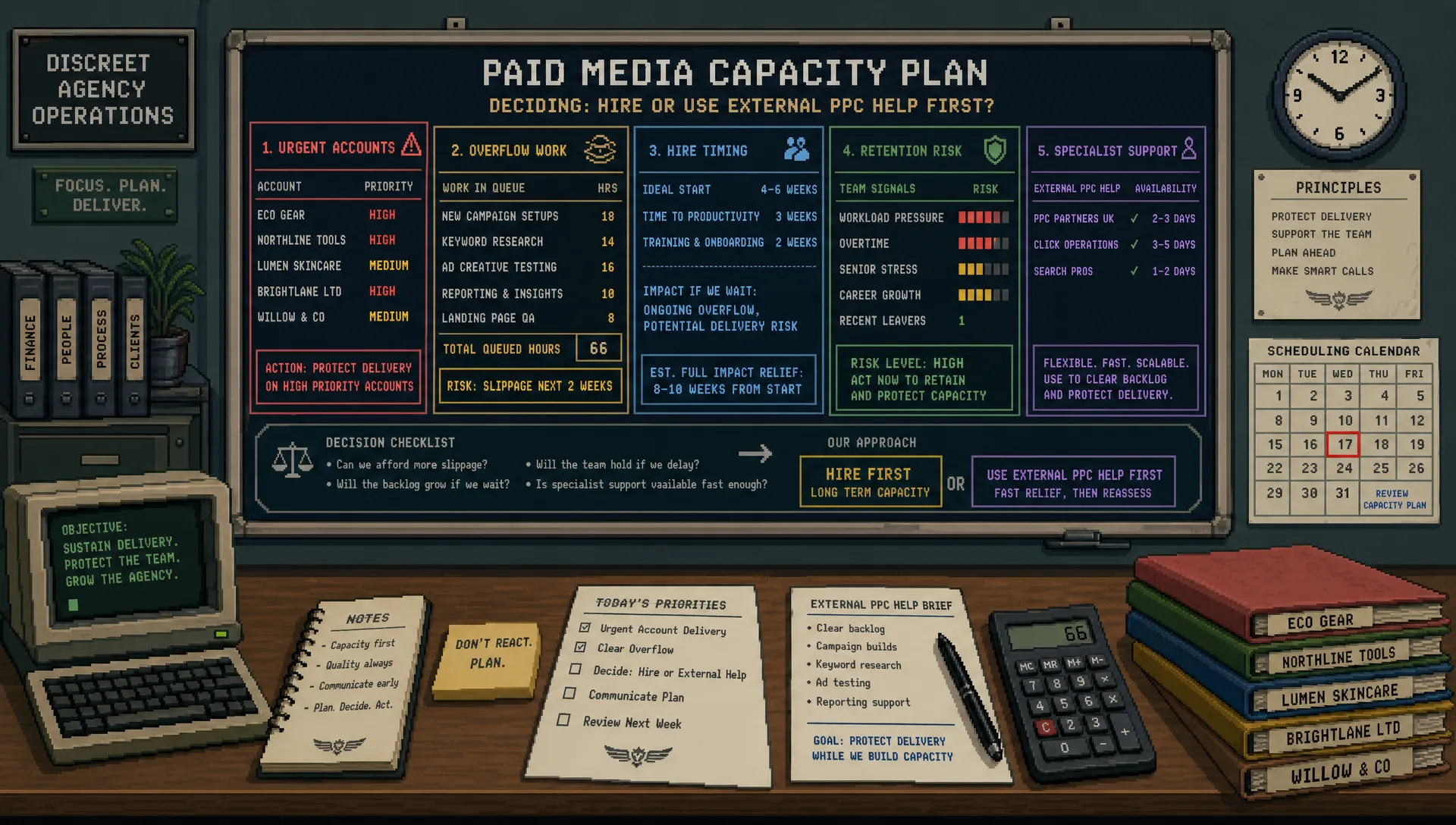
For many digital agencies, growth is not blocked by demand. It is blocked by delivery capacity. A new retainer lands, an existing client wants to expand into Google Ads, Meta Ads or Microsoft Ads, and suddenly the team is asking the same question: do we hire now, or risk overloading the people we already have?
Hiring can be the right move, but it is not always the smartest first move. A paid ads agency gives you a way to scale delivery before you commit to permanent headcount. Used well, it can protect client results, keep account managers focused, preserve cash flow and help you say yes to profitable opportunities without building a larger payroll too early.
For agency owners, the real question is not simply, "Can someone run the ads?" It is, "Can we add senior PPC capability in a way that improves service quality, protects our brand and does not create unnecessary fixed cost?"
Why hiring is often too slow for paid media growth
Paid media demand rarely grows in neat, predictable increments. You might have three quiet weeks, then two urgent account audits, a tracking issue, a new ecommerce build and a Meta Ads scale-up request all landing at once. A full-time hire assumes that demand is consistent. Agency life often is not.
Recruitment also creates lag. You need to write the role, source candidates, interview, negotiate, wait through notice periods, onboard the person, check their work and gradually expose them to client accounts. The ONS labour market overview is a useful reminder that hiring conditions change constantly, and agencies cannot always rely on being able to recruit the right specialist exactly when client work spikes.
Then there is the hidden cost. A paid media hire is not just salary. You also need management time, training, software access, holiday cover, sick cover, QA, progression planning and enough account volume to keep the person productive. If the workload dips, your cost remains. If the workload rises too quickly, one hire may still not be enough.
This is where an external delivery partner becomes strategically useful. A paid ads agency can give you access to experienced PPC capacity at the point of need, without forcing you to make a permanent staffing decision before the revenue is stable.
What a paid ads agency adds beyond extra hands
The best external paid media support is not just an overflow resource. It is a specialist layer that improves the quality and resilience of your delivery model.
A good partner can help with campaign builds, audits, optimisation, account restructures, conversion tracking checks, GA4 support, search term analysis, budget pacing, reporting inputs and strategic recommendations. That matters because modern PPC is no longer a simple matter of changing bids and adding keywords. Performance depends on account structure, creative testing, first-party data, conversion quality, automation settings and how well the account maps to the client’s commercial goals.
Measurement is especially important. Google’s own guidance on conversion tracking shows how much campaign optimisation depends on clean conversion actions and reliable data. If your agency is scaling paid media work without strong tracking foundations, you are not just creating delivery pressure. You are increasing the risk of poor decisions being made from bad data.
Here is the practical difference between common scaling options:
| Scaling option | Best for | Main limitation | Agency risk |
|---|---|---|---|
| Full-time hire | Stable, long-term account volume | Slow to recruit and costly if workload dips | Fixed overhead before revenue is proven |
| Junior delivery team | Routine tasks and lower complexity accounts | Requires senior oversight | Quality can vary under pressure |
| Freelancer | Short projects or ad hoc support | Availability and consistency may fluctuate | Process can be hard to standardise |
| Paid ads agency | Senior delivery capacity across multiple accounts | Needs clear briefing and workflow | Lower if white-label process is controlled |
The key advantage is flexibility. You can use a paid ads agency for a one-off rescue project, a short burst of implementation work or ongoing delivery support across several accounts. That gives you a buffer between "we are too busy" and "we need another full-time salary".
How it helps you scale without hiring
Scaling without hiring does not mean avoiding recruitment forever. It means buying time, reducing risk and proving demand before increasing fixed costs. A paid ads partner helps in several important ways.
First, it increases capacity immediately. If your internal team is stretched, external support can take delivery work off their plate so they can focus on client communication, strategy and retention. This is especially useful when you have strong account managers but limited specialist PPC depth.
Second, it helps you accept growth opportunities with more confidence. Many agencies hesitate to pitch paid media retainers because they are unsure whether they can deliver once the work is won. Having a trusted backend partner means you can build PPC into proposals without scrambling to hire after the client signs.
Third, it protects quality during busy periods. Overloaded teams make mistakes. They skip checks, delay optimisations, rush tracking reviews and produce weaker insights. Paid media is unforgiving because wasted spend shows up quickly. If you are already seeing warning signs, such as rising spend without better returns or tracking uncertainty, the guidance in when to bring in a Google Ads expert on demand is a useful next step.
Fourth, it reduces dependency on a single internal specialist. If all PPC knowledge sits with one employee, your agency is exposed when that person is unavailable, leaves, or becomes overloaded. External senior support gives you a safety net and a second pair of expert eyes.
Finally, it gives you a way to test commercial demand. If you consistently need external paid media help for months and the work is profitable, that may justify hiring. If demand stays lumpy, you can continue using flexible support without creating unnecessary overhead.
The right work to outsource first
Not every paid media task should leave your agency. In many cases, your internal team should continue owning the client relationship, commercial context and overall marketing strategy. The external paid ads agency should strengthen delivery, not take control of the account.
The best tasks to outsource first are usually the ones that require deep platform expertise or create bottlenecks for your team. These include technical audits, campaign restructures, new account builds, conversion tracking reviews, feed-related checks, search term clean-up, budget pacing reviews and performance diagnosis.
Routine reporting can also be supported externally, but be careful. Reports are not valuable just because they contain numbers. The value comes from interpretation. If your partner provides clear insights and recommendations, your account manager can turn them into confident client communication.
This division of labour works particularly well for agencies that are strong in strategy, creative, web design, SEO or client management, but do not want to build a full in-house paid media department yet.
A practical operating model for agency owners
The difference between a smooth external partnership and a frustrating one is process. A paid ads agency can only move quickly if access, priorities and decision rights are clear.
Start by deciding which accounts need support and why. Is the issue capacity, performance, tracking, lack of channel expertise, or an upcoming launch? Different problems need different levels of involvement. A struggling Google Ads account may need an audit and rebuild. A growing ecommerce client may need weekly optimisation. A new lead generation campaign may need tracking validation before spend increases.
Next, define the workflow. Your agency should usually remain the client-facing owner, while the paid media partner operates behind the scenes. This keeps accountability clear and protects your brand. It also allows your team to control tone, context and commercial messaging.
You should also agree what "done" looks like for each task. For example, an audit should not just say what is wrong. It should prioritise fixes by likely commercial impact. A campaign build should include naming conventions, conversion checks and budget logic. A reporting review should include what the client needs to understand, not just what changed in the platform.
If your team is under pressure, it can help to triage accounts by risk. Focus first on high-spend accounts, clients with upcoming renewals, broken tracking, deteriorating lead quality or campaigns where spend has increased faster than results. The ideas in PPC ads best practices for agencies under pressure can help you prioritise the work that protects revenue fastest.

How to protect margins when using a paid ads agency
The margin question is critical. Outsourcing should not simply move your profit to another supplier. It should help you sell, deliver or retain work that would otherwise be difficult to handle.
The simplest way to protect margin is to separate media spend from management fees. Client ad spend belongs to the platforms. Your revenue comes from strategy, delivery, tracking, analysis and account management. When you understand this distinction, it becomes easier to price external support properly.
You can use several commercial models. Some agencies package paid media into a monthly retainer. Others charge a setup fee plus management. Some use project pricing for audits, tracking fixes or campaign builds. The right model depends on the complexity of the account and the level of ongoing optimisation required.
What matters is that you price based on the real delivery requirement, not just a percentage of spend. A small account with messy tracking and multiple stakeholders can take more time than a larger, cleaner account. If you want a deeper view of the commercial side, Google PPC pricing for agencies breaks down the cost components that agencies often overlook.
A paid ads agency can improve margins when it helps you avoid premature hiring, reduce rework, retain clients and take on profitable campaigns faster. It can damage margins if you underprice the client, brief poorly, or use external support for work that your internal process should already handle efficiently.
When you should hire instead
External support is powerful, but it is not always the final answer. If you have consistent paid media demand, a clear internal management structure and enough retained revenue to cover a specialist comfortably, hiring may make sense.
A hire is especially attractive when paid media is becoming a core strategic service for your agency, not just an add-on. If you want to build proprietary processes, train a team around one methodology and make PPC central to your positioning, in-house talent can be a strong long-term investment.
However, even then, a paid ads agency can still play a role. Many agencies use external senior support while hiring, during onboarding, for overflow work, or for specialist areas such as Microsoft Ads, Meta Ads scaling, GA4 troubleshooting or complex account audits. Hiring and outsourcing are not opposites. They can work together.
The mistake is hiring out of panic. If you recruit because the team is overwhelmed this month, but you have not proven next quarter’s revenue, you may replace one problem with another. Flexible support gives you room to make a calmer decision.
What to look for in a paid ads partner
Choosing the right partner is about more than platform knowledge. You are trusting someone with client outcomes, delivery quality and often your agency’s reputation. The partner must understand how agencies work.
Look for evidence of senior execution, not just account management. Ask who will actually review the accounts, build campaigns and diagnose problems. Many agencies do not need another layer of meetings. They need someone who can get into the platforms and make sound decisions.
You should also check whether the partner is comfortable working white-label. That includes staying anonymous, following your processes, using your preferred communication style and respecting that your agency owns the client relationship.
Useful questions include:
- Can they support Google Ads, Meta Ads, Microsoft Ads and tracking where needed?
- Do they understand UK agency workflows and client expectations?
- Can they work on a flexible or pay-as-you-go basis?
- How quickly can they turn around urgent but clearly scoped tasks?
- Will senior specialists do the work, or will it be passed to juniors?
- How do they handle access, documentation, QA and confidentiality?
- Can they explain recommendations in commercial language your clients will understand?
The right partner should make your agency feel more in control, not less. If outsourcing creates confusion, vague accountability or inconsistent recommendations, the model will not scale.
Where PPC Ghost fits
PPC Ghost is designed for agencies that need senior paid media delivery without recruitment hassle or long-term contracts. It provides white-label PPC support across Google Ads, Meta Ads, Microsoft Ads, GA4 and tracking, with flexible pay-as-you-go support for UK agencies.
That means your agency can bring in expert PPC execution when client demand spikes, when an account needs senior attention, or when you want to expand paid media services without hiring immediately. You keep the client relationship. PPC Ghost works in the background.
This model is particularly useful when you need the reassurance of senior-only expertise but do not want the fixed cost, management burden or recruitment delay of building a larger internal team.
Frequently Asked Questions
What does a paid ads agency do for another agency? A paid ads agency can provide specialist PPC delivery, audits, campaign builds, tracking support, optimisation and reporting input. In a white-label setup, the external partner works behind the scenes while your agency remains client-facing.
Is using a paid ads agency cheaper than hiring? It can be more cost-effective when demand is inconsistent or project-based because you avoid fixed salary, recruitment and management costs. If you have stable long-term demand, hiring may eventually make sense.
Can a paid ads agency work anonymously for my clients? Yes, if the partner offers white-label support. This allows your agency to keep the relationship, communication and brand ownership while the specialist handles delivery in the background.
When should an agency outsource PPC instead of hiring? Outsourcing is usually best when you need senior expertise quickly, have fluctuating workload, are testing demand for paid media services, or need support for urgent account issues before committing to a full-time hire.
Will outsourcing paid ads reduce service quality? Not if you choose a senior partner and define the process clearly. In many cases, quality improves because accounts get specialist attention faster and internal teams are less overloaded.
Ready to scale paid media without adding headcount?
If your agency is winning PPC opportunities but does not want to rush into recruitment, a flexible paid ads partner can give you the capacity and confidence to grow safely.
PPC Ghost gives UK agencies senior, white-label Google Ads, Meta Ads, Microsoft Ads and tracking support on demand, so you can deliver more without hiring before you are ready.