What Professional Google Ads Management Should Include
Discover what professional Google Ads management should include, from tracking and bidding to reporting, testing and agency-ready optimisation.
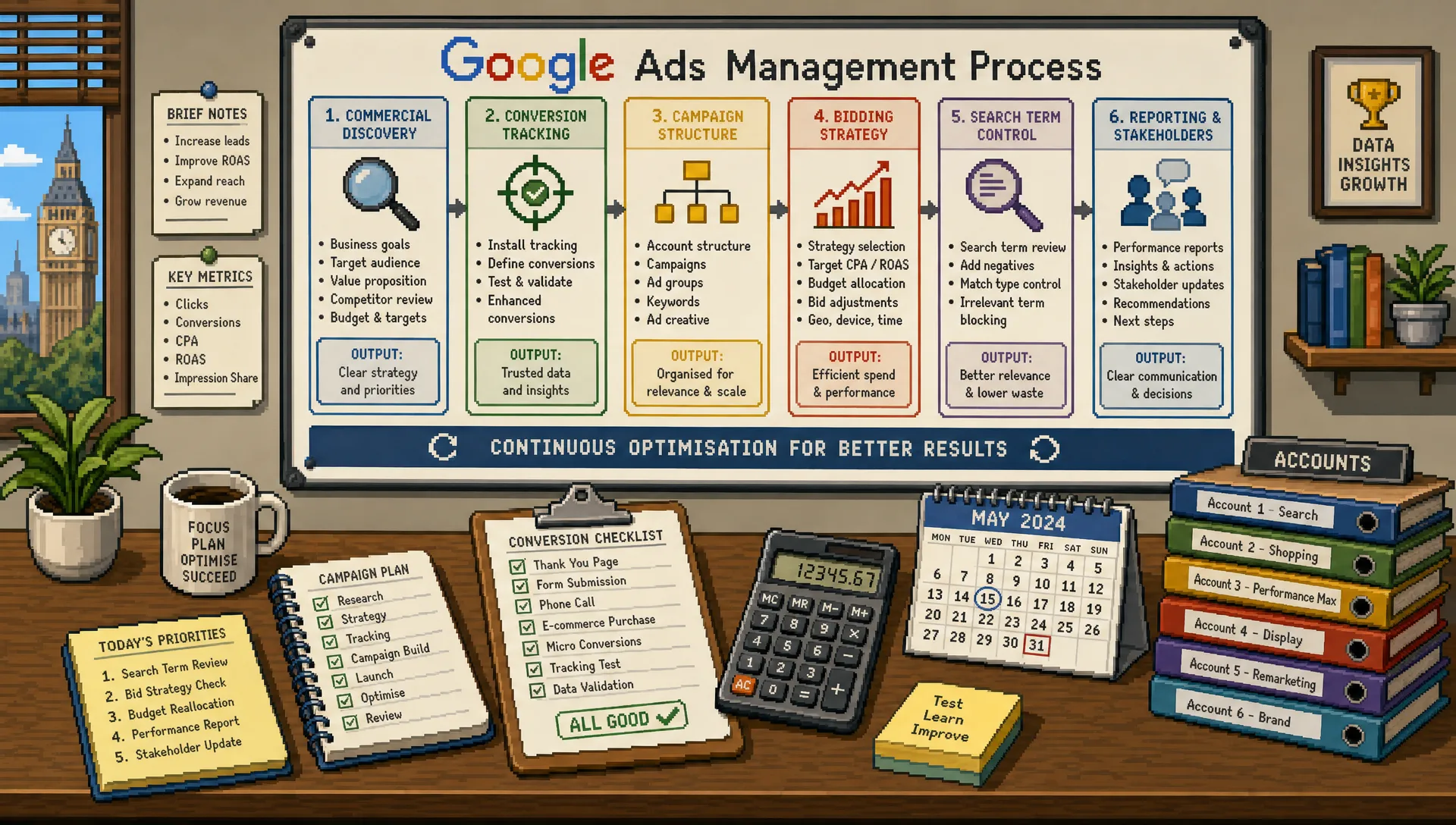
Professional Google Ads management is not simply launching campaigns, adding keywords and checking the dashboard once a week. Done properly, it is a commercial, technical and strategic discipline that connects ad spend to pipeline, revenue and client confidence.
For agencies, this matters even more. If you manage Google Ads in-house, you need a clear standard for what “good” looks like. If you outsource delivery, you need to know whether your provider is genuinely managing performance or just keeping accounts ticking over.
Below is a practical breakdown of what professional Google Ads management should include, from tracking and account structure to reporting, optimisation and stakeholder communication.
Commercial discovery before campaign setup
A professionally managed Google Ads account should begin with business context, not platform settings. Before anyone touches bidding strategies or keyword lists, they should understand what the account is meant to achieve.
That includes the client’s commercial model, margins, service areas, sales cycle, lead quality requirements and capacity constraints. A campaign that generates 100 cheap enquiries can still fail if those leads are from the wrong locations, wrong company size or wrong stage of intent.
At minimum, discovery should clarify:
- The main business goal, such as leads, booked calls, online sales, demos or store visits
- The target cost per lead, cost per acquisition or return on ad spend
- Which products, services or locations matter most commercially
- Which enquiries are unprofitable, low quality or operationally difficult
- How leads are handled after conversion, including response times and sales qualification
- Any seasonal patterns, promotions, compliance limits or brand constraints
This early stage is where professional Google Ads management separates itself from basic campaign execution. The ad account should be built around the economics of the business, not just around what the platform makes easy to launch.
Reliable conversion tracking and measurement
If tracking is wrong, optimisation becomes guesswork. One of the most important parts of professional management is making sure Google Ads is measuring meaningful actions correctly.
That usually means reviewing Google Ads conversion actions, GA4 events, form submissions, calls, ecommerce purchases, CRM events and imported offline conversions where relevant. It also means deciding which conversions should be marked as primary for bidding and which should remain secondary for observation.
Google’s own guidance on conversion tracking makes clear that conversion data helps advertisers understand what happens after someone interacts with an ad. In practice, that data is only useful if it reflects real commercial value.
A professional setup should check for common tracking problems, including duplicate conversions, missing call tracking, thank-you page reloads, unqualified micro-conversions being used for bidding, and mismatches between GA4 and Google Ads.
| Measurement area | What professional management should check | Why it matters |
|---|---|---|
| Primary conversions | Only business-critical actions are used for bidding | Prevents automation from chasing low-value actions |
| GA4 and Google Ads alignment | Events, conversions and attribution settings are reviewed | Reduces reporting confusion and data gaps |
| Call tracking | Calls from ads and landing pages are tracked where relevant | Essential for lead generation accounts |
| Offline conversions | Qualified leads or closed sales are imported where possible | Helps optimise towards quality, not just volume |
| Consent and data capture | Tracking respects privacy and consent requirements | Protects measurement quality and compliance |
For UK agencies, consent and privacy should not be an afterthought. Cookie banners, Consent Mode, GA4 configuration and CRM data handling can all influence how reliable the account’s data is.
A proper account audit and strategic roadmap
Professional management should include a structured audit, especially when taking over an existing account. This is not just a quick scan for obvious mistakes. It should assess whether the account structure, targeting, bidding, conversion tracking and budget allocation match the client’s goals.
A good audit looks at what has happened, why it happened and what should happen next. It should separate urgent fixes from longer-term improvements, so the client or agency knows what will be tackled first.
Typical audit areas include campaign structure, search terms, match types, negative keywords, bidding strategies, asset quality, landing page relevance, audience signals, budget constraints and conversion integrity.
If performance has been slipping, it is often because several small issues have compounded over time. Poor tracking, broad targeting, weak negatives and unchallenged automation can quietly drain budget. For a deeper look at those pitfalls, PPC Ghost has covered common Google Ads management mistakes that hurt ROI in more detail.
The output of an audit should be a roadmap, not a vague list of observations. Stakeholders should know which changes are expected to improve efficiency, which are designed to increase scale and which are simply housekeeping.
Campaign structure that supports control and scale
Google Ads gives advertisers many ways to group, target and automate campaigns. Professional management involves choosing the right structure for the objective, budget and data maturity of the account.
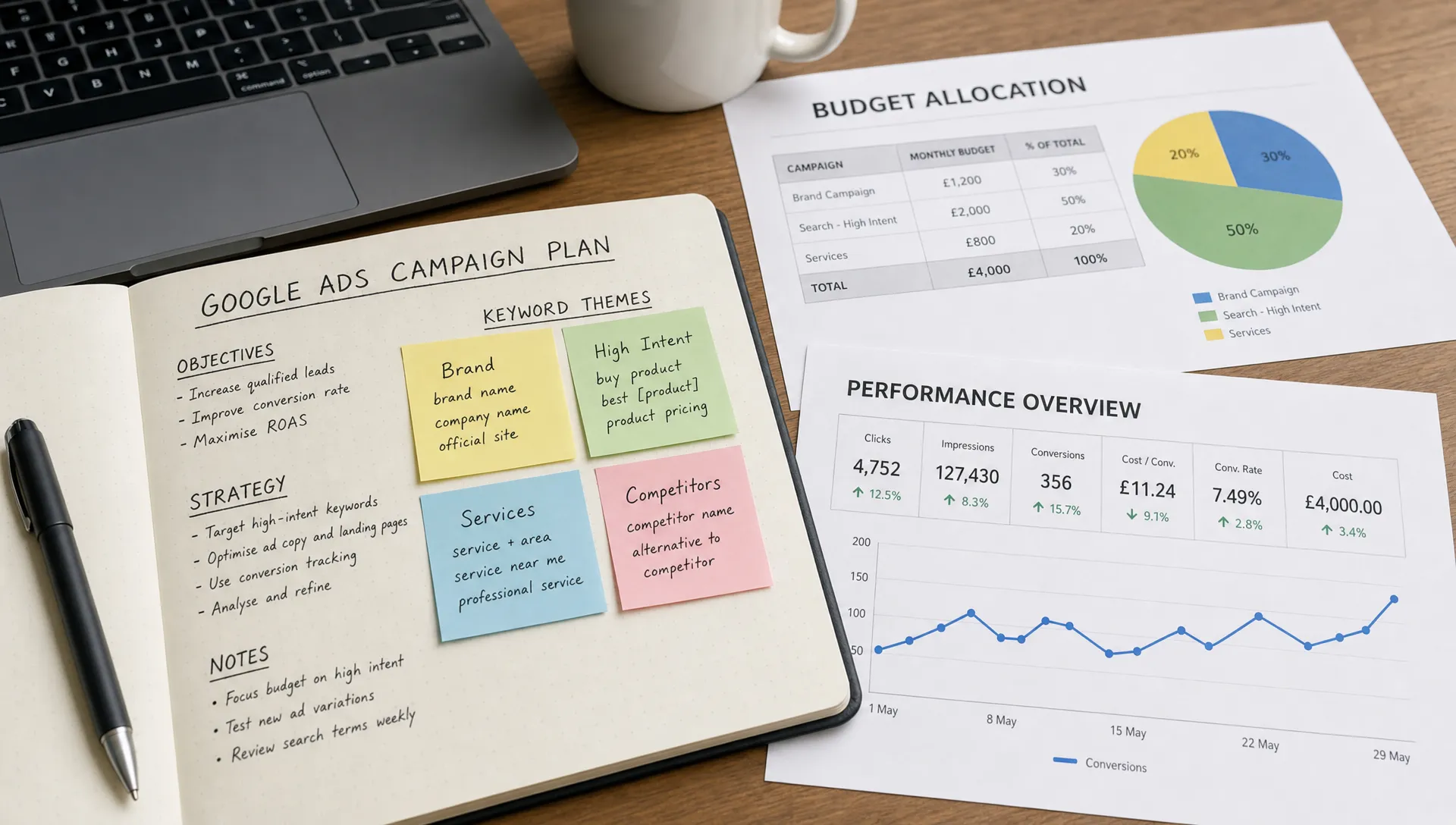
For Search campaigns, structure should usually reflect user intent. Brand terms, competitor terms, high-intent commercial queries and broader research queries often need different budgets, ads and bidding approaches. Mixing them together can make performance look better or worse than it really is.
For ecommerce, Shopping and Performance Max structures need careful thought around product margins, feed quality, product categories, stock availability and return on ad spend targets. For lead generation, structure needs to support lead quality, not just form volume.
A professional manager should also know when not to over-segment. Extremely granular structures can make accounts harder to manage and starve automated bidding of data. The right structure balances control with enough conversion volume for the platform to learn.
Good structure usually makes it easier to answer basic questions quickly: where is spend going, which themes are profitable, where is waste happening, and what can be scaled?
Budget and bidding strategy aligned with data quality
Bidding strategy should never be chosen just because it is popular. Maximise Conversions, Target CPA, Target ROAS, Maximise Conversion Value and manual approaches can all be valid in the right context.
The right choice depends on conversion volume, tracking quality, account history, budget, market competition and the value difference between conversion types. If the account has limited or unreliable data, aggressive automation can make poor decisions quickly. If the account has strong conversion data, automated bidding can help scale efficiently.
Professional management should also include budget pacing. That means monitoring whether spend is being used too quickly, underspending due to constraints, or being allocated to campaigns that are not aligned with business priorities.
A serious manager should be able to explain why a bidding strategy is being used, what data it depends on and when it should be changed.
Search term and wasted spend control
Even with automation, search term management remains a core part of professional Google Ads management. Search behaviour changes, competitors shift, and broad match can introduce queries that look acceptable at first glance but fail commercially.
A professional manager should review search terms regularly, identify irrelevant or low-intent traffic, add negative keywords and refine match type strategy. The goal is not to block every imperfect query, but to reduce avoidable waste while preserving room for discovery.
This is especially important in accounts where Google Ads is being used for lead generation. A query can produce conversions and still be poor quality if it attracts job seekers, students, suppliers, bargain hunters or people outside the service area.
Wasted spend control also extends beyond Search. Display placements, Performance Max insights, location reports, device performance, schedule performance and audience signals can all reveal budget leaks. If your agency needs a practical efficiency checklist, the PPC Ghost article on PPC Google Ads tips that cut wasted spend fast is a useful companion.
Ad copy, creative assets and landing page alignment
Professional Google Ads management should include more than bid changes. The quality of ads and landing pages has a direct impact on click-through rate, conversion rate and overall account economics.
For Search, responsive search ads should be written around intent, proof points and differentiation. Headlines should not simply repeat keywords. They should explain why the user should choose this business now.
Ad assets also need attention. Sitelinks, callouts, structured snippets, call assets, image assets and lead form assets can all improve visibility and user experience when used properly. Poorly written or outdated assets can make even a well-structured account feel generic.
Landing pages should be assessed for relevance, clarity, speed, trust signals and conversion friction. A Google Ads manager may not own the website, but they should flag issues that limit performance. If a page is slow, vague, poorly matched to the keyword or missing a clear call to action, campaign optimisation alone will only go so far.
Professional management connects message, intent and page experience. The user should feel a consistent journey from search query to ad copy to landing page.
Testing with clear hypotheses
Testing is often misunderstood. Randomly changing ads, budgets or landing pages is not a strategy. Professional management should include planned tests with clear hypotheses, success metrics and enough time to produce meaningful results.
A good test might compare a value-led ad message against a speed-led message, separate high-intent keywords into their own campaign, test a new landing page for a key service, or trial a different bidding strategy once enough conversion data is available.
Professional testing should define:
- What is being tested
- Why the test is being run
- Which metric determines success
- How long the test will run
- What decision will be made afterwards
Not every test will win. That is normal. The value comes from learning what improves efficiency, scale or lead quality, then applying those lessons across the account.
Reporting that explains performance, not just metrics
A professional Google Ads report should not be a screenshot dump or a list of numbers without context. Clients and agency stakeholders need to understand what happened, why it happened and what is being done next.
Useful reporting usually includes spend, conversions, cost per conversion, conversion value, ROAS, impression share, click-through rate and conversion rate. But these metrics need interpretation. A lower cost per lead may not be good if lead quality has dropped. A higher cost per click may be acceptable if it comes from more qualified search terms.
The best reports combine data with commentary. They explain performance changes, highlight completed actions, flag risks and recommend next steps. For agencies, this is particularly important because client communication can shape perceived value as much as platform performance.
| Report section | What it should communicate |
|---|---|
| Executive summary | The key performance story in plain English |
| KPI performance | Spend, conversions, CPA, ROAS or other agreed metrics |
| Quality indicators | Lead quality, search term relevance or sales feedback where available |
| Optimisation work | What was changed during the reporting period |
| Risks and blockers | Tracking issues, landing page problems, budget limits or market shifts |
| Next actions | The practical plan for the next period |
Professional reporting should help decision-making. If the report does not make the next step clearer, it is not doing its job.
Communication and stakeholder management
Google Ads does not operate in a vacuum. Professional management includes timely communication with clients, account managers, developers, designers and sales teams.
For agencies, this is often where delivery breaks down. The PPC specialist may know what needs fixing, but if that recommendation is buried in a report or delayed for weeks, performance suffers.
Strong communication includes clear priorities, fast responses to urgent issues, plain-English explanations and proactive flagging of risks. If tracking breaks, a campaign overspends, a landing page goes down or lead quality changes suddenly, stakeholders should hear about it quickly.
This is one reason many agencies use flexible specialist support rather than trying to hire before demand is stable. When workload spikes or an account becomes too complex, bringing in a senior specialist can protect both performance and client trust. PPC Ghost explains the warning signs in its guide to when you may need a Google Ads expert on demand.
Ongoing optimisation and account hygiene
Professional management is continuous. Markets change, competitors adjust bids, search trends move, tracking evolves and Google Ads releases new features. A campaign that performed well six months ago can become inefficient if it is left alone.
Ongoing optimisation should include routine checks across budgets, bids, search terms, ads, assets, conversion actions, recommendations, audiences, landing pages and campaign settings. It should also include judgement. Not every Google Ads recommendation should be accepted, and not every fluctuation requires a dramatic change.
Account hygiene matters too. Old experiments, unused conversions, outdated ads, messy naming conventions and duplicated campaigns can make an account harder to interpret. Clean structure and documentation help agencies work faster and reduce the risk of errors.
What should not be missing from professional Google Ads management?
If you are assessing an in-house process, freelancer or outsourced PPC partner, there are a few red flags to watch for.
Be cautious if management consists mainly of accepting platform recommendations, changing budgets without rationale, reporting only surface-level metrics or avoiding conversations about tracking. Be equally cautious if there is no clear testing plan, no search term review, no landing page feedback and no connection between ad performance and business outcomes.
Professional Google Ads management should feel commercially aware, technically sound and proactive. It should make the account easier to understand, not more confusing.
Frequently Asked Questions
What does professional Google Ads management include? Professional Google Ads management includes commercial discovery, conversion tracking, campaign structure, keyword and search term management, bidding strategy, ad copy, landing page feedback, testing, reporting and ongoing optimisation.
How often should Google Ads campaigns be optimised? Most active accounts should be reviewed weekly, with deeper analysis carried out monthly. Larger or high-spend accounts may need more frequent checks, especially when budgets, tracking or lead quality are changing quickly.
Is Google Ads management just about reducing cost per click? No. Cost per click is only one metric. Professional management focuses on profitable outcomes, such as qualified leads, sales, revenue, ROAS and pipeline quality. A higher CPC can be worthwhile if it attracts better prospects.
Should agencies outsource Google Ads management? Agencies may benefit from outsourcing when they need senior expertise, faster delivery, flexible capacity or white-label support without hiring a full-time PPC specialist. The key is choosing a provider with strong tracking, strategy and communication standards.
How do I know if my Google Ads account is being managed properly? You should see clear tracking, regular optimisation, documented changes, useful reporting and a logical plan tied to business goals. If you only receive basic metric updates with little explanation, the account may not be receiving professional management.
Need senior Google Ads support without hiring?
If your agency needs professional Google Ads execution without recruitment, long contracts or visible outsourcing, PPC Ghost provides senior, white-label PPC support on demand.
Whether you need an account audit, tracking help, campaign build, optimisation support or overflow delivery, you can bring in specialist expertise while your agency keeps the client relationship.