What Google Ads Support Can and Cannot Help With
Learn what Google Ads support can fix, where it falls short, and when agencies need expert PPC help for tracking, strategy and account issues.
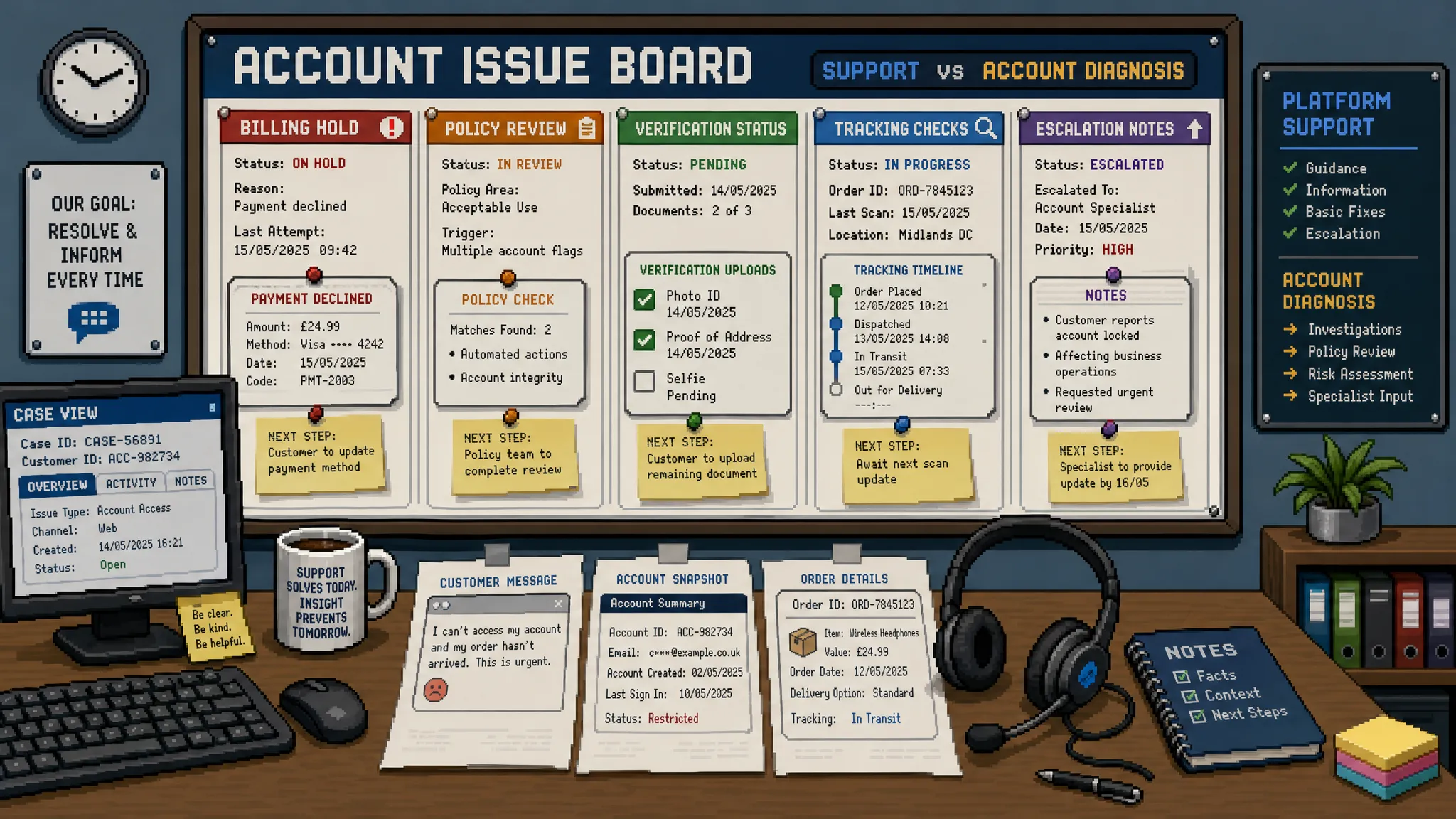
Google Ads support is useful, but it is often misunderstood.
For agencies, the difference matters. If a client account has a billing hold, an advertiser verification issue or a policy disapproval that needs clarification, support can save hours. If the problem is poor lead quality, messy conversion data, weak account structure or a client asking why spend went up while enquiries went down, Google support will not replace a senior PPC specialist.
The key is knowing when to use Google Ads support, what to ask, what evidence to prepare, and when to stop waiting for a platform answer and move into proper account diagnosis.
The short answer: Google Ads support helps with the platform, not your commercial strategy
Google Ads support is designed to help advertisers use the Google Ads platform. That includes account access, billing, policy questions, product features, basic troubleshooting and some technical escalation.
It is not designed to own your client’s profit, agency margin, lead quality, sales process or positioning. It will not build a complete PPC strategy for a niche B2B client, decide whether a campaign should be profitable at a specific CPA, or explain every auction movement in a way that satisfies a board-level stakeholder.
A helpful way to frame it is this:
| Situation | Google Ads support may help | You need PPC expertise |
|---|---|---|
| Payment declined or billing hold | Yes | Usually no |
| Account access problem | Yes | Sometimes |
| Ad disapproval or policy review | Yes, for clarification and review routes | Yes, if the offer or landing page needs fixing |
| Conversion tag not recording | Sometimes, especially for standard setup checks | Yes, for GA4, GTM, consent and CRM diagnosis |
| Poor lead quality | No | Yes |
| Campaigns spending without conversions | Only at a basic product level | Yes |
| Performance Max lacks transparency | Limited | Yes |
| Client wants a growth plan | No | Yes |
| Suspended account appeal | Yes, for appeal routes and status where available | Yes, to audit causes and reduce repeat risk |
The rest of this article breaks down the grey areas, because that is where most agency frustration happens.
What counts as Google Ads support?
When people say Google Ads support, they may mean several different things.
There is the Google Ads Help Centre, which contains documentation on account setup, billing, ads, conversion tracking, policies and troubleshooting. There are contact routes through Google’s support system, which may include chat, email or phone depending on account, location and eligibility. There may also be Google account strategists or sales teams who contact advertisers with recommendations.
Those are not all the same.
The Help Centre is documentation. It is useful for confirming how a feature is meant to work.
Front-line support is there to resolve platform questions, administrative problems and support cases.
Google reps or strategists may provide recommendations, but their incentives and visibility are not the same as an independent PPC specialist managing client outcomes. Some advice may be useful, but it still needs to be assessed against the account’s data, the client’s economics and the agency’s strategy.
For agencies, this distinction is important. If you ask a support agent a strategic question, you may receive a generic answer. If you ask a precise platform question with screenshots, account IDs, dates and examples, you are far more likely to get a useful response.
What Google Ads support can help with
Google support is at its best when the issue is specific, reproducible and clearly tied to the platform.
Account access and user permissions
Support can often help when an advertiser cannot access an account, an admin has left the business, an invitation is not arriving, or there is confusion around manager account access.
This is especially relevant for agencies taking over accounts from previous suppliers. Before contacting support, check whether the client has any admin user still attached to the account. In many cases, the fastest route is not a support case, but having the existing admin grant access to your manager account.
Support cannot usually override proper security processes just because an agency says it needs access quickly. Nor should it. If you are onboarding a client, build access checks into your kickoff process rather than discovering the problem on launch day.
Billing, payments and invoicing issues
Billing is one of the clearest use cases for Google Ads support. If a payment has failed, a card has been declined, an account is paused due to billing, or invoices are not appearing as expected, support can usually direct you to the correct next step.
For agencies, billing issues can be awkward because clients often assume the PPC manager has caused the pause. In reality, payment methods, thresholds, VAT information and billing profiles usually sit with the advertiser.
Support can help identify billing holds and payment settings. It cannot decide how your agency should handle client invoicing, media spend collection or credit risk.
Policy disapprovals and review requests
Google Ads support can help explain why an ad, asset, keyword or landing page appears to be affected by policy. It can also point you towards the correct appeal or review process.
This is useful, but there is a limit. Support cannot simply approve an ad because the client disagrees with the policy. It also cannot rewrite the landing page, adjust claims, fix missing disclosures or make a restricted business model compliant.
If an ad is disapproved, check Google’s advertising policies first, then gather exact examples. Include the campaign, ad group, ad ID, landing page and the policy shown in the interface. Vague messages such as the ads are wrong are much harder to resolve.
Advertiser verification
Advertiser verification can create real delivery delays, particularly when documentation, business names and payment profiles do not match neatly. Google support can help clarify verification steps and point advertisers towards the correct forms or status information.
However, support cannot bypass verification requirements just because a launch is urgent. Agencies should treat verification as an onboarding dependency, not an afterthought.
If the client’s legal entity, website, payment profile and ad account details are inconsistent, resolve that early. Otherwise, the support conversation may simply confirm that the account is blocked until the advertiser provides the correct information.
Basic product questions
Support can answer straightforward questions about where settings live, how to use certain features, or why a visible setting is unavailable in an account.
Examples include:
- Where to change a conversion action setting
- How to add users to an account
- Why a campaign cannot use a particular bid strategy yet
- How billing thresholds work
- How to submit an ad for review
This type of help is valuable for newer advertisers, but experienced agencies should be careful. If every operational question requires contacting support, your internal PPC processes may need tightening.
Tracking checks, within limits
Support may help with basic conversion tracking troubleshooting, such as checking whether a Google tag appears to be installed, whether a conversion action is active, or whether recent conversions have been recorded.
The limitation is that modern tracking is rarely just Google Ads.
A proper setup may involve GA4, Google Tag Manager, Consent Mode, server-side tagging, call tracking, CRM imports, offline conversion uploads and landing page forms. Platform support may point you to documentation, but it will not fully audit the client’s website, consent banner, CRM workflow and sales process.
That distinction is crucial. A tag can appear to fire, while the account still optimises towards the wrong action. Support may confirm that something is technically recording. It will not necessarily tell you whether that conversion data is commercially useful.
Known bugs and account-specific issues
Sometimes the problem really is the platform. A report may not load, a setting may fail to save, an import may stall, or an interface issue may affect an account.
Support can log cases and escalate reproducible bugs. You will get better results if you provide browser details, screenshots, affected account IDs, timestamps and a clear explanation of what you expected to happen versus what actually happened.
Do not send a long essay about general performance decline if the issue is a broken interface action. Keep platform bugs factual and narrow.
What Google Ads support cannot help with
The biggest mistake agencies make is expecting Google support to behave like an embedded strategist.
It will not, and it should not.
It cannot guarantee performance
Support cannot guarantee impressions, clicks, CPCs, conversion volume, cost per lead, ROAS or account growth. Google Ads is an auction-based platform affected by competition, budgets, bids, quality, demand, conversion rates and the offer itself.
A support agent may explain how a bidding strategy works. That is different from deciding whether the bidding strategy is right for your client.
If a campaign is spending but not converting, support may suggest checking budgets, keywords, ads, assets and conversion tracking. Useful, but basic. The deeper question is whether the campaign is targeting the right intent, using the right conversion goal, sending traffic to the right page and giving the algorithm clean enough data to optimise.
It cannot replace a proper account audit
Google support usually looks at the issue you raise. A PPC audit looks at the system.
A proper audit considers structure, search terms, match types, negative keywords, conversion actions, landing page intent, bidding, budget allocation, audience signals, asset quality, location settings, device performance, reporting and client goals.
Support may identify one visible problem. It is unlikely to map the account’s strategic weaknesses and prioritise fixes based on business impact.
It cannot make your client’s offer stronger
Many Google Ads problems are not really Google Ads problems.
A campaign may struggle because the landing page is unclear, the form is too long, the pricing is uncompetitive, the sales team is slow to respond, or the client wants cheap leads in a market where high-intent traffic is expensive.
Google support cannot fix positioning, pricing, sales follow-up or conversion rate optimisation. It can help you use the platform, but it cannot make an average offer irresistible.
It cannot settle agency-client disagreements
If a client says Google says we should increase budget, that does not automatically make it the right move. If support recommends broad match, Performance Max or a different bid strategy, the agency still needs to interpret that advice.
Support cannot decide who is right in a commercial disagreement between agency and client. It cannot validate your fee, rewrite your report or explain to the client why last month’s lead quality was weaker.
That is agency work.
It cannot reveal everything about the auction
Advertisers often want definitive answers to questions such as why did CPC rise this week, why did a competitor outrank us, or why did Performance Max spend more on one asset group.
Support can explain available reports and known diagnostics, but it cannot expose all auction mechanics, competitor data or machine learning decisions. Some parts of the system are not visible at the level advertisers would like.
This is where experience matters. A senior PPC specialist can use the available signals to form a likely diagnosis, even when Google cannot provide a perfect explanation.
It cannot implement broader automation or business systems
Some issues sit outside Google Ads entirely. For example, an agency may need to automate lead routing, connect ad data to a CRM, build internal QA workflows, or train teams to use AI safely in delivery processes. In those situations, platform support is the wrong route, and a specialist partner such as an AI agency for audits, training and custom automation may be more relevant.
The same principle applies to PPC delivery. Use Google support for Google platform issues. Use specialists for the surrounding systems that determine whether paid media actually works.
Why agencies often get poor answers from support
Sometimes support is limited. Sometimes the request is the problem.
Agencies often submit tickets that are too broad, too emotional or missing key evidence. A support agent cannot investigate performance is bad. They need a specific account, campaign, date range, error message, policy label or setting.
A weak support request looks like this: the campaign has stopped working and the client is angry, can you check it?
A strong support request looks like this: in account X, campaign Y dropped from 120 daily impressions to fewer than 10 after 14 May. No budget, bid strategy or status changes were made. Ads are eligible, billing is active and diagnostics show no policy issue. Screenshots attached. Can you check whether there is an account-level serving issue?
The second request is far more likely to get a useful answer because it narrows the issue.
How to prepare before contacting Google Ads support
Before opening a case, do your own triage. It saves time and helps you avoid looking unprepared in front of clients.
Gather the following before you contact support:
- Google Ads customer ID and manager account details where relevant
- Campaign, ad group, ad, asset or conversion action names
- Date range when the issue started
- Screenshots of errors, disapprovals or unusual behaviour
- Recent change history checks
- Billing and policy status checks
- Landing page URLs affected
- Browser and device details for interface bugs
- A short explanation of what you have already tested
Keep the request focused on one issue. If you combine billing, policy, tracking and performance in one ticket, the conversation will drift and resolution will slow down.
Also, never share passwords. Use proper account access, user permissions and manager account links. This protects the client, the agency and the account history.
When to stop waiting for support and bring in a PPC specialist
There is a point where continuing to ask support becomes a delay tactic. The platform is not broken. The account needs expert work.
You should escalate beyond Google support when:
- The account is spending but not producing qualified leads
- Conversion tracking is recording actions, but the data does not match commercial reality
- Search terms show irrelevant traffic and wasted spend
- Performance Max is consuming budget without clear insight
- The client needs a recovery plan, not a help article
- Multiple support conversations have produced generic recommendations
- You need someone to explain the issue clearly to your internal team before the next client call
For agencies, this is where white-label PPC support can be more useful than another support ticket. The problem is not access to Google’s documentation. The problem is capacity, senior judgement and execution.
FAQ
Is Google Ads support free? Google provides support routes and documentation for advertisers, although availability and contact options can vary by account, region and issue. The bigger cost is often the time spent chasing answers when the issue actually needs strategic PPC diagnosis.
Can Google Ads support fix conversion tracking? It can help with basic checks and point you towards relevant setup guidance. It usually will not provide a full technical audit across GA4, GTM, consent tools, CRM imports and offline conversion workflows.
Can support get disapproved ads approved? Support can help explain policy labels and direct you to review or appeal routes. It cannot guarantee approval or bypass Google Ads policies if the ad, landing page or business model does not comply.
Should agencies follow every Google Ads support recommendation? No. Treat recommendations as inputs, not instructions. Review them against the client’s goals, conversion data, budget, margins and lead quality before making changes.
When should I contact Google Ads support instead of a PPC expert? Contact support for account access, billing, policy clarification, verification steps, platform bugs and narrow technical questions. Bring in a PPC expert when the issue involves performance, strategy, tracking quality, wasted spend or client communication.
Need senior Google Ads support without adding headcount?
Google Ads support has its place, but it is not a substitute for senior PPC delivery.
If your agency needs help diagnosing accounts, fixing tracking issues, reducing wasted spend or delivering Google, Meta or Microsoft Ads work under your brand, PPC Ghost provides white-label PPC expertise on demand. You get senior-only support, flexible scaling and pay-as-you-go delivery, without recruitment or long-term contracts.
When the platform issue is real, contact Google. When the account needs experienced hands, bring in a specialist who can help you move faster and keep the client relationship with your agency.