What a PPC Expert Actually Does for Agency Clients
Learn what a PPC expert does for agency clients, from tracking and campaign builds to optimisation, reporting and white-label delivery.
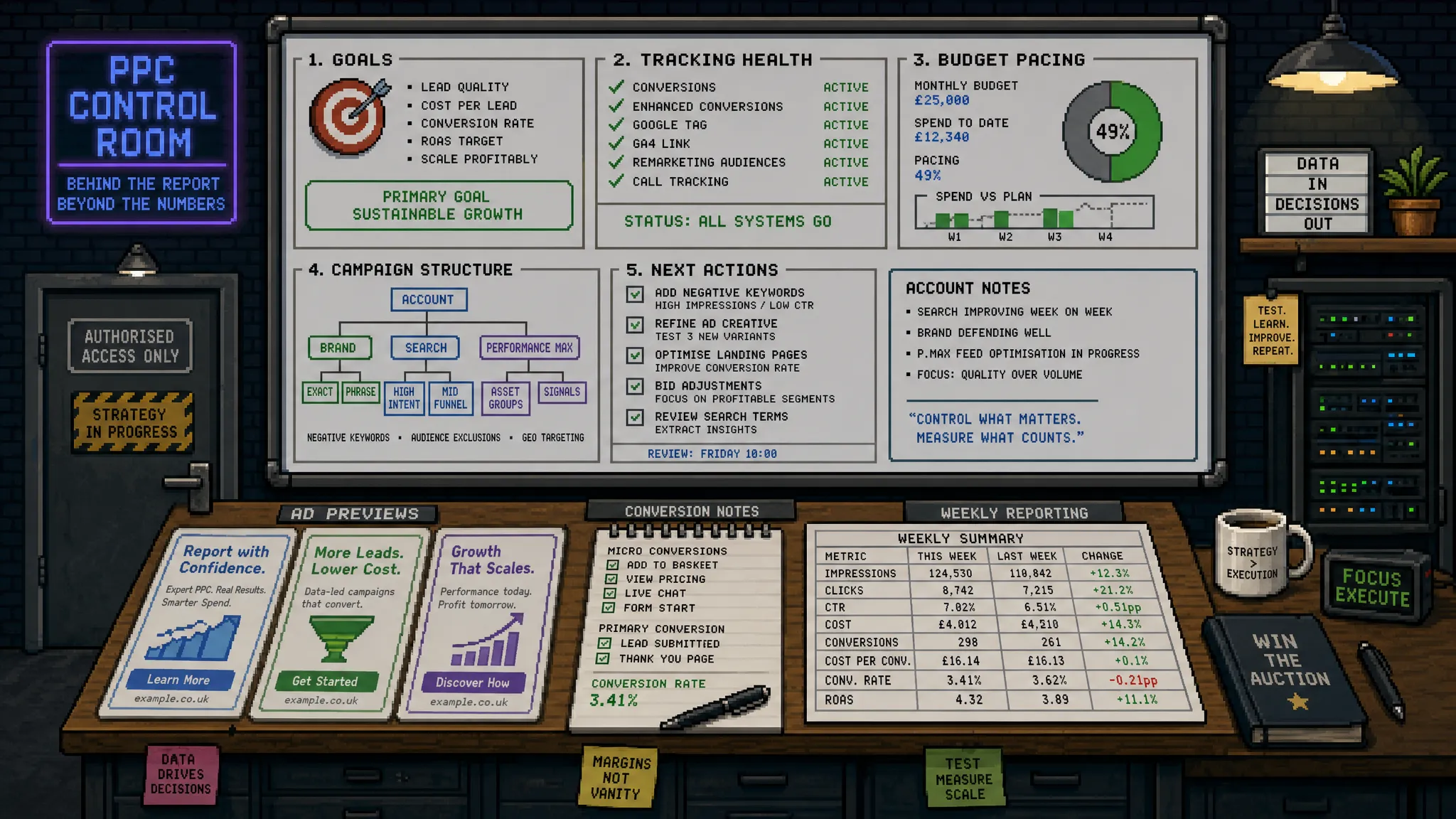
For agency clients, the visible part of PPC is usually a report, a few ad previews, and a monthly conversation about leads, sales, or spend. The real work happens behind the scenes.
A PPC expert is not simply the person who logs into Google Ads or Meta Ads Manager and presses publish. For an agency, the role is closer to a commercial operator: someone who turns client goals into measurable campaigns, protects media spend, spots tracking issues, and gives account managers clear recommendations they can confidently take back to the client.
That distinction matters. If your agency sells PPC, your client is not just buying platform access. They are buying judgement, prioritisation, and control over paid media risk.
The short answer: a PPC expert turns goals into controlled ad execution
A good PPC expert helps agency clients answer three practical questions:
- What are we trying to achieve commercially?
- How do we structure campaigns so the platforms can spend efficiently?
- What decisions should we make next based on the data?
That applies whether the channel is Google Ads, Meta Ads, Microsoft Ads, or a mix of all three. The tools change, but the core job is the same: connect the client’s business model to paid media activity in a way that can be measured, improved, and explained.
For agencies, this is especially important because the PPC expert often supports more than performance. They protect the client relationship. A poorly built account can waste budget, but unclear communication can damage trust even faster.
They clarify what success actually means
Before touching campaigns, a PPC expert should understand what the client really wants. Not just “more leads” or “more sales”, but the type of leads, the value of those sales, the available budget, the sales cycle, and the point at which PPC becomes commercially viable.
For example, a local service business may care about qualified phone calls more than form fills. An ecommerce client may care about profit margin rather than headline revenue. A B2B SaaS client may need demo requests, but only from companies of a certain size or market.
This is where many weak PPC projects go wrong. The agency launches campaigns around a vague objective, then has to defend results that were never properly defined. A PPC expert reduces that risk by asking sharper questions early.
Typical questions include:
- Which products or services should we prioritise first?
- What locations, audiences, or industries should we exclude?
- What counts as a valuable conversion?
- How quickly does the client respond to leads?
- What is the acceptable cost per lead, sale, or opportunity?
- Are there compliance, brand, or legal constraints around ad messaging?
The commercial context matters. For instance, a rights-holder or licensing business may need a very different acquisition journey from a simple ecommerce store, especially if growth depends on identifying, enforcing, and monetising IP usage through workflows like those supported by Third Chair. A PPC expert needs to understand these differences before deciding what to advertise and how to measure success.
They check tracking before judging performance
A senior PPC expert will rarely trust performance data blindly. One of the first jobs is to check whether the account is measuring the right actions accurately.
That includes reviewing conversion tags, GA4 events, Google Ads conversions, Meta Pixel data, Microsoft Ads tracking, consent behaviour, call tracking, ecommerce revenue, form submissions, and CRM handover where relevant. The goal is not to create a perfect analytics setup for its own sake. The goal is to avoid making expensive decisions based on broken data.
If a campaign appears to be generating cheap leads, but half of those conversions are page views or duplicate form events, the agency has a problem. If a campaign appears to be failing, but the thank-you page tag has stopped firing, the agency may pause activity that was actually working.
Good PPC work starts with measurement confidence. Without it, optimisation becomes guesswork.
| Tracking area | What the PPC expert checks | Why it matters to the agency |
|---|---|---|
| Conversion actions | Whether conversions reflect real business value | Prevents reporting inflated or misleading results |
| GA4 events | Whether key events are firing consistently | Helps connect ad traffic to on-site behaviour |
| Attribution settings | Whether results are being interpreted fairly | Reduces confusion between platforms and reports |
| Lead quality signals | Whether leads are useful after submission | Moves the conversation beyond volume alone |
| Consent and tag health | Whether tracking gaps are affecting decisions | Protects budget from data-driven mistakes |
For agencies under pressure, this tracking layer can be the difference between calm optimisation and reactive firefighting.
They build campaign structures that match intent
Campaign structure is one of the clearest differences between a junior operator and a seasoned PPC expert. Anyone can create a campaign. Fewer people can structure an account so budget, bidding, targeting, and messaging all support the client’s commercial priorities.
In Google Ads, that might mean separating high-intent search terms from broader research queries, using negative keywords properly, and making sure Performance Max is not swallowing budget before the basics are proven. In Meta Ads, it may mean choosing a simpler structure that gives the algorithm enough data while still allowing useful creative testing. In Microsoft Ads, it may mean using the channel to capture incremental demand rather than copying Google campaigns without thought.
The expert is not trying to make the account look complex. In fact, strong PPC structures are often simpler than clients expect. The aim is control.
A practical structure should make it clear:
- Which campaigns are responsible for which business outcomes
- Where budget is being spent
- Which audiences or keywords are being tested
- Which conversion actions are influencing bidding
- Where the next optimisation decision will come from
This is why PPC experts often push back on rushed campaign launches. If the structure is messy at the start, every later report becomes harder to explain.
They manage spend like it is the client’s money
Because it is.
A PPC expert is responsible for budget pacing, spend allocation, bid strategy choices, and waste reduction. That does not mean obsessively cutting cost at the expense of growth. It means making sure spend goes towards the areas most likely to create value.
In practice, this can include pausing irrelevant search terms, excluding poor-fit locations, adjusting budgets across campaigns, reviewing audience performance, checking placement quality, and avoiding blind trust in platform recommendations.
Modern ad platforms are increasingly automated. Smart Bidding, broad match, Advantage+ campaigns, and Performance Max can all be useful, but they need clean inputs and clear guardrails. The expert’s job is not to fight automation for the sake of it. It is to make automation work within the commercial reality of the account.
That often means asking questions such as:
- Is the campaign optimising towards a meaningful conversion?
- Does the platform have enough data to support this bid strategy?
- Are we giving too much budget to low-quality inventory?
- Is the cost per acquisition acceptable once lead quality is considered?
- Are we scaling because performance is strong, or because the platform recommends it?
If you want a deeper view of budget and commercial planning, PPC Ghost has also covered Google PPC pricing for agencies, including how to separate media spend from delivery costs.
They improve messaging, creative, and landing page alignment
PPC is not only about settings. A campaign can be technically clean and still fail if the offer, ad copy, creative, or landing page does not match the user’s intent.
A PPC expert looks at the full journey. What did the user search for? What did the ad promise? What happens when they land on the page? Is the call to action obvious? Does the page answer the objection the user is likely to have at that moment?
For search campaigns, this might involve tightening headlines around specific pain points, reflecting local or industry intent, and making sure ad extensions support the conversion goal. For Meta campaigns, it may involve testing different creative angles, formats, hooks, proof points, or offers.
The expert does not need to replace the agency’s copywriter, designer, or strategist. Their value is in spotting the performance gap. They can say, “The traffic is relevant, but the landing page is asking for too much too soon,” or “The creative is generating clicks, but the comments and conversion rate suggest the offer is unclear.”
That kind of feedback helps the whole agency team improve the client account, not just the media buying.
They optimise on a rhythm, not at random
Strong PPC management has a cadence. The expert knows what needs checking daily, weekly, monthly, and after major changes. This prevents two common problems: neglecting the account until performance drops, or making so many small changes that no test has time to produce meaningful data.
| Cadence | Typical PPC expert activity | Agency benefit |
|---|---|---|
| Daily or near-daily | Check spend, disapprovals, tracking alerts, major performance swings | Catches urgent issues before clients notice them |
| Weekly | Review search terms, budgets, creative performance, lead quality, pacing | Keeps optimisation consistent and explainable |
| Fortnightly | Assess tests, landing page issues, audience signals, bid strategy performance | Turns data into useful next steps |
| Monthly | Summarise results, decisions, risks, and future priorities | Gives account managers a clear client narrative |
| Quarterly | Revisit strategy, channel mix, budget levels, and growth opportunities | Keeps PPC aligned with wider business goals |
The best PPC experts are disciplined. They do not change bids, budgets, keywords, and creative all at once unless there is a clear reason. They understand conversion lag, learning periods, seasonality, and the danger of overreacting to small data sets.
For an agency, that discipline is valuable because it creates a defensible story. If the client asks what has changed and why, there is an answer.
They translate data into client-ready recommendations
Reporting is not just exporting numbers from ad platforms. A PPC expert should help the agency explain what happened, why it happened, and what should happen next.
Clients rarely need a wall of metrics. They need clarity. Did spend increase because volume improved or because efficiency dropped? Did cost per lead rise because competition changed, tracking changed, or lead quality improved? Are we recommending more budget, a new landing page, different creative, or a tighter campaign focus?
A useful PPC report should usually include:
- Performance against the agreed objective
- Key changes made during the period
- What the data suggests
- What risks or limitations exist
- What the next actions are
This is where white-label PPC support can be especially useful. The PPC expert can work in the background, while the agency keeps ownership of the relationship and presents the recommendations in its own voice.
If the client is happy, the agency gets the credit. If there is a challenge, the agency has senior technical support behind the scenes.
They protect the agency from avoidable mistakes
Agency clients often judge PPC harshly because money is visibly leaving the account every day. A mistake in organic social might be inconvenient. A mistake in PPC can be expensive by lunchtime.
A PPC expert reduces the risk of common problems such as poor conversion tracking, irrelevant search queries, weak location targeting, duplicated campaigns, budget leakage, disapproved ads, untested landing pages, and confusing reports.
They also know when not to act. That is underrated. Sometimes the right move is to wait for more data, avoid resetting a bid strategy, or resist a client request that would damage performance.
A good PPC expert should not:
- Promise guaranteed results from a fixed spend
- Follow every platform recommendation without review
- Hide weak performance behind jargon
- Make major changes without a clear reason
- Treat tracking as optional
- Report leads without caring about quality
This judgement is what agencies are really buying when they hire senior PPC support.
In-house, freelance, or white-label: the role changes slightly
The core work is similar, but the delivery model affects how a PPC expert supports agency clients.
An in-house PPC specialist is embedded in the agency team. They may attend internal meetings, support pitches, manage delivery processes, and stay close to account managers. This can work well when the agency has consistent PPC demand and enough margin to support a permanent hire.
A freelance PPC expert offers more flexibility. They can cover overflow, specialist projects, audits, launches, or periods of increased demand. The challenge is finding someone senior, reliable, and comfortable working with agency workflows.
A white-label PPC expert works behind the agency brand. This model is particularly useful when the agency wants to sell or retain PPC services without recruiting, training, or exposing the client to an external contractor. The client sees the agency. The expert supports delivery in the background.
That is the space PPC Ghost is built for: senior PPC execution on demand for agencies, including Google Ads, Meta Ads, Microsoft Ads, and GA4 or tracking support. The model is designed for agencies that need flexible capacity, white-label delivery, and no long-term recruitment commitment.
For more detail on service expectations, you can read PPC Ghost’s guide on what to expect from PPC management UK services.
When should an agency bring in a PPC expert?
An agency does not need to wait until an account is in trouble. In fact, the best time to involve a PPC expert is often before performance becomes a client issue.
Common triggers include taking on a new PPC client, pitching for paid media work, launching campaigns in a new platform, losing internal capacity, dealing with tracking uncertainty, seeing lead quality decline, or needing a second opinion on an underperforming account.
A PPC expert can also help when the agency is growing faster than its delivery team. Hiring takes time. Training takes longer. Client deadlines do not wait. Flexible PPC support gives the agency a way to say yes to opportunities without overloading the existing team.
That does not mean every task needs a senior specialist. But strategy, tracking, account structure, optimisation decisions, and client-sensitive reporting all benefit from experienced judgement.
What agency clients should expect to feel
Clients may not see every search term review, tracking check, naming convention, or bid strategy decision. But they should feel the impact.
They should feel that campaigns are under control. They should receive clearer explanations. They should see fewer obvious mistakes. They should understand why decisions are being made. They should have confidence that their budget is being actively managed, not simply spent.
For the agency, the benefit is similar. A good PPC expert gives account managers confidence, reduces delivery stress, improves client conversations, and creates more room for strategic growth.
That is what a PPC expert actually does for agency clients. They do not just manage ads. They manage the paid media system that sits between the client’s commercial goals and the platforms spending the money.
Frequently Asked Questions
What does a PPC expert do day to day? A PPC expert reviews performance, checks spend and tracking, analyses search terms or audience data, adjusts campaigns, plans tests, improves ad messaging, and prepares recommendations for the agency or client.
Does a PPC expert only work on Google Ads? No. Many PPC experts work across Google Ads, Meta Ads, Microsoft Ads, and tracking tools such as GA4. The right mix depends on the client’s goals, budget, audience, and sales journey.
How is a PPC expert different from a general digital marketer? A PPC expert focuses specifically on paid media performance, platform setup, bidding, tracking, budget control, and optimisation. A general marketer may understand the wider strategy but not the technical detail of paid ad execution.
Can a PPC expert work white-label for an agency? Yes. A white-label PPC expert works behind the agency’s brand, allowing the agency to offer PPC services while keeping the client relationship and credit.
When should an agency outsource PPC delivery? Outsourcing can make sense when the agency lacks internal capacity, needs senior expertise quickly, wants to avoid recruitment, or needs reliable support for campaign launches, audits, optimisation, and reporting.
Need senior PPC support behind the scenes?
If your agency needs expert PPC delivery without hiring, PPC Ghost provides white-label, on-demand support across Google Ads, Meta Ads, Microsoft Ads, and tracking.
You keep the client relationship. PPC Ghost supports the execution in the background, anonymously and flexibly, so your agency can deliver with confidence.