What to Look for in a White Label Google Ads Agency
Learn what to look for in a white label Google Ads agency, from senior expertise and tracking to reporting, discretion, and scalability.
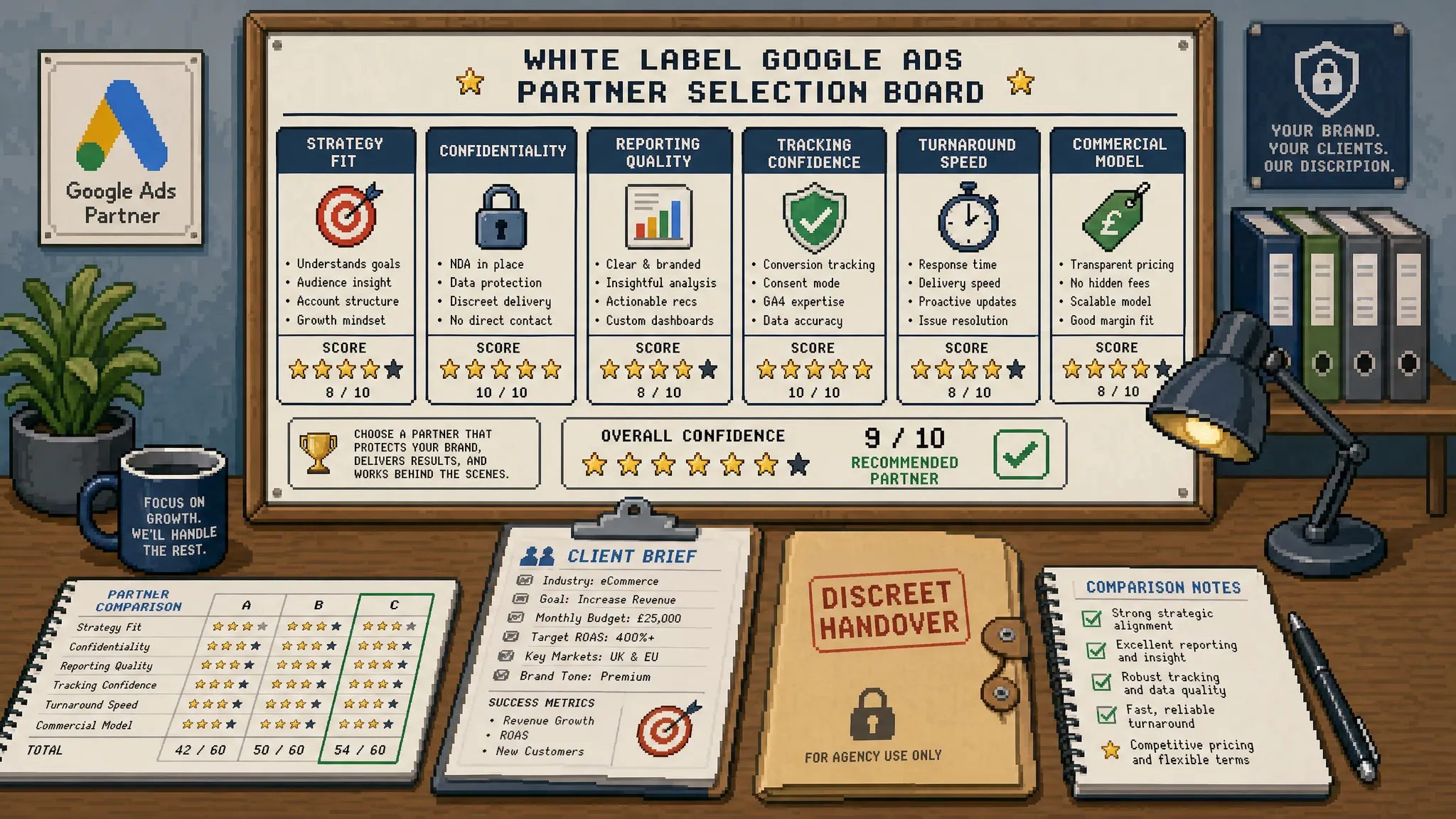
Choosing a white label Google Ads agency is a high-stakes decision because your client will never judge the partner directly. They will judge you.
The right partner gives your agency extra delivery capacity, sharper paid search expertise, and the confidence to say yes to more work without rushing into recruitment. The wrong partner creates hidden problems: slow turnarounds, weak optimisation, unclear reporting, poor tracking, and awkward client conversations that land back on your desk.
So the question is not simply, “Can they run Google Ads?” It is, “Can they protect our reputation while improving client performance?”
Below is a practical evaluation framework for agency owners, account directors, and delivery leads who need a dependable white label Google Ads agency, not just another outsourced supplier.
Why white label makes the decision different
Hiring a normal PPC supplier is mostly about performance and cost. Hiring a white label PPC partner is about performance, confidentiality, communication, process, and trust.
A white label partner works behind your brand. That means they need to fit into your agency’s way of working, support your client relationships, and deliver work that feels like it came from your internal team. Even if they never speak to your client, their output shapes how the client perceives your agency.
This is why the best white label Google Ads agency is rarely the cheapest option. It is the one that reduces delivery risk while giving you access to senior expertise when you need it.
If your agency is already weighing up whether to hire, outsource, or use flexible delivery support, it is worth understanding why white label PPC management helps agencies scale before you compare providers.
Look for strategic thinking, not just account maintenance
A good white label Google Ads agency should do more than keep campaigns running. They should be able to understand the client’s commercial reality and make paid search decisions accordingly.
That means asking questions such as:
- Which products, services, or locations are most profitable?
- What does a qualified lead actually look like?
- Which conversions matter most to the client’s sales team?
- Is the goal efficiency, volume, market share, or testing a new offer?
- How much conversion data is reliable enough to guide bidding?
A weak partner goes straight into keywords, budgets, and ad copy. A strong partner starts with business context, then builds the account around it.
This matters even more when your agency works with ambitious brands where PPC is only one part of the growth picture. For example, agencies supporting challenger brands often need paid media to align with positioning, messaging, and go-to-market strategy, the type of joined-up thinking championed by brand growth agencies like Boil®.
Google Ads execution should never sit in a silo. It should support the wider commercial direction your agency has agreed with the client.
Prioritise senior Google Ads experience
White label work often arrives when something important is happening. A new client has signed. A campaign needs rescuing. A pitch has turned into a live account. A team member has left. A client wants answers quickly.
In those situations, junior delivery is risky. You need someone who can review an account quickly, spot the real issue, and make sensible changes without overcomplicating the process.
Senior Google Ads expertise usually shows up in how someone thinks, not just what certifications they list. Look for evidence that they understand:
- Search intent and query quality
- Match types and negative keyword strategy
- Performance Max strengths and limitations
- Shopping feed and ecommerce considerations
- Lead generation quality and CRM feedback loops
- Budget pacing and bid strategy learning periods
- Conversion tracking, attribution, and data quality
- Landing page relevance and offer-message fit
You do not need a partner who makes every account look clever. You need a partner who makes every account more commercially disciplined.
When evaluating a white label Google Ads agency, ask them to talk through how they would approach a messy account. Their answer will tell you far more than a polished case study.
Check whether their white label process is genuinely discreet
Some PPC freelancers and agencies say they offer white label support, but their process is not built for it. True white label delivery requires operational discipline.
You need clarity on how they handle access, communication, documentation, reporting, and client confidentiality. If they are casual about these details at the start, they may create friction later.
A reliable partner should be able to explain:
| White label area | What to clarify before working together |
|---|---|
| Client visibility | Whether they ever contact clients directly, and under what circumstances |
| Account access | How they request and manage Google Ads, GA4, Tag Manager, or Merchant Center access |
| Documentation | Whether notes, recommendations, and changes are written in a way your team can use |
| Branding | Whether reports, audits, and updates can be delivered without their branding |
| Communication | How they update your team, and how quickly they respond to urgent requests |
| Ownership | Whether your agency and client retain ownership of ad accounts, data, and assets |
The best partners are almost invisible to the client, but highly visible to your internal team. You should always know what is happening, what changed, and why.
Make measurement and tracking a non-negotiable
Google Ads performance is only as good as the data feeding it. If your white label partner cannot confidently discuss conversion tracking, you are taking on unnecessary risk.
This does not mean every PPC specialist needs to be a full analytics engineer. It does mean they should understand how tracking affects campaign decisions.
At a minimum, they should be comfortable reviewing conversion actions, checking whether goals are primary or secondary, spotting duplicate conversions, and identifying when imported GA4 data may not match Google Ads data exactly. They should also know when to involve a developer or analytics specialist rather than guessing.
For lead generation clients, the key issue is often not lead volume. It is lead quality. A partner should be able to help your agency think through how form fills, calls, booked appointments, qualified leads, and closed deals connect back to paid search activity.
For ecommerce clients, they should understand the difference between revenue, profit, return on ad spend, average order value, and customer lifetime value. ROAS can look healthy while profit is weak, especially when discounting, returns, or low-margin products are involved.
Good tracking protects your decisions. Poor tracking makes even the best optimisation look uncertain.
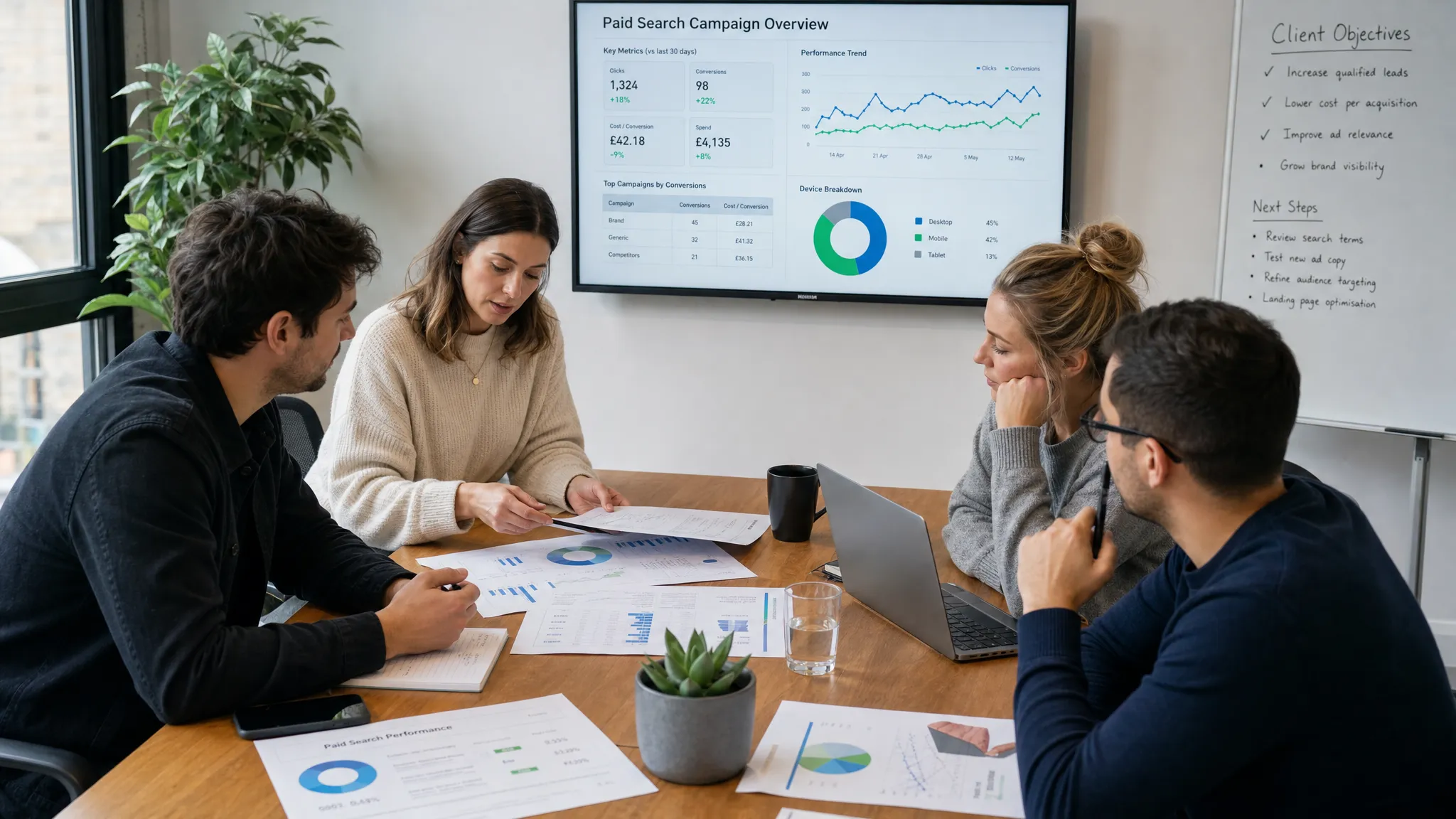
Expect reporting that helps you retain clients
Reporting is not just a monthly deliverable. It is one of the main ways clients decide whether your agency is in control.
A strong white label Google Ads agency should provide reporting input that your account managers can confidently translate into client-facing updates. The best reports do not simply list impressions, clicks, cost, and conversions. They explain what happened, why it happened, what has been done, and what should happen next.
That commentary matters. Clients rarely leave because one metric moved in the wrong direction for a week. They leave when they lose confidence that the agency understands what is happening.
If retention is a priority for your agency, it is worth looking at how a Google Ads PPC agency supports client retention through better optimisation, cleaner tracking, and clearer communication.
A useful white label reporting process should make your team sound informed, proactive, and commercially aware. If the partner sends vague updates, your account managers will be forced to fill in the gaps.
Test their speed, but do not reward rushed work
Fast turnaround is one of the biggest reasons agencies use white label support. When client requests pile up, the ability to get senior PPC help quickly can protect both revenue and reputation.
But speed only matters if the work is accurate. A same-day account review that misses a broken conversion action is not valuable. A fast campaign launch with poor naming conventions and weak QA creates more work later.
The ideal partner has a clear operating rhythm. They can handle urgent tasks quickly, but they also have enough process to avoid avoidable mistakes.
Before you commit, ask how they manage:
- New campaign build checks
- Tracking checks before launch
- Budget and bidding reviews
- Search term and placement reviews
- Ad approval issues
- Urgent client questions
- Handover notes for your account managers
This is especially important if your agency sells PPC as part of a broader digital package. Your client may not see the complexity behind delivery, but they will notice missed deadlines and inconsistent answers.
Understand how they approach budget responsibility
A good white label Google Ads agency treats client budget like real money, not platform data.
That sounds obvious, but it is a major difference between average and senior PPC support. Senior specialists think carefully before making changes that could destabilise performance. They understand when to test, when to consolidate, when to hold steady, and when to challenge the brief.
Look for signs that the partner respects budget responsibility. For example, they should be able to explain how they would handle under-spending, over-spending, limited conversion data, campaign learning phases, and sudden performance drops.
They should also be willing to say when a budget is unlikely to support the client’s goals. This is where a good partner protects your agency. Instead of simply accepting unrealistic expectations, they help you frame the commercial reality before it becomes a retention problem.
For UK agencies in particular, trust and expectation management are central to the client relationship. If that is a key concern, this guide on how to pick a PPC agency UK clients will trust explores the trust signals that matter most.
Make sure the commercial model matches agency reality
Many agencies do not need a full-time PPC hire. They need flexible senior support that can expand or contract depending on client demand.
That is why the commercial model matters. A white label Google Ads agency should not force you into a structure that creates margin pressure or unnecessary commitment. Before choosing a partner, get clear on how pricing works, how ad hoc tasks are handled, and whether there are minimum commitments.
The right model depends on your workload:
| Agency situation | Best-fit support model |
|---|---|
| Occasional PPC overflow | Ad hoc or pay-as-you-go expert support |
| Regular campaign management | Monthly white label management arrangement |
| New client onboarding | One-off audit, setup, or rebuild project |
| Pitch support | Strategic input, forecasting, or account review before proposal |
| Tracking issues | Short-term GA4, Tag Manager, or conversion tracking support |
Avoid judging price in isolation. A cheaper partner who needs constant checking may cost more in management time than a senior partner with a higher day rate or project fee.
Your goal is not just to buy PPC tasks. Your goal is to protect margin, reduce delivery stress, and maintain client confidence.
Watch for red flags early
Most problematic partnerships show warning signs before the first invoice is paid. The difficulty is that agencies often ignore those signs when they need capacity quickly.
Be cautious if a potential white label partner:
- Promises guaranteed results without understanding the account, market, or budget
- Talks mainly about platform tactics and rarely about business goals
- Cannot explain how they handle white label confidentiality
- Has no clear process for QA, reporting, or task handover
- Avoids discussing tracking quality or conversion reliability
- Pushes one campaign structure as the answer for every client
- Provides updates that are too vague for your team to use
- Seems uncomfortable working behind another agency’s brand
None of these automatically means the partner is incapable. But they do mean you should slow down, ask better questions, and avoid handing over sensitive client work too quickly.
Use a trial project before handing over key accounts
If possible, start with a contained piece of work before moving into ongoing management. A trial project gives you a realistic view of how the partner thinks, communicates, and delivers.
Good trial projects include an account audit, a campaign rebuild, a tracking review, a search term waste analysis, or support for a new campaign launch. These projects are specific enough to evaluate quality, but not so large that your agency becomes dependent before trust is established.
During the trial, pay attention to the working experience as much as the output. Did they ask sensible questions? Did they explain their reasoning? Were their notes useful? Did they meet the agreed deadline? Did your account manager feel more confident after receiving their input?
The best white label Google Ads agency should make your internal team feel calmer, not busier.
A practical selection checklist
When you are comparing partners, use a simple scoring framework. This keeps the decision grounded and reduces the temptation to choose based on personality, price, or availability alone.
| Evaluation factor | What good looks like |
|---|---|
| Google Ads expertise | Senior-level understanding of strategy, structure, bidding, search intent, and optimisation |
| White label fit | Clear confidentiality, no unwanted client visibility, and agency-friendly communication |
| Tracking knowledge | Comfortable with conversion actions, GA4, Tag Manager, attribution, and data quality issues |
| Commercial awareness | Understands margins, lead quality, sales outcomes, and realistic expectations |
| Reporting support | Provides clear commentary your team can turn into client-facing updates |
| Turnaround | Fast enough for agency deadlines without skipping QA |
| Flexibility | Can support audits, builds, management, overflow, or urgent fixes as needed |
| Ownership | Keeps accounts, data, assets, and client relationships under your agency’s control |
If a partner scores well across these areas, they are far more likely to strengthen your agency than simply remove tasks from your to-do list.
Frequently Asked Questions
What is a white label Google Ads agency? A white label Google Ads agency manages or supports Google Ads work on behalf of another agency, usually without appearing directly to the end client. The client sees the service as part of your agency’s delivery.
How is a white label PPC partner different from a freelancer? A freelancer may offer PPC delivery, but a true white label partner is set up to work discreetly behind your brand, provide agency-friendly communication, and support your client relationships without creating visibility or ownership issues.
Should a white label Google Ads agency speak directly to my clients? In most cases, no. The default should be that they support your team behind the scenes. If client contact is ever needed, it should be agreed in advance with clear boundaries.
What should I ask before hiring a white label Google Ads agency? Ask about their Google Ads experience, white label process, reporting style, tracking knowledge, turnaround times, account access requirements, confidentiality, and how they handle urgent performance issues.
Is white label Google Ads support better than hiring in-house? It depends on your workload. If you have consistent demand and management capacity, hiring may make sense. If demand fluctuates or you need senior expertise without recruitment risk, white label support can be a more flexible option.
Need senior white label PPC support?
The right white label Google Ads agency should protect your reputation, improve delivery quality, and help your team say yes to the right opportunities without overloading internal resource.
PPC Ghost provides on-demand, white-label PPC expertise for agencies, including Google Ads, Meta Ads, Microsoft Ads, and tracking support. If you need senior-only execution without recruitment, long-term contracts, or visible client handover, it is built for exactly that kind of agency support.