When White Label for Agencies Makes Commercial Sense
White label for agencies can protect margins, add senior PPC capacity and reduce hiring risk. Learn when it makes commercial sense.
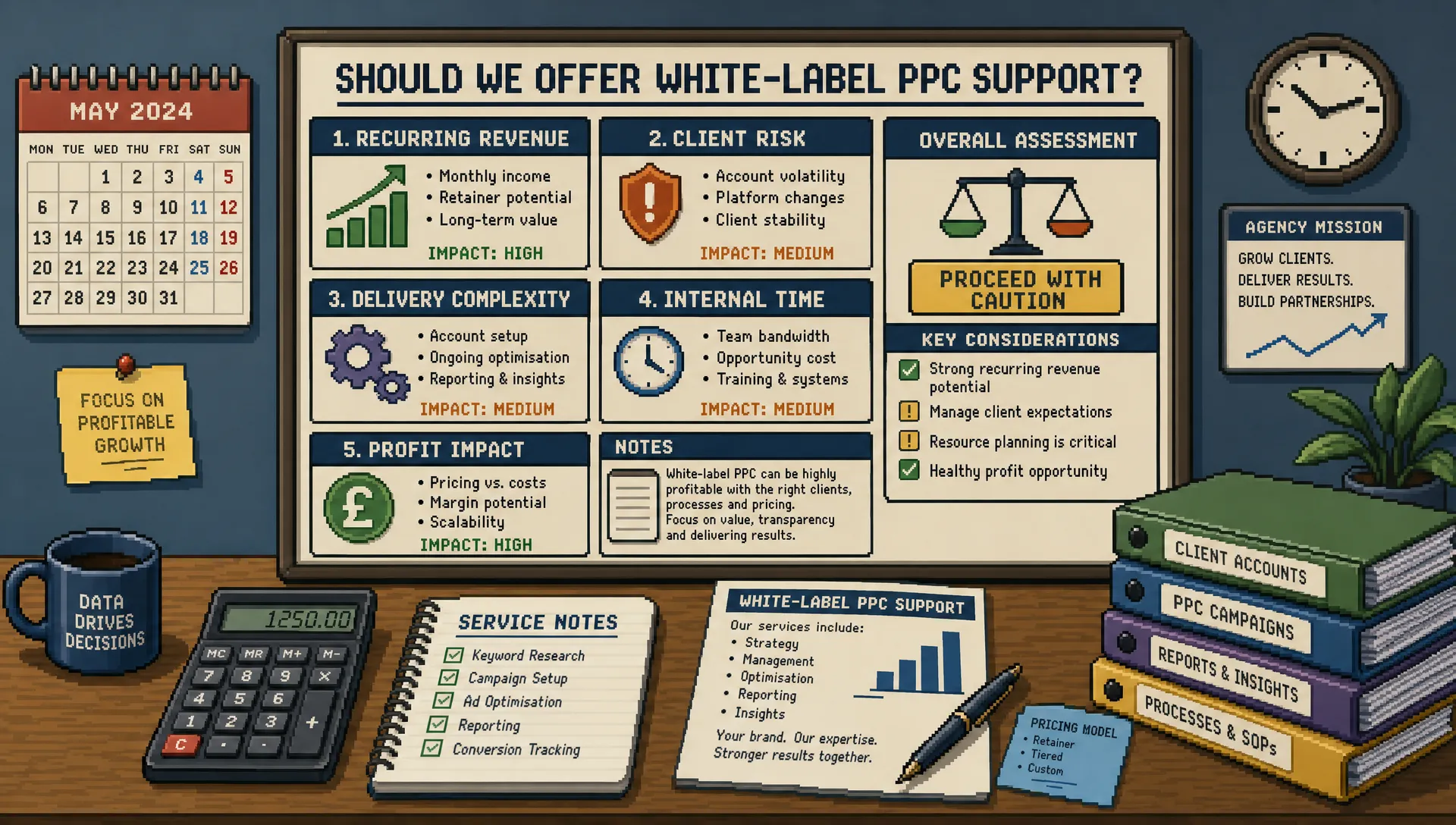
White label support is often discussed as a capacity fix. An agency wins more work than it can comfortably deliver, so it brings in external help under its own brand. That is true, but it is only part of the story.
The more important question is commercial: does white label for agencies improve the economics of delivery?
Used at the right time, a white-label partner can protect margin, reduce hiring risk, retain valuable clients, and help an agency say yes to profitable work without taking on permanent overhead. Used at the wrong time, it can hide deeper problems in pricing, positioning, or account ownership.
This guide looks at the situations where white label genuinely makes commercial sense, especially for agencies delivering PPC, paid social, and performance marketing services.
What “commercial sense” means for an agency
Commercial sense is not the same as “cheaper than hiring”. A full-time hire might be cheaper per hour once fully utilised. A freelancer might be cheaper for a one-off task. An internal team might offer more control.
The real question is whether the option improves the agency’s risk-adjusted profit.
For PPC and paid media delivery, that usually comes down to four factors: revenue certainty, delivery complexity, opportunity cost, and client risk.
| Commercial factor | What to ask | Why it matters |
|---|---|---|
| Revenue certainty | Is the client revenue recurring, stable, and priced properly? | Permanent headcount is risky if the income is uncertain. |
| Delivery complexity | Does the work require senior PPC judgement or routine execution? | Complex accounts are expensive to fix if handled badly. |
| Opportunity cost | What is your internal team not doing because they are stuck in delivery? | Leadership time should usually go towards growth, client strategy, and retention. |
| Client risk | Would under-delivery damage a valuable relationship? | The cost of losing a client can exceed the cost of external support. |
White label becomes commercially attractive when it reduces risk faster than it reduces margin. In other words, you may give up some delivery margin, but gain flexibility, speed, specialist expertise, and the ability to take on work you would otherwise decline.
The core dilemma: hire, outsource, or say no?
Agencies rarely face a simple “do we need PPC support?” decision. The harder choice is how to meet demand without creating a fixed cost base that becomes painful later.
Hiring can be the right answer when demand is predictable, the role is central to your agency proposition, and you have enough work to keep that person fully utilised. But recruitment takes time, and senior PPC talent is not always easy to find. A rushed hire can become more expensive than the capacity problem it was meant to solve.
Saying no can also be correct. If the client is a poor fit, the budget is too small, or the scope is underpriced, white-label support will not magically create profit. It may simply help you deliver an unprofitable service more efficiently.
White label sits between these options. It allows an agency to access specialist delivery without committing to salary, recruitment, management overhead, or long-term contracts. For many agencies, that flexibility is where the commercial value lies.
| Situation | Hiring may make sense when | White label may make sense when |
|---|---|---|
| New service line | You have proven demand and a clear pipeline. | You want to test demand before building a team. |
| Sudden client win | You have time to recruit properly. | Delivery needs to start immediately. |
| Specialist PPC need | The workload is constant and strategic. | The need is senior but intermittent. |
| Team overload | The overload is permanent. | The overload is caused by seasonality, launches, audits, or short-term growth. |
| Margin pressure | You can fully utilise a hire. | You need to protect margin without adding fixed cost. |
When white label for agencies makes strong commercial sense
You have demand, but not enough certainty to hire
One of the clearest use cases is uncertain demand. Perhaps you have won two PPC retainers, but you are not sure if the pipeline will support a permanent paid media hire six months from now. Perhaps existing clients are asking for Google Ads or Meta Ads support, but you do not yet know whether paid media will become a core service.
In that situation, white label lets you monetise demand without making a permanent bet. You can prove the revenue, understand the operational load, and learn what clients actually need before creating a fixed role.
This is especially useful for SEO, web design, branding, PR, and full-service agencies that want to add PPC without pretending to be paid media specialists overnight. The agency keeps the client relationship, while the white-label specialist handles delivery behind the scenes.
A profitable client win would otherwise be turned away
Sometimes the commercial case is simple: the agency can win good work, but cannot deliver it safely with current capacity.
If the client has a sensible budget, a clear need, and a realistic expectation of results, turning it away may mean losing revenue and weakening the relationship. White-label support can make the opportunity deliverable.
The key word is “profitable”. If the retainer is too low, the scope is vague, or the client expects daily support for a small fee, bringing in a partner may not solve the underlying issue. But when pricing is healthy, external delivery can help convert opportunity into margin.
If you are thinking about this from a scaling perspective, the broader argument is explored in more detail in PPC Ghost’s guide to why white label PPC management helps agencies scale.
Senior people are stuck in execution
Agency leaders often underestimate the cost of senior staff doing junior or repeatable delivery work. A founder, strategist, or account director who spends hours restructuring campaigns, checking tracking, or writing ad variations is not spending that time on sales, client strategy, team development, or retention.
That opportunity cost can be substantial.
White label makes commercial sense when it releases senior internal people to focus on higher-value work. This does not mean outsourcing responsibility. The agency still owns the relationship, the commercial direction, and the client experience. But delivery support can remove the bottleneck that stops senior people from doing the work only they can do.
You need depth, not just hands
There is a big difference between needing “someone to help with PPC” and needing senior judgement. Paid media mistakes can become expensive quickly, especially when budgets are meaningful, tracking is messy, or performance has already declined.
A generalist may be able to maintain a simple account. But complex Google Ads structures, Meta creative testing, Microsoft Ads expansion, GA4 issues, conversion tracking problems, and budget allocation decisions often need deeper experience.
White label can be commercially smarter than hiring a junior person if the problem requires senior-level diagnosis rather than extra hands. The cost per hour may be higher, but the risk of wasted spend, poor structure, or incorrect measurement can be lower.
You are protecting a valuable client relationship
Not every commercial decision is about immediate margin. Sometimes the priority is protecting a client relationship that is worth far more over time.
If an important client is unhappy with PPC performance, needs urgent account support, or has a launch deadline, slow delivery can damage trust. A white-label specialist can help stabilise the situation while your agency remains the visible partner.
This is particularly relevant when an account is under pressure and the team needs to triage quickly. For practical delivery guidance, PPC Ghost’s article on PPC ads best practices for agencies under pressure covers how agencies can prioritise commercial risk, measurement quality, and wasted spend.

When white label may not be the right answer
White label is a useful commercial tool, but it is not automatically the best answer. Agencies should be honest about the situations where it may not fit.
If PPC is your core proposition and you have steady demand, building internal capability may be the better long-term play. Owning the team, process, knowledge base, and culture can create more control and a stronger market position.
If the client work is underpriced, white-label delivery will not fix the model. You may still struggle to make the numbers work once external delivery costs and internal account management time are included.
If the scope is unclear, the risk also increases. White-label partners work best when roles are defined: who communicates with the client, who approves strategy, who owns reporting, who handles urgent requests, and what turnaround time is expected.
Finally, if the agency wants to outsource accountability entirely, white label may create tension. A good partner can deliver expert work discreetly, but the agency still needs to manage the commercial relationship and make sure the client experience is coherent.
How to model the numbers before you commit
Before deciding, build a simple commercial model. It does not need to be complicated. The goal is to understand whether the work remains profitable after delivery, management, and risk are considered.
Start with the client fee, then subtract the external delivery cost. After that, account for internal time. This includes account management, client calls, quality control, strategy alignment, and reporting oversight.
A simple formula is:
Gross contribution = client revenue minus external delivery cost minus internal management cost
Then ask whether the remaining contribution is worth the risk and effort. A £3,000 monthly retainer with £1,500 of delivery cost may look healthy at first. But if it also requires ten hours of senior internal time, frequent scope creep, and high client churn risk, the commercial picture changes.
| Question | Good sign | Warning sign |
|---|---|---|
| Is the client fee high enough? | Delivery cost still leaves useful contribution. | External cost consumes most of the retainer. |
| Is the scope clear? | Deliverables, channels, meetings, and reporting are defined. | The client expects unlimited support. |
| Is the work recurring? | There is likely ongoing revenue. | It is a one-off project with unclear follow-up. |
| Is the partner senior enough? | They can advise, not just execute tasks. | Your team must constantly diagnose and correct work. |
| Is the relationship valuable? | Support protects or expands a strong account. | The client is high-friction and low-margin. |
This exercise helps agencies avoid a common mistake: comparing white-label cost only against salary. The more useful comparison is against the total cost of delay, recruitment, wasted senior time, missed opportunities, and client churn.
Commercial signals that it is time to explore white label
White label for agencies usually becomes worth exploring when several signals appear at once. One urgent task is not always enough. But a pattern of pressure often means the current delivery model is holding the agency back.
Common signals include:
- You are delaying campaign launches because the internal team is full.
- Senior staff are spending too much time inside ad platforms.
- Clients are asking for PPC services that you do not want to hire for yet.
- You are turning away profitable retainers due to capacity.
- Tracking, GA4, or conversion measurement issues are slowing performance conversations.
- Paid media work is seasonal, unpredictable, or concentrated around launches.
- You need a discreet expert who can support your brand rather than replace it.
None of these signals automatically means you should outsource. But together, they suggest that the agency may be carrying more operational risk than necessary.
What to check before choosing a white-label partner
The commercial case only holds if the partner can deliver in a way that protects your agency’s reputation. A cheap provider who needs constant correction can become expensive quickly.
Look for evidence of senior expertise, clear communication, discreet processes, and practical understanding of agency life. It is also worth checking whether the partner can support the channels your clients actually need, such as Google Ads, Meta Ads, Microsoft Ads, GA4, and tracking.
Just as importantly, make sure the working model fits your commercial reality. If you need flexible support, a long contract may undermine the very reason you considered white label in the first place. If your clients need fast turnarounds, slow delivery may create more pressure rather than less.
For a deeper due diligence checklist, see PPC Ghost’s guide on what to look for in a white label Google Ads agency.
A practical decision rule
A simple way to decide is to ask this:
Would white-label support help us win, retain, or deliver profitable work with less risk than hiring or doing it ourselves?
If the answer is yes, it probably makes commercial sense. If the answer is only “it would be convenient”, pause and check the numbers.
The best white-label relationships are not panic purchases. They are deliberate capacity decisions. They allow agencies to stay focused on clients, growth, and strategy while accessing specialist delivery when it is commercially sensible.
Frequently Asked Questions
When does white label for agencies make the most sense? It makes the most sense when an agency has profitable client demand, but not enough certainty or capacity to justify a permanent hire. It is especially useful for specialist services such as PPC, paid social, tracking, and campaign audits.
Is white label cheaper than hiring? Not always on a simple hourly comparison. The commercial benefit is flexibility. Agencies can avoid recruitment time, fixed salaries, under-utilisation, and long-term commitments while still accessing specialist expertise.
Will clients know an agency is using a white-label partner? In a proper white-label arrangement, the partner works discreetly under the agency’s brand. The agency remains responsible for the client relationship, communication, and commercial direction.
Can white label support strategy as well as execution? Yes, if the partner has senior expertise. For PPC, this can include account structure, budget allocation, tracking recommendations, campaign optimisation, and channel expansion. The exact scope should be agreed before work begins.
What is the biggest mistake agencies make with white label? The biggest mistake is using it to rescue poorly priced or poorly scoped work. White label can improve delivery capacity, but it cannot turn an unprofitable client model into a healthy one without better pricing and clearer boundaries.
Need senior PPC capacity without adding headcount?
If you are weighing up whether white label makes sense for your agency, PPC Ghost provides discreet, senior-level PPC support for UK agencies across Google Ads, Meta Ads, Microsoft Ads, GA4, and tracking.
You stay client-facing. PPC Ghost works behind the scenes with white-label delivery, same-day turnaround where available, no recruitment burden, no long-term contracts, and pay-as-you-go flexibility.
When the numbers point towards external PPC support, PPC Ghost can help you deliver without adding permanent headcount.