Google Ads vs Meta Ads for Agency Growth
Google Ads vs Meta Ads for agency growth: compare intent, scaling potential, margins and delivery models to build stronger PPC retainers.
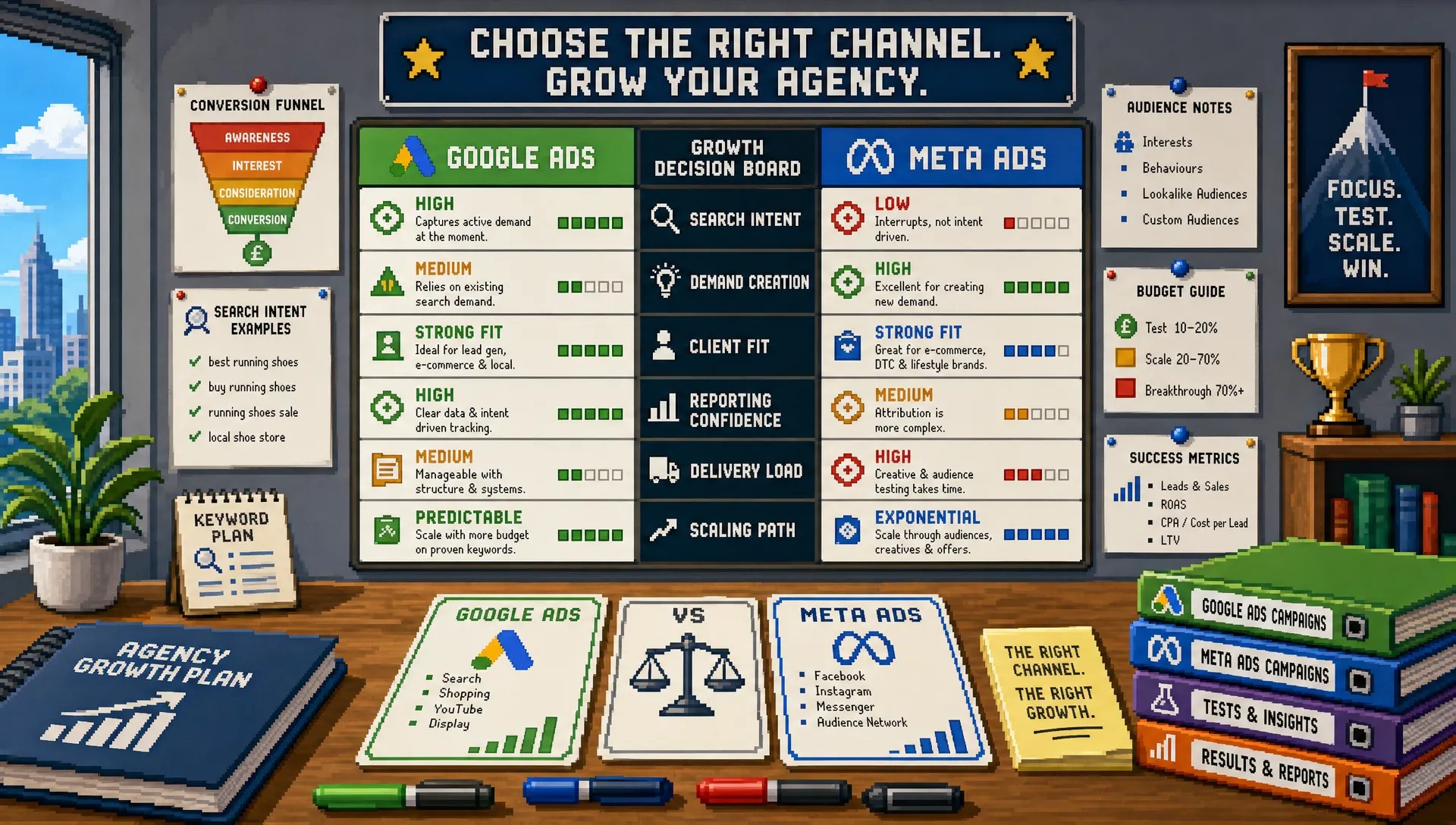
When agencies compare Google Ads vs Meta Ads, the real question is not which platform is better. It is which platform creates the clearest path to client results, stronger retainers and profitable delivery for your agency.
Google Ads and Meta Ads solve different growth problems. Google is strongest when people are already searching for a solution. Meta is strongest when you need to create demand, shape preference and reach people before they search. For agency growth, the winner depends on your client base, your delivery capacity and the kind of paid media product you want to sell.
If you pick the wrong lead channel, you can end up with disappointed clients, messy reporting and a delivery team stuck firefighting. If you pick the right one, you create a service that is easier to sell, easier to retain and easier to scale.
The short answer: Google captures demand, Meta creates demand
Google Ads works best when there is existing search intent. A user types a query because they want a product, service, quote, answer or local provider. That intent gives agencies a clear commercial story: your client can appear when prospects are actively looking.
Meta Ads works differently. People are usually scrolling Facebook or Instagram, not actively searching for a supplier. Meta helps agencies build demand through creative, offers, audience signals and retargeting. It can drive direct response, but it often needs stronger creative strategy and more patience with attribution.
A simple way to explain it to clients is this: Google Ads helps clients get found when demand already exists. Meta Ads helps clients become known before demand is fully formed.
Both can grow an agency. The mistake is treating them as interchangeable PPC channels.
Google Ads: best for high-intent client acquisition
Google Ads is often the easier starting point for agencies that serve lead generation, local services, B2B, high-value purchases or e-commerce brands with searchable products. The core advantage is intent. If someone searches for emergency plumber near me, commercial solicitor Manchester, CRM consultant or buy trail running shoes, there is already commercial momentum.
For agencies, that makes Google Ads easier to package around outcomes. You can audit search terms, improve conversion tracking, separate brand from non-brand performance, refine landing page relevance and show how spend translates into leads or sales.
Google Ads is especially powerful when:
- The client sells something people already know they need.
- Search volume exists for commercial keywords.
- The client can respond quickly to leads.
- The product or service has enough margin to absorb competitive clicks.
- Tracking is reliable enough to optimise around real conversions.
The downside is that Google Ads can hit a demand ceiling. If a client already appears for most of the viable search terms in their market, simply increasing budget may not create profitable growth. Competitive categories can also become expensive quickly, especially if landing pages, conversion rates or lead handling are weak.
That is why agencies should position Google Ads as a performance system, not just a media buying channel. Before increasing budgets, you need a clear plan to reduce waste, improve tracking and prioritise the queries most likely to convert. If you are tightening up search activity, these practical ways to cut wasted spend quickly in Google Ads are a useful starting point.
Meta Ads: best for demand creation and scalable storytelling
Meta Ads is often stronger when the client needs to reach a broader audience, introduce an offer, test messaging or scale beyond existing search demand. It is particularly useful for e-commerce, events, training, hospitality, fitness, lifestyle brands, consumer services and lead generation campaigns with a strong hook.
Meta can also support B2B, but it usually needs the right offer. A cold audience may not book a high-ticket consultancy call after one ad impression, but it might download a guide, register for a webinar, watch a case study or enter a nurture journey.
For agencies, Meta Ads can unlock a different type of retainer. The conversation expands beyond bids and budgets into creative testing, offer development, audience strategy, landing pages and funnel performance. This can be commercially attractive, but it also increases delivery complexity.
Meta Ads is strongest when:
- The client has visual proof, a strong offer or a clear transformation.
- The target audience can be defined by interests, behaviours, lookalikes or first-party data.
- The client can supply or approve fresh creative regularly.
- The sales journey benefits from retargeting and repeated exposure.
- The agency can interpret blended performance, not only last-click conversions.
The challenge is creative fatigue. A Meta account can go from strong performance to weak performance quickly if creative testing stalls. Agencies that sell Meta Ads need a reliable process for briefs, assets, approvals and launch checks. If that is a bottleneck, improving your process before opening Ads Manager can help you launch Meta campaigns faster without sacrificing quality.
Agency growth is not just platform performance
For agencies, the Google Ads vs Meta Ads decision should include more than cost per lead or return on ad spend. You are choosing what kind of service model you want to build.
Google Ads can be easier to sell to clients who already believe in search. Meta Ads can create broader strategic value if your agency is strong on creative, content and funnel development. Both can support growth, but they put pressure on different parts of your operation.
| Growth factor | Google Ads usually helps by | Meta Ads usually helps by | Agency implication |
|---|---|---|---|
| Client acquisition | Offering a clear response to existing demand | Showing clients how to reach new audiences | Google may be easier for urgent lead goals, Meta may be stronger for brand-led growth |
| Retainer expansion | Adding Search, Shopping, Performance Max, remarketing and tracking improvements | Adding creative testing, funnel campaigns, retargeting and offer testing | Meta can widen the scope, Google can deepen performance management |
| Reporting confidence | Connecting queries, clicks and conversions more directly | Combining platform data with wider funnel signals | Google can feel more measurable, Meta needs stronger context |
| Delivery load | Requires technical account structure, tracking and optimisation discipline | Requires ongoing creative, testing and audience iteration | The best margin depends on your team’s strengths |
| Scaling potential | Limited by available search demand and CPC pressure | Limited by creative quality, offer strength and audience response | Google scales through intent, Meta scales through creative and reach |
The best platform for agency growth is usually the one you can deliver repeatedly at a high standard. A channel that performs well but strains your team can still damage margins and client satisfaction.
When to lead with Google Ads
Lead with Google Ads when the client needs revenue or leads from people who are already in-market. This is often the right move for agencies serving professional services, trades, healthcare, legal, finance, SaaS, high-value B2B or e-commerce categories where people actively compare suppliers.
A Google-first pitch works well when the prospect already has evidence of demand. They may be receiving enquiries through organic search, directories, referrals or competitor activity. In that situation, the agency can frame Google Ads as a way to capture more of the demand that already exists.
This approach is also useful for agency sales. Google Ads audits can reveal wasted spend, poor conversion tracking, duplicated keywords, weak landing pages, over-reliance on broad match or unprofitable Performance Max activity. That gives your agency a concrete reason to start a conversation.
However, Google-first does not mean Google-only. Once profitable search activity is in place, Meta can help with retargeting, social proof, content distribution and mid-funnel nurturing. The sequence matters. For some clients, capturing intent first creates the cash flow and confidence needed to test broader demand generation.
When to lead with Meta Ads
Lead with Meta Ads when the client has a compelling story, offer or audience, but search demand is limited, expensive or not yet mature. This is common for new products, challenger brands, local events, direct-to-consumer offers, online courses and services where people need education before they search.
A Meta-first pitch works well when the client has creative assets or is willing to produce them. Strong product photography, customer testimonials, founder videos, before-and-after proof, demos and user-generated content can all give Meta campaigns a better chance of success.
Meta-first can also suit agencies that already provide branding, creative, social media or content. Paid social becomes a natural extension of the work rather than a standalone media buy. That can increase account value because your agency is not only managing spend, it is shaping the message that drives demand.
The risk is that clients may expect Google-style intent from a platform built around interruption and discovery. Agencies need to set expectations clearly. Meta performance often depends on creative iteration, funnel quality and offer strength, not just campaign settings.
The client-fit matrix
Use client type as the first filter before deciding which platform to prioritise. This keeps your recommendation grounded in commercial reality rather than channel preference.
| Client situation | Better starting point | Why it usually fits |
|---|---|---|
| Local service with urgent demand | Google Ads | Prospects often search when they need help now |
| B2B service with known buying terms | Google Ads | Search intent can reveal high-value commercial demand |
| New consumer product with low search volume | Meta Ads | Creative can introduce the product before people know to search |
| E-commerce brand with searchable products | Google Ads plus Meta Ads | Shopping and search capture demand, Meta supports discovery and retargeting |
| Event, course or webinar | Meta Ads | Audience targeting and creative hooks can drive registrations |
| Expensive category with limited budget | Depends on proof | Google may be too costly, Meta may need more testing before conversion volume appears |
| Brand with strong creative but weak tracking | Meta Ads only after tracking fixes | Creative can help, but poor measurement will limit optimisation |
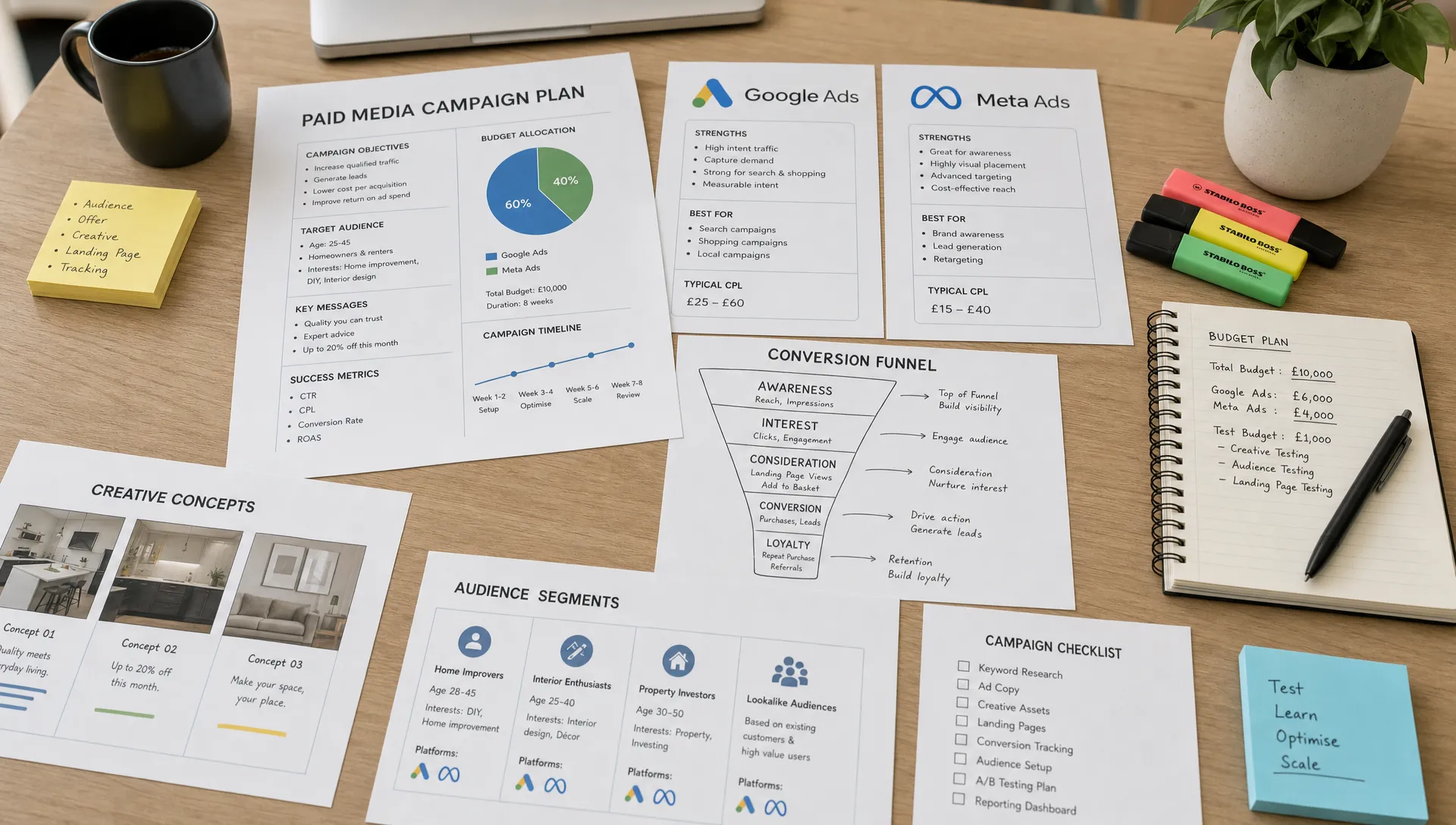
The margin question: which channel is easier to deliver profitably?
Agency growth is not just about winning the retainer. It is about keeping the retainer profitable once the work starts.
Google Ads delivery often requires deeper technical work. Account structure, keyword intent, search terms, negative keywords, bidding, feed quality, landing page alignment, conversion tracking and GA4 configuration can all affect performance. The workload is not always visible to clients, so agencies need strong communication to show the value of ongoing optimisation.
Meta Ads delivery often requires more creative operations. Campaign setup may be quicker, but performance depends heavily on fresh angles, formats, hooks and assets. If the client cannot provide creative or your agency does not control creative production, results can suffer. The media buyer may end up waiting on assets instead of improving performance.
For margin, the practical question is: where do you already have leverage?
If your agency is strong in technical PPC, analytics and lead generation, Google Ads may be easier to productise. If your agency is strong in creative, content and funnel strategy, Meta Ads may create more expansion opportunities. If you are strong in both, a blended PPC offer can create a more defensible service.
The danger is selling both platforms without the delivery capacity to support them. That can lead to rushed launches, weak tracking, poor optimisation and reporting calls where nobody can confidently explain what happened.
Attribution and tracking matter more than the platform debate
In 2026, agencies cannot treat platform-reported conversions as the full truth. Privacy changes, cookie consent, cross-device journeys, iOS limitations and modelled conversions all affect reporting. Google Ads and Meta Ads both use their own attribution logic, which means the same sale or lead can appear differently across platforms.
Before recommending either channel, agencies should define the measurement framework. At minimum, that means clear conversion actions, clean GA4 events, agreed attribution windows, CRM feedback where possible and a shared understanding of what counts as a qualified lead or sale. Google’s own guidance on conversion tracking is a useful reminder that campaign optimisation depends on the quality of the conversion data you feed back into the platform.
For UK agencies, consent and cookie practices also need to be taken seriously. The Information Commissioner’s Office provides guidance on cookies and similar technologies, which is relevant when agencies are advising clients on tracking setups.
The best reporting approach is not to ask whether Google or Meta is telling the truth. It is to build a consistent view of performance across platform data, analytics data and business outcomes. That is especially important when both channels are running together, because Meta may assist demand that Google later captures.
Should agencies sell Google Ads and Meta Ads together?
For many agencies, the strongest growth strategy is not choosing one forever. It is choosing the right lead channel first, then adding the second channel when the client has the budget, tracking and operational maturity to benefit from it.
Google-first growth model
This model starts with high-intent search. It is useful when a client needs leads or sales quickly and there is clear market demand. Once search activity is profitable, Meta can be added for retargeting, testimonial ads, educational content and audience expansion.
Meta-first growth model
This model starts with creative demand generation. It is useful when the client has a strong offer but limited search demand. Google can then be added to capture branded searches, competitor comparisons and high-intent queries created by the increased awareness.
Blended growth model
This model launches both channels together, but only when the budget and delivery setup can support it. It is best for clients with proven offers, enough conversion volume and a clear funnel. The agency must be able to explain how each channel contributes, rather than forcing both to meet the same last-click KPI.
Blended retainers can be attractive because they make the agency more strategically valuable. You are not just managing ads. You are managing demand capture, demand creation, tracking and budget allocation across the customer journey.
How to decide what to pitch next
Before pitching Google Ads, Meta Ads or both, ask questions that reveal the client’s real growth constraint.
- Are people already searching for what the client sells?
- Does the client have a proven offer and enough margin to advertise profitably?
- Is the main problem lead volume, lead quality, awareness, conversion rate or retention?
- Can the client provide creative assets quickly enough for Meta testing?
- Is tracking strong enough to optimise campaigns and defend performance in reporting?
- Does your agency have the internal capacity to deliver the channel properly?
The last question is often the most important for agency growth. A platform can be right for the client but wrong for your current team capacity. If delivery will stretch your agency too far, consider whether you need senior white-label support before you sell the work.
Final verdict: Google Ads vs Meta Ads for agency growth
Google Ads is usually the better growth lever when clients need to capture existing intent, prove ROI quickly and generate leads or sales from people already searching. Meta Ads is usually better when clients need to build awareness, test offers, scale creative and reach audiences before they enter the search market.
For agencies, the smartest answer is rarely platform loyalty. It is sequencing. Start with the channel that best matches the client’s growth constraint, then expand when the data, budget and delivery process are ready.
If your agency can confidently explain that logic, you will sell stronger retainers, retain clients for longer and avoid the common trap of recommending channels just because they are popular.
Frequently Asked Questions
Is Google Ads or Meta Ads better for agency growth? Google Ads is often better for high-intent lead generation and clients that need short-term commercial results. Meta Ads is often better for demand generation, creative testing and audience expansion. The best choice depends on the client’s market, offer, budget and tracking.
Should an agency offer both Google Ads and Meta Ads? Yes, if the agency can deliver both well. Offering both can increase retainer value and improve full-funnel performance, but only when tracking, creative production and optimisation capacity are strong enough.
Is Google Ads more expensive than Meta Ads? Not always. Google clicks can be more expensive in competitive search markets because users have higher intent. Meta can appear cheaper at the click or reach level, but it may need more creative testing and funnel work to produce qualified conversions.
Which platform is easier for agencies to report on? Google Ads can be easier to explain because search intent is clearer and conversions often happen closer to the click. Meta Ads reporting can be more nuanced because it influences awareness, consideration and retargeting as well as direct response.
Can Meta Ads help Google Ads performance? Yes. Meta can increase awareness, create branded search demand and warm up audiences that later convert through Google. This is one reason blended reporting is important when both channels are active.
Need senior PPC delivery without hiring?
If your agency wants to sell Google Ads and Meta Ads retainers but needs extra delivery capacity, PPC Ghost provides senior white-label PPC support on demand. You keep the client relationship, your agency takes the credit and you can scale paid media work without recruitment, long contracts or junior execution.