Why White Label PPC Management Helps Agencies Scale
Learn how white label PPC management helps agencies scale faster, protect margins, retain clients and add senior Google, Meta and Microsoft Ads capacity.
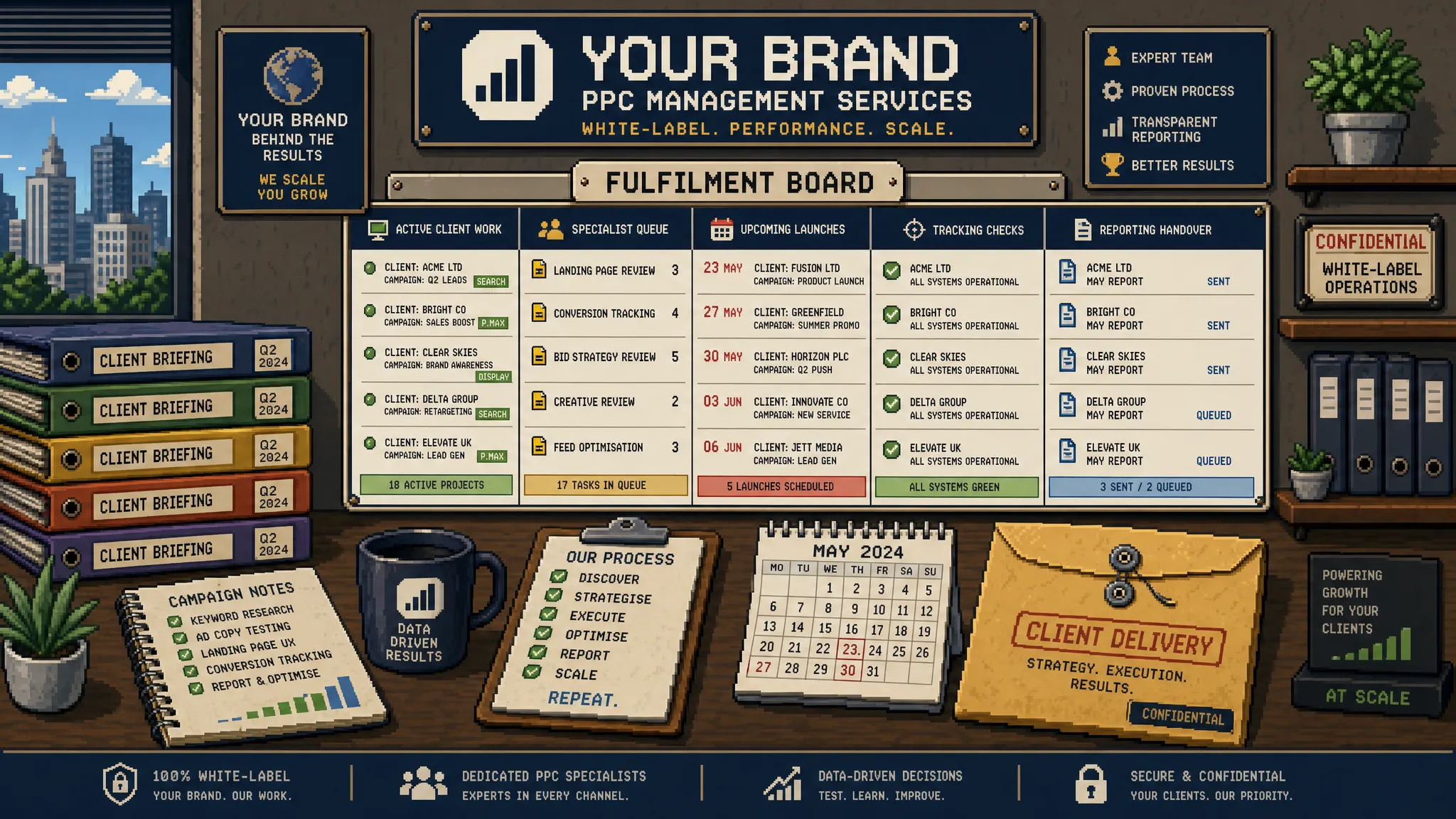
Agencies rarely hit a growth ceiling because they cannot sell. More often, they hit it because delivery becomes the bottleneck. One new PPC client can mean a full account audit, conversion tracking checks, campaign builds, creative coordination, weekly optimisation, reporting, and client questions before performance has had time to stabilise.
That is where white label PPC management becomes more than a fulfilment shortcut. Used properly, it gives an agency senior paid media capacity under its own brand, without taking on recruitment risk or stretching an already busy team.
For UK agencies, this matters because client expectations have become broader and less forgiving. Clients want Google Ads, Meta Ads, Microsoft Ads and GA4 to work together. They want commercial explanations, not just a spreadsheet of clicks and impressions. Scaling PPC delivery means increasing volume without letting quality, speed or trust decline.
The scaling problem agencies face
Most agency leaders recognise the same pattern. Sales momentum improves, referrals increase, and existing clients ask for more. At first, this feels like the growth everyone wanted. Then the operational pressure starts to show.
Account managers become the middle point for technical questions they cannot confidently answer. Founders get pulled into audits, tracking issues and performance reviews. Junior team members are asked to manage campaigns that need senior judgement. Eventually, the agency is not short of opportunity, it is short of safe delivery capacity.
| Scaling pressure | What it looks like | Risk if ignored |
|---|---|---|
| New sales outpace delivery | The agency wins retainers faster than PPC work can be onboarded | Delayed launches and early client frustration |
| Senior expertise is scarce | Only one or two people can solve complex account problems | Founder dependency and slow decisions |
| Campaign complexity increases | Clients need search, social, remarketing and tracking support | Fragmented strategy and inconsistent reporting |
| Hiring feels risky | PPC demand is growing, but not always predictable month to month | Salary commitments before utilisation is proven |
| Client expectations rise | Clients want clearer answers and faster action | Trust declines even when effort is high |
This is why scaling PPC is different from simply adding more tasks to a project management board. PPC is live, measurable, and client-visible. If performance drops, tracking breaks, or budgets are wasted, the agency feels it quickly.
What white label PPC management actually means
White label PPC management is paid media work delivered by an external specialist while your agency remains the named provider. The client sees your brand, your account management and your relationship. Behind the scenes, a specialist supports the technical PPC delivery.
It is not the same as casually handing a client to another agency. In a strong setup, you keep client ownership, commercial context and strategic direction. The white-label partner provides the PPC capability that helps you deliver at a higher level.
Depending on the agreement, white-label PPC support can include account audits, campaign builds, Google Ads optimisation, Meta Ads support, Microsoft Ads management, GA4 and tracking checks, reporting input, and urgent troubleshooting. The exact scope should always be defined before work begins, because unclear fulfilment is where margins and client confidence get damaged.
The best version of the model is simple. Your agency owns the client relationship. The specialist owns the technical execution. Both sides work from a shared brief, clear priorities and agreed communication rules.
Why white label PPC management helps agencies scale
It turns sales momentum into deliverable revenue
Winning a PPC client is only valuable if you can onboard and serve that client well. Without enough specialist capacity, agencies often delay sales conversations, turn down work, or accept retainers they are not operationally ready to fulfil.
White label PPC management gives you a way to say yes more confidently. Instead of waiting until you can justify a full-time hire, you can access senior delivery when demand appears. That is especially useful when PPC enquiries arrive in clusters, such as after a strong referral month, a new website launch, or a successful pitch cycle.
This does not mean selling anything to anyone. It means removing delivery uncertainty from good-fit opportunities. If your agency can win the right clients but lacks PPC bandwidth, white-label support can convert demand into recurring revenue without immediately increasing fixed costs.
It protects margins better than panic hiring
Hiring in-house can be the right move once PPC demand is stable and predictable. The problem is timing. Hire too early and you carry salary, management and training costs before utilisation is high enough. Hire too late and quality suffers while the team waits for capacity.
White-label support sits between those extremes. It gives agencies a flexible way to deliver work while testing demand, protecting cash flow and avoiding rushed recruitment decisions.
| Delivery option | Best suited to | Scaling trade-off |
|---|---|---|
| In-house hire | Predictable long-term PPC volume | Fixed cost, recruitment time and management overhead |
| Ad hoc freelancer | Small overflow or isolated tasks | Variable availability and process consistency |
| White label PPC management | Repeatable PPC delivery under your agency brand | Requires clear briefing, scope and ownership rules |
The margin benefit is not only about cost. It is also about avoiding expensive mistakes. Poor tracking, weak campaign structure and rushed optimisation can waste media budget and damage client trust. Senior support reduces the likelihood that growth comes at the expense of quality.
It keeps senior judgement close to the account
Modern PPC platforms are more automated than they used to be, but they are not simpler. Smart Bidding, Performance Max, Advantage+ campaigns, broad match, offline conversions and GA4 attribution all require judgement. The work has shifted from constant manual tinkering to better strategy, cleaner data and sharper interpretation.
That is where senior experience matters. A senior PPC specialist can spot whether a campaign is failing because of poor intent, weak conversion tracking, insufficient budget, bad landing page fit, seasonality, or the wrong optimisation goal. Those distinctions matter because each problem needs a different fix.
White label PPC management helps agencies keep that senior judgement available without needing every account manager to become a platform expert.
It reduces founder dependency
In many growing agencies, the founder becomes the unofficial PPC safety net. They join calls when a client is nervous, review performance when an account is under pressure, and translate platform issues into commercial language. That can work at five or ten clients. It becomes a growth blocker at twenty.
A white-label PPC partner can take technical weight off the founder while allowing the agency to keep strategic control. This frees leadership to focus on sales, positioning, partnerships, hiring and client growth rather than constant delivery firefighting.
It helps agencies expand services without losing focus
Not every agency wants to build a full internal paid media department. SEO agencies, web design studios, creative agencies and fractional marketing teams often need PPC capability because clients ask for it, but they do not necessarily want PPC to become their core operational burden.
White-label delivery lets those agencies offer a more complete service while staying focused on their main strengths. The same white-label logic applies in adjacent channels too. Agencies exploring offline media can learn from these white-label direct mail strategies, where branded reporting, reseller pricing and repeatable campaign packs help create scalable revenue without exposing the delivery partner.
Where white-label PPC fits in the agency growth model
White-label PPC is not only for agencies in crisis. It can support different stages of growth, from first PPC client to mature overflow model.
| Agency stage | Common trigger | Best use of white-label PPC |
|---|---|---|
| Early growth | Clients start asking for PPC, but the agency has no specialist team | Add capability without hiring prematurely |
| Scaling phase | PPC retainers are increasing, but internal capacity is tight | Maintain delivery quality while demand fluctuates |
| Established agency | The team has PPC skills, but needs backup during peaks | Handle overflow, audits, tracking fixes and launches |
| Specialist agency | The agency wants to protect senior staff from lower-value tasks | Use external support for execution while keeping strategy internal |
The key is to treat white-label support as part of your operating model, not as a last-minute rescue option. The earlier you define briefing, QA, reporting and client communication rules, the easier it becomes to scale without chaos.
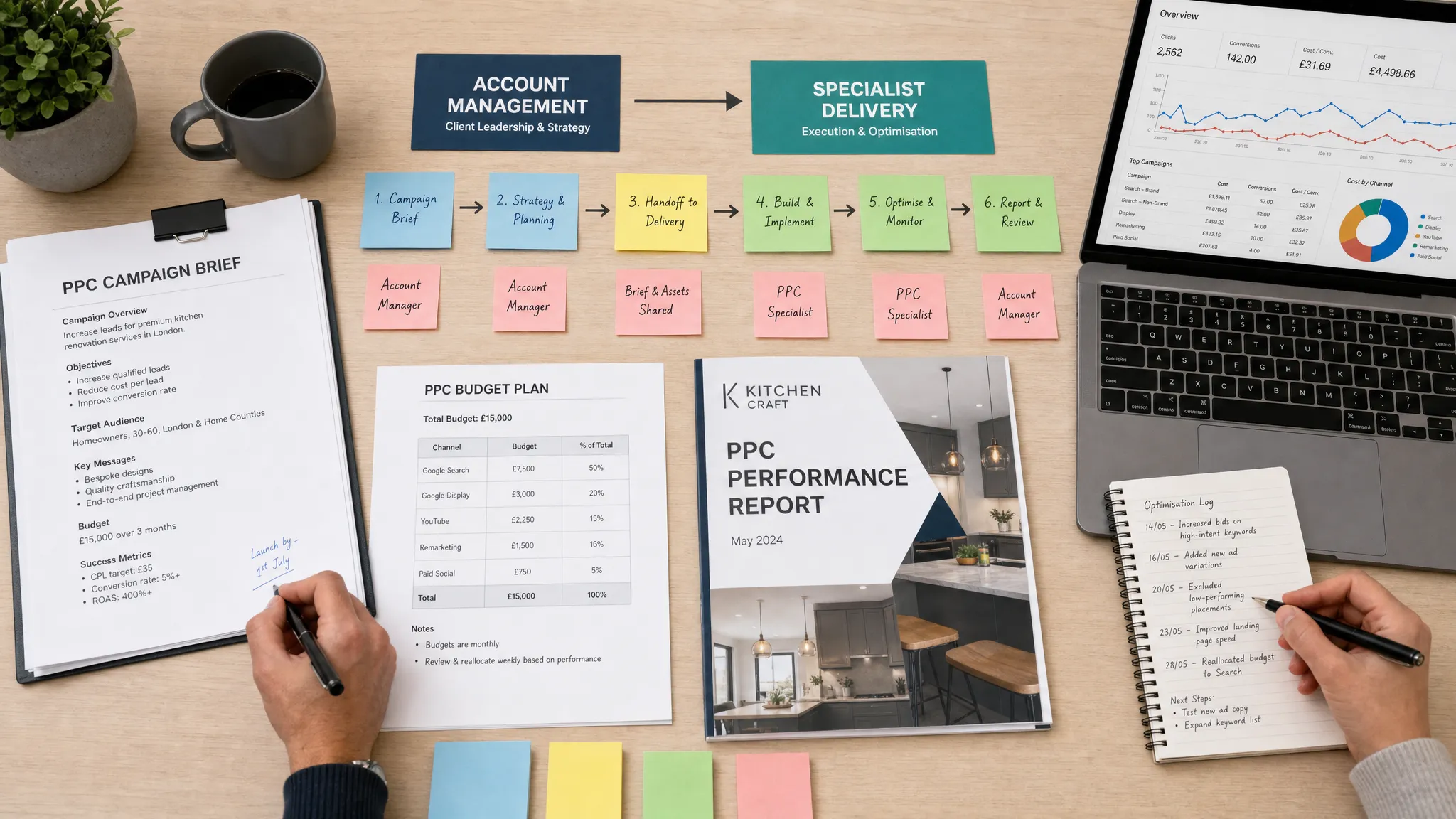
What strong white label PPC support should include
The quality of a white-label relationship depends on more than platform knowledge. A technically skilled PPC specialist still needs to understand how agencies work, how clients communicate and how commercial priorities affect campaign decisions.
Commercial discovery before platform work
Good PPC delivery starts with understanding the client’s business model. Lead quality, sales cycle length, average order value, margin, geography and capacity all shape campaign decisions. An account that looks successful in-platform may still be poor commercially if it drives low-quality leads or unprofitable sales.
Your white-label partner should ask enough questions to understand what success actually means. That does not require them to replace your strategy role, but it does mean they should avoid optimising blindly for surface-level metrics.
Measurement and tracking discipline
Scaling PPC without reliable tracking is risky. Before budgets increase, agencies need confidence that conversions are being recorded properly and that reports reflect meaningful actions. GA4, Google Ads conversion tags, Meta Pixel events, consent settings and CRM feedback can all affect decision quality.
White-label PPC management is especially valuable when it includes tracking awareness. Even if the specialist is not responsible for every technical implementation, they should be able to flag tracking problems, explain the performance impact and help prioritise fixes.
Repeatable builds with room for judgement
Templates help agencies scale, but PPC cannot be reduced to copying the same campaign structure into every account. Strong delivery uses repeatable processes while still adapting to the client’s market, budget, conversion volume and offer.
This balance matters for both efficiency and performance. Naming conventions, UTM standards, launch checklists and reporting formats create consistency. Senior judgement ensures the account is not forced into a structure that does not fit.
Reporting your account team can own
Clients do not only want to know what happened. They want to know what it means and what happens next. A good white-label PPC partner should provide reporting input that your account team can confidently explain under your brand.
That means highlighting decisions, risks, wins and next actions. It also means avoiding jargon that makes the agency look like a messenger rather than a strategic partner.
How white-label PPC improves client retention
Client retention often depends on confidence. A client can tolerate a difficult month if they trust the process, understand the reason and see a sensible plan. They are less forgiving when communication is vague or action feels slow.
White label PPC management helps retention by improving response quality. When technical issues are answered quickly and clearly, account managers sound more confident. When campaigns are reviewed by someone experienced, the agency is less likely to miss obvious problems. When reports connect PPC activity to business outcomes, clients are more likely to stay engaged.
This matters because retention is one of the strongest levers for agency scale. New business is expensive. Churn is disruptive. A delivery model that protects client trust can be just as valuable as one that increases capacity.
How to keep white-label PPC profitable
White-label PPC only helps agencies scale if the commercial model is sensible. The mistake is to resell PPC delivery at a thin margin without accounting for account management, strategy, meetings, project management and client communication.
Before quoting a client, define the scope clearly. Include the platforms involved, number of campaigns, tracking requirements, reporting frequency, meeting support, turnaround expectations and who is responsible for creative or landing page changes.
A simple rule helps. Your client fee should cover delivery cost, agency oversight, communication time, software or reporting costs, and profit margin. If it only covers the specialist’s fee, you are not building a scalable service, you are passing work through your agency with unnecessary risk.
It also helps to package PPC around outcomes and operating rhythms rather than random tasks. For example, you might offer a launch package, a monthly management retainer, a tracking rescue project, or overflow support for existing accounts. Clear packaging makes it easier to sell, deliver and manage expectations.
Risks to avoid when outsourcing PPC delivery
White-label PPC can create leverage, but only if it is managed well. The risks usually come from vague ownership rather than the model itself.
| Risk | Why it matters | How to reduce it |
|---|---|---|
| Unclear scope | The partner and agency assume different responsibilities | Agree deliverables, platforms and turnaround times in writing |
| Weak handovers | The specialist lacks commercial context | Use a structured brief before work begins |
| Poor access management | Delays and security issues slow delivery | Confirm account access, permissions and ownership early |
| Inconsistent reporting | The client receives confusing or conflicting messages | Align on reporting format and narrative before client updates |
| No QA process | Errors reach live campaigns or client-facing reports | Use launch and reporting checklists |
The client should experience one joined-up agency, not a patchwork of disconnected suppliers. That requires process, but it does not need to be complicated. Clear briefs, tidy communication and consistent reporting solve most white-label delivery problems before they start.
When white label PPC management may not be the right fit
White-label support is powerful, but it is not a cure for every agency problem. If an agency has no clear client strategy, no process for account management, or no willingness to price PPC profitably, outsourcing delivery will not fix the underlying issue.
It may also be the wrong time if the client has unrealistic expectations, an inadequate media budget, poor product-market fit, or no ability to act on landing page and tracking recommendations. In those cases, the agency should address the commercial foundations before adding more paid media activity.
The best results come when the agency has a clear client relationship, a defined offer and a realistic view of what PPC can achieve. White-label management then becomes a scaling tool, not a substitute for strategy.
Frequently Asked Questions
What is white label PPC management? White label PPC management is when an external PPC specialist delivers paid media work under your agency’s brand. Your agency keeps the client relationship while the specialist supports campaign strategy, setup, optimisation, tracking or reporting depending on the agreed scope.
How does white label PPC management help agencies scale? It gives agencies flexible access to senior PPC delivery without hiring full-time staff before demand is predictable. This helps agencies take on more work, protect quality, reduce founder dependency and maintain client confidence.
Is white-label PPC better than hiring in-house? It depends on your stage of growth. In-house hiring can work well when PPC demand is stable and long term. White-label PPC is often better when demand fluctuates, when you need specialist support quickly, or when you want to test a PPC service line before committing to recruitment.
Will clients know a white-label PPC specialist is involved? In a true white-label setup, the agency remains the client-facing brand. The external specialist works behind the scenes unless the agency chooses a different arrangement. Clear communication rules should be agreed before work begins.
What should agencies look for in a white-label PPC partner? Look for senior experience, commercial understanding, clear processes, tracking awareness, reliable communication and the ability to support your agency brand rather than compete with it.
Scale PPC delivery without hiring prematurely
If your agency is winning opportunities but PPC capacity is becoming the constraint, PPC Ghost provides senior, white-label PPC delivery on demand for UK agencies. You keep the client relationship, your brand stays front and centre, and you can access support across Google Ads, Meta Ads, Microsoft Ads and GA4 tracking without recruitment or long-term contracts.
When you need expert capacity without adding permanent headcount, speak to PPC Ghost and keep growing without compromising delivery quality.