How PPC White Label Support Saves Agency Time
Learn how PPC white label support saves agency time by reducing recruitment, delivery bottlenecks, reporting delays and PPC firefighting.
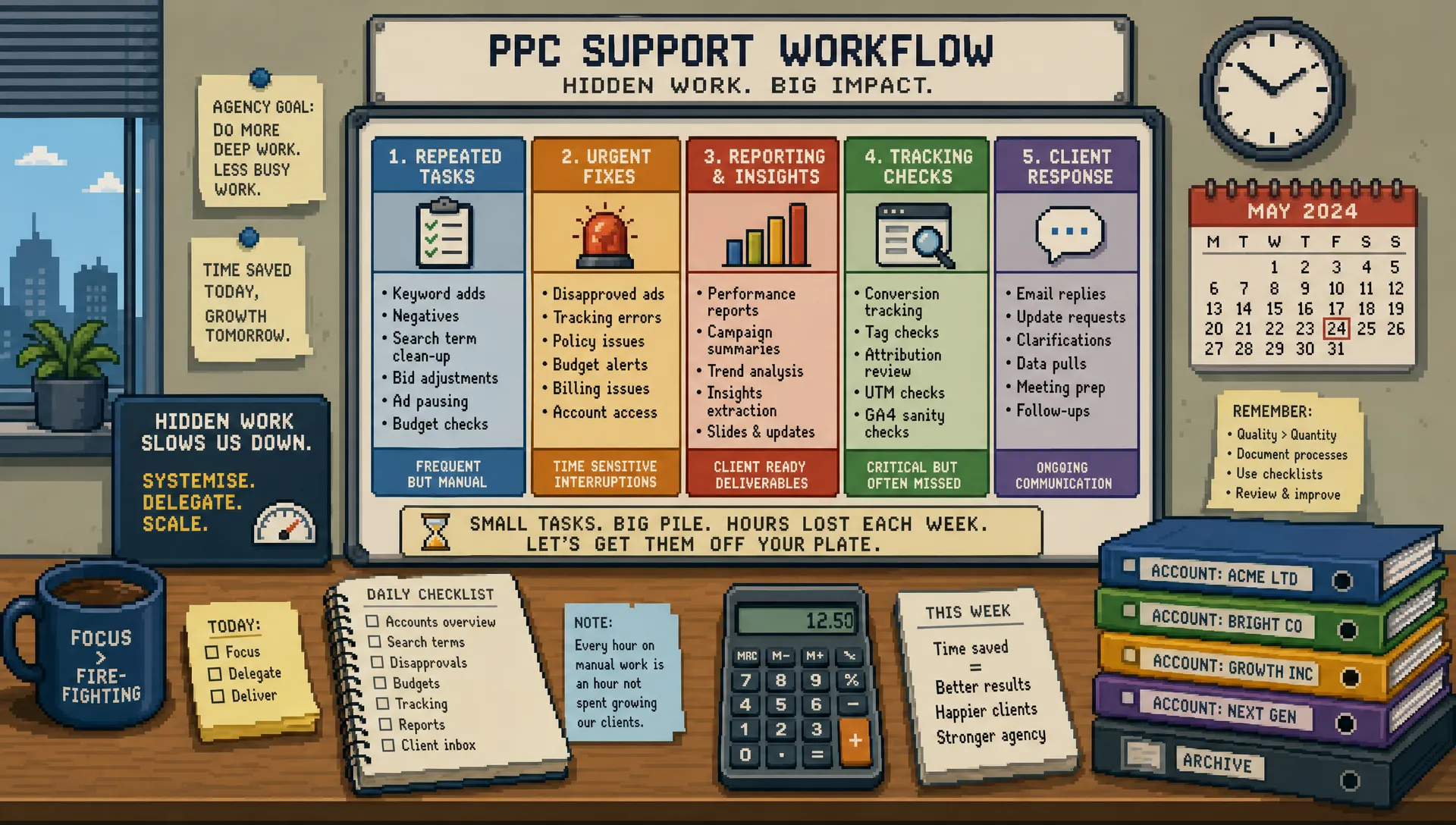
Agency owners rarely lose time in one dramatic moment. It disappears in small, repeated PPC tasks that do not look urgent on their own, but together slow down delivery, client communication and new business.
A Google Ads account needs a conversion check. A Meta campaign needs fresh exclusions. A client asks why leads dropped last week. A strategist needs budget pacing before a call. A junior account manager is waiting for someone senior to review search terms. None of these jobs are unusual. The problem is that agencies often carry them alongside SEO retainers, design deadlines, web projects, reporting cycles and sales calls.
That is where PPC white label support can save serious agency time. Not by replacing your client relationships, but by removing the specialist execution bottleneck that keeps your team stuck in the weeds.
For digital agencies, time is not just an operational issue. It affects margins, response speed, service quality and retention. When paid media support is structured properly, your agency can stay visible to the client while senior PPC work happens quietly in the background.
Why PPC Becomes Such a Time Drain for Agencies
PPC is fast-moving by nature. Platforms change, auctions fluctuate, tracking breaks, creative fatigue appears, client priorities shift and budgets rarely stay still. Even when an account is performing well, it still needs regular attention.
The real time drain is not usually the planned optimisation session. It is everything around it. Account access problems, unclear conversion data, last-minute client questions, rushed reporting notes, QA checks, campaign naming clean-up and small fixes that require specialist judgement.
Many agencies try to absorb this work internally because it seems manageable at first. One client becomes three. Three becomes eight. Suddenly, the same person who was supposed to lead strategy is spending Friday afternoon checking UTM parameters, rebuilding audience exclusions or trying to diagnose a sudden spike in cost per lead.
That is not a good use of senior agency time. It also creates a risk: when your best people are dragged into PPC delivery details, other parts of the agency slow down.
The Hidden Time Costs Agencies Often Underestimate
PPC delivery has visible tasks, such as campaign builds and optimisation. It also has hidden operational costs that are easy to miss when pricing retainers or planning workloads.
| PPC workload area | Why it consumes agency time | What happens when it is neglected |
|---|---|---|
| Account audits | Requires detailed review of structure, tracking, search terms, budgets and settings | Wasted spend continues and performance issues remain unclear |
| Campaign builds | Needs keyword research, audience planning, creative structure, tracking and QA | Launches are delayed or rushed |
| Conversion tracking | Often involves GA4, Google Tag Manager, platform pixels and consent considerations | Reports become unreliable and optimisation decisions weaken |
| Weekly optimisation | Requires repeated analysis and platform changes | Accounts drift, budgets misallocate and clients lose confidence |
| Reporting commentary | Needs commercial interpretation, not just data screenshots | Account managers spend too long explaining performance |
| Client firefighting | Urgent drops, tracking errors or budget questions interrupt planned work | Senior team members lose focus and deadlines slip |
This is why PPC can feel disproportionately heavy compared with other services. It is not only the number of tasks. It is the fact that many of them are time-sensitive and require specialist judgement.
A designer can often schedule production blocks. A developer can work through tickets. A PPC specialist has to respond to live spend, live data and live client pressure.
How PPC White Label Support Saves Time in Practice
White-label PPC support gives agencies access to paid media execution without needing to hire, train or publicly introduce another supplier. The agency keeps the client relationship. The specialist handles the delivery behind the scenes.
That saves time in several practical ways.
It removes recruitment delays
Hiring a PPC specialist is slow. Writing the role, screening CVs, interviewing, checking platform experience, negotiating salary and onboarding can take weeks or months. Even after someone joins, they need time to understand your agency processes and client accounts.
White-label support avoids that delay. For agencies that have won a new client, inherited a messy ads account or suddenly need cover, on-demand support can be much faster than starting a recruitment process.
This is especially useful when you do not yet have enough PPC work to justify a full-time hire. Instead of overcommitting payroll too early, you can bring in senior help only when there is real client demand. If capacity is the broader issue, this is also why many agencies use white label PPC management to scale without hiring prematurely.
It keeps senior agency people out of low-leverage work
Agency leaders and account directors should be focused on client relationships, strategic direction, retention and growth. Yet PPC often pulls them into detailed platform work because clients expect quick answers.
A white-label PPC partner can take on the technical execution that does not need to sit with your internal leadership team. This might include restructuring campaigns, checking conversion actions, reviewing search terms, preparing optimisation notes or investigating account anomalies.
Your team still owns the client narrative. They simply have better information and cleaner execution behind it.
It reduces context switching
Context switching is one of the biggest hidden productivity killers in agencies. A strategist may move from a website proposal to a Meta Ads issue, then back to a client call, then into a Google Ads report. Each switch creates mental drag.
PPC white label support reduces that drag by giving paid media work a dedicated owner. Instead of asking internal generalists to jump between unrelated tasks, agencies can route specialist work to someone who already lives in the platforms.
That means fewer half-finished tasks, fewer delayed replies and fewer moments where someone has to spend 30 minutes just remembering where they left off.
It speeds up urgent fixes
PPC problems rarely arrive at convenient times. A landing page changes and tracking stops firing. A payment issue pauses ads. A disapproved ad delays a launch. A campaign spends too quickly after a budget change.
When nobody has capacity, these issues sit in a queue. When senior white-label support is available, they can be handled more quickly, often before they become a bigger client problem.
Speed matters because paid media is tied directly to spend. A small delay can mean wasted budget, missed leads or awkward client conversations.
Where Agencies Usually Get the Biggest Time Savings
Not every PPC task should be outsourced. Agencies often get the best results when they keep strategy, commercial context and client communication in-house, while handing specialist execution and analysis to a white-label partner.
The biggest time savings usually come from tasks that are repetitive, technical or urgent.
| Task type | Typical agency challenge | How white-label support helps |
|---|---|---|
| New account audits | Internal teams struggle to find time for deep reviews | A specialist can identify issues and priorities quickly |
| Campaign launches | Builds require careful setup and QA | Delivery can happen without blocking account managers |
| Tracking checks | GA4, pixels and conversion actions need technical attention | Problems can be diagnosed before reports are questioned |
| Optimisation cycles | Weekly improvements compete with other deadlines | Accounts receive consistent specialist attention |
| Performance commentary | Account managers need clear explanations for clients | PPC insights can be translated into useful talking points |
| Overflow support | Demand spikes after new wins or staff absence | Agencies can flex capacity without permanent hiring |
This is not just about saving hours. It is about protecting the quality of those hours. An account manager who is not buried in platform checks can spend more time understanding the client’s business. A founder who is not troubleshooting tracking can focus on sales, partnerships and team leadership.
The Difference Between Delegating and Losing Control
Some agencies hesitate to use white-label support because they worry about losing control. That concern is understandable. Clients trust your agency, and the work still reflects your brand.
Good white-label PPC support should not create a black box. It should make delivery clearer, faster and easier to manage.
A reliable process usually includes:
- Clear briefs that explain the client goal, budget, market and urgency.
- Transparent task notes so your team knows what has been changed and why.
- Sensible QA before launches or major edits go live.
- Communication that fits your agency’s tone and workflow.
- No direct client contact unless your agency explicitly wants it.
The goal is not to hand over responsibility. The goal is to remove execution bottlenecks while keeping ownership of the client relationship.
If you are comparing providers, the same principle applies when reviewing what to look for in a white label Google Ads agency: expertise matters, but process, discretion and communication matter just as much.
How Better PPC Support Improves Client Response Times
Client response time is one of the easiest places to see the impact of white-label support.
Without support, a client question might sit while your team waits for someone technical to investigate. The account manager cannot answer confidently, the strategist is busy and the client senses hesitation.
With support, your team can get a clearer diagnosis faster. For example, if a client asks why lead volume dipped, a PPC specialist can check spend, impression share, conversion tracking, search terms, bid strategy changes, landing page status and auction movement. The agency can then respond with a calm explanation rather than a vague promise to “look into it”.
That speed builds trust. Clients do not expect every metric to improve every week, but they do expect their agency to notice issues, understand them and act quickly.
Fast internal support also reduces the emotional pressure on account managers. They no longer have to bluff their way through PPC details or chase several people for answers. They can communicate with more confidence because the technical thinking is already done.
Why Time Saved Often Becomes Margin Protected
Agency time and agency margin are closely linked. If a retainer is priced for 10 hours but PPC delivery quietly takes 16, the account may look profitable on paper while draining the team in reality.
White-label PPC support can help make delivery more predictable. Instead of absorbing every paid media task internally, agencies can assign defined work to a specialist and understand the true cost of delivery.
That clarity helps with pricing future retainers. It also helps agency owners decide which clients are worth taking on, which accounts need a bigger budget and which services should be packaged differently.
A simple way to estimate the value is to ask:
- How many hours does your team currently spend on PPC delivery each month?
- How many of those hours are done by senior people who should be focused elsewhere?
- How many client delays are caused by lack of paid media capacity?
- How often do PPC issues interrupt planned project work?
- What could your team do with those hours instead?
The answer will vary by agency, but the pattern is common. PPC support does not just remove work. It gives high-value time back to the people who grow and protect the agency.
When PPC White Label Support Is Most Useful
White-label support is not only for agencies that are overwhelmed. It can also be a smart operational choice during specific moments of pressure.
It is particularly useful after a new client win, when campaigns need to be audited, rebuilt or launched quickly. It can also help when an internal specialist leaves, goes on holiday or is already at capacity.
Agencies often use it when they want to offer PPC without hiring a full paid media team. This can be valuable for web, SEO, creative and social agencies whose clients are asking for Google Ads or Meta Ads support, but whose internal team is not built for hands-on media buying.
It is also useful when an account is underperforming and needs fresh senior eyes. A focused audit or optimisation sprint can save internal time and give the agency a clearer plan.
During especially busy periods, agencies should also tighten their own processes. The principles in PPC ads best practices for agencies under pressure are useful for deciding which accounts and tasks need attention first.
What to Prepare Before Bringing in White-Label PPC Help
The fastest results usually come when the agency provides a clear starting point. You do not need a perfect brief, but you do need enough context for a specialist to make good decisions.
At minimum, prepare the client’s commercial goal, target locations, monthly media budget, key services or products, current performance concerns and access to the relevant ad platforms or analytics tools.
It also helps to explain how your agency wants to communicate. Some teams prefer concise task notes. Others want deeper analysis they can repurpose for client updates. The clearer you are about the output you need, the more time you save later.
Good white-label work should feel like an extension of your agency rather than another supplier to manage. That only happens when expectations are clear on both sides.
Frequently Asked Questions
What is PPC white label support? PPC white label support is paid media delivery provided by a specialist under your agency’s brand. Your agency keeps the client relationship while the specialist handles tasks such as audits, campaign builds, optimisation, tracking checks or reporting input behind the scenes.
How does white-label PPC save agency time? It saves time by removing specialist execution from your internal workload. Agencies can avoid recruitment delays, reduce context switching, speed up technical fixes and give account managers clearer PPC insight without asking them to do all the platform work themselves.
Will clients know a white-label PPC specialist is involved? In a true white-label setup, the support is discreet and your agency remains client-facing. The exact arrangement depends on how you choose to work, but the purpose is to let your agency take the credit while expert delivery happens in the background.
Is PPC white label support only for Google Ads? Not necessarily. Many agencies need help across Google Ads, Meta Ads, Microsoft Ads and tracking tools such as GA4. The right fit depends on your client accounts and the platforms you need supported.
When should an agency consider white-label PPC help? It is worth considering when PPC tasks are slowing down your team, new client wins are stretching capacity, reporting is taking too long, tracking problems are recurring or you are not ready to hire a full-time paid media specialist.
Save Agency Time Without Hiring Too Soon
PPC can be a profitable service line, but only if delivery is controlled. When paid media work eats into senior time, slows account managers down or creates constant firefighting, the agency pays for it in lost focus and weaker margins.
PPC Ghost gives agencies on-demand, white-label paid media support across Google Ads, Meta Ads, Microsoft Ads and tracking. It is built for agencies that need senior execution without recruitment, long contracts or visible outsourcing.
If your team is losing too many hours to PPC delivery, PPC Ghost can help you get that time back while your agency stays firmly in front of the client.