Google AdWords Management Mistakes That Hurt ROI
Avoid Google AdWords management mistakes that hurt ROI. Learn how agencies can fix tracking, bidding, budgets, search terms and reporting.
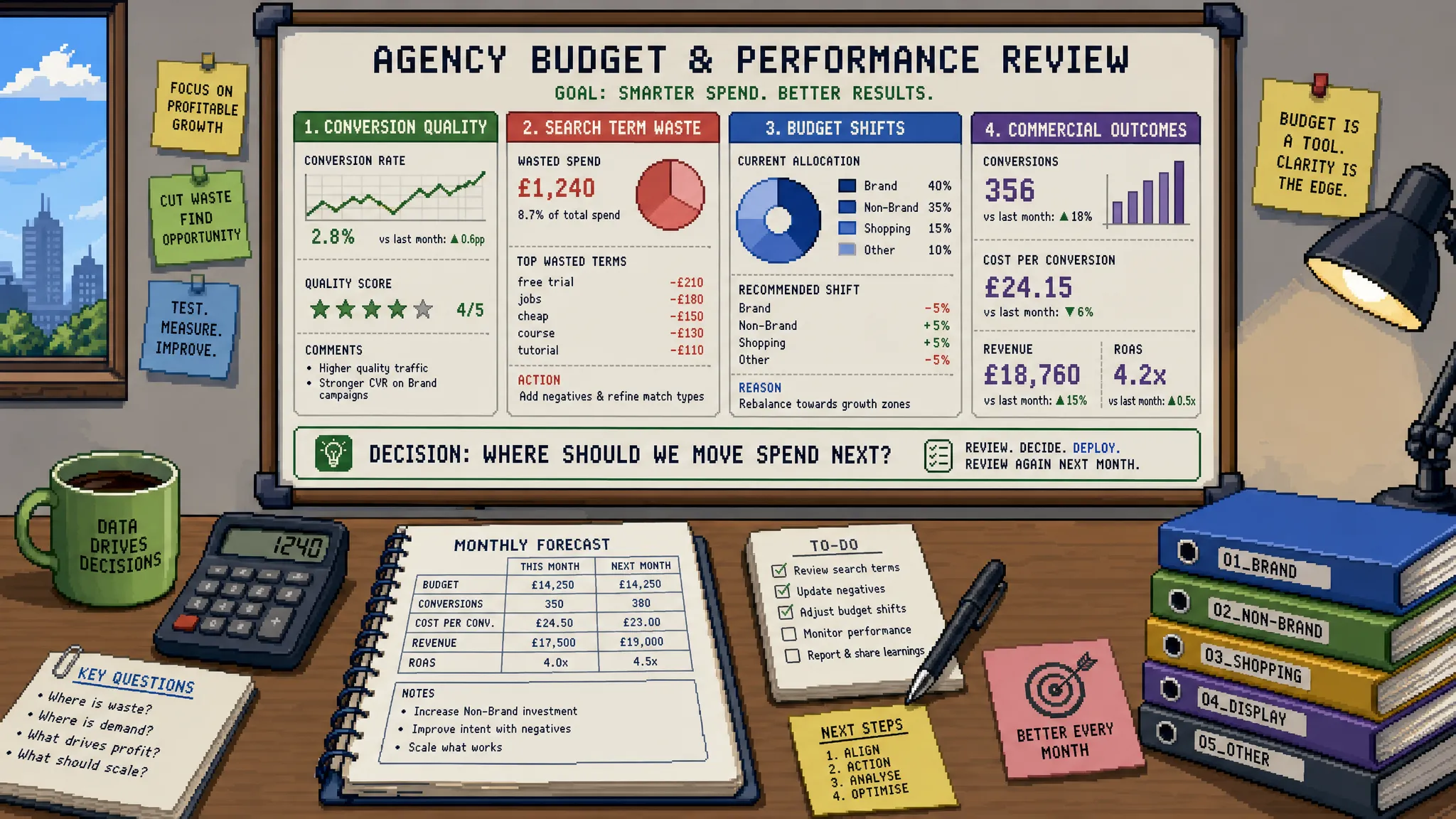
Many clients still say “Google AdWords” even though the platform has been Google Ads for years. The name may have changed, but the management problem is the same: small account decisions can quietly drain budget, distort performance data, and make a campaign look less profitable than it should be.
For agencies, the stakes are even higher. A badly managed account does not just hurt the client’s ROI. It creates awkward reporting calls, emergency audits, and pressure on account managers who may already be stretched across too many channels.
The worst Google AdWords management mistakes are rarely dramatic. They are usually practical issues that sit unnoticed for weeks: weak conversion tracking, messy match types, automation without controls, poor budget allocation, and reports that hide the real commercial picture.
Below are the mistakes that most often damage ROI, plus what to fix before you scale spend.
1. Optimising around unreliable conversion tracking
If conversion tracking is wrong, every optimisation decision becomes questionable. Bids, budgets, keywords, audiences, and asset tests all depend on the data being trustworthy.
This is one of the most common ROI killers because the account can look healthy on the surface. Cost per conversion may appear stable, but the conversions being counted might include page views, accidental button clicks, duplicate form submissions, low intent enquiries, or actions that do not match what the client actually values.
Google’s conversion tracking guidance is clear that conversion actions should represent valuable customer activity. In practice, many accounts still have a mix of old goals, imported analytics events, and legacy actions that were never reviewed after a website rebuild.
Before adjusting bids, check:
- Which conversion actions are set as primary
- Whether forms, calls, purchases, bookings, and lead events fire correctly
- Whether duplicate conversions are being counted
- Whether imported analytics events match Google Ads attribution needs
- Whether consent, cookie, and tag changes have affected data quality
A campaign cannot optimise towards profit if the platform is being told that every soft interaction is a business outcome.
2. Treating every conversion as equally valuable
A brochure download, a phone call, a qualified sales enquiry, and a completed purchase are not equal. Yet many accounts still optimise as if they are.
This mistake hurts ROI because automated bidding will chase the easiest conversion type, not necessarily the most valuable one. If low quality leads convert at a higher rate than genuine buyers, the algorithm may find more of them while reported CPA appears to improve.
For lead generation clients, this can create a dangerous gap between Google Ads performance and sales reality. The campaign may be producing “leads”, but the sales team may be rejecting them due to poor fit, low budget, wrong location, student enquiries, spam, or existing customers looking for support.
A better approach is to separate conversion actions by commercial value. Use primary conversions for the outcomes that matter most. If possible, import offline conversion data from the CRM so Google can learn which leads became qualified opportunities or sales.
Even a simple lead quality feedback loop can improve decision making. For example, ask the client or sales team to label recent leads as good, average, or poor. Then compare quality by campaign, keyword, search term, location, device, and landing page.
3. Building campaign structure for neatness instead of intent
A tidy account is not always a profitable account. Structure should support intent, budget control, reporting clarity, and bidding decisions.
Some accounts are too fragmented. They have dozens of tiny campaigns and ad groups with too little data for bidding systems to learn. Others are too broad, with high intent and low intent searches mixed together in the same campaign. Both approaches can damage ROI.
The goal is not to create the most elegant account map. The goal is to give Google enough clean data while preserving control where commercial intent differs.
| Management mistake | How it hurts ROI | Better approach |
|---|---|---|
| Splitting campaigns too finely | Budgets thin out and bidding has limited data | Consolidate where intent, margins, and goals are similar |
| Mixing all intent levels together | High intent terms subsidise weaker searches | Separate by intent where budget and bid strategy need control |
| Using ad groups as keyword storage | Ads become less relevant to the search | Group terms around clear themes and user needs |
| Copying old structures blindly | Legacy logic survives after business changes | Rebuild around current goals, products, and margins |
Strong structure also makes client conversations easier. If a campaign is designed around commercial priorities, reporting can focus on business outcomes rather than explaining why the account contains hundreds of confusing legacy segments.
4. Letting automation run without guardrails
Automation is not the enemy. Smart Bidding, broad match, Performance Max, responsive search ads, and automated assets can all play a useful role. The mistake is assuming automation removes the need for strategic management.
Google’s Smart Bidding documentation explains that automated bid strategies use conversion data to optimise bids. That means automation is only as good as the data, goals, and constraints behind it.
ROI often suffers when accounts move to automation too quickly or with weak inputs. Common examples include launching Target CPA before conversion volume is stable, using Maximise Conversions with no cost guardrail, expanding broad match without search term control, or combining Performance Max with unclear asset groups and poor audience signals.
Automation works best when a PPC manager sets the rules of the game:
- Clean conversion actions
- Realistic CPA or ROAS targets
- Clear budget limits
- Exclusions where needed
- Search term and placement reviews
- Asset quality checks
- Landing pages aligned to the offer
The question is not whether to use automation. The question is whether the account gives automation the right conditions to make profitable decisions.
5. Ignoring search terms until spend has already leaked
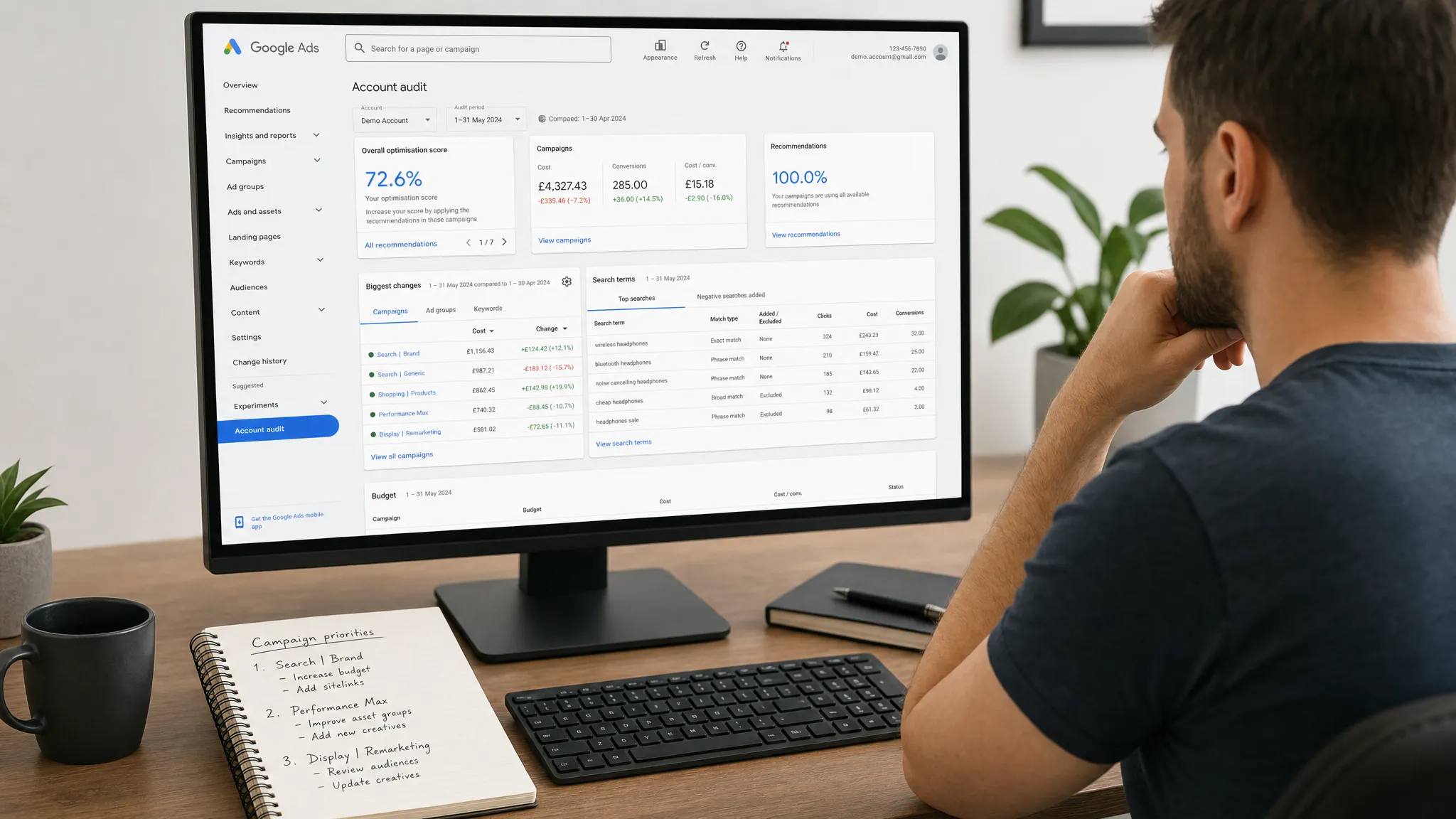
Search term management remains one of the fastest ways to protect ROI. Even with changes in search term visibility over time, the available data still provides valuable clues about wasted spend and new opportunities.
A keyword may look profitable at keyword level while hiding poor searches underneath. Broad match and phrase match can both attract queries that sound related but carry very different intent. For example, a B2B software client may pay for searches from students, job seekers, free tool hunters, or consumers outside the target market.
The fix is not to add negatives once and forget about them. Search terms should be reviewed regularly, especially after match type changes, bid strategy changes, new campaign launches, landing page updates, or seasonal shifts.
If an account is already bleeding spend, start with the highest cost campaigns and work down. Look for irrelevant searches, competitor ambiguity, research intent, support queries, locations the client cannot serve, and terms that convert but never become qualified leads.
For a deeper account clean-up process, PPC Ghost has covered practical PPC Google Ads tips that cut wasted spend fast, including the checks agencies can use when an account needs urgent attention.
6. Focusing on traffic cost while ignoring landing page quality
Google AdWords management does not stop at the ad click. If the landing page is unclear, slow, generic, or poorly matched to the search intent, ROI will suffer even when campaign settings are sound.
This is where agencies sometimes split responsibility too sharply. The PPC specialist looks after the account. The web team looks after the page. The client looks after the offer. In reality, performance depends on all three.
A campaign sending commercial traffic to a weak page will usually show the symptoms inside Google Ads: low conversion rate, high CPA, poor engagement, inconsistent lead quality, or a gap between click intent and form submissions. The solution may not be a new bid strategy. It may be a clearer above the fold message, stronger proof, better form design, faster mobile load time, or a landing page that matches the specific ad promise.
For agency teams, it helps to flag landing page issues early rather than waiting for a reporting call. PPC managers do not need to become CRO specialists, but they should be able to identify when media performance is being limited by the post-click experience.
7. Allocating budget based on habit rather than marginal return
Many accounts keep spending in the same places because “that is how the budget has always been split”. This is especially common in long-running accounts where campaigns were created years ago and slowly accumulated spend.
Budget should follow opportunity, not history. If a campaign has limited commercial value, weak lead quality, poor margins, or low impression share in a low priority area, it may not deserve the budget it currently receives. Equally, a campaign with strong ROI may be capped too tightly because nobody has challenged the old allocation.
The best budget reviews look beyond platform averages. They consider:
- Profit margin by product or service
- Sales capacity and geographic coverage
- Lead quality by campaign
- Impression share lost to budget on high value terms
- Seasonality and sales cycle length
- The client’s appetite for growth versus efficiency
A lower CPA is not always better if it comes from low value conversions. A higher CPA can be acceptable if it produces stronger revenue, better retention, or larger deal sizes. ROI improves when budget decisions reflect commercial value rather than surface level efficiency.
8. Reporting on metrics that do not answer the client’s real question
Most clients are not asking, “What was our click-through rate?” They are asking, “Did this spend help us grow profitably?”
CTR, Quality Score, impression share, CPC, and conversion rate all have their place. But if reports focus on platform metrics without connecting them to pipeline, revenue, cost per qualified lead, or sales outcomes, the agency risks missing the ROI story.
This is especially damaging when performance appears good in Google Ads but poor in the client’s business. If a campaign produces cheap leads that never close, the report needs to show that. If a more expensive campaign drives fewer but better enquiries, the report should explain why it deserves budget.
A stronger report separates diagnostic metrics from decision metrics. Diagnostic metrics explain what is happening inside the platform. Decision metrics help the client decide what to do next.
| Metric type | Examples | Purpose |
|---|---|---|
| Diagnostic metrics | CTR, CPC, Quality Score, search impression share | Helps identify account issues and optimisation opportunities |
| Efficiency metrics | CPA, conversion rate, cost per lead, ROAS | Shows whether media spend is becoming outcomes efficiently |
| Commercial metrics | Qualified leads, pipeline value, revenue, margin | Shows whether PPC is contributing to business growth |
| Decision metrics | Budget recommendation, forecast, next test, risk level | Guides the next commercial action |
Good reporting does not hide complexity. It translates complexity into decisions.
9. Making too many changes at once
When performance drops, it is tempting to fix everything immediately. New bids, new ads, new keywords, new landing pages, new audiences, new budgets. The problem is that a flood of simultaneous changes makes it hard to know what actually worked.
This mistake is especially common when an agency inherits a messy account or when a client is frustrated. The account needs improvement, but uncontrolled change can create more noise.
A better method is to prioritise by risk and impact. Fix critical tracking problems first. Pause obvious waste. Stabilise spend. Then test changes in a way that produces useful learning.
Not every change needs a formal experiment, but every meaningful change should have a reason. Before editing, ask what problem the change is solving, what result you expect, and how long you will give the data before judging it.
PPC management is not just doing more work in the interface. It is knowing which changes are worth making now and which should wait.
10. Mistaking activity for senior management
A busy change history does not prove good management. An account can have weekly edits and still lack strategy.
True senior Google AdWords management involves judgement. It means knowing when to consolidate, when to segment, when to trust automation, when to override it, when to challenge the client’s landing page, and when the reported CPA is hiding lead quality problems.
This matters for agencies because junior or overloaded teams can easily fall into maintenance mode. They refresh ads, add keywords, adjust budgets, and produce reports, but the account still drifts away from ROI.
Warning signs include rising spend without better outcomes, unclear tracking ownership, constant reactive changes, weak search term hygiene, and client calls dominated by explanations rather than decisions. If those symptoms sound familiar, it may be time to review the signs you need a Google AdWords expert on demand before the account becomes a retention risk.
A quick ROI protection checklist for agencies
When you need to assess an account quickly, focus on the items most likely to distort ROI first. This simple checklist can help prioritise the audit.
| Check | Why it matters | Priority |
|---|---|---|
| Primary conversion actions | Bad conversion data misguides bidding and reporting | High |
| Lead or sale quality | Cheap conversions may not create revenue | High |
| Search terms and negatives | Irrelevant traffic drains budget quickly | High |
| Budget allocation | Spend may be trapped in low value campaigns | High |
| Bid strategy settings | Automation needs correct goals and limits | Medium |
| Campaign structure | Poor structure weakens control and learning | Medium |
| Landing page fit | Strong traffic can fail after the click | Medium |
| Reporting logic | Clients need decisions, not just metrics | Medium |
This order is useful because it starts with the foundations. There is little point refining ad copy if the account is optimising towards the wrong goal or spending heavily on irrelevant traffic.
Frequently Asked Questions
Is Google AdWords management the same as Google Ads management? Yes. Google AdWords was renamed Google Ads in 2018, but many clients and agencies still use the old name. The management principles are largely the same, although today’s platform relies far more on automation, machine learning, and conversion data quality.
What is the biggest Google Ads mistake that hurts ROI? Poor conversion tracking is often the most damaging mistake because it affects every other decision. If the account is optimising towards the wrong actions, even well-written ads and smart bid strategies can push spend in the wrong direction.
How often should agencies review Google Ads search terms? The right frequency depends on spend, volatility, and campaign type. High spend accounts, new campaigns, broad match tests, and accounts with lead quality issues should be reviewed more frequently than stable, low spend campaigns.
Can automated bidding improve ROI? Yes, but only when the account has reliable conversion data, realistic targets, enough volume, and clear commercial goals. Automated bidding can amplify good strategy, but it can also amplify bad inputs.
When should an agency outsource Google Ads management? Outsourcing can make sense when internal capacity is stretched, accounts need senior diagnosis, tracking is unreliable, or client retention is at risk. If you are considering external support, it is worth knowing how to vet a Google ad company before you outsource.
Need senior PPC support without hiring?
If your agency needs experienced Google Ads, Meta Ads, Microsoft Ads, or tracking support without recruitment delays or long-term contracts, PPC Ghost provides white-label PPC execution on demand for UK agencies.
You keep the client relationship. PPC Ghost works anonymously in the background, helping you protect performance, reduce pressure on your team, and deliver senior-level paid media support when you need it.