PPC Google Ads Tips That Cut Wasted Spend Fast
Cut wasted spend in PPC Google Ads with fast fixes for tracking, search terms, locations, budgets and Performance Max.
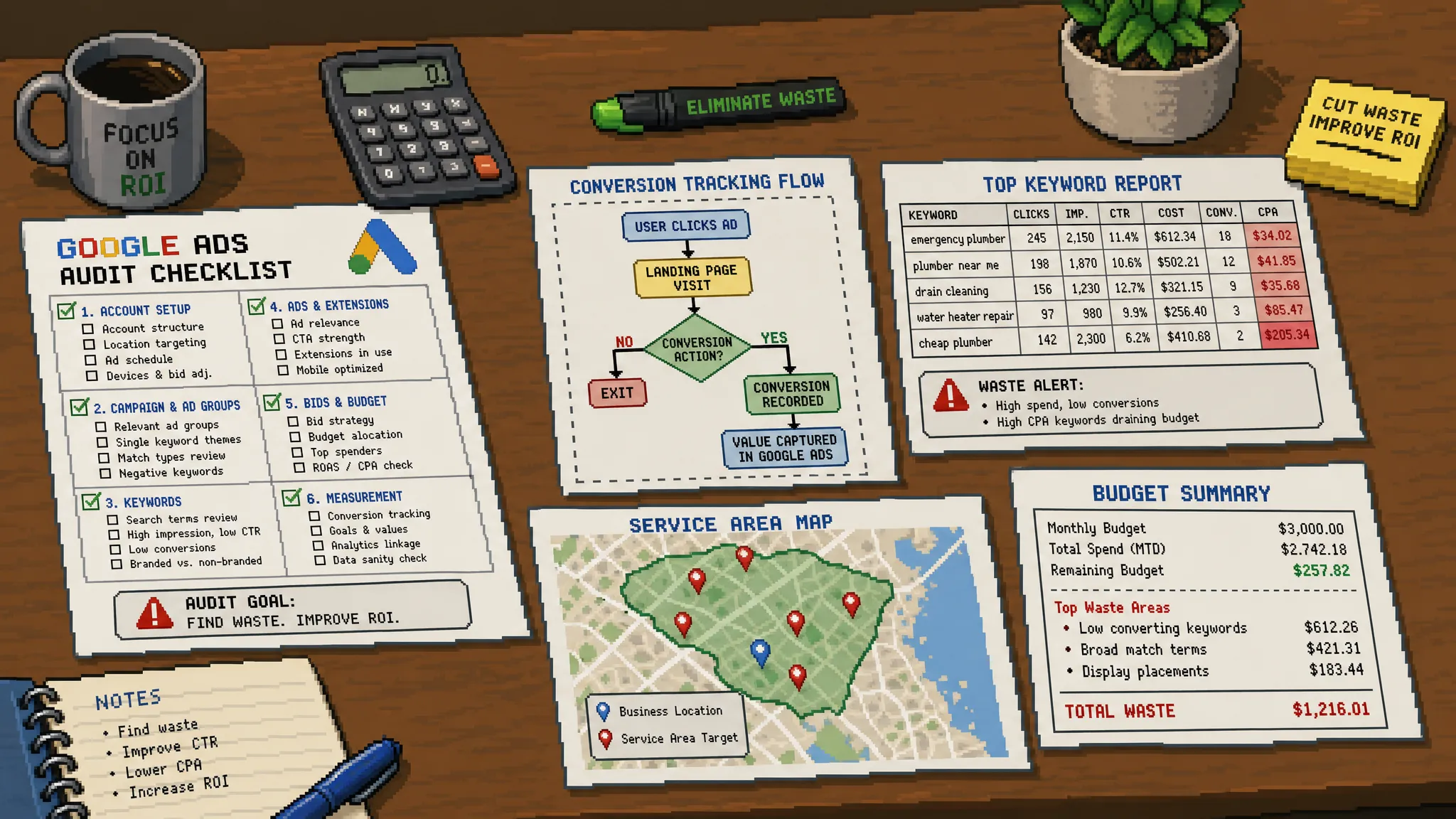
Wasted Google Ads spend rarely arrives with a warning label. It hides inside vague match types, messy tracking, under-qualified clicks, weak location settings and automated campaigns that are optimising towards the wrong signals.
For agencies, the pressure is even higher. A client might not care that the account inherited years of clutter or that the market changed last month. They see the spend, the leads and the CPA. The good news is that many PPC Google Ads leaks can be found quickly if you know where to look.
The goal is not to slash budgets blindly. It is to redirect spend away from low-intent traffic and towards the queries, audiences, locations and campaigns most likely to produce revenue.
What counts as wasted spend in Google Ads?
Wasted spend is any ad spend that is unlikely to support the commercial goal of the account. In lead generation, that might mean clicks from people outside the service area, irrelevant search terms, duplicated conversion actions or form fills from users who will never become customers. In ecommerce, it might mean spend on products with poor margins, low-stock items or campaigns optimising for add-to-carts rather than purchases.
A fast wasted spend audit should separate poor performance from poor measurement. If tracking is broken, you may cut campaigns that are actually working. If targeting is too loose, you may keep funding traffic that looks cheap but never converts.
| Waste source | Common symptom | Fast fix |
|---|---|---|
| Bad conversion tracking | High conversions but poor lead quality | Audit primary conversions and remove weak signals |
| Irrelevant search terms | Clicks from research, jobs or DIY queries | Add negatives and tighten match type strategy |
| Loose locations | Spend outside the real service area | Use presence-based targeting and exclusions |
| Poor budget allocation | Top campaigns limited while weak ones spend freely | Reallocate budget by qualified conversion value |
| Automation fed by bad data | Smart bidding chases low-quality actions | Fix goals before changing bids |
| Landing page mismatch | Good CTR but low conversion rate | Align ad intent, page message and form friction |
Start with conversion tracking before touching bids
If conversion tracking is inaccurate, every optimisation decision becomes risky. This is the first place to look when a client says Google Ads is wasting money, especially in accounts with multiple forms, phone calls, imported CRM events or historic conversion actions.
In Google Ads, only the actions that represent genuine business value should be marked as primary conversions. Secondary actions can still be useful for observation, but they should not steer automated bidding unless they are meaningful. For example, a page view, PDF download or time-on-site event might be helpful context, but it should not carry the same weight as a qualified lead or purchase.
Google provides a useful starting point in its guide to conversion tracking in Google Ads. Agencies should go further by checking whether the tracked action matches the client’s sales process. A tracked lead is not always a good lead.
Fast checks to run:
- Confirm every primary conversion action is still relevant.
- Check for duplicate tracking from Google Ads tags, GA4 imports and third-party tools.
- Compare recent conversions with CRM or sales data.
- Segment conversions by campaign, device and location to find quality gaps.
- Review call length settings if phone calls are counted as leads.
This is often where the biggest hidden waste appears. If a campaign is optimising for every form submission, including spam or unqualified enquiries, Google Ads may get very efficient at finding more of the wrong people.
Mine the search terms report for obvious leaks
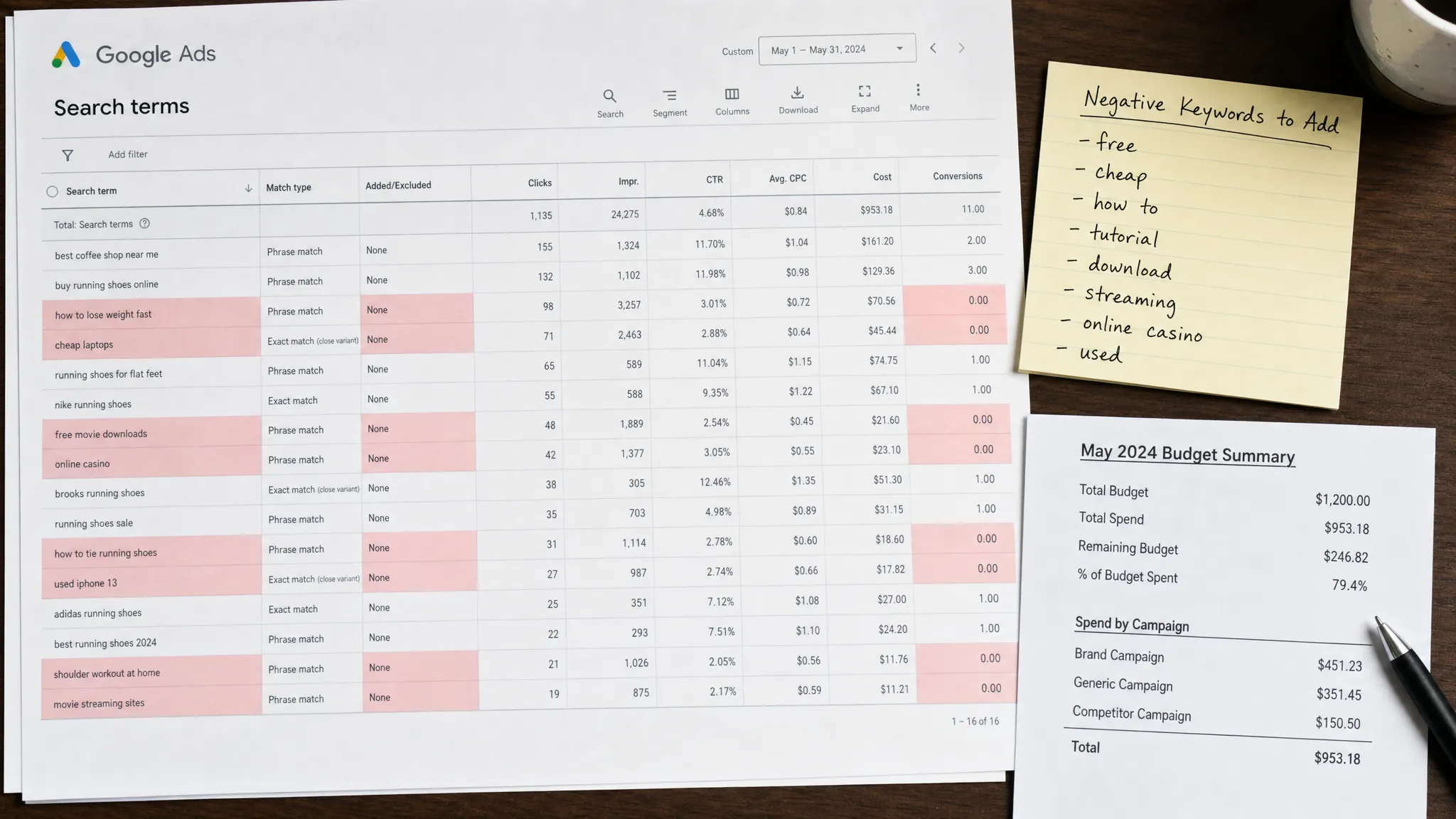
The search terms report is still one of the fastest ways to cut wasted spend in Search campaigns. It shows the queries people used before clicking your ads, subject to Google’s reporting thresholds. Even with limited visibility, the patterns are usually clear.
Look for terms that reveal the wrong intent. Words like free, template, salary, jobs, training, definition, DIY, cheap, complaints or reviews can be valuable in some accounts and wasteful in others. The right decision depends on the client’s offer and funnel stage.
For example, a B2B SaaS client may want competitor comparison searches, but not student research queries. A local trades business may want emergency plumber near me, but not plumbing apprenticeship jobs. A high-ticket legal client may want consultation searches, but not generic law school content.
Google’s search terms report documentation explains how the report works. From an optimisation perspective, the key is to turn query patterns into account structure decisions, not just one-off negatives.
| Query pattern | What it may indicate | Action |
|---|---|---|
| Jobs, careers, salary | Recruitment intent | Add negatives unless hiring is the goal |
| Free, template, sample | Low commercial intent | Exclude or move to a separate awareness campaign |
| Competitor names | Comparison intent | Keep only if conversion quality justifies CPCs |
| How to, what is | Research intent | Exclude from BOFU campaigns |
| Locations outside coverage | Poor geo control | Add location exclusions and adjust targeting settings |
| Existing customer support terms | Service or login intent | Exclude if not tied to acquisition |
Do not add negatives so aggressively that you block useful long-tail searches. The best approach is to identify recurring themes, then apply phrase or exact negatives carefully. Shared negative lists can also keep agency-managed accounts cleaner, especially where multiple campaigns serve the same client.
Tighten match types without killing scale
Broad match can work well when conversion data is clean, bidding is mature and the account has enough volume. It can also burn through budget quickly when the account is new, tracking is weak or the offer has many adjacent meanings.
If wasted spend is rising fast, review match types by campaign intent. Exact match and phrase match are often better for high-intent, budget-sensitive campaigns where the client needs predictable lead quality. Broad match may be useful in separate test campaigns with clear budgets, strong negatives and a reliable conversion goal.
A practical structure is to separate proven intent from exploration. Keep core commercial terms in tightly managed campaigns. Put discovery terms, broader match types or new keyword themes into controlled tests. That way, learning does not cannibalise budget from the terms already paying the bills.
Also watch for close variants. They can expand reach beyond the keyword as written. Sometimes that expansion is helpful. Sometimes it turns a precise lead-generation campaign into an expensive research campaign.
Fix location settings that quietly drain budget
Location targeting is one of the simplest settings to miss and one of the fastest to correct. Many accounts spend money on users who are interested in a location rather than physically in it. For some advertisers, that is fine. For local services, regional agencies, clinics, trades and many B2B sales teams, it can be a costly mismatch.
Google Ads location targeting allows advertisers to choose how location intent is handled. Google’s guide to location targeting is worth reviewing if you manage local or regional campaigns.
For quick waste reduction, check whether campaigns are targeting people in, regularly in or interested in the selected locations. If the client only serves users physically in a region, presence-based targeting is usually safer. Then review the user location report to identify spend outside the real catchment area.
Do not stop at countries and cities. Check postcodes, counties, radius targeting and excluded locations. In UK accounts, this can make a noticeable difference for clients whose service area is specific, such as London boroughs, commuter towns, regional franchises or local branches.
Reallocate budget based on qualified outcomes
A campaign with the lowest CPA is not always the best campaign. It may simply be generating the easiest conversions. For lead-generation accounts, qualified lead rate matters. For ecommerce, profit and revenue quality matter. For subscription businesses, lifetime value may matter more than first purchase CPA.
When cutting wasted spend, sort campaigns by business value, not just platform metrics. If you have CRM data, offline conversion imports or GA4 ecommerce revenue, use them. If not, speak to the client or sales team and classify leads manually for a sample period.
A simple agency-friendly approach is to label campaigns as:
- Scale: Strong conversion volume and acceptable quality.
- Fix: Good intent but weak conversion rate, poor page fit or tracking issues.
- Limit: Spend is high but lead quality or revenue is poor.
- Test: New campaign with capped budget and a clear learning goal.
This keeps budget conversations objective. Instead of saying a campaign feels wasteful, you can show that it spends 30 percent of budget but produces only low-quality enquiries, or that a campaign with a higher CPA creates better sales opportunities.
Be careful with automated bidding changes
Smart bidding is powerful, but it is not magic. It optimises towards the conversion signals you provide. If those signals are inflated, duplicated or low quality, automated bidding can accelerate waste.
Before changing bid strategies, ask whether the bid strategy is the real issue. A target CPA campaign may look inefficient because the target is unrealistic for the market. A Maximise conversions campaign may overspend because the budget is too high relative to good traffic. A target ROAS campaign may struggle because product margins and feed quality are uneven.
Fast improvements often come from fixing the inputs around automation:
- Remove weak primary conversions.
- Set realistic targets based on recent performance.
- Give campaigns enough budget to learn, but cap experimental campaigns.
- Avoid making multiple major changes at once.
- Use experiments where the account has enough volume.
Google’s documentation on campaign experiments is useful when you need to prove a change without gambling the whole account. For agencies, experiments can also reduce client anxiety because the test has a defined scope.
Do not let Performance Max run without guardrails
Performance Max can find incremental conversions, but it can also blur where spend is going if the setup is too loose. For waste reduction, the aim is not always to pause Performance Max. The aim is to give it better constraints and better inputs.
Review asset groups, audience signals, product or service grouping, final URL settings and brand controls. If ecommerce products vary heavily by margin or availability, do not let one campaign treat everything as equal. If a lead-generation offer has separate services with different values, avoid mixing them into one vague campaign with one generic conversion goal.
For brand-heavy accounts, check how much reported success is coming from existing demand. Brand traffic is valuable, but it should not be allowed to disguise weak prospecting performance. If Performance Max is taking credit for conversions that Search brand campaigns used to capture more cheaply, the budget conversation changes.
The same applies to remarketing. Converting warm users is useful, but it is not the same as generating new demand. Segment reporting as much as Google allows, compare against other campaigns and judge Performance Max by incremental value, not vanity conversion volume.
Improve landing page fit before blaming keywords
Sometimes the click is not the waste. The page is.
A high-intent search term can still fail if the landing page is generic, slow, confusing or misaligned with the ad promise. In agency accounts, this often happens when several services are sent to the same homepage or when paid traffic lands on a page built for brand credibility rather than conversion.
Look for message match. If the query is emergency boiler repair, the ad and page should clearly reflect emergency boiler repair. If the query is white-label PPC support, the page should not force users to decode a broad digital marketing proposition.
Fast landing page fixes include clearer headings, more specific proof points, reduced form friction, stronger calls to action and better mobile usability. You do not always need a full redesign to reduce wasted spend. Sometimes you need a page that answers the searcher’s immediate question faster.
Build a 30-minute wasted spend routine
The best PPC teams do not wait for monthly reporting to find leaks. They use a recurring routine that catches issues before they become expensive.
A practical 30-minute routine might look like this:
- Check spend spikes by campaign, day and device.
- Review search terms for new irrelevant patterns.
- Compare conversions with qualified leads or revenue where available.
- Check location reports for spend outside target areas.
- Review campaigns limited by budget and campaigns spending without conversions.
- Inspect recent change history for accidental settings changes.
- Flag any tracking anomalies before making bid decisions.
This routine is especially useful for agencies managing multiple client accounts. It creates a consistent quality-control layer and makes performance conversations easier. When a client asks what has been done this week, you can point to specific waste removed, not just general optimisation.
Know when not to cut spend
Cutting wasted spend fast does not mean cutting every underperforming campaign immediately. Some campaigns need time, especially in longer sales cycles or low-volume B2B niches. A campaign may look inefficient in-platform while still influencing pipeline. Another may be gathering useful data for a new market.
Before pausing, check the decision window. Has the campaign had enough clicks? Is conversion lag significant? Are offline sales imported? Is the landing page fair? Are competitors pushing CPCs up temporarily? A fast audit should protect the budget, but it should not punish campaigns before the data is meaningful.
This is where senior judgement matters. Junior optimisers often overreact to short-term CPA swings. Experienced PPC specialists know the difference between normal variance and structural waste.
Reporting wasted spend reductions to clients
Clients usually do not need a long technical explanation. They need to know what was found, what changed and what the expected impact is. The clearer you make that story, the easier it is to maintain trust.
| Client question | Strong agency answer |
|---|---|
| Why was spend wasted? | The account was paying for irrelevant search intent and locations outside the service area. |
| What did you change? | We added negative keywords, corrected location settings and cleaned up conversion goals. |
| What happens next? | We will monitor lead quality and reallocate budget towards campaigns with stronger qualified outcomes. |
| Will volume drop? | Possibly in the short term, but the aim is fewer poor clicks and better quality enquiries. |
This level of communication is particularly important when reducing spend causes lead volume to dip. Fewer leads can be a positive outcome if the removed leads were low quality. Make that distinction clear before the client spots the change themselves.
Frequently Asked Questions
What is the fastest way to cut wasted spend in Google Ads? Start with conversion tracking, search terms and location settings. These areas often reveal obvious leaks quickly and can be corrected without rebuilding the whole account.
Should I pause broad match keywords to reduce wasted spend? Not always. Broad match can work when tracking, bidding and negatives are strong. If spend is leaking, separate broad match into controlled tests rather than letting it share budget with proven high-intent terms.
How often should agencies review search terms? High-spend or volatile accounts may need search term reviews several times a week. Smaller or stable accounts can often be reviewed weekly, with deeper analysis during monthly optimisation.
Can Performance Max waste budget? Yes, especially if goals, asset groups, product groupings or brand controls are too broad. Performance Max needs clear conversion signals and guardrails to avoid optimising towards low-value outcomes.
Is a lower CPA always better? No. A low CPA is only useful if the conversions are commercially valuable. Lead quality, sales rate, revenue and margin should influence budget decisions.
Need senior PPC support without adding headcount?
If your agency needs to cut wasted spend quickly but your team is stretched, PPC Ghost provides on-demand, white-label PPC execution for UK agencies. You get senior-only support across Google Ads, Meta Ads, Microsoft Ads and GA4 tracking, without recruitment, long contracts or visible third-party branding.
Whether you need a same-day account audit, overflow optimisation or flexible pay-as-you-go support, PPC Ghost helps your agency deliver sharper paid media work while you keep the client relationship.