PPC Ads Best Practices for Agencies Under Pressure
PPC ads best practices for agencies under pressure: triage accounts, protect budgets, improve tracking, and scale delivery without chaos.
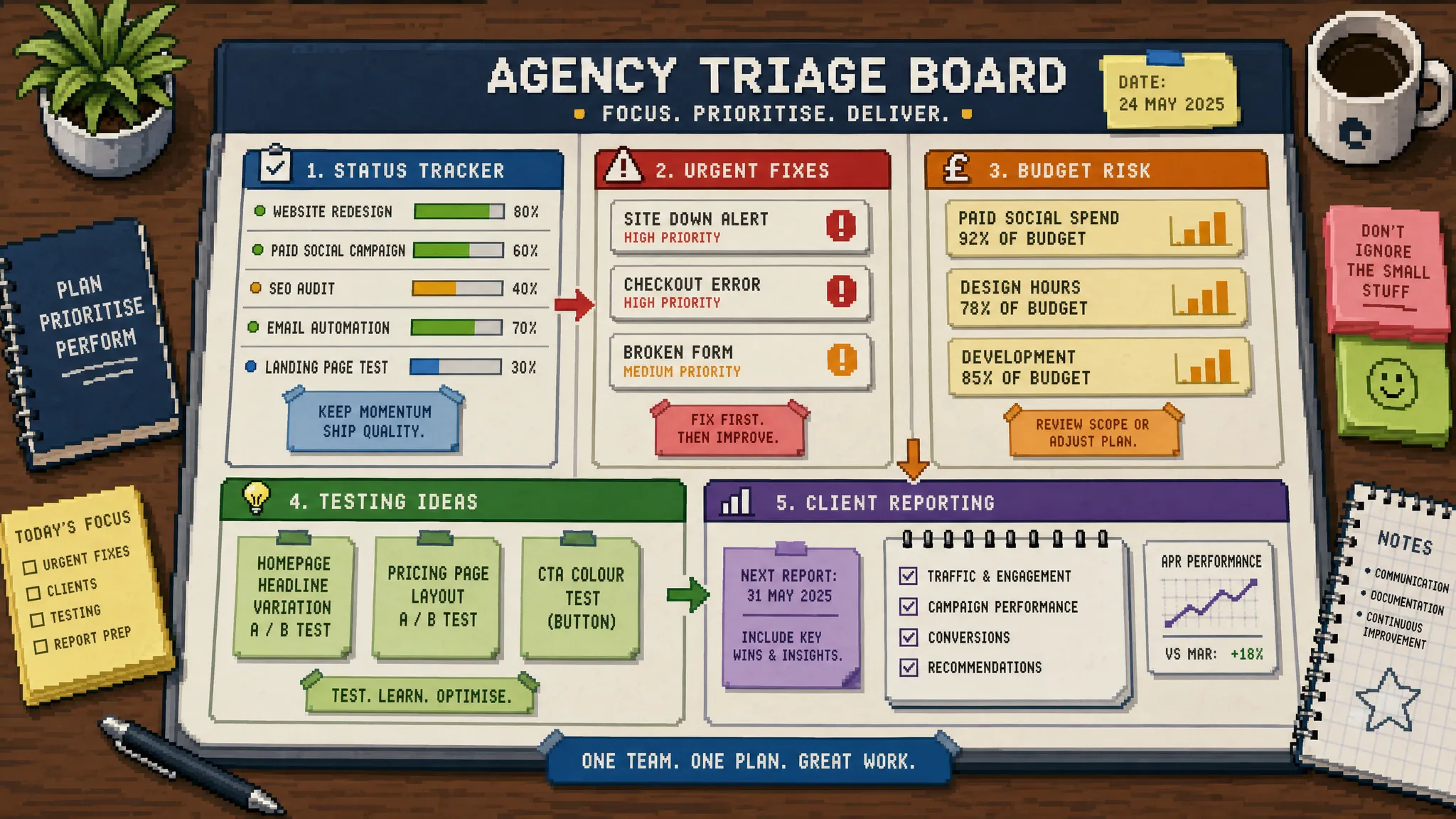
When budgets are tight, deadlines are shorter, and clients want answers yesterday, PPC ads can quickly move from a growth channel to an operational stress test. The problem is rarely a lack of effort. It is usually a lack of prioritisation, clean data, and delivery capacity at the exact moment the agency needs all three.
For agencies under pressure, the best PPC work is not about testing every feature or rebuilding every account from scratch. It is about knowing what to fix first, what to leave alone, and how to protect client performance while your team is stretched.
This guide covers practical PPC ads best practices for agencies that need to keep accounts moving, reduce wasted spend, and maintain client confidence without burning out the delivery team.
Start With Triage, Not Tinkering
The biggest mistake under pressure is optimising whatever is loudest. A client flags a bad week, a campaign spends more than expected, a new lead looks poor quality, or a sales team complains that enquiries are not converting. All of these may matter, but they do not all deserve the same response.
A better approach is to triage by commercial risk. Ask: which issue is costing the client the most money, damaging the sales pipeline fastest, or putting the relationship most at risk?
| Situation | Priority level | First action |
|---|---|---|
| Conversion tracking is broken or duplicated | Critical | Pause major optimisation decisions until data is verified |
| Spend has increased but qualified leads have dropped | High | Review search terms, audience quality, budgets, and conversion actions |
| Campaign is limited by budget but CPA is strong | Medium | Decide whether extra spend is commercially justified |
| CTR is down but conversions are stable | Low to medium | Review ad relevance, but do not overreact |
| A new test has not converted after a small spend | Low | Check sample size before making changes |
This kind of triage keeps the team focused. It also gives account managers a clearer explanation for clients: “Here is what matters most, here is what we checked, and here is what we are doing next.”
Pressure often creates unnecessary account activity. Resist the urge to change bids, budgets, assets, audiences, and landing pages all at once. If performance improves or worsens, you will not know which change caused it.
Protect Measurement Before You Optimise
Reliable PPC performance starts with reliable measurement. If the data is wrong, every optimisation decision becomes guesswork. Under pressure, tracking problems are easy to miss because everyone wants visible action fast. But fixing campaigns before fixing measurement is like steering with a fogged windscreen.
At minimum, every active account should have a clear answer to these questions:
- Which conversion actions are primary, and which are secondary?
- Are leads, purchases, calls, forms, and booked appointments being counted once?
- Are GA4 events, Google Ads conversions, Meta Pixel events, and Microsoft Ads goals aligned?
- Are internal team visits, test leads, spam forms, and duplicate thank-you page visits excluded where possible?
- Are UTMs consistent enough for reporting across GA4, CRM, and client dashboards?
For Google Ads in particular, Smart Bidding relies on conversion signals to make auction-time decisions. Google’s own Smart Bidding documentation explains how automated bid strategies use signals and conversion data to optimise bids. If the account is feeding poor signals into the system, better bidding will not save it.
A useful agency habit is to create a “tracking confidence score” for each client account. It does not need to be complicated. Green means data is reliable enough for optimisation, amber means usable with caveats, and red means major decisions should be delayed until tracking is fixed.
This also protects your agency commercially. If a client challenges results, you can show that measurement quality is part of your process, not an afterthought.
Use Guardrails to Stop Waste Fast
When an agency is under pressure, the quickest wins often come from preventing obvious waste rather than chasing advanced gains. This is especially true in accounts that have been running for months with limited maintenance.
Start with the places where platforms can spend money beyond the client’s real intent.
In Google Ads, review search terms, match type behaviour, location settings, brand versus non-brand separation, Performance Max asset groups, and budget distribution. In Meta Ads, check audience overlap, creative fatigue, placement quality, frequency, and whether the algorithm is optimising for a meaningful event. In Microsoft Ads, review imported Google settings carefully, especially locations, schedules, match types, and audience targeting.
Small controls can make a large difference. Examples include excluding irrelevant queries, tightening location targeting from “interest in” to actual presence where appropriate, separating prospecting from remarketing, and preventing low-priority campaigns from draining budget.
The key is to avoid blanket cuts. Reducing spend everywhere may make the account look safer for a week, but it can also starve the campaigns that are doing the real work. Instead, reallocate budget from weak intent to strong intent.
A simple rule works well: protect spend where intent, tracking, and landing page fit are strongest. Challenge spend where one or more of those are weak.
Standardise Campaign Builds Before Deadlines Hit
Agencies often lose time because every PPC build feels custom. Custom strategy is valuable. Custom admin is not.
If your team is repeatedly building PPC ads under time pressure, standardisation becomes a performance advantage. It reduces errors, speeds up QA, and makes it easier for another specialist to step in if the original account owner is unavailable.
At a minimum, create shared standards for:
- Campaign and ad set naming conventions
- UTM parameters
- Conversion action naming
- Negative keyword lists
- Budget labels and notes
- Audience naming
- Asset file naming
- Launch QA checklists
This is not bureaucracy. It is risk control.
For example, a clear naming convention helps a senior PPC specialist understand an account quickly. A standard UTM structure makes GA4 reporting easier. A pre-launch QA checklist reduces embarrassing mistakes such as sending traffic to the wrong landing page, launching with missing exclusions, or using the wrong optimisation event.
Agencies under pressure should also keep template briefs for common scenarios: lead generation, ecommerce, local service campaigns, B2B demand generation, remarketing, and campaign rescue work. The brief should capture goals, budget, geography, offer, landing pages, tracking status, approval process, and reporting expectations.
The less your team has to remember, the more attention they can give to strategy.
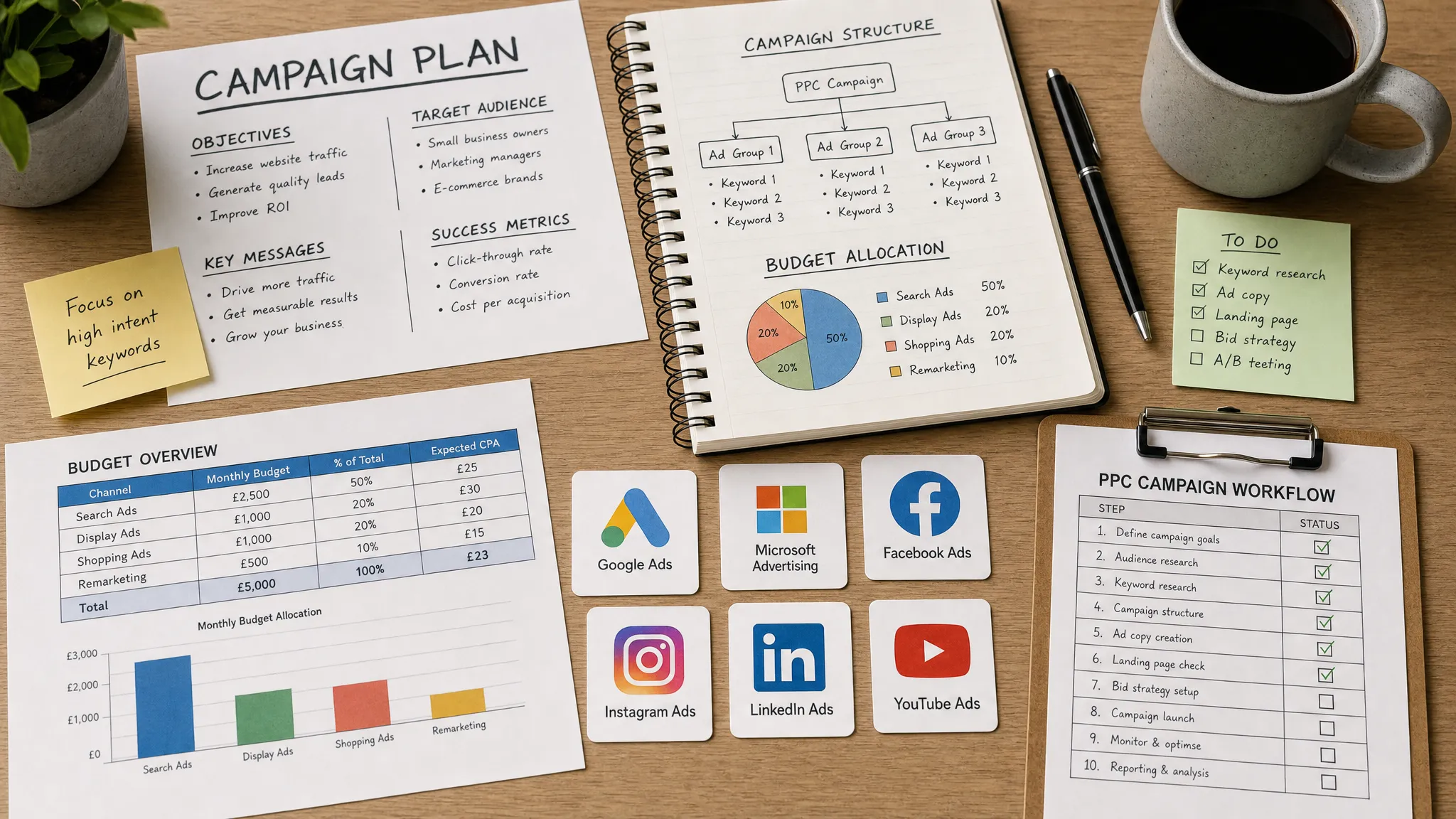
Separate Urgent Fixes From Strategic Improvements
Not every good idea belongs in the current week. Under pressure, teams often mix urgent fixes with strategic improvements, then become overwhelmed because everything feels important.
Create two categories in every account review: stabilise and improve.
Stabilise work includes tracking fixes, wasted spend reduction, budget control, disapproved ad resolution, broken landing pages, poor lead quality investigations, and urgent client reporting.
Improve work includes new landing page tests, creative refreshes, bidding experiments, audience expansion, feed optimisation, CRO projects, and new channel launches.
Both matter, but they should not compete for the same mental space. If a client’s account is leaking budget due to irrelevant traffic, that comes before a new creative testing roadmap. If tracking is broken, that comes before a bidding experiment.
This distinction also helps client communication. You can say, “This week is about stabilising performance. Once the account is clean, we will move into controlled growth tests.” That is much more reassuring than sending a long list of disconnected actions.
Build Reporting Around Decisions, Not Data Dumps
Clients rarely want more PPC data. They want clarity. Under pressure, reporting can become a defensive exercise, full of screenshots, platform metrics, and vague explanations. That usually creates more questions, not fewer.
A strong agency report should connect PPC activity to decisions.
Instead of simply saying clicks increased or CPC fell, explain what that means. Did lead volume improve? Did cost per qualified lead move in the right direction? Did a campaign generate pipeline, or just form fills? Should budget move, hold, or reduce?
A decision-led report usually answers four questions:
- What changed?
- Why did it change?
- What are we doing about it?
- What do we need from the client?
This format is especially useful when performance is mixed. For example, an account may show lower CPA in Google Ads but weaker lead quality in the CRM. A data dump might make the campaign look successful. A decision-led report would flag the quality issue and recommend adjusting conversion signals, search terms, landing page messaging, or qualification questions.
Under pressure, honesty builds trust faster than spin. If performance is down, say so. Then show the diagnosis, actions, and expected review point.
Do Fewer Tests, But Make Them Cleaner
Testing is essential in PPC, but overloaded agencies often run too many weak tests. A new audience here, a bidding change there, a landing page tweak, a creative refresh, a campaign restructure, and a budget increase all go live in the same fortnight. When results change, nobody knows why.
A cleaner testing process is better than a busier one.
Define the hypothesis before the test. For example: “Using a more specific landing page for non-brand search traffic will increase qualified lead rate because the message will better match the query.” That is stronger than “test new landing page.”
Give each test enough time and budget to mean something. Avoid judging a campaign after a handful of clicks unless the issue is clearly technical or policy-related. For low-volume B2B accounts, you may need to look at directional signals such as search intent, form quality, CRM notes, and sales feedback, not just platform conversions.
Document test outcomes in plain English. Future account managers should be able to see what was tested, what happened, and whether the result was conclusive. This prevents teams from repeating failed experiments every time an account changes hands.
Align PPC Ads With Sales Reality
One of the most overlooked PPC ads best practices is to check whether the campaign is optimising for what the business actually values.
Lead generation accounts are especially vulnerable. A campaign can produce cheap leads that sales teams hate. Meta Ads can generate high form volume with low intent. Google Ads can drive enquiries for services the client does not want to prioritise. Microsoft Ads can uncover valuable B2B traffic, but only if the offer and follow-up process match the audience.
The fix is to bring sales reality into PPC decisions. Ask clients what happened after the conversion. Which leads became opportunities? Which keywords, audiences, or offers produced poor-fit enquiries? Are calls being answered quickly? Is the landing page promising something the sales team cannot deliver?
If possible, import offline conversion data or at least review CRM outcomes regularly. Even a simple monthly lead quality review can improve PPC decision-making.
This matters more in 2026 because automation is only as good as the goal it is given. If platforms are told to find the cheapest conversion, they may do exactly that. Agencies need to help clients define the right conversion, not just generate more of the easiest one.
Know When Capacity Is the Real Bottleneck
Sometimes the issue is not strategy. It is capacity.
Agency teams may know exactly what needs doing, but lack the hours to do it properly. The account manager is handling client calls, the PPC specialist is covering too many accounts, the tracking expert is booked, and the creative team is waiting on approvals. This is how good agencies end up delivering rushed work.
There are three main ways to solve capacity pressure: hire, outsource, or simplify the service scope.
Hiring can be the right long-term move, especially if PPC demand is consistent and margins support a permanent role. If you are recruiting, platforms focused on verifiable hiring and trust profiles can help make talent decisions more defensible. But hiring is not always fast enough when client work needs attention this week.
Outsourcing to a white-label PPC specialist can help agencies bridge the gap without adding permanent headcount. This is particularly useful when you need senior execution, account audits, campaign builds, tracking support, or overflow optimisation while your agency keeps the client relationship.
Simplifying scope is also valid. If a client is paying for a lean management package, they may not need every possible test across Google, Meta, and Microsoft at once. A narrower scope delivered well is better than a broad scope delivered badly.
Use a Weekly Operating Rhythm
PPC accounts do not need constant fiddling, but they do need rhythm. A simple weekly process helps agencies stay proactive even when workloads are heavy.
| Frequency | Focus | Example checks |
|---|---|---|
| Daily or every few days | Risk monitoring | Spend spikes, disapprovals, broken URLs, tracking outages |
| Weekly | Performance optimisation | Search terms, budgets, CPA, ROAS, lead quality, creative fatigue |
| Fortnightly | Testing review | Bidding tests, landing page tests, audience tests, creative outcomes |
| Monthly | Strategic review | Channel mix, budget allocation, CRM feedback, growth opportunities |
| Quarterly | Account architecture | Campaign structure, measurement model, offer strategy, expansion plan |
The exact cadence depends on spend, volatility, and client expectations. A high-spend ecommerce account may need daily checks. A smaller B2B lead generation account may not. The principle is to separate monitoring from meaningful optimisation.
This also helps reduce panic. If clients know when reviews happen and what is being checked, they are less likely to demand random updates every time a metric moves.
Keep a “Pressure Playbook” for Common PPC Problems
Every agency should have a pressure playbook for recurring PPC issues. This is a simple internal document that explains what to check first when something goes wrong.
Common playbook scenarios include sudden CPA increase, drop in conversion volume, poor lead quality, overspend risk, tracking mismatch, Meta creative fatigue, Google Ads disapprovals, Performance Max concerns, and landing page conversion drops.
For each scenario, document the first checks, likely causes, owner, client communication template, and escalation point. This turns panic into process.
For example, if lead quality drops, the playbook might prompt the team to review search terms, recent query changes, form fields, Meta placement breakdowns, CRM notes, location data, and any recent landing page edits. Without a playbook, the team may jump straight to bid changes and miss the real cause.
A pressure playbook is especially useful for agencies using freelancers, contractors, or white-label partners. Everyone works from the same logic, which reduces confusion and protects delivery quality.
Avoid These PPC Mistakes When the Team Is Stretched
Pressure does not just create workload. It creates bad decisions. The most common mistakes are usually avoidable.
One mistake is pausing campaigns too quickly. If a campaign has a strong history and a short-term dip, investigate before cutting it. Another is trusting platform recommendations without context. Some recommendations can be useful, but they are not a substitute for commercial judgement.
A third mistake is changing automated bidding too often. Bid strategies need stable signals. Frequent resets can delay learning and make performance harder to interpret. Another is launching new channels to distract from weak fundamentals. If Google Ads tracking is broken, adding Meta or Microsoft will not fix the measurement problem.
Finally, agencies often under-communicate when they are busy. Silence makes clients nervous. A concise update that explains the issue, action, and next review date can prevent a difficult call later.
Frequently Asked Questions
What are the most important PPC ads best practices for agencies? The most important practices are clean conversion tracking, disciplined budget control, clear campaign structure, regular search term and audience reviews, decision-led reporting, and a consistent optimisation rhythm.
How can agencies reduce PPC stress quickly? Start by triaging accounts by commercial risk. Fix tracking issues, stop obvious wasted spend, resolve urgent disapprovals, and communicate the action plan clearly to clients. Avoid unnecessary changes until the core problems are understood.
Should agencies outsource PPC ads management? Outsourcing can make sense when the agency has client demand but not enough senior delivery capacity. A white-label PPC specialist can support execution while the agency keeps the client relationship and brand ownership.
How often should PPC ads be optimised? It depends on spend and volatility, but most active accounts benefit from weekly optimisation and more frequent risk monitoring. Larger or fast-moving accounts may need checks several times per week.
What should agencies do before scaling PPC budgets? Confirm that tracking is accurate, lead or revenue quality is acceptable, landing pages are converting, and the current budget is being spent efficiently. Scaling weak foundations usually increases waste.
Need Senior PPC Support Without Adding Headcount?
If your agency is under pressure and PPC delivery is becoming a bottleneck, you do not always need to hire before you can move forward.
PPC Ghost provides on-demand, white-label PPC support for agencies across Google Ads, Meta Ads, Microsoft Ads, GA4, and tracking. You get senior-only expertise, flexible pay-as-you-go support, and anonymous delivery while your agency keeps the credit.
When the workload spikes, the right support can turn PPC pressure back into a controlled, profitable service line.