What to Expect From a Professional Google Ads Service
Know what a professional Google Ads service includes, from strategy and tracking to optimisation, reporting and realistic agency expectations.
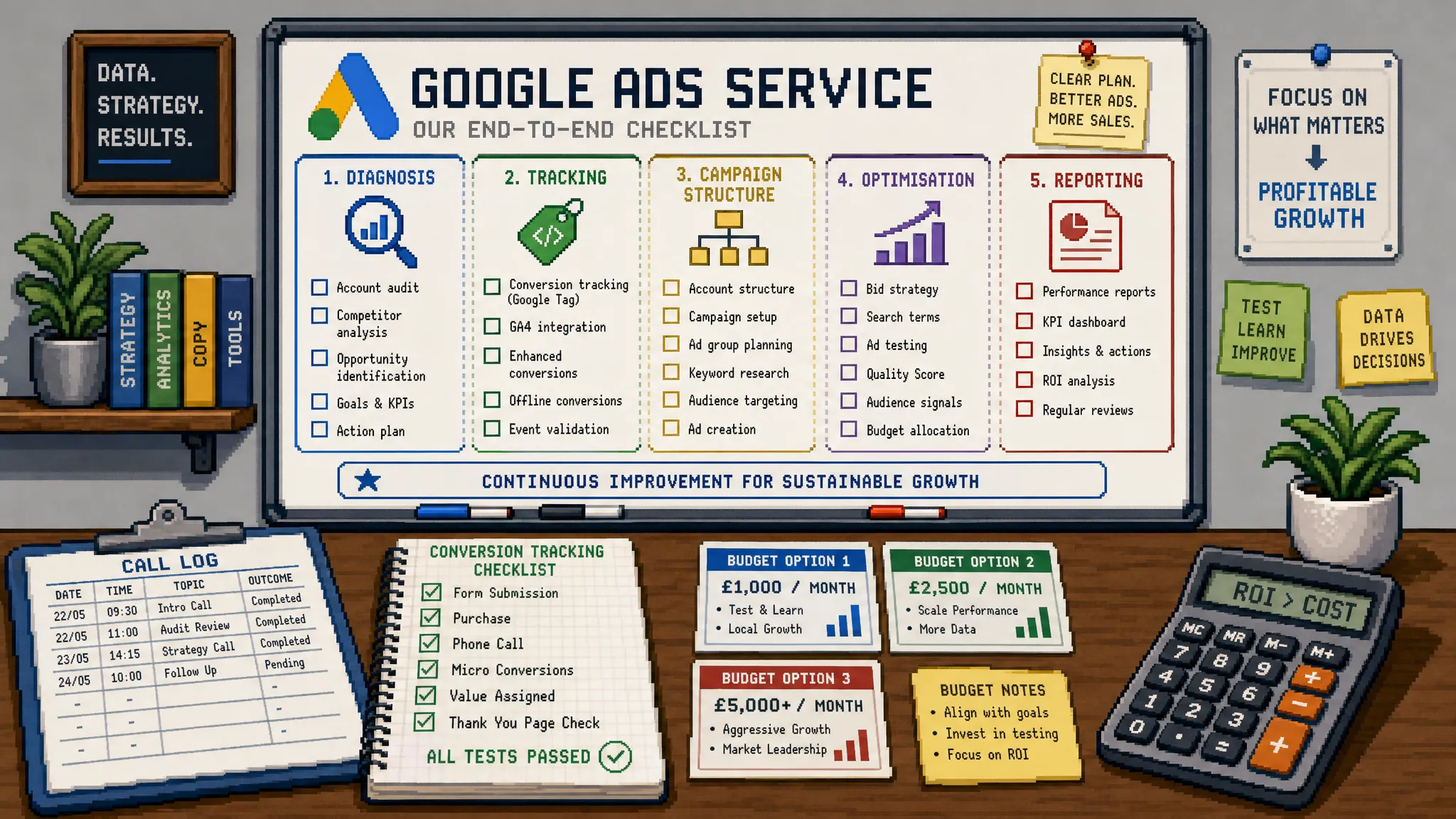
A professional Google Ads service should do more than “set up some campaigns” and check the account once a month. Done well, it gives you a clearer route from ad spend to measurable business outcomes, with the technical foundations, strategic judgement and day-to-day optimisation needed to make paid search commercially useful.
That matters because Google Ads can look deceptively simple from the outside. You choose keywords, write ads, set a budget and wait for leads or sales. In practice, the results depend on account structure, conversion tracking, bidding strategy, search intent, landing pages, data quality and how quickly wasted spend is spotted.
If you are comparing providers, or deciding whether to outsource for a client account, here is what a strong Google Ads service should include and what you should reasonably expect at each stage.
A proper diagnosis before anyone starts rebuilding campaigns
The first sign of a professional Google Ads service is restraint. A good specialist will not rush into changing bids, pausing campaigns or launching Performance Max without understanding the commercial context.
Before any meaningful work starts, expect questions such as:
- What is the main business goal, leads, sales, bookings, calls or pipeline value?
- Which conversions are genuinely valuable and which are vanity actions?
- What is the acceptable cost per lead, cost per sale or return on ad spend?
- Which locations, products, services or customer types are most profitable?
- How quickly does the business respond to enquiries?
- Are there offline sales, CRM stages or repeat purchases that should influence optimisation?
This discovery stage separates execution from guesswork. Two accounts can have the same monthly spend and completely different priorities. A local service business may care most about phone calls from specific postcodes. A B2B agency may need fewer leads, but higher quality enquiries. An e-commerce brand may want revenue growth, but only if profit margins can support the cost of acquisition.
If spend is rising without better results, or if campaigns feel busy but directionless, it may be worth reviewing the signs you need a Google AdWords expert on demand before committing to another long-term arrangement.
Core deliverables you should expect from a Google Ads service
Not every provider packages their work in the same way, but a professional service should usually cover the following areas. Some may be included as standard, while others depend on account size, website access and the complexity of the sales process.
| Service area | What it should involve | Why it matters |
|---|---|---|
| Account audit | Review of structure, spend, search terms, settings, tracking and historical performance | Identifies wasted spend and missed opportunities before changes are made |
| Strategy | Clear plan for targeting, budgets, bidding, campaign types and priority actions | Keeps optimisation tied to business goals rather than platform activity |
| Conversion tracking | Checks for GA4, Google Ads conversions, tags, forms, calls and CRM data where relevant | Gives bidding and reporting a reliable performance signal |
| Campaign build or restructure | Search, Shopping, Performance Max, remarketing or other campaign setup where appropriate | Creates a cleaner foundation for testing and scaling |
| Ad copy and assets | Search ads, extensions, creative guidance and message testing | Improves relevance, click quality and conversion potential |
| Ongoing optimisation | Search term reviews, negatives, bid adjustments, budget shifts and testing | Reduces waste and improves efficiency over time |
| Reporting | Clear summary of what changed, what happened and what should happen next | Helps stakeholders understand performance without drowning in data |
The exact mix will depend on the account. A small lead generation account may need tight search campaigns and call tracking before anything else. A retailer may need feed quality, Shopping structure and Performance Max segmentation. A professional provider should be able to explain why each recommendation matters.
Strategy should be grounded in commercial reality
A Google Ads service is not just a media buying function. It should connect platform decisions to business economics.
For example, a campaign generating leads at £40 each might look strong on paper. But if only one in 20 leads becomes a customer and the average customer is worth £500, the maths may not work. On the other hand, a £150 lead could be profitable if the close rate, order value or lifetime value is high enough.
A professional specialist will usually look beyond surface metrics such as impressions, clicks and average CPC. Those numbers still matter, but they are not the final measure of success. Better questions include:
- Which campaigns are producing qualified enquiries or profitable sales?
- Are certain keywords driving research traffic rather than buying intent?
- Is the budget being spent in the right locations and at the right times?
- Are high-volume campaigns crowding out more profitable niche opportunities?
- Is automated bidding being fed with clean conversion data?
This is where senior judgement becomes important. Google Ads offers many automation features, but automation still needs the right inputs, guardrails and interpretation. A professional service should know when to trust machine learning, when to limit it and when to simplify the account.
Tracking should be treated as non-negotiable
If tracking is broken, duplicated or misleading, the whole account is at risk. You cannot optimise confidently if the platform is counting the wrong actions or missing the actions that matter.
Google’s own documentation explains that conversion tracking helps show what happens after someone interacts with an ad, such as purchases, sign-ups, phone calls or app downloads. In practical terms, this is the data that helps advertisers understand whether campaigns are producing meaningful outcomes.
A professional Google Ads service should check whether conversions are set up correctly, not simply accept the existing numbers at face value. Common issues include duplicate form submissions, page views counted as leads, old conversions still marked as primary, missing call tracking, consent mode gaps and GA4 events that do not match business priorities.
You should expect a provider to explain tracking limitations clearly. Sometimes fixes require developer support, access to Google Tag Manager, CRM integration or changes to the website. A good specialist will not pretend everything is perfect if the data is unreliable. They will prioritise the most important fixes and explain how measurement quality affects bidding, reporting and decision-making.
Campaign structure should be easy to explain
A well-managed Google Ads account does not have to be simplistic, but it should be understandable. If a provider cannot explain the campaign structure in plain English, that is a problem.
For Search campaigns, structure should usually reflect intent. Brand searches behave differently from non-brand searches. Emergency service keywords behave differently from early-stage research terms. Competitor campaigns need different expectations from high-intent category campaigns.
For e-commerce accounts, structure may involve Shopping, Performance Max, feed segmentation and product priorities. For lead generation, the focus may be on tight keyword themes, location relevance, call quality and landing page fit.
The key is that every campaign should have a purpose. “Because Google recommended it” is not enough. Recommendations can be useful, but they still need human review.
| Account element | Weak approach | Professional approach |
|---|---|---|
| Keywords | Broad targeting with little intent control | Keyword choices mapped to buyer intent and budget limits |
| Match types | Used without understanding likely query quality | Chosen based on data volume, query control and conversion goals |
| Negative keywords | Added rarely or reactively | Reviewed regularly to reduce irrelevant spend |
| Bidding | Changed frequently without a clear reason | Matched to conversion volume, data quality and business targets |
| Assets | Basic sitelinks and generic copy | Assets aligned with proof points, offers and user intent |

Optimisation should be continuous, but not chaotic
Professional optimisation is not about making random changes to prove work is happening. It is about improving the account based on evidence.
Some optimisation tasks may happen frequently, especially in higher-spend or newly launched accounts. Others need enough data before a decision is made. A strong provider should know the difference between a useful adjustment and premature tinkering.
Typical optimisation work includes search term analysis, negative keyword expansion, budget reallocation, ad copy testing, landing page feedback, audience observation, location analysis and bidding reviews. In e-commerce accounts, it may also include product feed checks, asset group performance reviews and segmentation by margin or product category where data allows.
The rhythm of optimisation should reflect account maturity. A newly restructured account may need close monitoring in the first days after launch to catch obvious issues. A mature account may benefit more from structured testing, budget planning and deeper analysis of lead quality or profitability.
You should also expect your provider to say no sometimes. Not every campaign type is suitable. Not every keyword deserves budget. Not every automated recommendation should be applied. Professional management includes protecting the account from unnecessary complexity.
Reporting should explain performance, not just export data
A monthly report full of charts is not automatically useful. A professional Google Ads service should help you understand what happened, why it happened and what should happen next.
Strong reporting usually includes a mix of performance metrics, commercial interpretation and action points. It should be clear enough for a non-specialist stakeholder, but detailed enough to support proper decision-making.
| Reporting element | What good looks like |
|---|---|
| Performance summary | Plain-English explanation of key movements in spend, conversions, CPA, revenue or ROAS |
| Change log | Clear record of important optimisations, tests and structural changes |
| Insight | Explanation of why results changed, not just whether they improved or declined |
| Next steps | Prioritised actions for the next period |
| Risks or blockers | Tracking issues, landing page problems, low data volume or sales follow-up concerns |
For agencies, reporting also needs to be client-safe. If you are using a white-label partner, you may need summaries that fit your tone, your reporting process and your client relationship. The provider should be able to work behind the scenes without creating confusion.
Timelines should be realistic
One of the biggest misconceptions about Google Ads is that a new service should produce instant improvement. Sometimes quick wins are possible, especially if an account has obvious wasted spend. But sustainable improvement usually depends on tracking quality, account history, competition, budget, landing pages and the length of the sales cycle.
A realistic timeline might look like this:
| Stage | Typical focus | What to expect |
|---|---|---|
| First few days | Access, discovery, audit and urgent fixes | Clear priorities, obvious waste identified and tracking reviewed |
| Weeks 1 to 2 | Restructure, campaign launch or early optimisation | Initial changes go live and early data is monitored closely |
| Weeks 3 to 6 | Data collection and refinement | Search terms, bidding, budgets and ads are adjusted based on results |
| Months 2 to 3 | Scaling and deeper testing | Stronger decisions around profitability, lead quality and campaign expansion |
These are not guarantees. A high-spend account can collect data quickly, while a niche B2B account may need more time to generate statistically useful conversion volume. A professional provider should set expectations honestly rather than promise dramatic results by a fixed date.
What you need to provide for the service to work well
Even the best specialist cannot fix every issue in isolation. Google Ads performance is influenced by the offer, website, sales process, tracking access and internal responsiveness.
To get the most from a professional service, be ready to provide access to Google Ads, GA4, Google Tag Manager, Merchant Center where relevant, landing pages, historic reports and any CRM or sales quality feedback available. If you are an agency, you should also share the client’s commercial priorities, approval process and any sensitive relationship details that affect communication.
Feedback matters. If the account is generating leads, someone needs to confirm whether those leads are useful. Without lead quality feedback, optimisation can drift towards cheap conversions rather than valuable enquiries. If the account is generating sales, margin and stock information can help avoid scaling revenue that is not profitable.
What agencies should expect from a white-label Google Ads service
For agencies, the expectations are slightly different. You are not only buying technical PPC support. You are protecting your client relationship, your delivery standards and your reputation.
A white-label Google Ads service should be discreet, reliable and easy to slot into your existing workflow. That usually means no direct client contact unless agreed, no visible third-party branding, clear written updates and a tone that matches your agency’s way of working.
The best white-label setups feel like an extension of your team. They help you deliver senior-level PPC work without hiring, training or stretching internal staff beyond capacity. If this is your situation, it is worth understanding what to look for in a white label Google Ads agency before choosing support.
This is especially important when speed matters. Agencies often need urgent audits, same-week launches, holiday cover, overflow support or a senior second opinion before a client call. A professional provider should be clear about turnaround times, access requirements and what can realistically be delivered within the available window.
Red flags to watch for when choosing a provider
A professional Google Ads service should make performance clearer. If the relationship makes the account harder to understand, proceed carefully.
Common red flags include vague strategy, unclear ownership of the ad account, reluctance to discuss tracking, overreliance on Google recommendations, no explanation of changes, excessive focus on impressions or clicks, and guarantees that ignore budget, competition or conversion quality.
Be cautious if a provider talks only about campaign setup and not about measurement, reporting or ongoing optimisation. Also be wary of anyone who recommends a full rebuild before reviewing historical data. Sometimes a rebuild is needed, but it should be justified.
If you are outsourcing on behalf of clients, due diligence matters even more. This guide on how to vet a Google ad company before you outsource covers practical checks around expertise, access, communication and commercial judgement.
Frequently Asked Questions
What does a professional Google Ads service include? It usually includes account audits, strategy, conversion tracking checks, campaign setup or restructuring, ad copy, ongoing optimisation and performance reporting. The exact scope depends on the account, goals and budget.
How quickly should I expect results from Google Ads? Some improvements can happen quickly if there is obvious wasted spend, but reliable performance trends usually take several weeks of clean data. More complex accounts, low-volume B2B campaigns and long sales cycles often need more time.
Should a Google Ads service manage tracking too? At minimum, the provider should audit tracking and flag issues. Many professional services also help with GA4, Google Tag Manager and conversion setup, although some fixes may require developer or CRM support.
Is Google Ads suitable for every business? Not always. Google Ads works best when there is clear search demand, a strong offer, a usable landing page and a realistic budget. A professional provider should be honest if the channel is unlikely to be efficient.
What is the difference between a freelancer, agency and white-label Google Ads service? A freelancer may offer direct specialist support, an agency may provide broader account management and creative resources, while a white-label service works behind the scenes for another agency. The right choice depends on your capacity, client relationship and delivery needs.
Need senior Google Ads support without hiring?
If your agency needs expert PPC execution on demand, PPC Ghost provides white-label Google Ads, Meta Ads and Microsoft Ads support for UK agencies. You get senior-only expertise, flexible scaling and discreet delivery while your agency keeps the client relationship.
Whether you need an audit, urgent account support, campaign builds or ongoing optimisation, PPC Ghost can help you add specialist capacity without recruitment, long contracts or visible third-party branding.