Why PPC Specialists Deliver Better Results Than Generalists
Discover why PPC specialists outperform generalists in Google Ads and Meta Ads, with sharper strategy, tracking and optimisation for agencies.
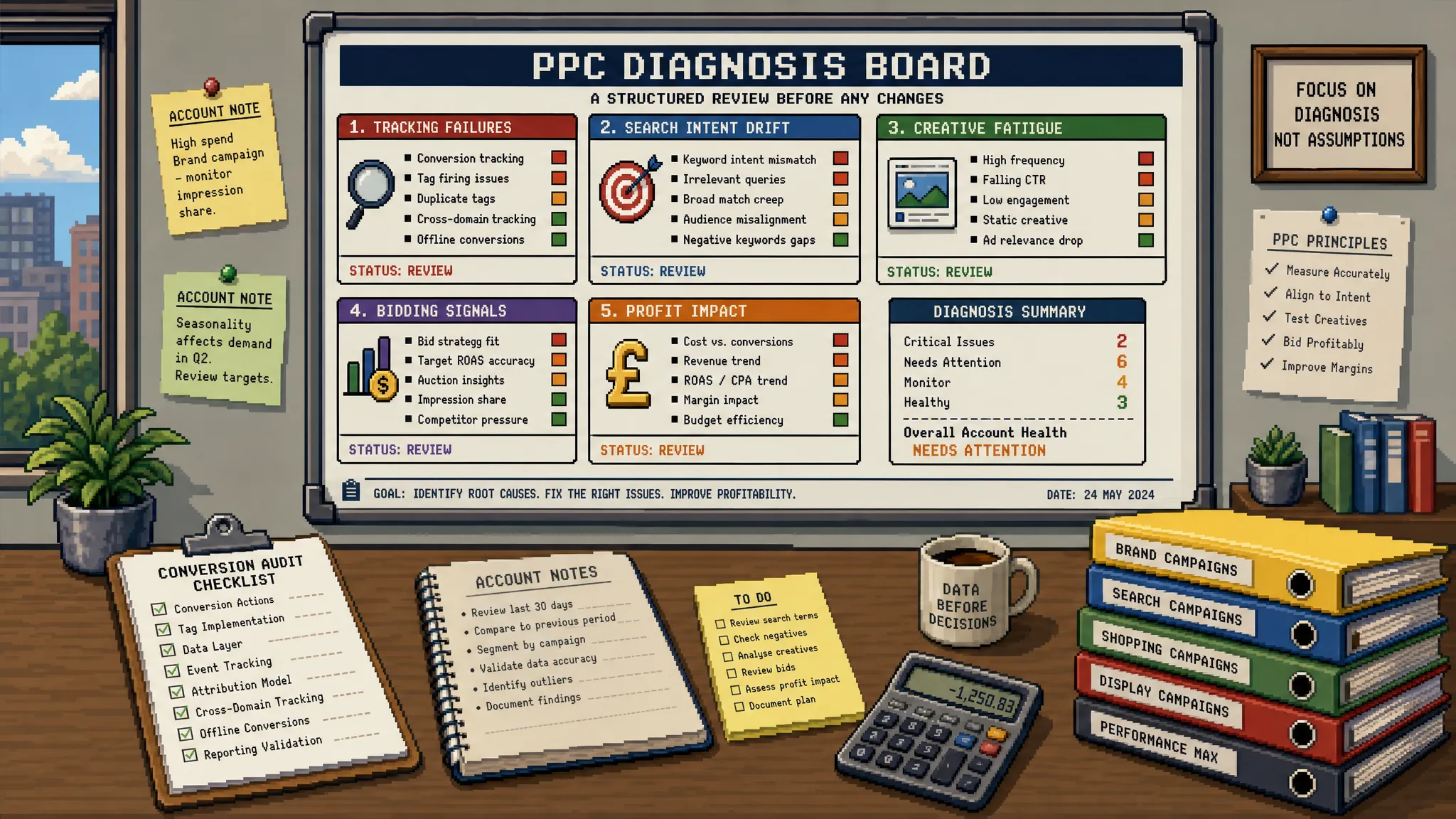
A strong generalist is useful. They can see the whole marketing picture, keep campaigns aligned with brand activity, spot obvious gaps and communicate clearly with clients. But when paid media performance is under pressure, broad knowledge is rarely enough.
PPC is no longer a simple channel where someone can set a few bids, write a handful of ads and check results once a week. Google Ads, Meta Ads and Microsoft Ads now rely on automation, first-party data, conversion quality, creative testing, audience signals, tracking integrity and commercial judgement. That combination rewards depth.
This is why PPC specialists consistently deliver better results than generalists. They do not just know how to operate the platforms. They know how to diagnose performance issues, protect budget, interpret messy data and make decisions that improve the account without creating new problems elsewhere.
For agencies, the difference matters. A generalist may keep a client account moving. A specialist is more likely to rescue margin, reduce wasted spend, explain performance shifts and give the client confidence that someone senior is in control.
PPC has become too complex for surface-level management
Paid search and paid social used to be more manual. Campaign structures were easier to inspect, keyword intent was more visible and advertisers had more direct control over bids and placements. Today, much of the work sits below the surface.
A modern PPC account might involve Performance Max, broad match, value-based bidding, offline conversion imports, enhanced conversions, GA4 events, Meta Advantage+ campaigns, creative fatigue analysis, consent signals and landing page quality. A generalist can learn the basics of these features, but a PPC specialist understands how they interact.
That interaction is where performance is often won or lost. For example, a campaign may look like it has a bidding problem when the real issue is poor conversion tracking. A Meta account may appear to need more creative volume when the bigger issue is audience overlap or weak offer positioning. A Performance Max campaign may be spending, but not learning from the right conversion actions.
A specialist is trained to ask better questions before making changes. That reduces unnecessary tinkering, protects the learning phase and avoids the common agency problem of changing too much because the client wants reassurance.
Specialists diagnose the real problem faster
One of the biggest differences between PPC specialists and generalists is diagnostic speed. Generalists often work through visible symptoms. Specialists look for the underlying cause.
If cost per lead rises, a generalist may reduce budgets, pause keywords or rewrite ads. Sometimes that helps. Often, it only hides the issue. A specialist will usually investigate the account from several angles before deciding what to change.
They might check whether:
- Search terms have drifted away from commercial intent
- Conversion tracking is double-counting or missing key events
- Automated bidding is optimising towards low-quality enquiries
- Meta creative has fatigued among the highest-value audience segments
- Landing page conversion rate has dropped after a website update
- Budget is being pulled into campaigns that look efficient but do not generate revenue
That level of diagnosis saves time and money. It also helps agencies communicate with clients more confidently. Instead of saying, “We are testing a few changes,” the agency can explain what is happening, why it matters and what action is being taken.
For agencies with stretched teams, this is especially important. When an account is already under pressure, a slow diagnosis can turn a manageable dip into a retention risk. If this is a recurring challenge, PPC Ghost has also covered practical PPC ads best practices for agencies under pressure that help prioritise the highest-risk fixes first.
Generalists optimise channels. Specialists optimise commercial outcomes
A generalist often thinks across the marketing mix, which can be valuable. The risk is that PPC becomes one task among many. Campaigns are checked, reports are sent and obvious issues are handled, but deeper commercial optimisation gets missed.
PPC specialists tend to think differently. They connect platform metrics to business outcomes. They care about cost per lead, but they also ask whether those leads close. They care about ROAS, but they also consider margin, stock position, customer lifetime value and the difference between new and returning customers.
That commercial lens changes account management. A specialist might accept a higher CPC if the query has strong purchase intent. They might reduce spend on a campaign with a low cost per conversion if the sales team reports poor lead quality. They might split campaigns by margin, geography or funnel stage rather than by a neat naming convention.
This is where the difference becomes obvious. Generalists often aim for tidy accounts. Specialists aim for profitable accounts.
| Area | Generalist approach | PPC specialist approach |
|---|---|---|
| Budget changes | Reallocate based on visible CPA or ROAS | Reallocate based on quality, margin, intent and conversion reliability |
| Tracking | Check that conversions are firing | Validate whether the right conversions are being used for optimisation |
| Search terms | Add negatives when waste is obvious | Analyse intent patterns and restructure where needed |
| Creative | Refresh ads when performance drops | Test angles, formats and fatigue signals against funnel stage |
| Reporting | Explain what happened | Explain why it happened and what should happen next |
Specialists understand automation without blindly trusting it
Automation is powerful, but it is not strategy. This is one of the most important reasons PPC specialists outperform generalists.
Google, Meta and Microsoft Ads all push advertisers towards automated campaign types, smart bidding and AI-assisted workflows. These tools can improve performance when they are fed clean data, given appropriate budgets and aligned with the right business goal. They can also waste money quickly when the setup is weak.
A generalist may assume the platform knows best. A specialist knows when to trust automation, when to constrain it and when to rebuild the inputs. That might mean tightening conversion goals, excluding irrelevant placements, segmenting campaigns more carefully, improving audience signals or separating prospecting from remarketing logic.
The best PPC specialists are not anti-automation. They are anti-passivity. They understand that automation needs direction, measurement and guardrails. This will only become more important as paid media changes. For a wider view of what agencies need to prepare for, PPC Ghost’s guide to PPC UK trends agencies should watch in 2026 highlights the growing importance of measurement, AI-led campaign management and creative performance.
Measurement is where specialists protect performance
Many PPC problems are actually measurement problems. If the data is wrong, every optimisation decision becomes weaker.
A generalist may know how to set up a basic conversion action or read GA4 reports. A PPC specialist is more likely to question whether the measurement framework is fit for decision-making. Are primary and secondary conversions separated properly? Are form submissions being counted once? Are phone calls tracked accurately? Are offline sales imported? Are consent changes affecting reported conversion volume? Is Meta receiving enough event quality to optimise effectively?
This matters because modern PPC platforms learn from the data advertisers provide. If a campaign is optimising for every micro-conversion, it may chase cheap but low-value actions. If lead quality is not fed back into the account, the platform may keep finding more of the wrong people.
A specialist can spot these issues before they become performance narratives. That is especially useful for agencies, because clients rarely separate “the ads are underperforming” from “the tracking is misleading.” To the client, it is all one problem. A specialist helps the agency explain the distinction and fix it.

Specialists know which changes not to make
Better PPC management is not always about doing more. Often, it is about knowing what to leave alone.
Generalists can feel pressure to make visible changes, particularly when a client is anxious. They may rewrite ads, adjust budgets, change bidding strategies and add new audiences in quick succession. This creates noise. If performance improves or declines, it becomes difficult to know why.
PPC specialists are more disciplined. They understand learning periods, statistical significance, conversion lag and account history. They know that changing a bid strategy too soon can reset progress. They know that pausing a campaign with a high CPA may be a mistake if it is driving the best customers. They know that one bad week is not always a trend.
This restraint is valuable. It gives campaigns space to generate reliable signals. It also creates cleaner reporting, because the agency can connect actions to outcomes without guessing.
Paid social makes the specialist gap even clearer
The specialist advantage is not limited to Google Ads. In Meta Ads, generalists often focus on surface-level indicators such as CPM, CTR and cost per lead. Those metrics matter, but they rarely tell the full story.
A Meta specialist looks at creative fatigue, offer-market fit, account structure, event match quality, landing page continuity and funnel intent. They know that a cheap lead campaign can damage sales team confidence if the form is too easy to complete. They also know that creative testing is not just about making more ads. It is about testing the right hooks, formats, proof points and objections.
This is where many generalists struggle. They may be good marketers, but Meta performance requires a specific blend of creative judgement and media buying discipline. Without that depth, agencies can end up producing more creative without learning much from it.
The same principle applies across channels. Many businesses use broad managed marketing support, including managed digital marketing services, but when an agency is accountable for paid media performance, specialist execution can be the difference between activity and measurable progress.
Specialists reduce client retention risk for agencies
For agencies, PPC performance is not just a delivery issue. It is a retention issue.
Clients often judge an agency by the channel that has the clearest spend attached to it. If they are paying £10,000 a month into Google Ads, they expect clarity. When results dip, they want fast answers. If the agency cannot provide those answers, confidence drops quickly.
PPC specialists help protect that relationship in several ways. They improve the quality of decisions, but they also improve the quality of communication. They can explain why conversion volume changed, what is being tested, which risks are being managed and what results should be expected next.
This does not mean every client needs a full-time PPC hire. Many agencies need senior input at specific moments, such as account audits, new campaign builds, performance turnarounds, tracking fixes or overflow support during busy periods. That is why white-label specialist support can be so useful. It gives the agency senior expertise without recruitment delays or long-term overhead.
If client retention is a priority, PPC Ghost has written more about how a Google Ads PPC agency supports client retention through cleaner tracking, sharper optimisation and stronger reporting.
When a generalist is enough, and when a specialist is not optional
There are situations where a generalist can manage PPC adequately. If spend is low, the account is simple and the client does not rely heavily on paid media for revenue, broad marketing support may be enough.
But as soon as complexity increases, the risk changes. A PPC specialist becomes far more valuable when:
- Monthly spend is high enough that small efficiency gains have a meaningful financial impact
- The client relies on paid media for leads, sales or pipeline
- Tracking is unclear, incomplete or disputed
- Campaigns use automated bidding or AI-led campaign types
- Lead quality matters more than lead volume
- The agency needs senior support but cannot justify a permanent hire
- The client is asking more detailed questions than the internal team can answer confidently
The key question is not, “Can a generalist run the account?” It is, “Can a generalist protect the account when performance becomes difficult?”
That is where specialists earn their value.
What PPC specialists do differently in the first 30 days
A good specialist does not start by changing everything. They start by understanding what the account is really trying to achieve.
In the first month, they will typically look at tracking, conversion actions, campaign structure, search terms, bidding strategy, budget allocation, landing pages, creative performance and reporting quality. They will also look for mismatches between what the account is optimising for and what the business actually values.
The best specialists prioritise. They do not produce a huge list of theoretical improvements and leave the agency to decide what matters. They identify the few changes most likely to protect spend or improve performance, then sequence the work properly.
That sequencing is important. Fixing conversion tracking before changing bidding strategy is often smarter than the other way around. Cleaning search intent before scaling budget is safer than pushing more spend into a leaky structure. Testing new creative angles before expanding audiences is usually more useful than simply broadening targeting.
This is the practical advantage of specialist experience. It turns a messy account into a manageable plan.
Why this matters more for white-label agency delivery
White-label PPC support has a specific challenge. The work must be strong, but the agency relationship must remain protected. The client should feel that the agency is in control, even when specialist execution is happening behind the scenes.
That requires more than platform knowledge. It requires commercial awareness, clear communication and the ability to work anonymously within the agency’s process. A specialist who understands white-label delivery can provide the senior thinking without disrupting client ownership.
For UK agencies, this can be a practical alternative to recruitment. Hiring a senior PPC manager is expensive and slow. Training a junior takes time and still leaves risk on complex accounts. Using on-demand PPC specialists gives agencies flexible capacity when they need it, without adding permanent cost when they do not.
The result is better delivery, less internal pressure and stronger client confidence.
Frequently Asked Questions
Are PPC specialists always better than generalist marketers? Not always. Generalists are valuable when a business needs broad marketing coordination. PPC specialists are better when paid media performance, tracking quality, spend efficiency and client retention are at stake.
What makes someone a PPC specialist? A PPC specialist has deep hands-on experience in paid media platforms, measurement, optimisation, bidding strategy, campaign structure and performance diagnosis. The key difference is depth, not just familiarity with Google Ads or Meta Ads.
Can a generalist manage small PPC accounts? Yes, especially if the account is simple, spend is low and expectations are modest. As spend, complexity or commercial pressure increases, specialist input becomes much more important.
Why do agencies use white-label PPC specialists? Agencies use white-label PPC specialists to access senior expertise without hiring, training or adding long-term overhead. It also lets the agency keep the client relationship while improving delivery behind the scenes.
How quickly can a PPC specialist improve results? It depends on the account, the tracking setup and the severity of the issues. A specialist can often identify priority fixes quickly, but sustainable improvement usually comes from better measurement, structured testing and disciplined optimisation over time.
Need senior PPC expertise without hiring?
If your agency needs sharper PPC delivery but does not want the cost, delay or commitment of recruitment, PPC Ghost provides white-label PPC support on demand.
You get senior-only expertise across Google Ads, Meta Ads, Microsoft Ads, GA4 and tracking support, with flexible pay-as-you-go delivery and no long-term contracts. Your agency keeps the client relationship. PPC Ghost handles the specialist execution in the background.
When paid media performance matters, do not leave it to guesswork. Bring in a specialist and give your clients the confidence they expect.