How a White Label Digital Agency Model Boosts Profit
Learn how a white label digital agency model can improve margins, add specialist capacity and turn PPC delivery into profitable growth.
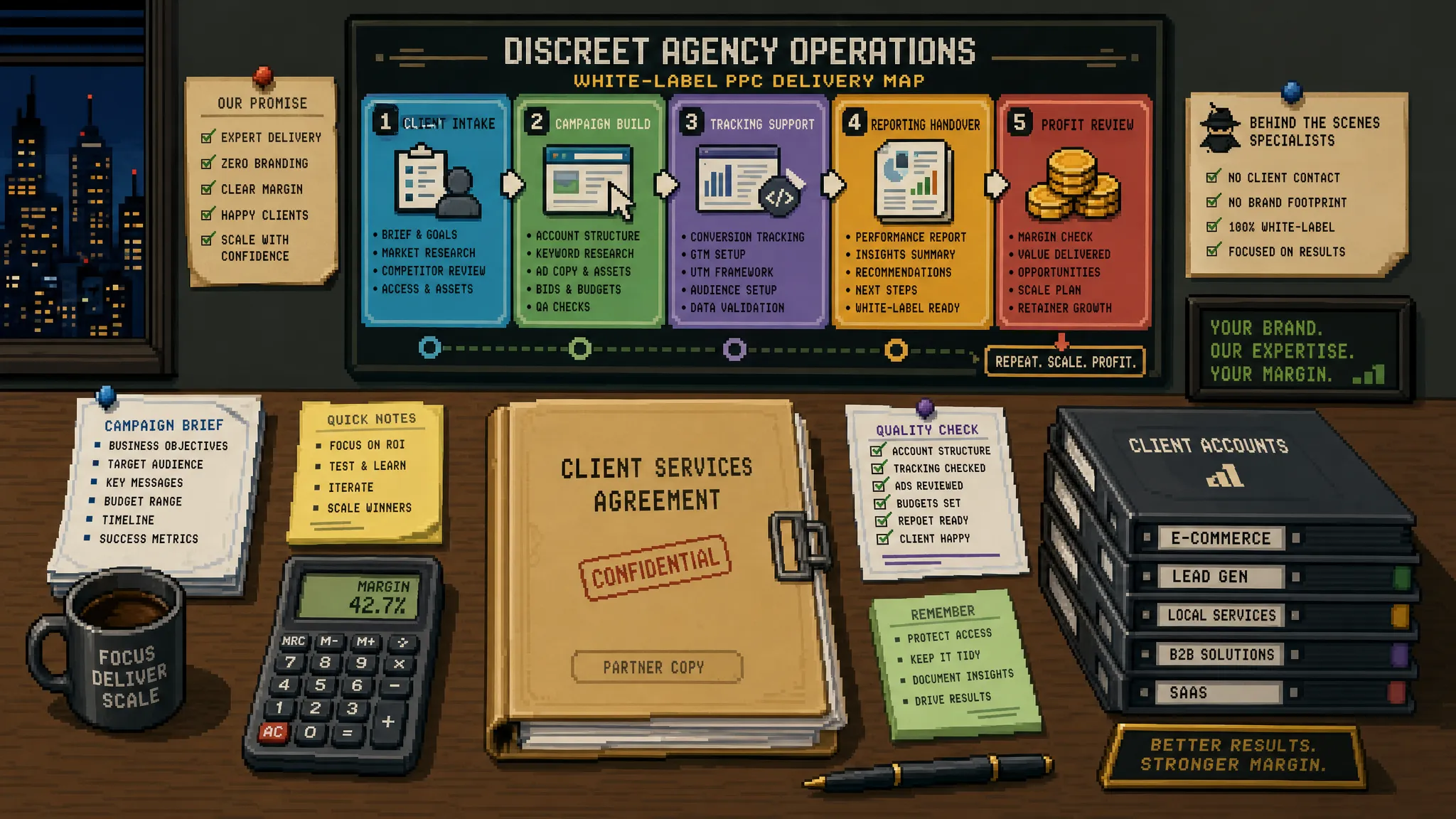
More agency revenue is not automatically more agency profit. Many agencies win new retainers, expand service lists and appear busier than ever, yet net margin barely moves because delivery costs, recruitment time, senior oversight and client servicing expand at the same pace.
A white label digital agency model changes that equation. Instead of hiring every specialist in-house before demand is predictable, an agency can resell expert delivery under its own brand, keep ownership of the client relationship and treat specialist capacity as a flexible delivery cost.
For PPC, paid social and tracking work, this can be especially powerful. The work is technical, performance is measurable and mistakes are expensive. When the right partner sits behind the scenes, an agency can protect margin, reduce hiring risk and increase client lifetime value without pretending to be bigger than it is.
What a white label digital agency model actually means
In a white-label model, your agency sells the service, manages the commercial relationship and remains the visible partner to the client. A specialist provider performs some or all of the delivery anonymously in the background.
For example, a web design or SEO agency might sell Google Ads management to an existing client, then use a white-label PPC specialist to build campaigns, optimise performance, support reporting and advise on tracking. The client receives a joined-up service from the agency they already trust, while the agency gains technical capability without recruiting a permanent paid media employee.
This is not the same as simply outsourcing a task to the cheapest freelancer. A profitable white label digital agency model depends on repeatable delivery, clear scope, reliable communication and enough senior expertise to protect the client relationship. If the provider needs constant hand-holding, the agency still carries the hidden cost.
The model works best when it supports services that are commercially valuable but operationally difficult to staff consistently. PPC is a strong example because demand can fluctuate month to month, account complexity varies, and specialist knowledge across Google Ads, Meta Ads, Microsoft Ads and GA4 is hard to keep fully covered in a small team.
The core profit equation: margin, utilisation and risk
Agency profitability usually improves when three things happen at once: gross margin rises, internal utilisation becomes healthier and commercial risk falls. White-label delivery can affect all three.
The basic formula is simple:
| Metric | Formula | Why it matters |
|---|---|---|
| Gross profit | Client fee minus direct delivery cost | Shows whether the service is commercially viable before overheads |
| Gross margin | Gross profit divided by client fee | Helps compare service lines fairly |
| Net profit | Gross profit minus overhead contribution | Shows the real impact on the agency, not just the project |
| Utilisation | Billable work divided by available team capacity | Reveals whether internal talent is being used profitably |
| Client lifetime value | Average monthly profit multiplied by retention period | Connects delivery quality to long-term profit |
A white-label partner does not automatically make these numbers better. The improvement comes from designing the model properly. You need to know what you charge, what you pay, what your team still handles and what level of oversight is required.
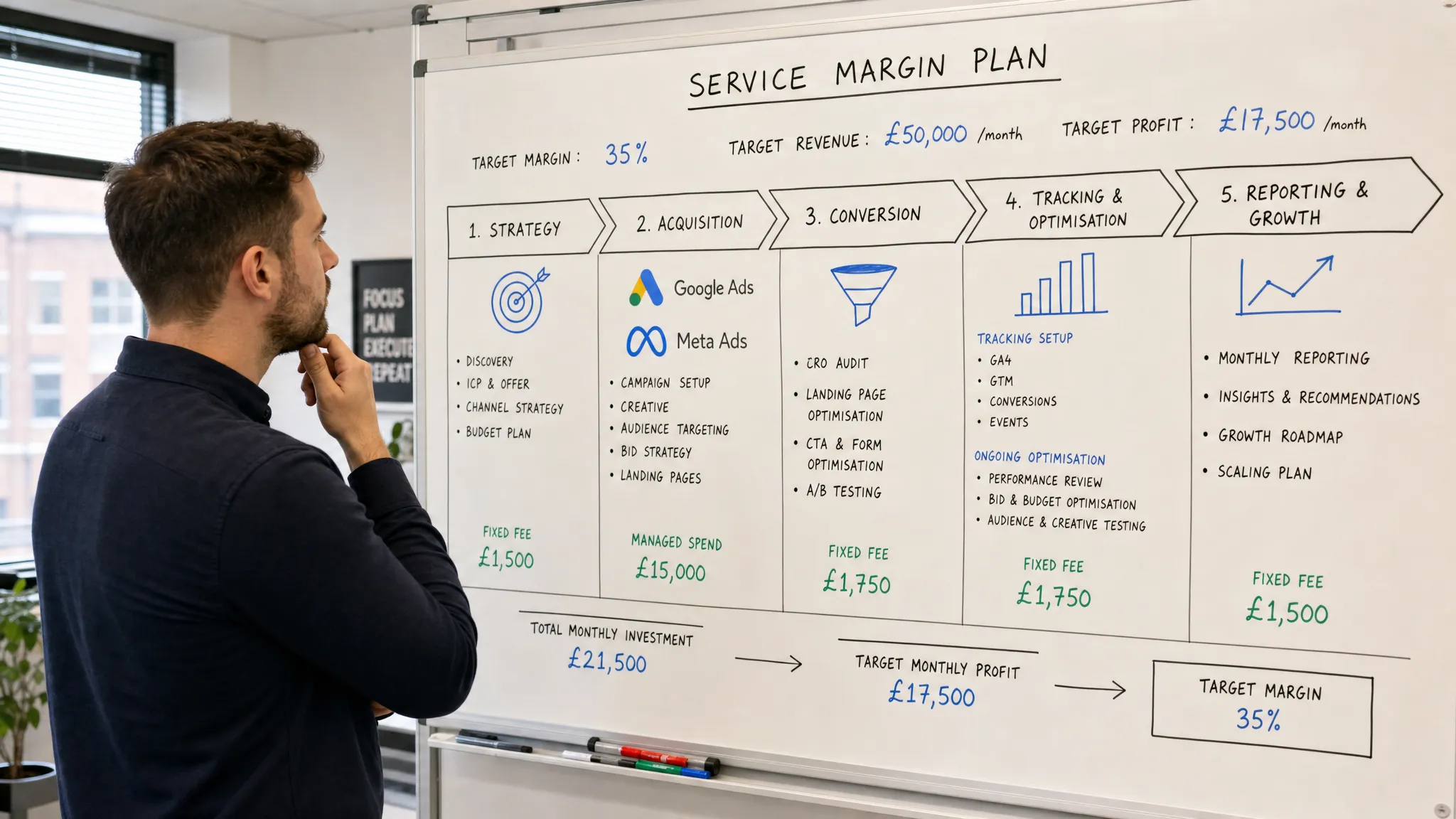
If your agency charges £2,500 per month for PPC management and pays a white-label specialist £1,500 for delivery, the visible gross profit is £1,000, or 40 percent. But if your account manager spends ten unplanned hours translating reports, checking work and calming the client, your true margin is lower. Profit depends on both the commercial structure and the operational fit.
How the model boosts profit in practical terms
The main benefit is not just that you avoid hiring. It is that you avoid hiring too early, hiring too broadly or hiring for uneven demand.
1. It turns fixed staffing cost into variable delivery cost
Permanent hires are valuable when demand is stable, predictable and large enough to justify the role. But many agencies face uneven demand. One quarter brings several PPC opportunities, the next brings mostly web, SEO or strategy work.
A full-time specialist still needs salary, management, training, software access and enough work to stay commercially useful. With a white-label model, delivery cost can align more closely with revenue. If a client pauses, reduces spend or changes scope, the agency is not left carrying the full cost of an underused role.
That flexibility can be the difference between profitable growth and a larger payroll that quietly erodes margin.
2. It increases revenue per existing client
New client acquisition is expensive. Agencies often spend months building trust before a prospect signs. It is usually more efficient to grow the value of an existing relationship than to win a brand-new one from scratch.
A white-label digital agency model lets you add high-demand specialist services to accounts where trust already exists. A design agency can add paid search. A content agency can add Meta Ads. A development agency can add tracking and conversion measurement support.
This matters because profit often improves when you increase average account value without proportionally increasing sales effort. You already understand the client, their objectives and their approval process. Adding PPC or paid social can make the relationship more valuable while keeping the agency positioned as the central strategic partner.
3. It protects senior team time
In many agencies, founders and senior strategists become the safety net for every specialist gap. They review campaigns, join awkward calls, interpret data and fix delivery problems at the last minute. This work is important, but it is not always the best use of senior time.
If senior people are dragged into execution too often, they have less time for sales, strategy, partnerships and client growth. A strong white-label partner reduces that drag by bringing specialist judgement directly into delivery.
This is where the quality of the partner matters. Cheap execution that requires constant supervision is rarely cheap in practice. Senior-led delivery costs more than basic task completion, but it can protect the agency from rework, churn and founder bottlenecks.
For agencies weighing capacity against hiring risk, PPC Ghost has a separate guide on why white label PPC management helps agencies scale, but the profit point is specific: capacity only helps if it improves margin and reduces internal strain.
4. It reduces the cost of mistakes
Paid media mistakes can become visible quickly. Poor tracking, weak campaign structure, loose search terms, bad budget allocation or unclear reporting can damage client confidence. The direct cost might be wasted media spend, but the larger commercial cost is often client churn.
A white-label specialist who understands PPC execution, measurement and optimisation can reduce those risks. Better setup and clearer reporting give the agency a stronger basis for client conversations. That improves perceived value, which supports retention.
Retention is a profit lever because every extra month of a good-fit client adds revenue without repeating the full cost of acquisition. If specialist support keeps a profitable client for six additional months, the impact is often far greater than the margin on a single setup project.
Where agencies most often gain margin
The clearest profit gains usually come from services that meet three conditions: clients already ask for them, internal delivery is inconsistent, and the perceived value is high enough to support a healthy management fee.
For PPC and paid media, agencies often gain margin through:
- Campaign setup projects that are priced separately from monthly management
- Ongoing Google Ads, Meta Ads or Microsoft Ads retainers
- Tracking and GA4 support that improves attribution and reporting clarity
- Paid media audits that lead into retained optimisation work
- Overflow delivery when the internal team is at capacity
The key is to avoid selling white-label delivery as a low-margin add-on. If the service solves a serious business problem, such as lead quality, sales volume or measurable return on ad spend, it should be priced as a strategic service rather than a cheap bolt-on.
Pricing the model so profit does not leak away
A white label digital agency model boosts profit only when pricing reflects the full scope of delivery. Many agencies lose margin because they sell a vague PPC service, then absorb extra work later.
Before selling, define exactly what is included. Monthly optimisation, reporting, search term reviews, creative testing, conversion tracking checks, client calls and landing page recommendations all take time. If they are valuable, they need to be scoped.
A simple way to protect margin is to separate setup, management and advisory work.
| Work type | Why separate it | Profit benefit |
|---|---|---|
| Initial setup or restructure | Front-loaded work can be heavier than monthly optimisation | Prevents the first month from destroying margin |
| Ongoing management | Recurring optimisation needs predictable scope | Creates stable monthly gross profit |
| Tracking support | Measurement work can become technical and time-consuming | Keeps specialist work from being hidden inside the retainer |
| Strategy or review calls | Senior time should be deliberately allocated | Avoids unpaid consultancy creep |
| Additional campaigns or platforms | More complexity means more delivery time | Allows price to rise with scope |
Pricing should also account for your agency's role. Even when the white-label partner delivers the technical work, your team may still manage the relationship, handle commercial decisions and join client calls. That coordination has value and cost.
If your agency is unsure how to package PPC fees, the guide to Google PPC pricing for agencies in 2026 can help separate media spend, management fees, setup costs and tracking work more clearly.
The hidden profit killer: poor operational fit
The fastest way to lose money with white-label delivery is to choose a partner who creates operational friction. Even if their fee looks attractive, the true cost rises when your team has to chase updates, rewrite reports, explain basic strategy or repair client confidence.
Look for a partner who can work inside your agency's rhythm. That means clear communication, discreet processes, respect for your client ownership and enough senior judgement to make sensible recommendations without needing constant direction.
Operational fit is especially important for UK agencies that sell to clients expecting practical commercial advice, not just platform activity. A PPC provider should understand how performance connects to leads, sales, budget constraints and the client's wider marketing plan.
A strong partner should help you answer questions such as:
- What budget level is realistic for the client's objective?
- Which platform should be prioritised first?
- Is the account limited by tracking, offer strength, landing pages or campaign structure?
- What should be reported to the client, and what should stay as internal optimisation detail?
- When should the agency push back on unrealistic expectations?
These answers protect profit because they reduce rework and help retain clients. The right white-label partner is not just a pair of hands. They are a delivery asset that makes the agency more commercially confident.
For a more detailed evaluation framework, PPC Ghost covers what to look for in a white label Google Ads agency, including senior expertise, tracking quality, reporting and discreet delivery.
When the model is most profitable
White-label delivery is not the right answer for every agency or every service. It is most profitable when there is a clear commercial gap between what clients want and what the agency can deliver efficiently in-house.
The model is usually a good fit when your agency has more client demand than specialist capacity, when hiring would be premature, or when you want to test a new service line before building an internal department. It also works well when you need senior expertise for complex accounts but cannot justify a full-time senior hire.
It is less effective when the agency has no defined sales process, no clear service packaging or no internal owner for the client relationship. A white-label partner can improve delivery, but they cannot fix a broken proposition or unclear client expectations on their own.
Think of the model as a profit multiplier, not a substitute for strategy. It works best when your agency already has trust, demand and commercial direction, then uses specialist delivery to monetise those strengths more efficiently.
Metrics to track once you adopt the model
To know whether the model is boosting profit, track more than revenue. Revenue can rise while margin falls.
The most useful metrics include gross margin by service line, delivery cost per client, hours spent internally per account, client retention, upsell rate and the number of issues escalated to senior leadership. You should also review how often scope changes occur and whether additional work is being charged properly.
A quarterly review is usually enough for strategic decisions. Ask whether the white-label service is increasing average account value, reducing founder involvement, improving delivery consistency and helping you retain better clients. If the answer is yes, the model is doing more than filling a delivery gap. It is strengthening the agency's operating model.
Frequently Asked Questions
What is a white label digital agency model? A white label digital agency model is where an agency sells a service under its own brand while a specialist provider delivers the work behind the scenes. The agency keeps the client relationship, pricing and brand experience.
How does white-label delivery improve agency profit? It can improve profit by reducing fixed hiring costs, increasing revenue per client, protecting senior team time and allowing the agency to sell specialist services without building a full in-house department first.
Is a white-label model better than hiring in-house? It depends on demand. Hiring can be better when workload is stable and large enough to fully utilise a specialist. White-label support is often better when demand is variable, when senior expertise is needed quickly, or when the agency wants to test a service line.
Which services work well in a white-label model? PPC, paid social, Microsoft Ads, Google Ads, tracking support, audits and reporting can work well because they require specialist knowledge and have clear commercial value for clients.
Can clients know that delivery is white-label? That depends on your agency's positioning and agreements. In a true white-label setup, the provider remains anonymous and the agency stays client-facing. Clear confidentiality and communication processes are important.
Build a more profitable PPC offer without hiring first
A white label digital agency model boosts profit when it gives your agency specialist delivery capacity, cleaner margins and less recruitment risk. The goal is not to outsource responsibility. The goal is to deliver better work under your brand while keeping your internal team focused on growth and client relationships.
If your agency needs senior, discreet PPC support across Google Ads, Meta Ads, Microsoft Ads, GA4 or tracking, PPC Ghost provides white-label execution on demand for UK agencies. You keep the client relationship and take the credit, while experienced paid media support helps you deliver profitably without long-term contracts or recruitment delays.