PPC UK Trends Agencies Should Watch in 2026
Explore PPC UK trends for agencies in 2026, from AI-led campaigns and tracking to creative, Microsoft Ads and client retention.
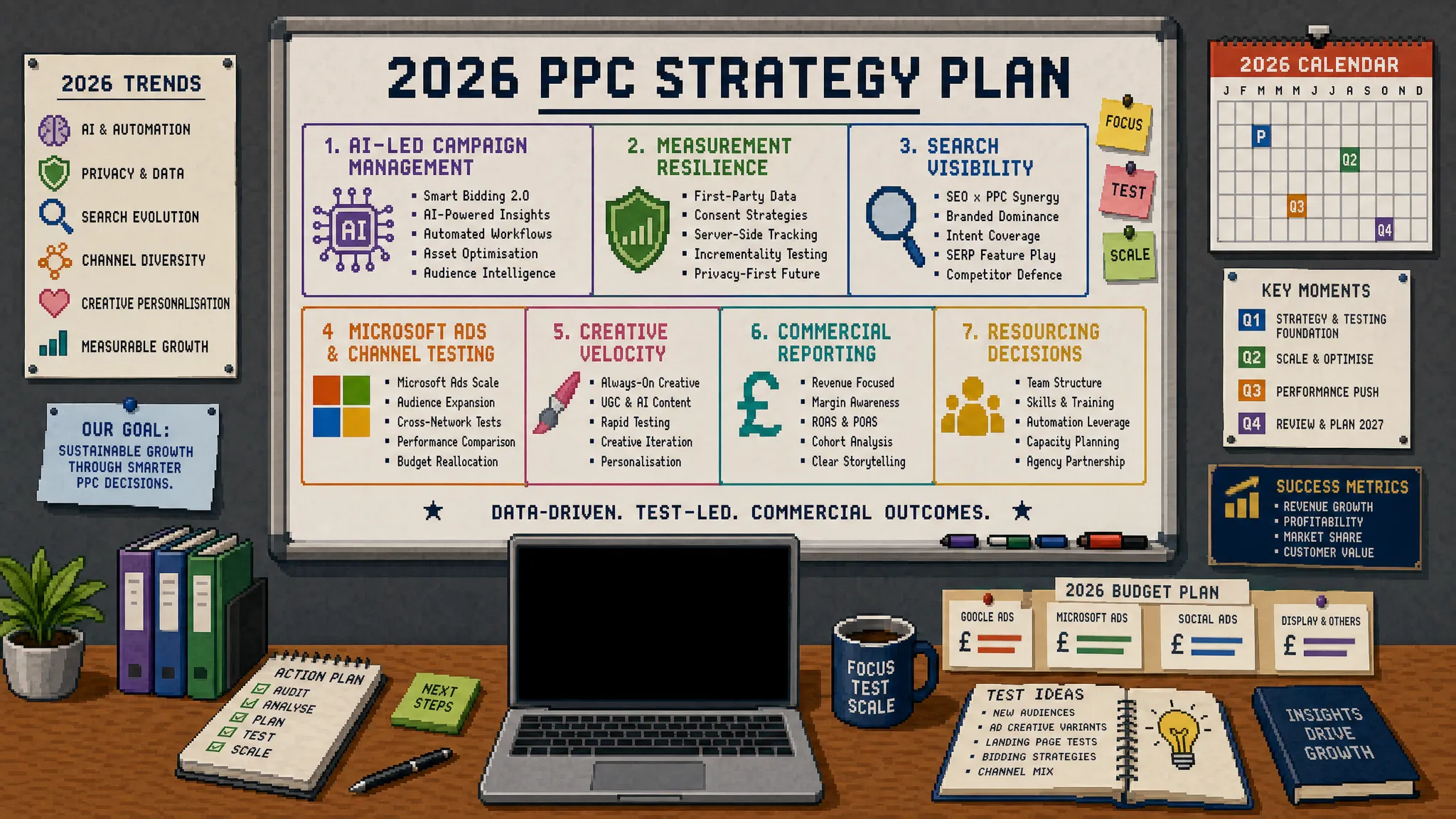
2026 will not be a quiet year for paid media. Automation is getting stronger, search behaviour is fragmenting, privacy pressure is not going away, and UK clients are asking sharper questions about margin, lead quality and accountability.
For agencies selling PPC UK services, the opportunity is clear: the market still needs expert execution, but the definition of expert is changing. Clients no longer pay for button pushing. They pay for judgement, cleaner measurement, faster testing and the confidence that their budget is being protected.
Below are the PPC UK trends agencies should watch in 2026, with practical implications for account structure, resourcing and client retention.
| Trend | Why it matters in 2026 | What agencies should do |
|---|---|---|
| AI-led campaign management | Platforms optimise faster than humans, but only from the signals they are given | Improve conversion quality, feeds, exclusions, creative and landing pages |
| Measurement resilience | Consent, attribution gaps and platform modelling make reporting harder | Invest in enhanced conversions, CRM imports, GA4 hygiene and clear definitions |
| AI search visibility | Buyers are researching through AI assistants before they search or click | Align PPC messaging with content, reviews, metadata and brand authority |
| Microsoft Ads growth | Some sectors can find cheaper incremental demand outside Google | Test intelligently, especially for B2B, professional services and older demographics |
| Creative velocity | Meta and YouTube performance depends on constant new angles | Build repeatable creative testing systems, not one-off campaign launches |
| Commercial reporting | Clients care about pipeline and profit, not just conversions | Report on qualified leads, revenue, CAC and wasted spend reduction |
| Flexible specialist delivery | Agencies need senior capacity without adding fixed overhead | Use white-label support when demand spikes or accounts need expert attention |
1. AI will make weak PPC management more obvious
AI is already embedded across Google Ads, Meta Ads and Microsoft Ads. By 2026, the gap between agencies that understand automation and agencies that simply accept platform recommendations will be much wider.
The key point is that AI does not remove the need for strategy. It increases the importance of inputs. Performance Max, broad match, Demand Gen and Advantage+ style campaign types can all work, but they rely heavily on conversion quality, audience signals, creative assets, feeds, landing pages and budget structure.
This means senior PPC work will continue to shift away from manual bid tinkering and towards system design. Agencies will need to answer questions such as:
- Are we feeding the algorithm real commercial outcomes or low-value form fills?
- Are budgets grouped around intent and profitability rather than internal convenience?
- Are poor-fit search terms, locations and placements being controlled quickly?
- Are creative and landing page tests giving the platform enough useful variation?
- Are we reviewing recommendations critically rather than applying them blindly?
The agencies that win will not position themselves as anti-automation. They will position themselves as the people who make automation commercially safe.
2. Measurement quality will become a board-level issue
PPC reporting has always been messy, but 2026 will raise the stakes. Clients are more aware of attribution limitations, tracking gaps and modelled conversions. At the same time, they still expect agencies to explain performance clearly.
For UK agencies, measurement resilience should be treated as a core service, not an optional technical extra. That means tighter GA4 setup, better conversion naming, deduplication checks, call tracking validation, consent-aware tagging and offline conversion imports where possible.
Google’s enhanced conversions guidance is worth understanding because it shows how hashed first-party customer data can help improve conversion measurement when implemented correctly. For lead generation, importing qualified leads or closed deals from a CRM can also help bidding systems optimise towards value rather than volume.
There is also a compliance angle. The UK’s privacy environment means agencies must stay close to PECR, UK GDPR and cookie consent expectations. The ICO guidance on cookies and similar technologies remains a useful reference point when discussing tracking with clients.
The practical takeaway is simple: agencies that can explain what is tracked, what is modelled, what is missing and what has been improved will be more trusted than agencies that only export platform dashboards.
3. AI search visibility will influence paid search performance
Search is no longer limited to typing a query into Google. Buyers increasingly use AI assistants, comparison platforms, Reddit threads, marketplaces, YouTube, TikTok and review sites before they ever click a paid ad.
This does not mean search ads are disappearing. High-intent paid search will remain valuable because it captures demand at the point of action. But it does mean PPC teams need better awareness of what buyers have already seen before they search.
If an AI answer summarises a client poorly, misses them entirely or references outdated information, paid campaigns may face lower trust before the click even happens. Agencies managing competitive categories should start looking beyond keyword coverage and ask whether the brand is visible in AI-generated research journeys. Tools such as CapstonAI can help agencies audit how brands appear in AI engines and identify blind spots that may affect wider acquisition performance.
For PPC teams, this trend matters because ad copy, landing pages and content need to reinforce the same commercial message. A brand that claims one thing in ads, another on its landing pages and nothing at all in AI-assisted discovery is creating friction before the sale.
4. Microsoft Ads will move from afterthought to sensible test budget
Google will remain the main paid search platform for most UK advertisers, but agencies should not ignore Microsoft Ads in 2026. In some markets, especially B2B, finance, professional services, software and higher-value consumer categories, Microsoft can provide useful incremental demand.
The attraction is not that Microsoft Ads replaces Google. It is that it can diversify acquisition, reduce dependence on one auction and sometimes reach audiences that are more desktop-heavy, older or professionally focused.
The mistake is treating Microsoft as a lazy copy-and-paste from Google Ads. The platform needs its own bid strategy checks, query analysis, audience layering, device review and budget expectations. If your agency is ready to explore the channel more seriously, these Microsoft Ads strategies UK agencies should use offer a practical starting point.
5. Creative testing will become the biggest Meta Ads performance lever
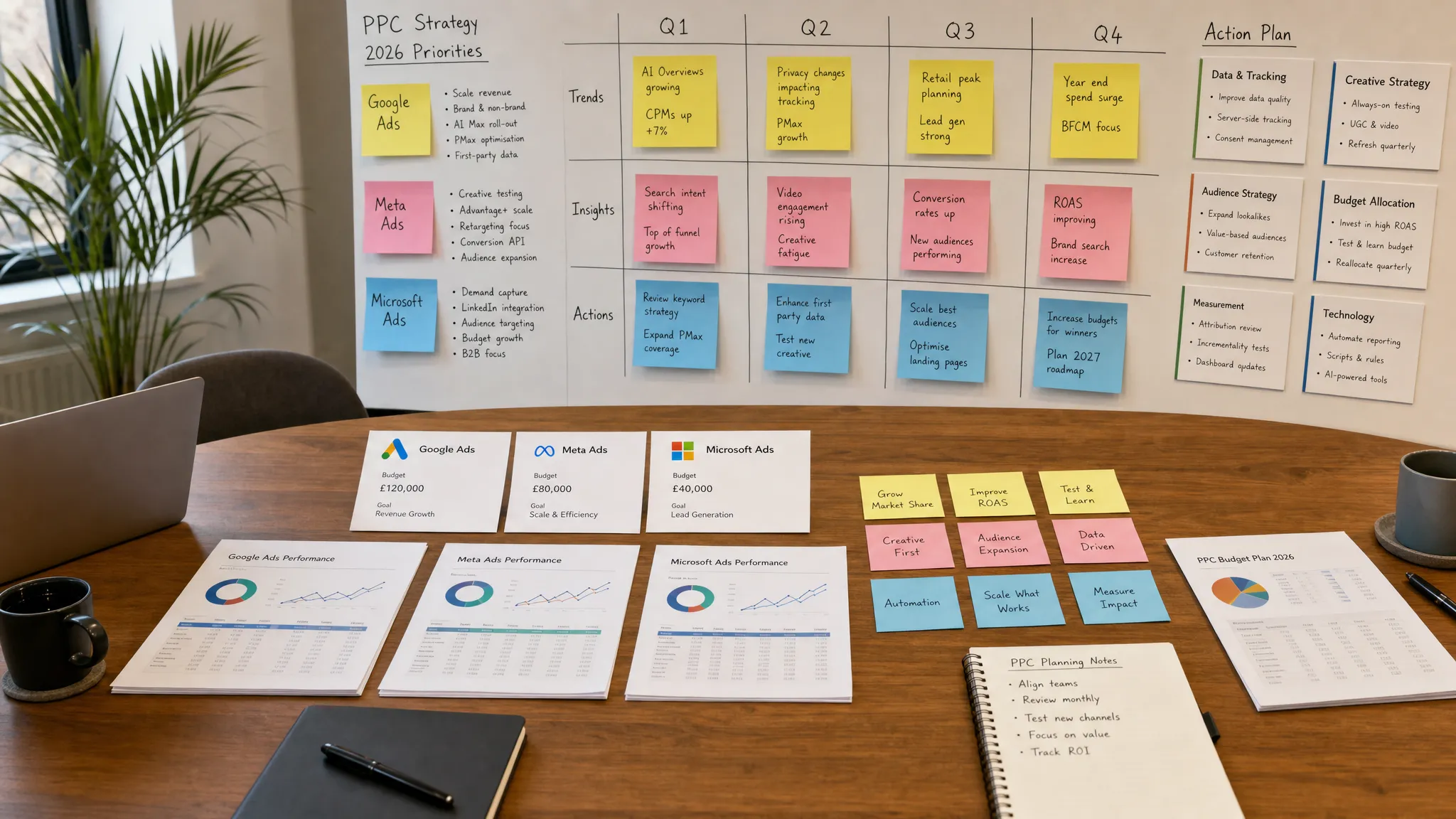
Meta’s targeting automation has reduced the old obsession with tiny audience segments. In many accounts, creative now does more of the heavy lifting. The platform needs enough fresh, distinct creative to identify what resonates, and users need a reason to stop scrolling.
For agencies, this changes the operating model. A monthly batch of generic image ads is unlikely to be enough for ambitious clients. Creative testing in 2026 should be structured around messages, proof points and buyer objections, not just formats.
For example, a lead generation client might need separate angles around speed, trust, pricing clarity, local expertise and risk reduction. An ecommerce client might need creative around use cases, comparison, social proof, bundles and seasonal urgency.
The PPC team does not always need to produce every asset, but it should own the testing logic. That includes documenting hypotheses, naming creative clearly, reviewing fatigue, feeding insights back to designers and helping clients understand why creative volume affects performance.
6. Clients will scrutinise PPC pricing and value more closely
Economic pressure has made clients more careful with marketing spend. In 2026, agencies should expect more questions about what PPC management costs, what media spend covers and how account work translates into commercial value.
This is not necessarily bad news. Transparent pricing can help strong agencies stand out. The problem arises when clients see a management fee but cannot see the strategic work behind it.
Agencies should separate the different parts of PPC cost clearly: media spend, setup, tracking, feed work, creative support, landing page input, reporting and ongoing optimisation. They should also explain that cheap management can become expensive if it leads to poor tracking, weak structure or wasted spend.
If you need a client-friendly breakdown, this guide to Google PPC pricing for agencies in 2026 can help frame the conversation without making unrealistic promises.
The agencies that retain clients will be the ones that connect their fee to risk reduction, faster learning and better budget allocation.
7. First-party data will separate serious advertisers from casual ones
The most resilient PPC accounts in 2026 will have stronger first-party data foundations. That includes customer lists, CRM stages, lead quality feedback, product margin data, lifetime value insight and clearer consent processes.
For ecommerce, this may mean better product feed segmentation, customer match strategy and value-based bidding. For lead generation, it may mean feeding back qualified leads, rejected leads and closed revenue. For local services, it may mean tracking calls, booked appointments and repeat enquiries more carefully.
This is where agencies can create genuine strategic value. Many clients have useful business data, but it is scattered across CRMs, spreadsheets, call systems and sales teams. A PPC specialist who can help turn that data into better bidding signals becomes much harder to replace.
The limitation is that first-party data must be handled carefully. Agencies should avoid overpromising what data can do, and they should work with clients to ensure consent, storage and platform uploads are appropriate.
8. PPC teams will need faster triage processes
As automation accelerates, bad accounts can waste money quickly. Agencies under pressure need a repeatable way to identify risk before it becomes a client problem.
In 2026, triage should focus on the highest commercial risks first: broken tracking, sudden CPA spikes, poor search terms, budget leakage, disapproved assets, feed issues, weak lead quality and landing page conversion drops.
This is especially important for agencies managing many small to mid-sized accounts. Not every account needs a full rebuild every month, but every account needs enough oversight to catch obvious waste. A disciplined triage process can protect margin, improve client confidence and stop account managers from reacting to every small fluctuation.
For a more tactical framework, these PPC ads best practices for agencies under pressure are useful when you need to prioritise quickly.
9. White-label PPC will become a more strategic resourcing option
Many agencies will face the same staffing problem in 2026: clients want senior PPC thinking, but hiring full-time specialists is expensive, slow and risky. Junior account teams can handle communication and coordination, but complex accounts often need deeper platform experience.
White-label PPC support is likely to become more common because it gives agencies a way to scale delivery without committing to permanent headcount. It can also help agencies protect client relationships when workloads spike, a key team member leaves or a prospect requires specialist input before the agency is ready to hire.
The best use case is not outsourcing responsibility. It is strengthening delivery. Agencies can keep the client relationship, strategy and brand ownership while bringing in senior execution behind the scenes.
This model is particularly relevant for UK agencies that want to offer Google Ads, Meta Ads, Microsoft Ads and tracking support without building every capability in-house.
How agencies should prepare now
The strongest agencies will not wait until performance drops before adapting. They will use early 2026 to tighten their systems and client conversations.
A practical preparation plan could include:
- Audit conversion tracking across every retained PPC client.
- Review campaign structures for over-fragmentation, duplicated intent and weak budget control.
- Build a creative testing calendar for Meta and YouTube accounts.
- Identify clients where Microsoft Ads could provide incremental demand.
- Create a standard explanation of attribution limits, modelled conversions and lead quality.
- Decide which accounts need senior specialist review before renewal conversations.
None of these actions require panic. They require consistency. Agencies that make these improvements early will have better answers when clients ask why performance is changing, where budget is going and what the agency is doing about it.
Frequently Asked Questions
What is the biggest PPC UK trend for agencies in 2026? The biggest trend is the shift from manual campaign management to signal management. Agencies need to improve tracking, data quality, creative inputs and commercial feedback so automated platforms can optimise towards better outcomes.
Should UK agencies still prioritise Google Ads in 2026? Yes. Google Ads will remain central for most PPC strategies, especially for high-intent search. However, agencies should also test supporting channels such as Meta, Microsoft Ads and YouTube where they fit the client’s goals.
Is Microsoft Ads worth testing for UK clients? It can be, particularly for B2B, professional services, finance and other sectors where the audience may be more desktop-focused or professionally active. It should be tested with its own strategy rather than copied blindly from Google Ads.
How can agencies prove PPC value when attribution is imperfect? Agencies should combine platform data with GA4, CRM feedback, lead quality checks, call tracking and commercial reporting. The goal is not perfect attribution, but a more honest and useful view of performance.
When should an agency use white-label PPC support? White-label support is useful when an agency needs senior PPC expertise quickly, has too much work for its internal team or wants to offer paid media without hiring full-time specialists.
Need senior PPC support in 2026?
If your agency needs expert PPC delivery without recruitment delays or long-term contracts, PPC Ghost provides white-label Google Ads, Meta Ads, Microsoft Ads and tracking support for UK agencies.
You keep the client relationship and the credit. PPC Ghost works behind the scenes with senior-only expertise, flexible pay-as-you-go support and fast turnaround when your team needs extra capacity.