Google Ads Freelance Support for Overflow Work
Need Google Ads freelance support for overflow work? Learn when agencies should outsource, what to delegate, and how to protect client quality.
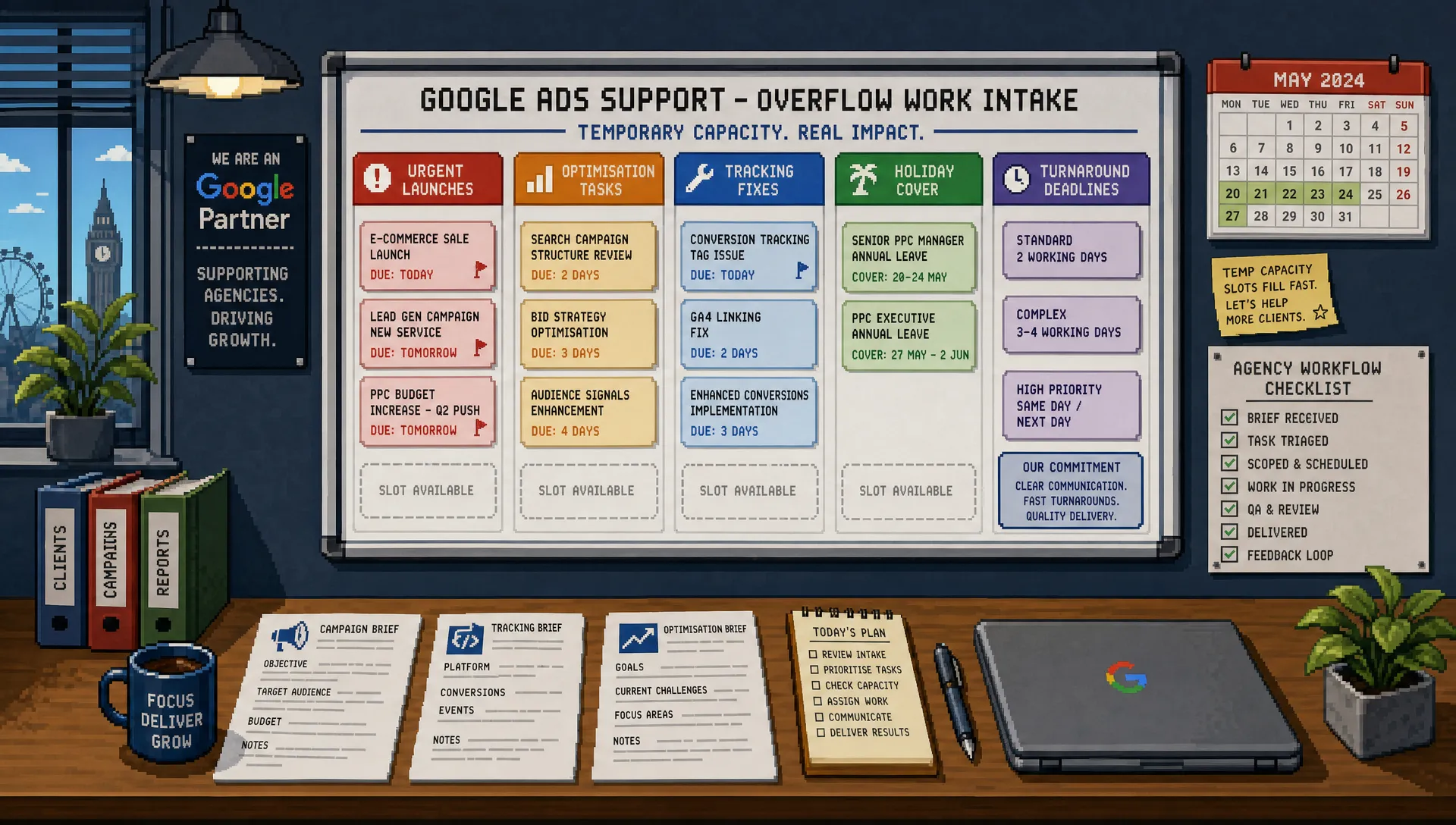
Overflow work is a healthy sign for a digital agency, until it starts to damage delivery quality. New retainers arrive, existing clients ask for campaign expansion, a strategist goes on annual leave, and suddenly your team is trying to build, optimise, report and troubleshoot Google Ads accounts at the same time.
That is where Google Ads freelance support for overflow work becomes useful. Not as a replacement for your agency, and not as a public-facing supplier your client needs to meet. Used well, freelance PPC support gives your agency extra senior execution capacity while you keep the relationship, strategy and commercial control.
For many UK agencies, the question is not whether they need more PPC capability. It is how to add that capability without hiring too early, overloading account managers, or turning away profitable work.
Why overflow PPC work becomes risky so quickly
Google Ads work is rarely a single task. A new campaign build might include keyword research, competitor checks, audience decisions, conversion tracking, ad copy, extensions, bid strategy settings, landing page feedback, negative keyword planning, QA and launch monitoring. Even a small account can become time-consuming if the tracking is messy or the client changes direction mid-project.
Overflow becomes risky because PPC is high visibility. If a blog post is a week late, the client may not notice immediately. If a Google Ads budget spends incorrectly, a conversion import fails, or a campaign launches with the wrong location targeting, the impact is immediate.
Agencies often feel the pressure in three areas:
- Speed: Clients expect fast launches, quick fixes and weekly momentum.
- Accuracy: One setup mistake can waste spend or undermine trust.
- Consistency: Optimisation quality drops when specialists are stretched across too many accounts.
There is also a strategic cost. Senior team members who should be focused on growth, client direction and retention end up buried in search term reports, asset checks and conversion debugging.
If these patterns are already familiar, it may be worth reviewing the wider warning signs that you need a Google Ads expert on demand, especially if rising workload is starting to affect account performance or team morale.
What Google Ads freelance support actually covers
A good PPC freelancer for overflow work should not simply be someone who can “do Google Ads”. The value is in being able to step into an agency workflow, understand the commercial context quickly, and complete specific tasks without creating extra management burden.
Depending on the agency's needs, overflow support can cover build work, optimisation, troubleshooting or account audits. The most common workstreams include:
| Overflow need | Typical freelance support | Why agencies outsource it |
|---|---|---|
| New campaign setup | Search, Performance Max, Shopping or lead generation campaign builds | To launch faster without pulling internal staff from retainers |
| Account optimisation | Search term reviews, bid strategy checks, budget adjustments and ad testing | To maintain account quality during busy periods |
| Tracking support | Google Ads conversion checks, GA4 events and tag troubleshooting | To avoid reporting gaps and poor bidding signals |
| Audit work | Account structure, wasted spend, quality score and conversion review | To get senior input before a proposal or client review |
| Emergency cover | Short-term support during absence, hiring gaps or sudden demand | To keep client delivery moving without long-term commitment |
The best use of freelance support is not always to outsource an entire client account. Sometimes the smartest move is to hand over defined execution tasks while your internal strategist remains the main decision-maker.
For example, an agency might keep client communication, forecasting and positioning in-house, then ask a white-label PPC specialist to complete the build, QA the tracking, and prepare optimisation notes for the next call.
When overflow support is better than hiring
Hiring is valuable when you have predictable, long-term demand and enough management capacity to train and retain the right person. But PPC hiring can be slow, expensive and uncertain, especially if you need senior capability rather than junior support.
Freelance support is often a better fit when demand is uneven. Agencies commonly need extra help during sales spikes, seasonal campaign launches, staff holidays, maternity or paternity cover, or when a large client suddenly increases scope.
The practical difference is flexibility. A full-time hire needs a role, salary, onboarding plan and long-term utilisation. A freelancer can support a specific project, account or deadline, then step back when the pressure drops.
This makes freelance PPC particularly useful for agencies that are growing but not yet ready to commit to another permanent specialist. It also reduces the risk of hiring under pressure, which often leads to compromises on seniority or cultural fit.
Where freelancers fit inside an agency delivery model
Overflow support works best when roles are clearly defined. The freelancer should know what they own, what they should escalate, and how their work will be reviewed or presented to the client.
A clean white-label model usually separates responsibilities like this:
| Role | Internal agency owner | Freelance PPC support |
|---|---|---|
| Client relationship | Owns communication, expectations and commercial decisions | Stays invisible unless agreed otherwise |
| Strategy | Sets goals, positioning and broader channel direction | Provides input or recommendations when requested |
| Execution | Briefs tasks and approves priority | Builds, optimises, audits or troubleshoots campaigns |
| Reporting | Presents results and next steps to the client | Supplies notes, data checks or recommendations |
| Quality control | Confirms work matches client expectations | QA checks own work and flags risks early |
This structure protects the agency's relationship while still giving the freelancer enough context to make good decisions. It also avoids the common mistake of treating freelance help as a vague extra pair of hands. PPC work needs ownership, even when it is temporary.
What to outsource first when you are overloaded
Not every Google Ads task should be outsourced immediately. If your team is new to using freelance support, start with work that has a clear brief, defined output and obvious quality criteria.
Good first tasks include account audits, campaign restructures, search term reviews, new campaign builds, conversion tracking checks and one-off optimisation sprints. These are easier to scope than open-ended account management and they quickly show whether the working relationship is a good fit.
More complex work, such as full strategic ownership or direct client communication, should come later if trust has been built. For many agencies, the ideal freelancer remains behind the scenes and provides senior delivery support rather than becoming another client-facing stakeholder.
Before outsourcing, ask yourself three simple questions:
- Can the task be explained clearly in writing? If not, it may need more internal thinking before handover.
- Is there a specific deadline or deliverable? Overflow support works best when expectations are concrete.
- Would external senior input improve quality or speed? If yes, it is likely a strong candidate for freelance support.
A simple overflow support workflow
The smoothest freelance relationships are built on repeatable process. You do not need a heavy project management system, but you do need enough structure to prevent confusion.
Start with a short brief that explains the client goal, current account status, budget, deadline, landing pages, key conversion actions and any sensitive constraints. Include what the freelancer should not change, especially in live accounts where bid strategies, budgets or experiments are already in progress.
For Google Ads access, follow the principle of least privilege. Google provides guidance on account access levels in Google Ads, and agencies should only grant the access needed for the task. If the work involves tracking, also confirm who controls Google Tag Manager, GA4 and the website CMS.
A practical handover flow looks like this:
- Brief the outcome: Define what success looks like, such as a completed campaign build, an audit document or a tracking fix.
- Share access and context: Provide the account, conversion goals, landing pages and relevant client history.
- Agree change rules: Clarify whether the freelancer can publish changes or should submit them for review.
- Request notes: Ask for concise commentary on what was done, why it was done and what should happen next.
- Review and reuse: Turn successful briefs into templates for future overflow work.
The goal is to make repeat support easier each time. Once the freelancer understands your standards, naming conventions and reporting style, handovers become faster and less stressful.
Quality checks before any outsourced work goes live
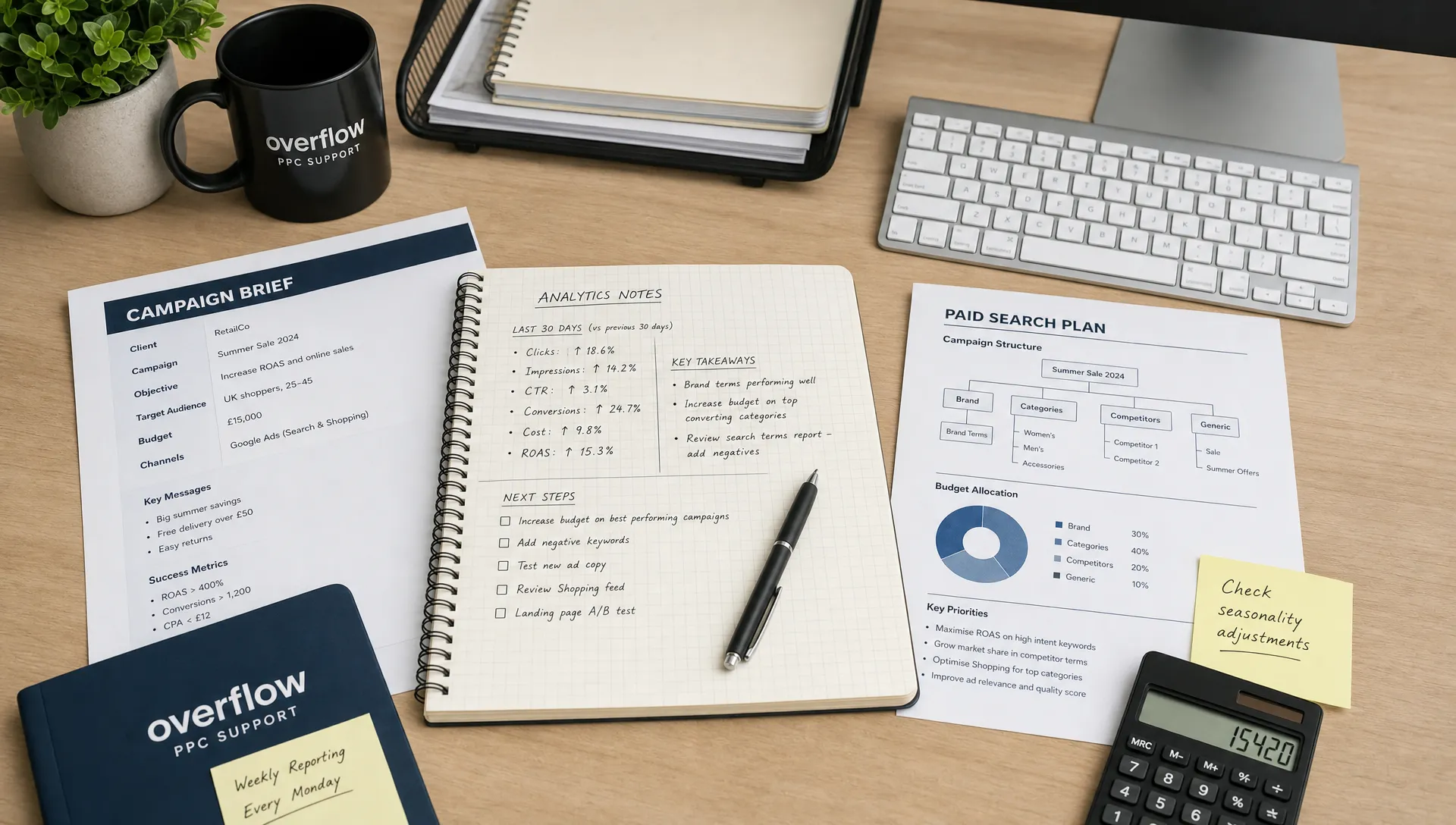
Even experienced PPC specialists need a QA process. Google Ads accounts contain many small settings that can materially affect performance, so a checklist is worth using every time.
For campaign builds, review location targeting, language settings, campaign goals, bidding strategy, daily budgets, ad schedule, final URLs, tracking templates, negative keywords, brand exclusions where relevant, audience settings and asset approval status.
For optimisation work, check that any changes align with the account's learning phase, budget constraints and conversion volume. A bid strategy change that looks sensible in isolation may be risky if the campaign has limited data or an upcoming promotion.
For tracking, make sure the conversion actions used for bidding are the correct ones. Google's own documentation on setting up conversion tracking is a useful reference, but agency QA should also include real test conversions where possible, GA4 comparison checks and confirmation that primary and secondary conversion actions are being used intentionally.
A freelancer should make your delivery safer, not more opaque. If changes cannot be explained clearly, they should not go live.
How to protect your agency's white-label relationship
Many agencies hesitate to use freelancers because they worry about confidentiality, client ownership or inconsistent communication. Those concerns are valid, especially if the freelancer is not used to white-label delivery.
A proper white-label setup should make the freelancer invisible to the end client unless you decide otherwise. That means no direct client contact, no branded documents, no unsolicited recommendations sent outside the agreed workflow, and no public use of client names without permission.
It also means matching your agency's tone. Some clients want deep technical detail. Others want concise commercial summaries. A good freelance PPC specialist should adapt their notes so your team can use them in client conversations without heavy rewriting.
If you are evaluating different options, the criteria in this guide to choosing the right PPC company for your agency are also useful when comparing freelance, white-label and outsourced PPC support.
Freelance support vs outsourced PPC management
The line between freelance support and outsourced management can blur, but they are not always the same thing.
Freelance overflow support is usually task-based or capacity-based. You need help with a build, audit, optimisation sprint or temporary workload spike. Outsourced PPC management is broader and may involve ongoing account ownership, regular optimisation, reporting input and strategic recommendations.
Neither model is automatically better. The right choice depends on how much control your agency wants to keep internally.
| Option | Best for | Watch out for |
|---|---|---|
| Freelance overflow support | Short-term workload, specific tasks, fast delivery gaps | Requires clear briefs and internal ownership |
| White-label PPC specialist | Anonymous senior support across builds, audits and optimisation | Needs strong confidentiality and workflow alignment |
| Full outsourced management | Ongoing account delivery when internal PPC capability is limited | Can reduce internal visibility if reporting is weak |
| Permanent hire | Predictable long-term demand and enough budget for salary | Recruitment can be slow and utilisation must be maintained |
For agencies with existing strategy and account management capability, white-label freelance support is often the most balanced option. It adds delivery capacity without forcing you to change how clients experience your agency.
What a strong Google Ads freelance brief should include
The quality of the brief directly affects the quality of the work. A senior PPC freelancer can fill gaps, but they should not have to guess the business model, client expectations or conversion priorities.
A strong brief should include the client background, website, target locations, monthly budget, primary KPIs, current pain points, deadline and access details. It should also clarify whether the account is lead generation, ecommerce, local service, B2B, SaaS or another model, because campaign structure and conversion value differ significantly.
For lead generation, include what counts as a qualified lead and whether offline conversion imports are used. For ecommerce, include product margins, priority categories, feed status and any promotional calendar. For local services, include service areas, opening hours and call tracking details.
It is also helpful to include examples of previous reports, naming conventions and tone of voice. The more your freelancer can mirror your internal standards, the easier it is to keep the work white-label.
How overflow PPC support improves profitability
Overflow support is not just about reducing stress. It can protect agency margin and growth.
When internal specialists are overloaded, work takes longer, mistakes become more likely and senior people spend too much time on execution. That affects profitability because the most expensive people in the agency are not always doing the highest-value work.
Freelance support helps agencies stay commercially flexible. You can accept more PPC work without committing to a hire before the demand is proven. You can also respond to client opportunities faster, which matters when a prospect wants a campaign live this week or an existing client needs urgent performance support.
There is another benefit: better focus. If a senior freelancer handles the technical PPC overflow, your internal team can spend more time on client strategy, retention, upsell planning and creative direction.
For accounts where wasted spend is part of the pressure, it can also help to combine overflow support with practical efficiency checks. These Google Ads PPC tips for cutting wasted spend are a useful starting point before or during an optimisation sprint.
Choosing the right Google Ads freelancer for overflow work
The right freelancer should reduce complexity, not add another person to manage. Look for evidence of senior Google Ads experience, agency workflow understanding, tracking competence and clear communication.
Technical skill matters, but so does judgement. A good PPC specialist knows when not to make a change, when to question the brief, and when to flag a risk before it becomes a client issue.
When assessing support, consider:
- White-label experience: Have they worked invisibly behind agencies before?
- Speed and availability: Can they support urgent work without overpromising?
- Platform depth: Do they understand Google Ads, conversion tracking and related tools?
- Communication quality: Are notes clear enough for your team to use with clients?
- Commercial awareness: Do recommendations connect to lead quality, revenue or client goals?
Avoid choosing purely on hourly rate. Cheap execution can become expensive if it creates rework, damages performance or forces your team to spend hours checking every detail.
Frequently Asked Questions
What is Google Ads freelance support for overflow work? It is flexible PPC help from an external specialist when your agency has more Google Ads work than it can comfortably deliver in-house. It can include campaign builds, audits, optimisation, tracking checks and short-term cover.
Is freelance PPC support suitable for white-label agency work? Yes, if the freelancer is comfortable working anonymously, following your processes and avoiding direct client contact unless agreed. Clear confidentiality expectations are essential.
When should an agency use a Google Ads freelancer instead of hiring? Freelance support is usually better when demand is temporary, unpredictable or project-based. Hiring makes more sense when you have consistent long-term workload and enough budget to keep a permanent specialist fully utilised.
Can a freelancer work inside our existing Google Ads accounts? Yes, but access should be controlled carefully. Grant only the permissions needed, agree what can be changed, and use a QA process before major changes go live.
What should we outsource first? Start with defined tasks such as audits, campaign builds, tracking checks or optimisation sprints. These are easier to brief and review than handing over full account ownership immediately.
Need senior Google Ads support without hiring?
Overflow work should not force your agency to choose between delaying launches, overloading your team or hiring before you are ready.
PPC Ghost provides on-demand, white-label PPC support for agencies that need senior execution across Google Ads, Meta Ads, Microsoft Ads, GA4 and tracking. It is built for flexible scaling, with anonymous delivery, same-day turnaround where available, no recruitment requirement and pay-as-you-go support.
If your agency needs Google Ads freelance support for overflow work, PPC Ghost can help you keep delivery moving while your agency takes the credit.