Microsoft Bing Ads Opportunities Agencies Overlook
Explore Microsoft Bing Ads opportunities agencies miss, from B2B targeting to shopping, tracking and white-label delivery for client growth.
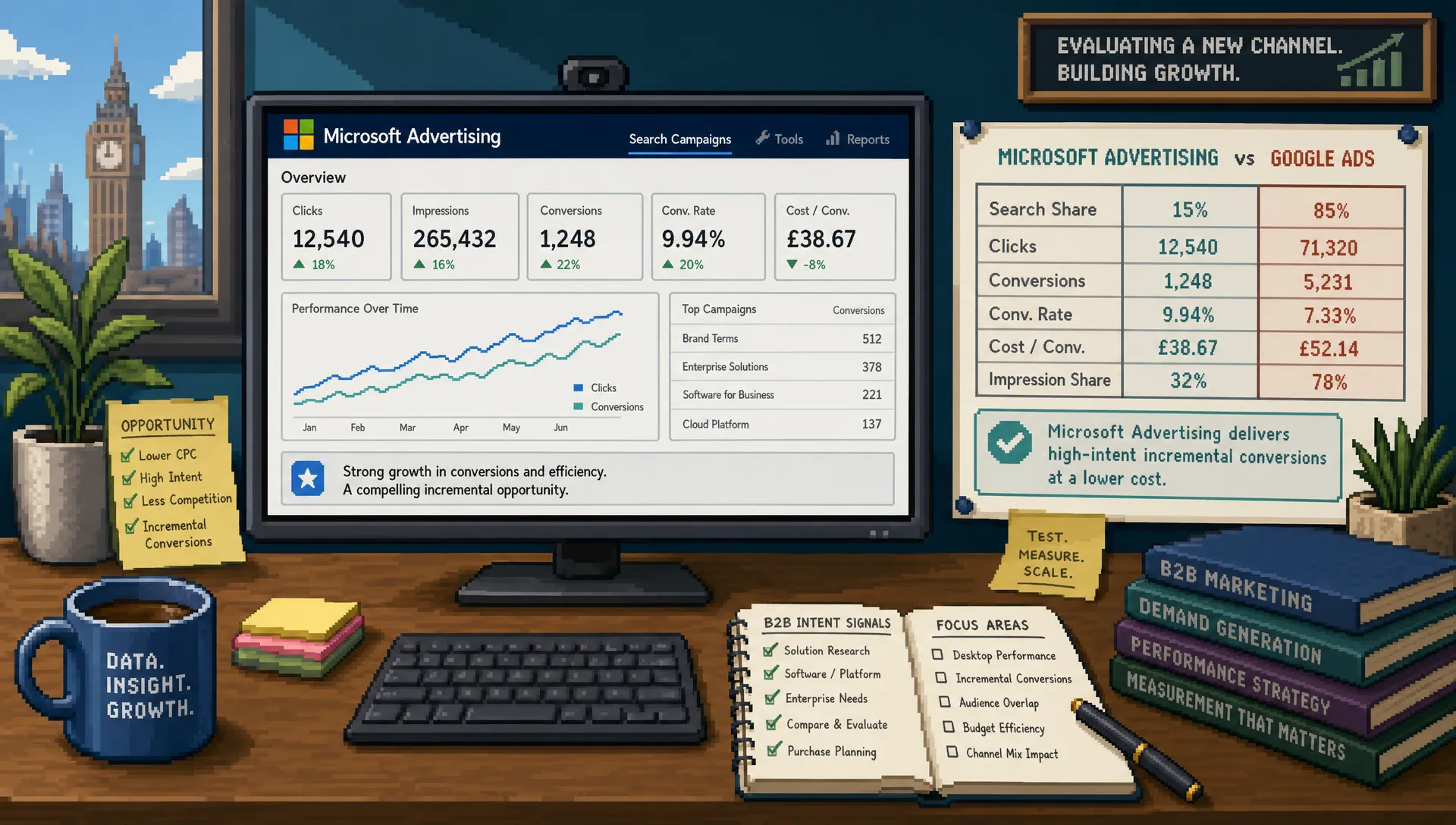
For many UK agencies, Microsoft Bing Ads still sits in the “nice to have” column. Google Ads gets the budget. Meta gets the creative attention. Microsoft Advertising, the platform many clients still call Bing Ads, is often imported once, left on a small budget, and judged by whatever happens next.
That creates a quiet opportunity.
Microsoft Bing Ads will not be right for every client, and it should not be sold as a magic replacement for Google. But in the right accounts, especially B2B, lead generation, ecommerce with clean feeds, local services, finance, professional services and considered purchases, it can add incremental conversions without asking the client to reinvent their funnel.
The agencies that win with Microsoft Ads are not simply copying Google campaigns. They are spotting the areas where Bing search behaviour, desktop usage, audience controls and competitive dynamics create a different kind of advantage.
Why agencies overlook Microsoft Bing Ads in the first place
The most common reason is not ignorance. It is pressure.
Agency teams are often managing too many accounts, too many platforms and too many client requests. When Google Ads performance is under scrutiny, the instinct is to focus all energy there. Microsoft Ads gets treated as a secondary channel because its volume is usually smaller.
That logic sounds reasonable, but it misses the commercial question clients actually care about: “Where can we find profitable growth that our competitors are not overworking?”
Smaller volume does not mean lower value. A channel can produce fewer conversions and still be worth serious attention if the cost per qualified lead, sales quality or marginal return is strong. This is especially true when Google CPCs are rising or when a client has already reached the point where extra Google spend produces diminishing returns.
If your agency already runs mature search campaigns, Microsoft Bing Ads may be one of the cleanest ways to test incremental demand without building a new channel from scratch.
Opportunity 1: Incremental demand after Google starts getting expensive
A client does not need to abandon Google to benefit from Microsoft Ads. The real opportunity is often incremental demand.
When a Google Ads account has strong conversion tracking, proven keyword themes and clear commercial intent, Microsoft Ads can give you another search environment to test those same business assumptions. The key is to avoid treating it as a low-effort clone.
A sensible starting point is to identify Google campaigns where performance is already strong but marginal growth is becoming harder. These might include campaigns with rising CPCs, limited impression share due to budget, strong exact match terms, high-value search terms, or consistent lead quality but capped budget.
Instead of importing everything, prioritise the themes with the strongest buying intent. Microsoft Ads is particularly useful when you are trying to protect cost per acquisition while still giving the client a growth story.
| Google Ads signal | Microsoft Bing Ads opportunity | Agency action |
|---|---|---|
| CPCs are rising on proven keywords | Test the same intent at a potentially different auction cost | Build focused campaigns from top-performing search terms |
| Budget is capped on high-intent campaigns | Capture additional searches outside Google | Allocate a controlled test budget |
| Lead quality is strong but volume is flat | Find incremental qualified enquiries | Compare CRM outcomes, not just form fills |
| Competitor bidding is aggressive | Test competitor and comparison terms in a less crowded auction | Use strict match types and careful ad copy |
For a deeper tactical view, PPC Ghost has also covered Microsoft Ads strategies UK agencies should use, but the main point here is simple: start where intent is proven, then adapt for the Microsoft ecosystem.
Opportunity 2: B2B and professional audiences that skew desktop
Microsoft Bing Ads can be especially interesting for B2B and professional services because of how people use search at work. Many users encounter Bing through Microsoft Edge, Windows devices, workplace defaults or corporate environments. That does not make every Bing user a perfect B2B prospect, but it does mean agencies should pay attention to desktop-heavy, workday search patterns.
StatCounter’s desktop search engine market share data has consistently shown Bing performing more strongly on desktop than it does on mobile in the UK. For agencies managing clients with office-based decision makers, that matters.
Think about sectors such as:
- Accountancy, legal, insurance and financial services
- SaaS and B2B technology
- Recruitment and HR services
- Training providers and professional education
- Industrial, manufacturing and trade suppliers
- Commercial property and facilities management
In these categories, users are often researching during working hours, comparing providers, downloading guides, requesting demos or looking for specialist suppliers. If your agency only looks at total search volume, Bing may seem small. If you look at qualified commercial intent, it can become much more attractive.
The overlooked play is daypart and device analysis. Agencies often import campaigns, leave device settings untouched, then report that the channel “does not scale.” A better approach is to review performance by device, hour and day. You may find that weekday desktop traffic carries the account, while mobile traffic contributes less value.
That insight can shape bids, budgets, landing page priorities and even client reporting.
Opportunity 3: LinkedIn profile targeting inside Microsoft Advertising
One of Microsoft Advertising’s most distinctive features is access to LinkedIn profile targeting options for search, shopping and audience campaigns in eligible markets. According to Microsoft Advertising’s own guidance, advertisers can use LinkedIn profile information such as company, industry and job function as targeting signals.
This is a major advantage that agencies often underuse.
It is not the same as running LinkedIn Ads. Search intent still matters. But for B2B clients, layering professional audience signals over high-intent searches can help you prioritise the users most likely to match the client’s ideal customer profile.
For example, a SaaS client might not want every searcher looking for “project management software.” They may care more about searches from users associated with certain industries, company types or job functions. A law firm might want to understand whether commercial searches behave differently when filtered through industry signals. A training provider might find different conversion values across job functions.
The key is to use these signals carefully. Treat them as bid adjustments or audience observations where appropriate, not as a reason to strangle volume too early. The agency opportunity is in testing whether audience context improves lead quality, not just whether it improves click-through rate.
Opportunity 4: Competitor campaigns with less auction noise
Competitor campaigns on Google can be expensive, volatile and politically sensitive. They can still work, but many agencies have watched competitor CPCs rise while conversion rates fail to keep pace.
Microsoft Bing Ads may offer a more controlled environment for competitor testing, especially in sectors where buyers compare multiple suppliers before enquiring.
This does not mean writing misleading ad copy or using trademarks irresponsibly. It means building campaigns around comparison intent, alternative searches and category-level pain points. Examples include searches such as “alternative to [competitor],” “[competitor] pricing,” “[competitor] reviews” or “best [service] provider UK.”
The opportunity is not just lower cost. It is the chance to capture users who are already in evaluation mode. Agencies should send this traffic to landing pages that make comparison easy, address switching concerns and show clear proof.
If the client lacks comparison content, this becomes a wider agency opportunity. Paid search insights can inform SEO pages, sales enablement and nurture campaigns. The search data tells you which competitors prospects already have in mind.
Opportunity 5: Shopping campaigns for ecommerce clients with underused feeds
Ecommerce agencies often focus feed optimisation around Google Merchant Center, but Microsoft Shopping can be a useful additional route for products with established search demand.
The mistake is assuming the same feed will automatically perform the same way. Product titles, images, pricing, availability and category structure still matter. If a client has strong Google Shopping results, Microsoft Shopping deserves at least a structured test.
This is particularly true for products with considered purchase behaviour, higher average order values or older demographic appeal. Microsoft’s audience may not always drive the highest volume, but it can still contribute profitable sales when the feed is clean and budgets are controlled.
Agencies should look for products where Google Shopping has already proved commercial demand. Then test Microsoft Shopping with clear segmentation, proper conversion tracking and a budget that allows enough data to make a decision.
Opportunity 6: Search partner control and traffic quality checks
One reason agencies become disappointed with Microsoft Ads is that they fail to monitor traffic sources closely enough.
Microsoft Advertising can show ads across Bing and partner networks, depending on campaign settings and distribution choices. Partner traffic can sometimes help scale, but it should not be accepted blindly. Agencies need to review search term quality, publisher performance where available, conversion quality and assisted contribution.
If a campaign is producing cheap leads that the sales team dislikes, the issue may not be Microsoft Ads as a whole. It may be distribution, match type looseness, weak negatives or conversion tracking that rewards the wrong action.
This is where agencies can create value quickly. A short audit of search terms, network settings, location reports, device splits and conversion actions can reveal whether the channel is genuinely weak or simply unmanaged.
The same principle applies across PPC. If measurement quality is poor, optimisation decisions become unreliable. PPC Ghost has written about PPC ads best practices for agencies under pressure, and the same triage mindset applies here: protect tracking first, then optimise spend.
Opportunity 7: Microsoft Ads as a client retention lever
Agencies often think of Microsoft Bing Ads as an acquisition channel for the client. That is true, but it can also be a retention lever for the agency.
When a client asks, “What else can we test?” many agencies default to more Google spend, more Meta creative or a broad “full funnel” proposal. A focused Microsoft Ads test can be easier to justify because it is close to existing search intent and does not require the client to learn an entirely new demand generation model.
This matters when clients are cautious. In uncertain budgets, a controlled Microsoft Ads test can sound more practical than a large new channel rollout.
Position it as:
- A 30-day incremental search test
- A way to reduce reliance on one auction
- A controlled expansion from proven Google search themes
- A B2B audience quality experiment
- A shopping or remarketing extension for existing demand
The client does not need to be sold a huge strategic transformation. They need to understand the commercial hypothesis, the budget, the success metric and the decision point.
Strong communication helps. When agencies need to formalise test approvals, scope changes or client updates, using an AI letter generator for polished client correspondence can speed up the admin side while keeping the message professional.
Opportunity 8: Better reporting than “Bing was cheaper”
A common agency reporting mistake is presenting Microsoft Ads as a cheaper version of Google. That undersells the channel and can make it look optional.
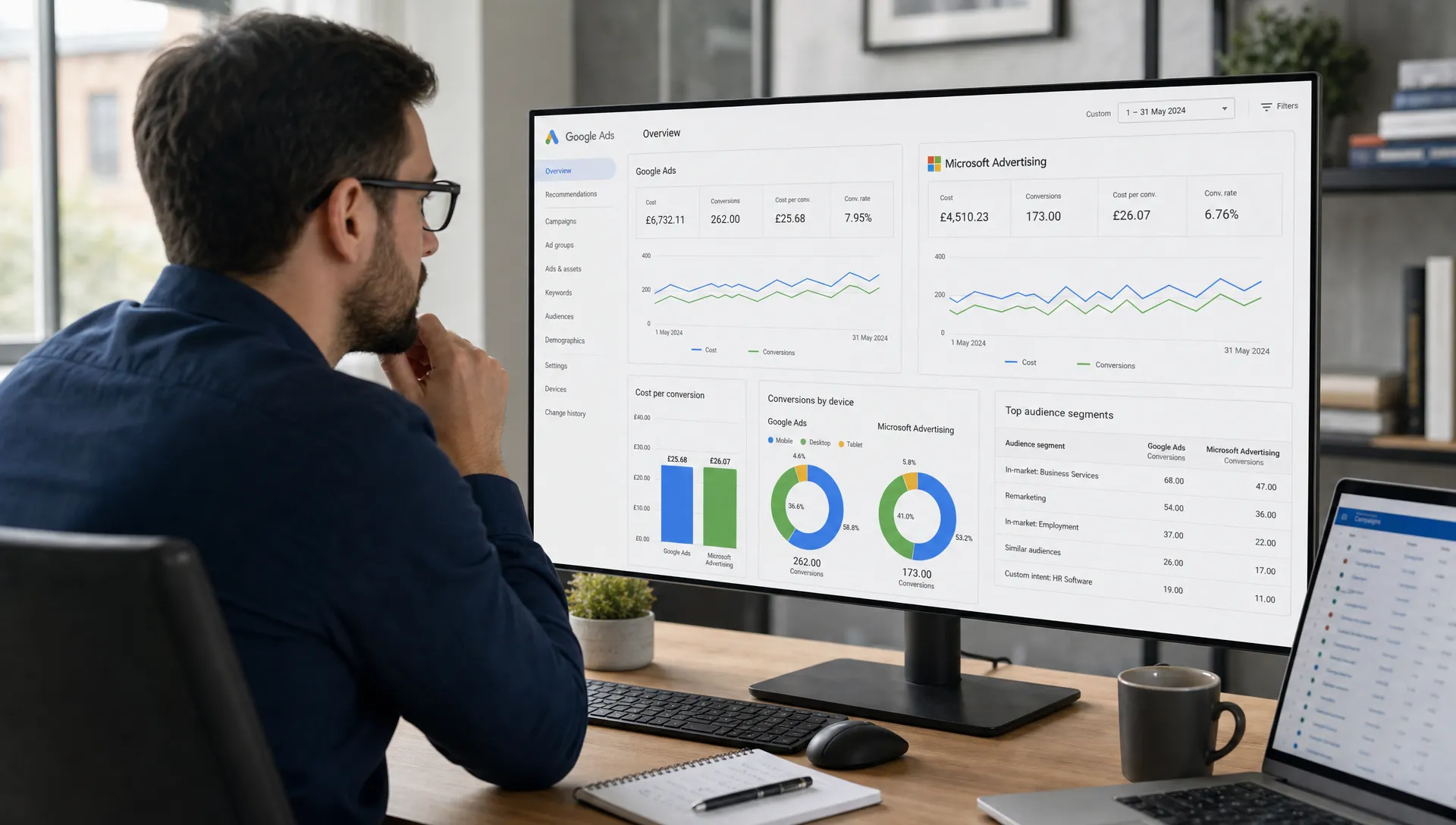
Better reporting focuses on incrementality and lead quality. If Microsoft Ads produces fewer conversions but reaches a different audience, supports a different device mix or drives stronger downstream opportunities, clients need to see that.
For lead generation, report beyond platform conversions where possible. Useful measures include qualified lead rate, cost per qualified lead, pipeline value, sales acceptance rate and conversion to consultation or demo.
For ecommerce, look at revenue, margin indicators if available, new customer rate, assisted conversions and product-level profitability. A cheap sale with low margin is less useful than a slightly more expensive sale that moves profitable stock.
A simple reporting frame can change the conversation:
| Reporting question | Why it matters |
|---|---|
| Did Microsoft Ads add conversions we would not have captured otherwise? | Shows incrementality rather than duplication |
| Which campaigns produced qualified outcomes, not just leads? | Protects the client from vanity metrics |
| Which devices, times and audiences performed best? | Guides budget and bid decisions |
| What did search terms reveal about buyer intent? | Feeds SEO, landing page and sales messaging |
| Should the next month scale, refine or pause? | Keeps the test commercially disciplined |
This is where a senior PPC specialist can make the difference between “we tried Bing” and “we found an incremental growth pocket.”
Opportunity 9: Importing from Google, then fixing what the import breaks
Google import is useful, but it can create false confidence. Agencies often import campaigns, glance at the settings and assume the job is done.
That is risky.
Platform differences can affect bidding, budgets, tracking templates, audience settings, ad extensions, match behaviour and recommendations. Even when the import works smoothly, the resulting account still needs a Microsoft-specific review.
After any import, agencies should check:
- Conversion goals and whether they match the client’s real commercial outcomes
- Location targeting and exclusions
- Network distribution and partner settings
- Match types, negatives and search term quality
- Device performance and bid adjustments
- Ad assets, sitelinks, callouts and structured snippets
- Budget allocation across brand, non-brand, competitor and shopping activity
The opportunity is speed with control. Importing from Google can shorten setup time, but optimisation should not stop there. A Microsoft Ads account should have its own logic, not just Google’s structure in a different interface.
If your agency has clients where Google Ads is mature but internal capacity is stretched, it may be worth reviewing when to hire a Microsoft Ads agency for client growth rather than letting the opportunity sit untouched.
A practical 30-day Microsoft Bing Ads opportunity audit
If you want to decide whether Microsoft Ads is worth pitching to a client, do not start with a vague channel recommendation. Start with an audit.
In week one, review the Google Ads account for proven search themes. Identify campaigns with strong conversion quality, rising CPCs, limited impression share or high-intent search terms. Exclude weak campaigns from the test.
In week two, map those themes into a lean Microsoft Ads structure. Prioritise brand protection, top non-brand terms, remarketing audiences where appropriate, and shopping campaigns if the ecommerce feed is strong.
In week three, validate tracking, import only what is useful and rewrite anything that depends too heavily on Google-specific assumptions. Confirm budgets, exclusions, locations and conversion goals before launch.
In week four, review early data with caution. Do not overreact to a tiny sample, but do look for obvious waste. Search terms, device splits, partner quality and lead feedback can usually reveal whether the account is moving in the right direction.
By the end of the first month, the agency should be able to recommend one of three paths: scale the campaigns with stronger budget support, refine the structure before further investment, or pause because the channel does not fit the client’s economics.
That is much more useful than leaving Microsoft Bing Ads as a forgotten import with no owner.
Frequently Asked Questions
Is Microsoft Bing Ads still worth testing in 2026? Yes, for the right clients. It is most attractive when Google Ads already proves search demand but marginal growth is becoming expensive, or when the client sells to B2B, desktop-heavy or considered-purchase audiences.
Should agencies copy Google Ads campaigns into Microsoft Ads? Importing can save time, but it should not replace strategy. Agencies should review tracking, budgets, match types, audiences, device performance, network settings and ad assets after import.
What types of clients are best suited to Microsoft Bing Ads? B2B services, professional services, SaaS, finance, ecommerce with strong product feeds, local services and high-value lead generation clients are often good candidates. The deciding factor is not the sector alone, but whether search intent and conversion economics are strong.
How much budget should a Microsoft Ads test need? It depends on CPCs and conversion volume, but the budget should be large enough to produce meaningful data without distracting from core channels. A controlled test against proven Google themes is usually better than spreading a tiny budget across too many campaigns.
How should agencies report Microsoft Ads performance to clients? Focus on incrementality, qualified leads, revenue, pipeline contribution, device performance and search intent insights. Avoid reporting only that clicks or leads were cheaper, because that does not prove commercial value.
Need senior Microsoft Ads support without hiring?
Microsoft Bing Ads opportunities are easy to miss when your team is already stretched across Google, Meta, reporting, tracking and client requests.
PPC Ghost gives UK agencies on-demand, white-label PPC support across Microsoft Ads, Google Ads, Meta Ads and tracking. You keep the client relationship and the credit, while a senior specialist helps with execution when you need extra capacity.
If Microsoft Ads is sitting in your client accounts as an afterthought, now is a good time to turn it into a structured growth test. Visit PPC Ghost to explore white-label PPC support without recruitment hassle or long-term contracts.