Meta Lead Ads Best Practices for Better Lead Quality
Improve Meta Lead Ads quality with better forms, targeting, creative, CRM follow-up and tracking tips built for agency client accounts.
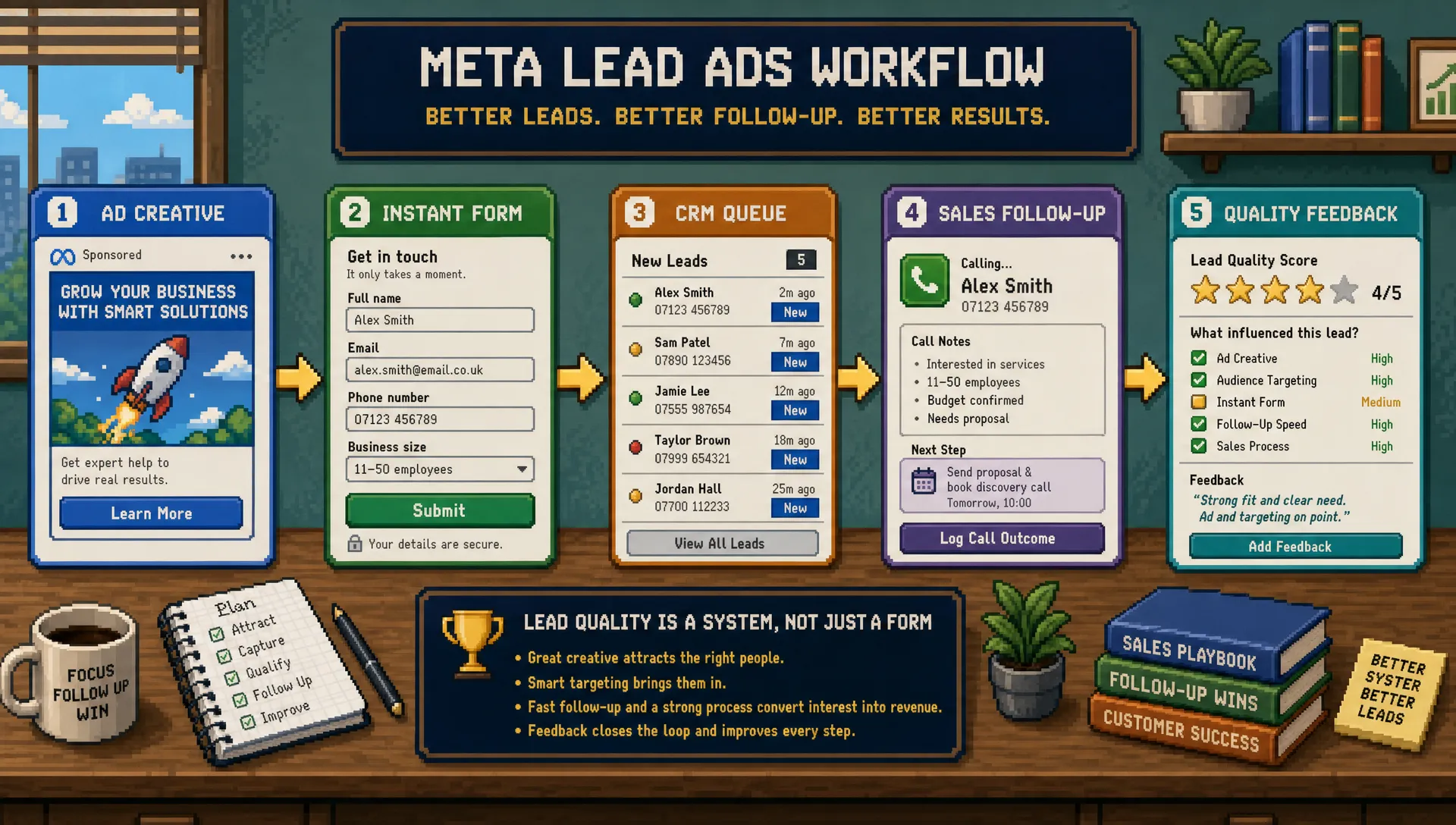
Meta Lead Ads are often judged too quickly. A campaign launches, the cost per lead looks attractive, the spreadsheet fills up, then the client says the leads are poor. The problem is rarely the format alone. It is usually a gap between what the ad promised, what the form asked, how quickly sales followed up, and what Meta was told to optimise towards.
For agencies, this matters because lead quality is what clients remember. A low CPL may look good in a weekly report, but it will not protect the account if the sales team is wasting hours on unqualified enquiries. The best Meta Lead Ads campaigns are built around business outcomes from the start, not just form submissions.
This guide covers practical Meta Lead Ads best practices for improving lead quality, especially for agency-managed client accounts where speed, clarity, and accountability all matter.
Define lead quality before building the campaign
Lead quality cannot be improved if nobody has agreed what a good lead looks like. Before opening Ads Manager, get the client to define what counts as a useful enquiry in operational terms.
A good definition should go beyond basic demographics. For B2B clients, quality might depend on company size, location, job role, current provider, urgency, or available budget. For local service businesses, quality may depend on postcode, property type, service need, appointment availability, or whether the person is the decision-maker.
This step also protects the agency. If a client simply says they want more leads, it is easy to optimise towards cheap submissions that never become pipeline. If they say they want homeowners in specific postcodes looking to book a survey within 30 days, the campaign can be structured with much better intent signals.
| Lead quality metric | What it tells you | Why it matters |
|---|---|---|
| Contact rate | Percentage of leads reached by phone, email, or SMS | Shows whether form data and follow-up timing are strong |
| Qualification rate | Percentage that match the client’s criteria | Separates cheap volume from useful enquiries |
| Appointment rate | Percentage that book a call, quote, demo, or visit | Measures commercial intent after submission |
| Cost per qualified lead | Spend divided by qualified leads, not total leads | Gives a more honest view of performance |
| Sales outcome | Opportunities, revenue, or closed deals where available | Connects Meta activity to business value |
If the client cannot provide these definitions, use the first campaign phase to learn them. Just make sure expectations are clear. The first two to four weeks may be about building a feedback loop, not declaring victory based on CPL.
Match the offer to the user’s level of intent
Meta is not search. People are usually not opening Instagram or Facebook to request a quote from a supplier. Your offer has to earn attention while still filtering for the right people.
For colder audiences, a softer offer can work well, such as a guide, checklist, webinar, calculator, or audit. These can generate volume, but they often need nurture before sales involvement. For warmer audiences, such as retargeting users or people who engaged with previous content, a direct consultation, quote request, demo, or appointment booking may be appropriate.
The offer should also signal who it is for. A vague free consultation can attract anyone. A more specific offer, such as a paid media audit for UK ecommerce brands spending over a certain threshold, will naturally filter the audience before they even open the form. You do not need to make the ad restrictive for the sake of it, but you do need to avoid promising value to everyone.
If your agency is deciding how Meta should sit alongside search activity, it helps to understand the different roles of each channel. PPC Ghost has covered this wider channel fit in its guide to Google Ads vs Meta Ads for agency growth.
Use Instant Forms with deliberate friction
Meta Lead Ads use Instant Forms, which let users submit details without leaving Facebook or Instagram. That convenience is the main advantage, but it is also the main risk. When the form is too easy, you may get people who barely remember submitting it.
Meta’s own lead ads overview highlights the native, mobile-friendly nature of the format. For lead quality, your job is to decide how much friction the campaign needs.
| Form approach | Best for | Lead quality consideration |
|---|---|---|
| Lower-friction form | Lead magnets, newsletters, early-stage content | Usually higher volume, but more nurture needed |
| Higher intent form | Quote requests, demos, consultations, sales calls | Adds a review step, which can reduce accidental submissions |
| Custom questions | Qualification for sales teams | Helps filter intent, budget, need, and timing |
| Appointment-style journey | Service businesses with booking capacity | Can improve actionability if sales operations are ready |
A common mistake is assuming more questions always mean better quality. Long forms can reduce completion rates and may still attract poor-fit leads if the questions do not reveal anything useful. The aim is not to make the process difficult. The aim is to create enough commitment for the right person to self-identify.
As a rule, ask only for information that will change what happens next. If sales will never use a field, remove it. If a question helps route, prioritise, or disqualify leads, keep it.
Write ad creative that filters, not just attracts
Lead quality starts in the ad, not the form. If the creative is broad, exaggerated, or unclear, the form has to work much harder to clean up the traffic.
Strong lead ads do three things before the click. They explain the problem, identify the right audience, and make the next step clear. This does not mean every ad needs dense copy. It means the message should make it obvious who should respond and why.
For example, a weak ad might say: Free marketing consultation for growing businesses. It is easy to click, but it gives almost no qualification context. A stronger version might say: Book a paid media audit for a UK ecommerce account spending £10k+ per month. The second version will likely reduce volume, but the people who submit are much more likely to match the intended client profile.
Creative can qualify through:
- Service scope, such as audit, quote, installation, demo, or consultation
- Location, such as UK-wide, London only, Manchester, or specific service areas
- Budget or scale cues, where appropriate and compliant
- Timing cues, such as ready this month or planning for Q4
- Use-case cues, such as ecommerce, lead generation, local services, SaaS, or franchise accounts
Avoid hiding important details until after the lead is captured. If price range, eligibility, or location matters, consider mentioning it earlier. You may lose some leads, but you will often save the client’s sales team from low-value conversations.
Improve targeting without over-segmenting
Many advertisers respond to poor lead quality by narrowing targeting too aggressively. That can work in some cases, but it can also starve the algorithm and push costs up without solving the underlying message problem.
For most accounts, quality improves when targeting, creative, and form design work together. Broad or relatively open targeting can still produce strong leads if the ad copy and form questions are clear. On the other hand, precise targeting cannot rescue a vague offer.
Start by using the client’s strongest first-party data where available. Customer lists, website audiences, engaged social audiences, and qualified CRM segments can all help Meta understand the right pattern. Lookalike audiences can still be useful when the seed list represents real quality, not just every historic lead.
Exclusions also matter. Exclude existing customers where relevant, recent poor-fit converters if you have reliable data, or people who already submitted the same form. For agencies, this is where account hygiene becomes a quality lever, not just an admin task.
Be careful with constant structural edits. Splitting every persona, placement, and creative concept into separate ad sets can slow learning and make results harder to interpret. If you are seeing inconsistent performance across client accounts, it may be worth reviewing the broader Facebook Meta Ads mistakes agencies still make, especially around over-segmentation and weak briefs.
Ask qualifying questions sales can actually use
Custom questions are one of the simplest ways to improve Meta Lead Ads quality, but only when they are chosen carefully. The goal is to identify intent, fit, and urgency without creating unnecessary friction.
For B2B campaigns, useful questions might ask about company size, current challenge, monthly ad spend, timeframe, or decision-making responsibility. For home services, questions might ask about postcode, property type, service required, and preferred appointment window. For education, events, or professional services, questions might focus on interest area, availability, or eligibility.
Multiple-choice questions are often better than open text because they are faster for users and easier for sales teams to scan. Open text can be useful when context matters, but it tends to create messier data.
You should also make disqualification options explicit. If the client only serves businesses above a certain size, include a lower-size option rather than forcing everyone into a qualified-looking answer. That makes reporting more honest and helps you train future optimisation decisions.
Compliance matters too. Avoid asking for sensitive information unless it is genuinely necessary and lawful. For UK campaigns, make sure the client’s privacy policy, consent language, and follow-up process are aligned with data protection expectations. The UK Information Commissioner’s Office provides useful guidance on direct marketing and privacy rules.
Connect lead capture to fast follow-up
Even high-intent leads cool quickly. A person who filled out a form on Instagram during a lunch break may not remember the brand clearly by the next day. If the client takes 48 hours to respond, campaign quality will look worse than it really is.
The follow-up process should be agreed before the campaign goes live. Decide who receives the lead, how quickly they respond, what channel they use first, and how many attempts are made before a lead is marked unresponsive.
A strong follow-up workflow usually includes an immediate confirmation message, fast sales notification, a clear call script or email template, and a CRM status that records what happened. If the client has a sales team, make sure they know exactly what the ad promised. If the ad offers an audit, the first call should not feel like a generic sales pitch.
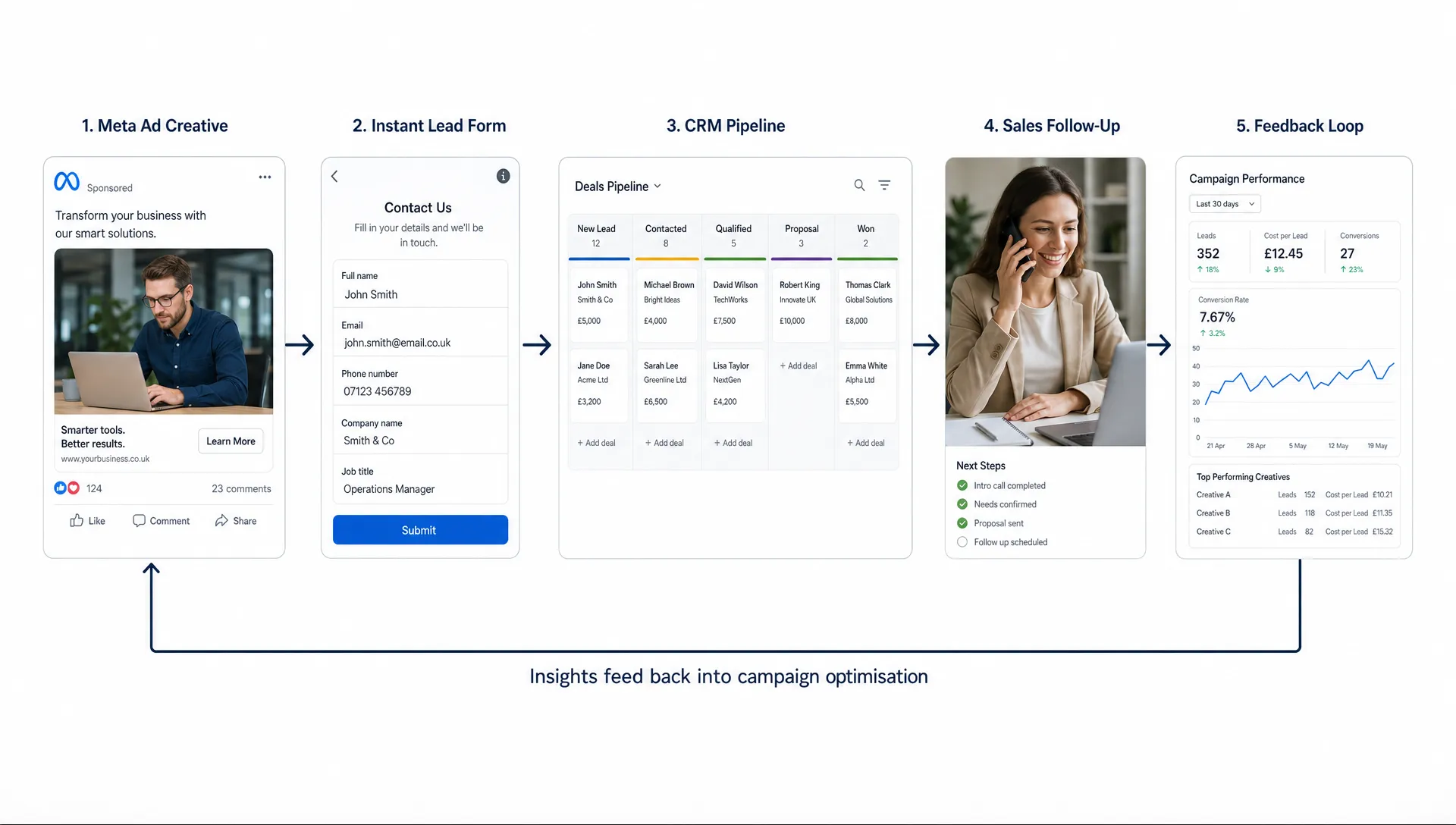
For agencies, this is often the hidden difference between a retained client and a frustrated one. You may not control the client’s sales team, but you can control the handover process, response expectations, and reporting visibility.
Track lead quality beyond the form submission
If Meta only sees form submissions, it will optimise for people likely to submit forms. That does not always mean people likely to become customers. To improve quality, send better feedback into your reporting and, where possible, your optimisation.
At minimum, use consistent UTM parameters so leads can be tied back to campaign, ad set, ad, creative angle, and form. Make sure the CRM captures those fields. If the client’s CRM cannot capture them natively, use a documented workaround before launch rather than trying to reconstruct performance later.
Where available, offline conversion data can help connect downstream outcomes to Meta activity. This might include qualified lead, booked appointment, opportunity created, or sale. You do not always need full revenue attribution to make better decisions. Even a reliable qualified or not qualified status is more useful than judging campaigns by raw CPL alone.
Tracking should also be QA’d before launch. Check that forms deliver leads correctly, CRM fields map properly, notifications fire, and test leads are removed from reporting. If your agency is under pressure to move quickly, a repeatable setup process helps prevent avoidable errors. PPC Ghost has a practical guide on Meta Ads Manager tips for faster campaign launches that complements this kind of quality control.
Optimise for qualified outcomes, not cheap enquiries
Once data starts coming in, resist the temptation to optimise too early. A few poor leads do not prove an ad is bad, and a few cheap leads do not prove an ad is good. Wait until you have enough volume to see patterns by creative, audience, placement, device, form, and qualification status.
When optimising, look for mismatches. If one ad has a low CPL but poor contact rate, the promise may be too casual or the form too light. If one audience produces expensive leads but a high appointment rate, it may deserve more budget than the headline CPL suggests. If a form question reveals many poor-fit users, adjust the ad copy so those people self-select out earlier.
A useful optimisation rhythm is to review lead quality weekly, but make structural changes only when the evidence is strong. Creative can usually be refreshed more often than campaign architecture. Form changes should be tracked carefully because they can affect both volume and quality.
| Optimisation signal | Possible issue | Practical response |
|---|---|---|
| High volume, low contact rate | Accidental submissions or weak user recall | Add higher intent form, clearer confirmation, faster follow-up |
| High contact rate, low qualification | Targeting or offer too broad | Add qualifying copy and better form questions |
| Good qualification, low appointment rate | Sales handover or offer mismatch | Review call script, landing promise, and next-step clarity |
| Strong quality, high CPL | Valuable but constrained audience | Compare cost per qualified lead before cutting spend |
| Good early results, then decline | Creative fatigue or audience saturation | Refresh angles and review frequency by segment |
Build a simple testing plan
Better lead quality usually comes from controlled testing, not random tweaks. Before launch, decide which variables matter most and how you will judge success.
Good tests for Meta Lead Ads include comparing a lower-friction form against a higher intent form, testing broad creative against qualification-heavy creative, comparing offer types, or testing retargeting against prospecting. Avoid changing the offer, form, audience, and creative all at once unless the current campaign is clearly unusable.
For agency teams, a simple testing roadmap is often easier to explain to clients than a long list of optimisations. It shows that quality improvement is a process, not guesswork.
| Test | What you learn | Primary metric |
|---|---|---|
| Short form vs higher intent form | Whether added friction improves serious enquiries | Cost per qualified lead |
| Broad message vs specific message | Whether the creative is attracting the right people | Qualification rate |
| Lead magnet vs consultation | Whether users are ready for sales contact | Appointment rate |
| Prospecting vs retargeting | Whether warmer audiences justify higher costs | Cost per appointment |
| Different qualifying question sets | Which data helps sales prioritise | Sales acceptance rate |
Make sure clients understand that a lower lead count can still be a win if the sales team gets better conversations. The report should make that trade-off visible.
Report on quality in language clients understand
Meta reports are useful, but they do not tell the full story. Clients care about whether leads answer the phone, match the brief, book appointments, and buy. Your reporting should bridge the gap between platform metrics and sales reality.
A strong Meta Lead Ads report should include total leads, CPL, contact rate, qualified leads, cost per qualified lead, appointment rate, and notable patterns from comments or sales feedback. If revenue data is available, include it. If it is not, be clear about the next-best proxy.
Qualitative feedback is also valuable. Sales teams often spot recurring issues before the data is statistically obvious. They may tell you that leads are too junior, outside the service area, expecting a lower price, or confused about the offer. Turn that feedback into campaign changes rather than treating it as anecdotal noise.
This is especially important in white-label or outsourced delivery. The end client may never see the media buyer, so the agency’s report must explain not only what happened, but what will be improved next.
Common reasons Meta Lead Ads produce poor quality
When lead quality drops, diagnose the whole system before blaming the channel. The issue is usually one or more of the following:
- The offer is too broad and attracts curiosity rather than intent
- The ad copy does not state who the service is for
- The form uses too few qualification questions
- The form asks questions that sales never uses
- Follow-up is too slow or inconsistent
- CRM feedback is missing, so Meta performance is judged only by CPL
- The campaign is edited too often, making learning unstable
- The client’s definition of a qualified lead is unclear or changes mid-campaign
The best agencies treat these as operational issues, not just media buying problems. Meta can produce strong lead generation results, but only when the campaign is connected to a clear sales process.
A practical pre-launch checklist for better lead quality
Before setting a Meta Lead Ads campaign live, run through a short quality checklist. This is especially useful when multiple agency team members are involved or when a client needs fast turnaround.
- Confirm the client’s qualified lead definition and disqualifiers
- Choose an offer that matches the audience temperature
- Make the ad copy clear about audience, service, location, and next step
- Use a form type that matches the required level of intent
- Ask only questions that improve routing, qualification, or follow-up
- Check privacy policy links and consent language
- Test lead delivery into email, CRM, or automation tools
- Agree response time, owner, and follow-up sequence with the client
- Use UTMs and naming conventions that make quality analysis possible
- Schedule the first quality review before the campaign launches
This checklist does not need to slow down production. In practice, it often speeds things up because fewer issues need to be fixed after leads start arriving.
Frequently Asked Questions
Are Meta Lead Ads good for B2B lead generation? Yes, they can work well for B2B when the offer, creative, form questions, and follow-up process are designed around qualification. They are usually weaker when advertisers use vague offers and judge success only by CPL.
How many questions should a Meta lead form include? Use as few questions as possible while still capturing the information sales needs. For many campaigns, two to four well-chosen qualifying questions are better than a long form that creates friction without improving follow-up.
Should I use higher intent forms for all campaigns? Not always. Higher intent forms can reduce accidental submissions and improve seriousness, but they may also lower volume. They are best suited to sales-led offers such as quotes, demos, consultations, and appointments.
Why are my Meta leads not answering the phone? Common causes include delayed follow-up, weak brand recall, accidental submissions, unclear ad promises, or low-commitment offers. Improve the confirmation experience, respond faster, and make the ad and form more specific.
What is the most important metric for Meta Lead Ads quality? Cost per qualified lead is often more useful than cost per lead. It shows what you are paying for enquiries that actually match the client’s criteria, rather than every form submission.
Need senior Meta Ads support without hiring?
If your agency needs help improving Meta Lead Ads quality, or you need white-label execution across Google, Meta, Microsoft Ads, GA4, and tracking, PPC Ghost provides senior PPC support on demand.
You keep the client relationship. PPC Ghost works anonymously in the background, helping your agency scale delivery without recruitment, long contracts, or junior handovers.