Meta Facebook Ads Strategies That Still Convert
Meta Facebook Ads strategies that still convert in 2026, from creative testing to tracking, budgets and lead quality for agencies.
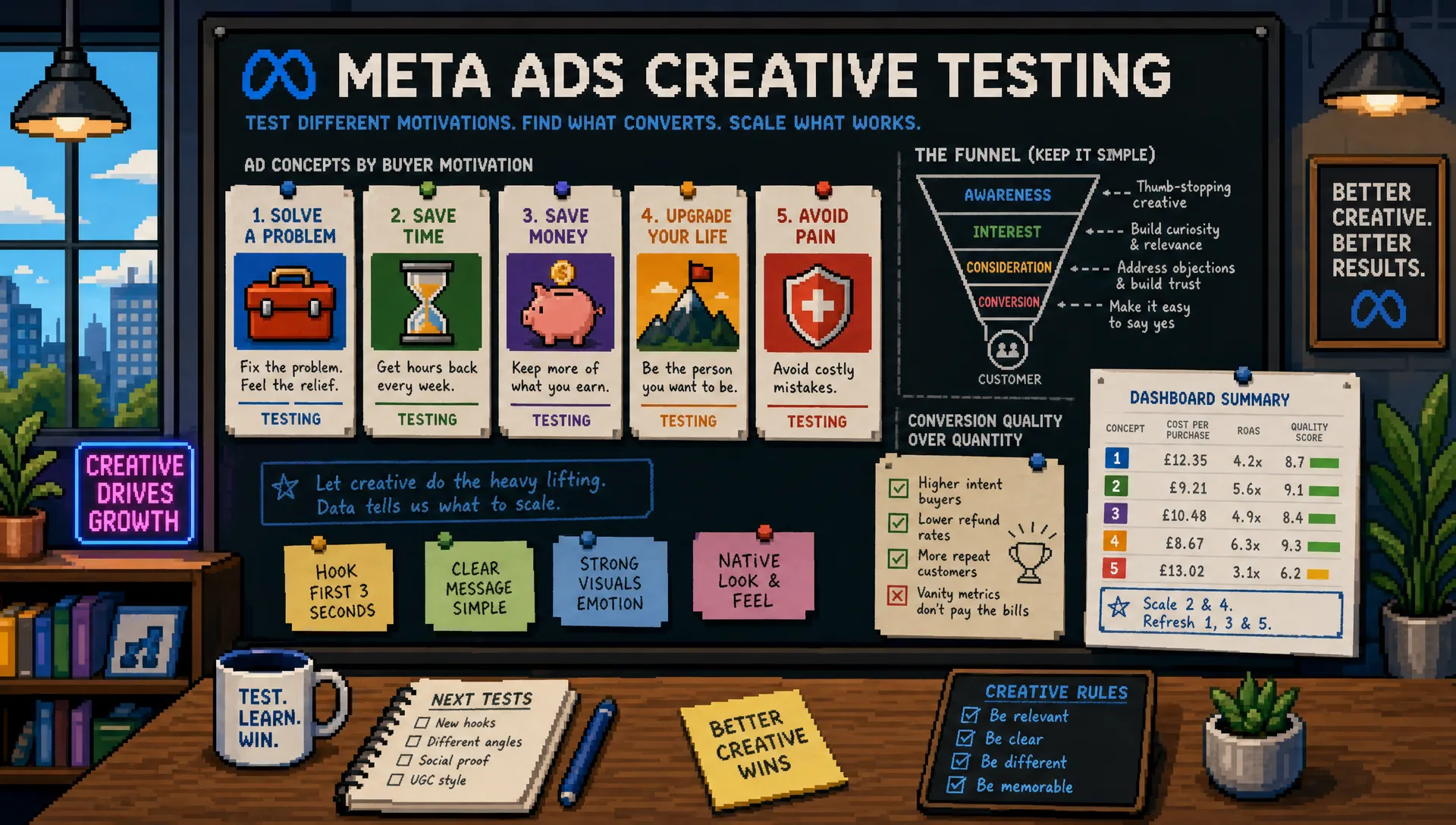
Meta Facebook ads are not dead. What has stopped working is the old habit of launching a few interest-based ad sets, waiting for cheap clicks, and calling it a strategy.
In 2026, Meta is still one of the strongest paid channels for demand creation, ecommerce growth, local lead generation, course launches, B2B awareness, and retargeting. But the platform has changed. Automation carries more of the targeting load, privacy changes limit easy attribution, and creative now does a large part of the heavy lifting.
For agencies, that creates both a problem and an opportunity. The problem is that weak campaigns fail faster. The opportunity is that clients still need help turning Meta Facebook Ads into measurable revenue, qualified leads, and useful pipeline, not just reach and engagement.
If you are deciding how Meta should sit alongside search, it is worth understanding how Google Ads and Meta Ads support agency growth. In simple terms, Google captures demand that already exists. Meta creates, shapes, and reactivates demand. The strategies below focus on the Meta side of that equation.
Start with what conversion actually means
The first strategy is not inside Ads Manager. It is defining the conversion you really want.
Many campaigns underperform because the account is optimised for the easiest action, not the most valuable action. A lead form submission is not always a sales opportunity. An add to basket is not a purchase. A landing page view is not buying intent.
Before launching or rebuilding Meta Facebook Ads, agree the primary conversion and the quality signal behind it.
| Business type | Primary conversion | Quality signal to monitor |
|---|---|---|
| Ecommerce | Purchase | New customer revenue, margin, repeat purchase rate |
| Lead generation | Form submission or booked call | Contact rate, qualified lead rate, close rate |
| Local services | Enquiry or call | Service area fit, job value, appointment attendance |
| B2B | Demo request or content-assisted lead | CRM stage movement, sales feedback, pipeline value |
| Subscription | Trial or sign-up | Activation, retention, payback period |
This matters because Meta will optimise towards the event you choose. If the event is too shallow, you may get volume without business value. If the event is too rare, the algorithm may struggle to learn. The skill is choosing the deepest conversion event that still gives Meta enough signal to work with.
Build for signals, not tiny audiences
Older Facebook Ads strategies relied heavily on detailed targeting. Agencies would build ad sets for individual interests, stack lookalikes, split age brackets, and run endless audience combinations.
That approach can still have a place in niche accounts, but it is rarely the main driver now. Meta's delivery system is much better at finding people within larger audiences, provided the campaign has enough clean conversion data, strong creative, and sensible budget allocation.
For most accounts, broad or lightly guided targeting is now a serious conversion strategy, not a lazy shortcut. This does not mean you ignore the customer. It means you feed Meta better signals instead of forcing the campaign into narrow boxes.
Good signal inputs include:
- Clean Pixel and Conversions API events
- Recent customer lists where consent and platform policies allow
- High-intent website audiences for retargeting
- Strong creative angles matched to real buyer motivations
- CRM feedback for lead quality and sales outcomes
The goal is to give the algorithm room to find converters while giving it enough context to avoid obvious waste. This is where agencies often need to retrain clients. A bigger audience does not mean less control. It means control moves from manual audience slicing to better data, better creative, and better optimisation discipline.
Treat creative as your targeting system
Creative is no longer just the wrapper around the strategy. On Meta, creative is strategy.
The platform reads signals from the ad itself: who engages, who pauses, who clicks, who converts, and which message attracts which type of user. A broad audience with weak creative will waste money. A broad audience with sharp creative can find pockets of demand that detailed targeting would never identify.
The best converting Meta Facebook Ads usually test different buyer motivations, not just different colours or headlines. A serious creative testing plan should include distinct angles such as problem awareness, product demonstration, social proof, comparison, objection handling, urgency, and lifestyle aspiration.
For example, a home improvement client might test one ad around the cost of delaying repairs, another around before-and-after proof, and another around a simple booking process. Those are different psychological routes to the same conversion.
Agencies should also stop assuming video always beats static. Short-form video, founder-style clips, product demos, carousels, and simple static ads can all work. The deciding factor is whether the creative communicates the offer clearly enough for a distracted user to understand it in seconds.
A useful creative testing framework looks like this:
| Creative variable | What you are testing | Example question |
|---|---|---|
| Angle | Buyer motivation | Does the audience respond more to pain relief or desired outcome? |
| Format | Delivery method | Does static, video, carousel, or Reels placement generate better qualified traffic? |
| Proof | Trust trigger | Do reviews, case snippets, credentials, or user-generated content improve conversion rate? |
| Offer | Reason to act | Does a consultation, discount, bundle, guide, or trial move more people to action? |
| Hook | First impression | Which opening line or visual stops the right person from scrolling? |
The key is to test big enough differences. If all your ads say the same thing in slightly different ways, you are not testing strategy. You are testing decoration.
Use a simple account structure that can learn
Overcomplicated Meta accounts are hard to manage and harder for the algorithm to optimise. They also create reporting noise, because every ad set has too little data to make confident decisions.
A cleaner structure usually converts better. It gives budget to the campaigns that matter, reduces overlap, and makes testing easier to interpret.
A practical structure for many agency-managed accounts is:
| Campaign layer | Purpose | Typical use |
|---|---|---|
| Prospecting or acquisition | Find new customers or leads | Broad targeting, lookalikes where useful, conversion objective |
| Retargeting | Convert warm intent | Recent site visitors, engaged users, cart abandoners, lead form openers |
| Creative testing | Validate new angles | Controlled budget, clear testing rules, enough variation to learn |
| Existing customer or retention | Increase lifetime value | Cross-sell, upsell, repeat purchase, reactivation |
Not every account needs every layer. Small budgets often need fewer campaigns, not more. If the monthly spend is limited, splitting it across too many campaigns can prevent meaningful learning.
This is also where agencies should avoid the most common operational traps: constant edits, inconsistent naming, vague objectives, poor tracking, and reporting on platform metrics without commercial context. If those issues are familiar, this breakdown of Facebook Meta Ads mistakes agencies still make is a useful companion piece.
Fix tracking before you scale spend
Tracking will never be perfect, but it must be good enough to make decisions.
Meta's Pixel alone is no longer enough for many advertisers. Browser restrictions, cookie limitations, consent requirements, and cross-device behaviour can all reduce the visibility of conversion data. That is why many serious advertisers use the Pixel alongside Conversions API.
Meta's Conversions API guidance explains how server-side data can help advertisers share web and offline events more reliably. For agencies, the practical takeaway is simple: do not wait until the account is spending heavily to fix tracking. Build the measurement foundation before you judge performance.
At minimum, campaign tracking should cover:
- Pixel events that match the funnel
- Conversions API where technically appropriate
- Clear UTM parameters for GA4 and CRM reporting
- Event prioritisation for meaningful actions
- Lead source visibility inside the client's CRM or sales process
- Offline conversion imports where sales happen away from the website
The last point is especially important for lead generation. If Meta only sees every form submission as equal, it will optimise for more form submissions. If you can feed back which leads became qualified opportunities or customers, the optimisation picture becomes much stronger.

Optimise for lead quality, not the cheapest lead
For agencies running lead generation campaigns, the cheapest cost per lead is often a trap.
Instant forms can generate high volume, but they can also attract low-intent enquiries if the form is too easy. Landing pages may produce fewer leads, but the additional friction can improve intent. Neither is automatically better. The right choice depends on the client, the sales process, and the level of qualification required.
A strong Meta lead generation strategy usually adds friction deliberately. That might mean qualifying questions, clearer pricing expectations, location filters, service eligibility checks, or a calendar booking step after the form.
The aim is not to make conversion difficult. The aim is to stop Meta optimising towards people who will never buy.
Lead quality should be reviewed with the sales team, not just inside Ads Manager. Ask what percentage of leads are contactable, relevant, ready to buy, and inside the target area or sector. If the sales team hates the leads while the platform says the campaign is performing, the campaign is not performing.
For B2B and high-value service campaigns, consider optimising towards booked calls or qualified lead events once volume allows. Early campaigns may need a higher-funnel conversion while data builds, but the long-term objective should move closer to revenue.
Let winners mature before you interfere
One of the fastest ways to damage a converting Meta campaign is to keep touching it.
Frequent budget changes, audience edits, creative swaps, and bid adjustments can interrupt learning and make performance harder to read. Meta campaigns need enough stable delivery time to show patterns.
That does not mean you leave campaigns unattended. It means you work to a clear optimisation rhythm. Launch, check tracking, monitor early delivery, then make decisions based on meaningful data rather than anxiety.
A sensible optimisation rhythm for many accounts is:
| Timing | Main focus | Decision to make |
|---|---|---|
| First 24-48 hours | QA and delivery checks | Are events firing, spend pacing, and ads approved? |
| Days 3-7 | Early signal review | Are CTR, CPC, conversion rate, and lead quality within a plausible range? |
| Days 7-14 | Creative and audience evaluation | Which angles deserve more budget, and which need replacing? |
| Days 14-30 | Scaling and refinement | Can budget increase without breaking CPA or lead quality? |
This rhythm will vary by spend level. A high-spend ecommerce account can reach conclusions faster than a low-spend B2B campaign. The principle is the same: do not optimise before the data is useful.
If your bottleneck is getting campaigns live cleanly in the first place, these Meta Ads Manager tips for faster campaign launches can help tighten the setup process before optimisation even begins.
Make retargeting useful, not repetitive
Retargeting still converts, but lazy retargeting is easy to spot.
Showing the same ad to every website visitor for 30 days is not a strategy. It is a reminder. Sometimes reminders work, but better retargeting matches the message to the user's behaviour.
Someone who viewed a pricing page needs a different message from someone who watched three seconds of a video. A basket abandoner needs a different ad from someone who read a blog post. A returning customer should not always see the same acquisition offer as a cold prospect.
Effective retargeting often uses objection handling. If users reached the product page but did not buy, show reviews, guarantees, delivery information, comparisons, or use cases. If users opened a lead form but did not submit, clarify what happens after the enquiry. If users visited a service page, show proof that reduces perceived risk.
Keep retargeting windows proportionate to the buying cycle. A same-day ecommerce purchase might need short windows. A considered B2B purchase may need longer nurturing. The best retargeting feels helpful because it answers the next question in the buyer's mind.
Use landing pages that match the ad promise
Meta can find attention, but the landing page has to convert it.
Many campaigns lose money because the ad makes one promise and the page tells a different story. If the ad sells speed, the landing page cannot bury the booking form. If the ad leads with a specific offer, the page cannot open with generic brand copy. If the ad shows a product demo, the page should make it easy to continue that journey.
The strongest Meta landing pages usually have a clear headline, immediate relevance to the ad, visible proof, low-friction next steps, fast mobile loading, and a single dominant call to action. For lead generation, they should also set expectations about who the offer is for and what happens after submission.
Mobile experience is critical. Meta traffic is often mobile-heavy, so a page that looks acceptable on desktop can still quietly destroy conversion rate. Check form length, button visibility, page speed, sticky elements, pop-ups, and whether key proof appears before the user gives up.
Measure blended performance, not only platform ROAS
Meta reporting is useful, but it should not be the only source of truth.
Attribution windows, view-through conversions, cookie restrictions, and cross-channel journeys can all affect what Meta claims. GA4 may underreport some assisted demand. CRM data may lag behind. None of these systems gives the whole truth alone.
Agencies should build a measurement view that combines platform data with business outcomes. For ecommerce, that might include blended ROAS, MER, new customer acquisition cost, average order value, margin, and repeat purchase. For lead generation, it might include cost per qualified lead, booked appointment rate, close rate, and pipeline value.
This is where client communication matters. If Meta is driving profitable demand but the client only sees a last-click report, the channel may look weaker than it is. If Meta is producing cheap leads that never close, the platform dashboard may look stronger than reality.
The best agencies explain the difference between platform efficiency and commercial effectiveness. Then they optimise for the second.
Refresh creative before performance collapses
Creative fatigue is not always dramatic. Sometimes it appears as a slow rise in CPA, a lower click-through rate, higher frequency, weaker comments, or a drop in conversion rate.
Waiting until performance collapses is expensive. Build a creative refresh cycle into the account before fatigue becomes urgent. The cycle does not have to be complicated. Keep winning concepts, then introduce new hooks, proof points, formats, and offers around the same core message.
A good rule is to separate concept from execution. If an ad angle is working, do not abandon it just because one asset fatigues. Rebuild the same angle with a new opening, a different testimonial, a clearer product shot, a new creator, or a stronger landing page match.
This is how Meta accounts scale sustainably. They do not rely on one miracle ad. They build a repeatable system for finding and refreshing conversion angles.
Frequently Asked Questions
Are Meta Facebook Ads still worth it for lead generation in 2026? Yes, but only when campaigns are optimised for lead quality as well as volume. Strong tracking, qualification steps, CRM feedback, and clear offer positioning are essential.
Should agencies use broad targeting or detailed audiences? Broad targeting often works well when tracking, creative, and conversion data are strong. Detailed audiences can still help in specific niches, but over-segmentation usually limits learning.
How often should Meta ad creative be refreshed? It depends on spend, audience size, and frequency. Higher-spend accounts need faster refresh cycles, while smaller accounts may refresh less often. Watch CPA, CTR, frequency, comments, and conversion rate for fatigue signals.
Do I need Conversions API if the Pixel is already installed? In many cases, yes. The Pixel is still useful, but Conversions API can improve event reliability by sending data server-side, especially when browser tracking is limited.
Is Meta better than Google Ads for conversions? It depends on intent. Google is usually stronger for capturing active demand, while Meta is stronger for creating demand, scaling creative, and re-engaging warm audiences.
Need senior Meta Ads support without adding headcount?
Meta Facebook Ads still convert when strategy, creative, tracking, and optimisation work together. The challenge for agencies is delivering that consistently while managing client deadlines, reporting, and capacity.
PPC Ghost provides on-demand, white-label PPC support for agencies that need senior paid media execution without recruitment, long-term contracts, or visible third-party involvement. Support covers Meta, Google, Microsoft Ads, GA4, and tracking, with flexible pay-as-you-go delivery for UK agencies that need expert help behind the scenes.