White Label SEM Support for Growing Digital Agencies
Learn how white label SEM support helps growing digital agencies add senior search expertise, protect margins and scale without hiring.
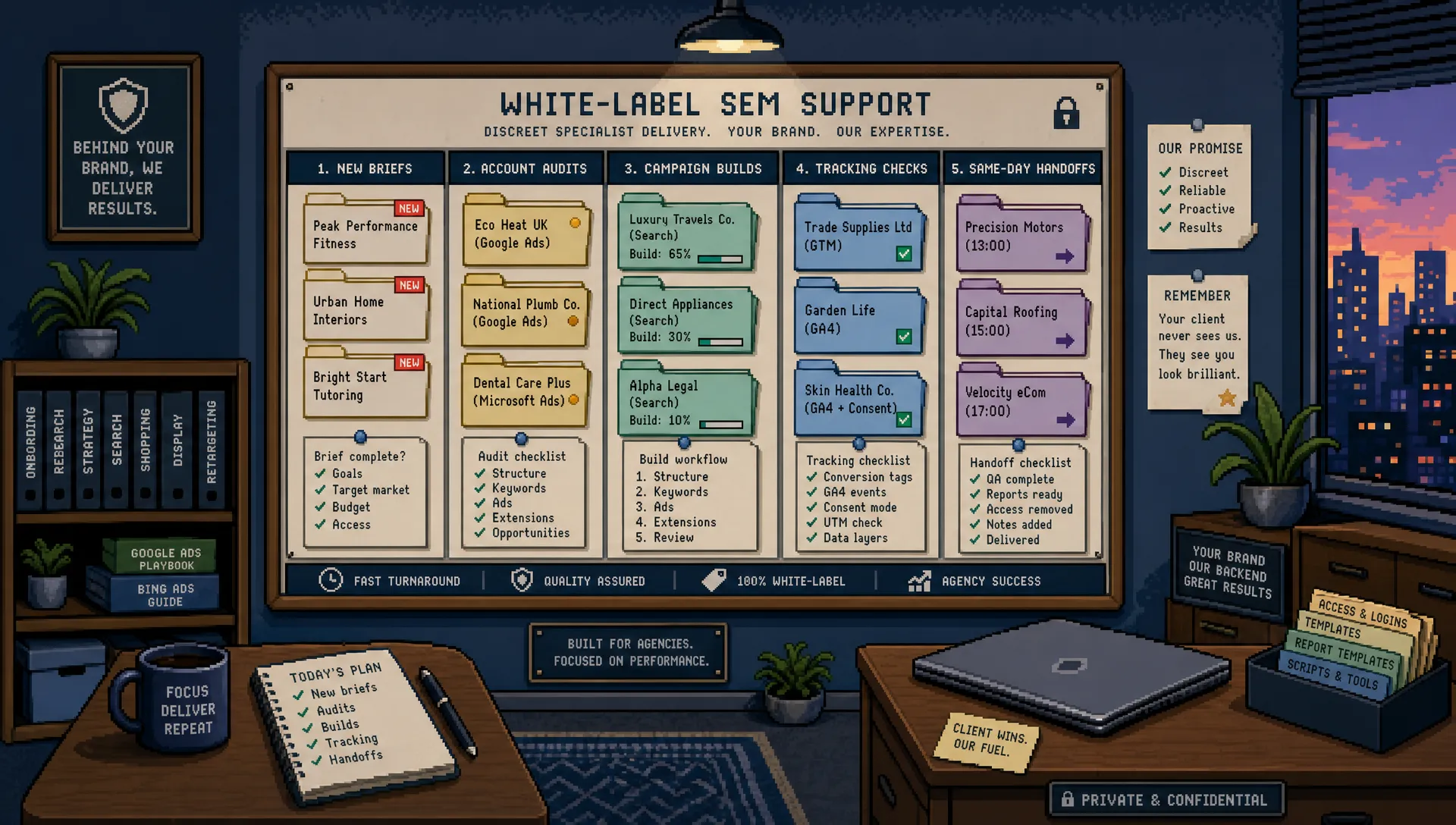
SEM is often one of the first delivery bottlenecks a growing digital agency hits.
The agency wins a bigger retainer. A web design client asks for Google Ads. A social client wants search added to the mix. A founder spots an opportunity to pitch full-funnel acquisition, but the internal team is already stretched.
Hiring a full-time paid search specialist can solve the problem, but not always at the speed or flexibility a growing agency needs. Recruitment takes time, salaries add fixed cost, and SEM workload rarely arrives in a neat, predictable pattern. That is where white label SEM support becomes valuable.
Used well, it gives agencies access to senior search expertise under their own brand, without adding permanent headcount or exposing the client relationship to a third party.
What white label SEM support actually means
White label SEM support is outsourced search engine marketing delivery that sits quietly behind your agency. Your client sees your agency. Your team manages the relationship. The specialist handles the technical execution, optimisation, audits, campaign builds, tracking checks, or overflow support in the background.
In most agency contexts, SEM refers mainly to paid search and related paid media, such as Google Ads, Microsoft Ads, Shopping, Performance Max, remarketing, and conversion tracking. Some partners may also support Meta Ads or wider paid media, depending on their skill set.
The important difference is not just the channel. It is the operating model. A white-label partner should work as an extension of your agency, not as a visible supplier competing for influence.
| Support model | Best for | Main limitation |
|---|---|---|
| In-house SEM hire | Predictable long-term workload and deep client involvement | Fixed cost, recruitment time, management overhead |
| General freelancer | Occasional tasks or short projects | Quality and availability can vary |
| White label SEM specialist | Scalable expert delivery under your agency brand | Requires clear briefing and good internal communication |
| Platform rep or automated recommendations | Basic platform guidance | Not a substitute for strategic account ownership |
For growing agencies, the white label model is especially useful because it sits between a risky freelance marketplace approach and a permanent hire. You get specialist capacity when demand appears, while keeping commercial ownership inside the agency.
Why SEM becomes a bottleneck as agencies grow
Search campaigns look deceptively simple from the outside. A client may think Google Ads is just keywords, budgets, and ad copy. In reality, profitable SEM delivery depends on account structure, intent mapping, conversion quality, landing page alignment, bidding strategy, audience signals, budget pacing, exclusions, and measurement.
That level of detail creates pressure when an agency is scaling.
A small team can usually handle a few accounts manually. But once workload grows, the cracks appear. New campaigns take longer to launch. Reporting becomes reactive. Search terms are checked less often. Tracking issues sit unresolved because nobody has time to untangle GA4, Google Tag Manager, consent settings, and CRM attribution.
There is also a commercial problem. Agencies often sell SEM before they have fully secured delivery capacity. That is understandable, since paid media is a natural upsell for SEO, design, content, social, and web development clients. But if the work is not delivered at a high standard, the new revenue can quickly turn into margin pressure and client risk.
The broader scaling case is covered in more depth in PPC Ghost’s guide to why white label PPC management helps agencies scale, but the core point is simple: specialist delivery capacity should not be the thing that stops an agency from taking on good opportunities.
Signs your agency is ready for white label SEM support
You do not need to wait until your team is overwhelmed. In fact, white label support works best when it is introduced before quality slips.
Common signs include:
- Paid search proposals are being delayed because nobody has time to scope them properly.
- One person in the agency has become the bottleneck for every Google Ads question.
- Campaign launches are slower than the client expects.
- Account optimisation is happening only when performance drops.
- Tracking problems are creating uncertainty in reports.
- Senior team members are spending evenings inside ad accounts instead of leading strategy.
- You are turning away SEM work that would otherwise be commercially attractive.
These are not just operational annoyances. They affect client trust. A slow launch or unclear report can make an agency look less capable, even when the issue is simply lack of specialist capacity.
| Agency pressure | What it looks like | How white label SEM support helps |
|---|---|---|
| Too many launches | Campaign builds queue up behind other client work | Adds execution capacity without a permanent hire |
| Thin specialist knowledge | Strategy relies on one internal person | Gives access to senior paid search judgement |
| Tracking gaps | Conversions are unclear or disputed | Supports GA4, tags, pixels, and conversion setup checks |
| Margin squeeze | Senior staff do too much hands-on work | Frees internal time for account direction and client growth |
| Unpredictable demand | Workload spikes after new wins | Lets the agency scale up or down more flexibly |
What to delegate first
The best way to use a white label SEM partner is not always to hand over everything at once. A controlled, phased approach usually creates better results and less internal friction.
Start with work that is specialist, time-sensitive, or easy to define.
Account audits
Audits are an excellent first project because they reveal where performance is leaking and give your agency a clear action plan. A senior SEM specialist can review structure, queries, match types, bidding, budgets, creative, conversion actions, and tracking quality.
This is useful before taking over a client account, before pitching a restructure, or when performance has plateaued.
Campaign builds and restructures
New builds are ideal for white label support because they are delivery-heavy and often deadline-driven. A specialist can translate your client brief into campaign architecture, keyword themes, ad assets, negative keyword foundations, conversion settings, and launch checks.
For agencies, this protects both speed and quality. Your account manager stays focused on client communication, while the SEM expert handles the setup detail.
Ongoing optimisation
Ongoing support can include search query reviews, budget pacing, bid strategy adjustments, ad testing, landing page feedback, negative keyword expansion, and performance commentary. This is where senior expertise matters. SEM optimisation is not about making random weekly changes. It is about knowing when to intervene, when to let data accrue, and which metrics actually indicate progress.
Tracking and measurement support
SEM performance is only as reliable as the conversion data behind it. If conversion actions are duplicated, imported incorrectly, or poorly defined, the campaigns may optimise towards the wrong outcomes. Support with GA4, Google Tag Manager, platform pixels, and conversion mapping can prevent expensive mistakes.
Google’s own guidance on linking Google Ads and Analytics highlights how important connected measurement is for understanding campaign performance across tools. For agencies, this is not just a technical detail. It is the basis for credible reporting.
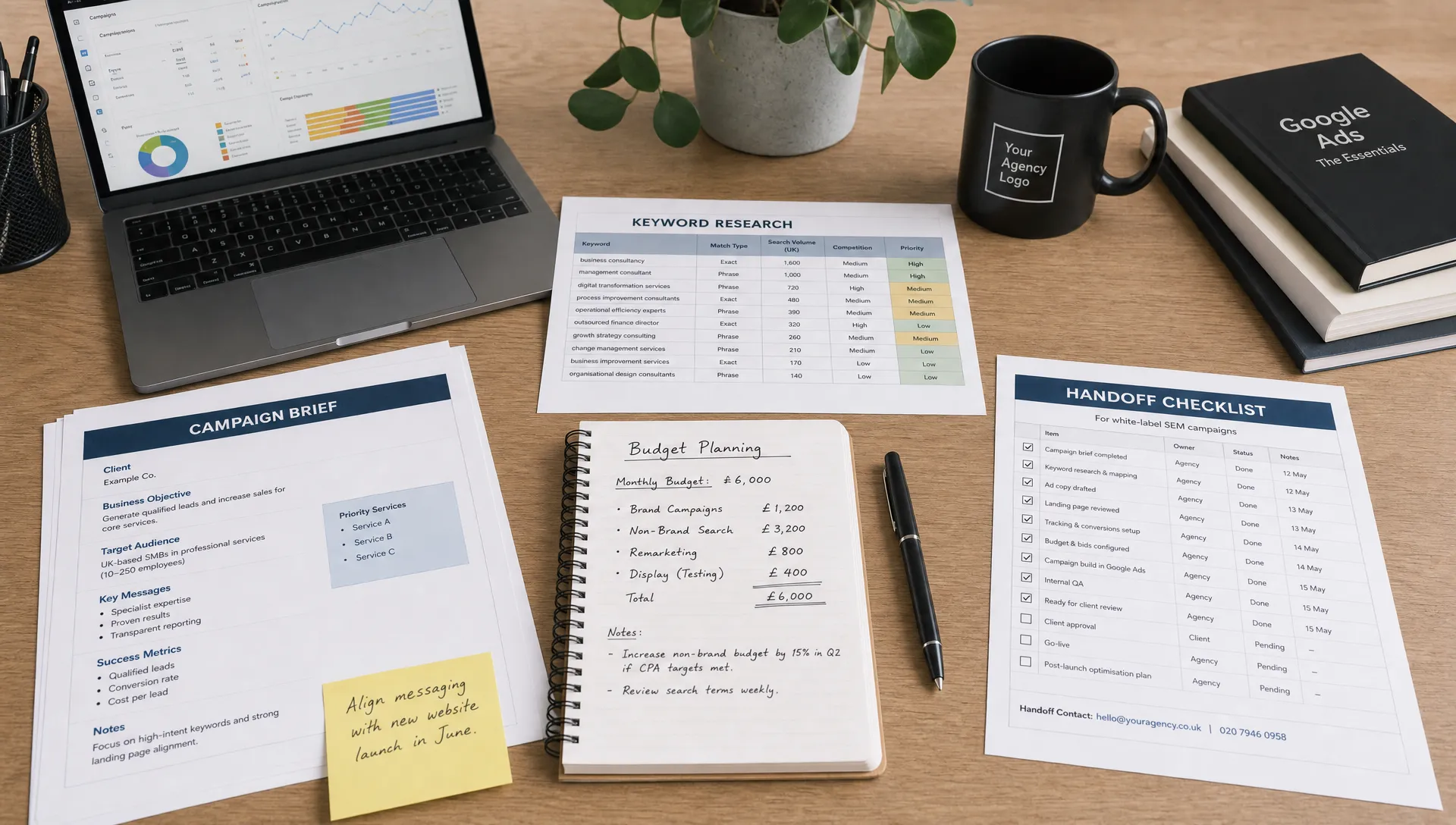
How white label SEM support protects agency margins
The commercial value of white label support is not only about avoiding a salary. It is about matching cost to demand.
A full-time SEM hire can be the right move when paid search revenue is stable and large enough to justify the role. But many agencies reach a middle stage first. They have enough SEM demand to need expertise, but not enough consistency to guarantee a profitable hire every month.
White label support helps agencies bridge that stage. It gives you access to senior input when you need it, without carrying unused capacity when the workload dips.
It can also protect margins by keeping expensive internal people focused on the work only they can do. Founders, strategists, and account directors should not be stuck rebuilding conversion actions late at night if an experienced specialist can handle it faster and more accurately.
The margin benefit is strongest when scope is clear. If your partner knows exactly what is included, what the turnaround expectations are, and how feedback should be delivered, the work stays efficient.
The handoff process that makes support work
White label SEM support succeeds or fails on communication. The specialist can be excellent, but if the brief is vague, the output will suffer.
Before handing over work, prepare the essentials:
- Client objective and commercial context.
- Target locations, services, products, and audience priorities.
- Monthly budget and any pacing constraints.
- Conversion definitions and lead quality notes.
- Access requirements for Google Ads, Microsoft Ads, Meta, GA4, or Tag Manager.
- Brand rules, compliance restrictions, and claims to avoid.
- Launch deadline and review process.
A good partner should also ask questions. If they accept a vague brief without clarifying goals, conversion quality, or budget priorities, that is a warning sign.
The best agency relationships are collaborative but discreet. Your internal team should feel that the specialist strengthens the agency’s thinking, while the client experience remains seamless.
What to look for in a white label SEM partner
Not every paid media provider is suited to white label work. Some are strong technicians but poor collaborators. Others are used to direct client relationships and may not understand the importance of staying invisible.
When comparing options, look for a partner that offers:
- Senior-level hands-on experience, not junior delivery hidden behind account managers.
- Clear white-label boundaries, including no direct client contact unless agreed.
- Strong Google Ads and Microsoft Ads knowledge, plus tracking competence.
- Commercial understanding of agency margins and deadlines.
- Fast, concise communication that your team can use internally.
- Flexibility for one-off tasks, overflow work, and recurring support.
- A practical approach to reporting and performance commentary.
If you are actively evaluating suppliers, the checklist in what to look for in a white label Google Ads agency is a useful companion. Even if your immediate need is broader SEM support, the same principles apply: senior expertise, discretion, measurement quality, and reliable turnaround.
Common mistakes agencies make with outsourced SEM
White label support is powerful, but it is not a magic fix. The agencies that get the best results treat the partner as a specialist delivery extension, not a disconnected task machine.
One common mistake is outsourcing too late. By the time a client is unhappy, the partner is not just fixing campaigns. They are also trying to recover trust. It is far better to bring in help when the first signs of strain appear.
Another mistake is hiding context. A paid search specialist needs to know if leads are low quality, if the sales team is slow to follow up, if a product has low margin, or if the client has strong preferences about messaging. Without that context, optimisation can become too platform-focused.
Agencies also sometimes choose purely on cost. Cheap execution can look attractive, but SEM errors are expensive. Poor tracking, loose match types, weak negatives, or careless budget allocation can burn through savings quickly. Senior judgement usually pays for itself by avoiding avoidable waste.
Finally, some agencies fail to define ownership. Decide who owns strategy, who owns implementation, who checks performance, and who writes client-facing commentary. Clear ownership prevents duplicated work and awkward gaps.
Is white label SEM support right for every agency?
It is most useful for agencies that already have client demand or a realistic route to selling SEM services. If paid search is not part of your positioning and your clients are not asking for it, you may not need support yet.
But if you are already being asked about Google Ads, Microsoft Ads, Shopping, paid social, or conversion tracking, it can make sense to build delivery capacity before you sell more aggressively.
White label SEM support is particularly well suited to:
- SEO agencies adding paid search as a faster route to leads.
- Web design agencies helping clients drive traffic after launch.
- Social media agencies expanding into search demand capture.
- Full-service agencies with fluctuating paid media workload.
- Small agency founders who need senior execution without hiring.
The right model lets you say yes to more opportunities while staying realistic about internal capacity.
Frequently Asked Questions
What is white label SEM support? White label SEM support is paid search and related campaign delivery provided by an external specialist under your agency’s brand. Your agency keeps the client relationship, while the specialist supports execution, optimisation, audits, tracking, or strategy behind the scenes.
Is SEM the same as PPC? The terms are often used differently. SEM usually refers to search engine marketing, especially paid search through platforms such as Google Ads and Microsoft Ads. PPC is a broader payment model that can include search, shopping, display, paid social, and other channels where advertisers pay per click.
When should a digital agency outsource SEM? Consider outsourcing when paid search work is slowing your team down, campaign quality is becoming inconsistent, tracking issues are unresolved, or you are turning away profitable opportunities because you lack specialist capacity.
Will clients know a white label specialist is involved? They do not need to. In a true white-label setup, the partner works anonymously behind your agency, unless you choose to involve them directly. The agency remains the visible owner of the relationship.
Can white label SEM support include Meta Ads and tracking? It can, depending on the partner. PPC Ghost supports Google Ads, Meta Ads, Microsoft Ads, and GA4 and tracking support, which is useful for agencies that need paid media delivery beyond search alone.
Need senior SEM support behind your agency?
If your agency is winning or pitching paid media work but does not want the cost, delay, or risk of hiring, PPC Ghost provides senior white-label support for Google Ads, Meta Ads, Microsoft Ads, and tracking.
The model is built for UK agencies that need expert delivery on demand, with anonymous white-label execution, flexible scaling, same-day turnaround for suitable tasks, and no long-term contracts. Your agency keeps the credit. The specialist work happens quietly in the background.