How to Choose a Meta Ads Agency for Client Accounts
Choose the right Meta Ads agency for client accounts with checks on strategy, tracking, reporting, white-label delivery and fit.
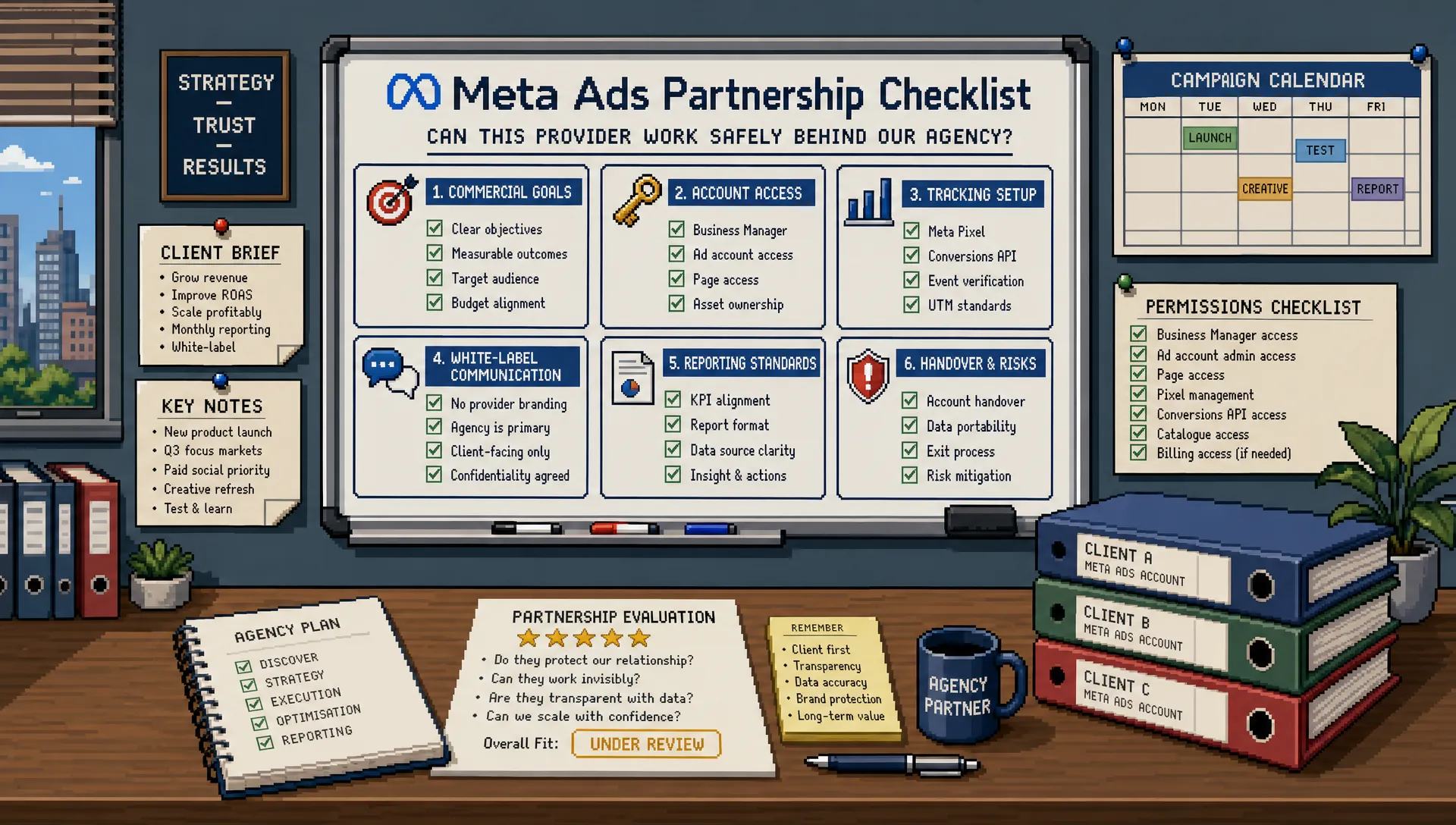
Choosing a Meta Ads partner for your own brand is one thing. Choosing one to work on client accounts is riskier. You are not just buying media buying support, you are trusting someone with your client relationship, your delivery standards and your agency’s reputation.
A good Meta Ads agency should make your team look sharper, not create extra management work. They should understand the commercial goal behind the campaign, handle the technical details without drama, communicate clearly and protect your white-label position if they are working behind the scenes.
The challenge is that many providers sound similar on the surface. They mention ROAS, lead generation, funnels, creative testing and scaling. The real difference appears in how they diagnose accounts, structure work, report outcomes and collaborate with your agency.
This guide breaks down what to look for before you hand over client accounts.
Start with the role you need the agency to play
Before comparing suppliers, define why you need a Meta Ads agency in the first place. Agencies usually look for external Meta support for one of four reasons.
You may need specialist input because Meta Ads has become more complex than your in-house team can comfortably manage. You may need overflow delivery because your team is at capacity. You may need a white-label operator who can run accounts quietly while your agency owns the relationship. Or you may need a second opinion on underperforming campaigns before a client loses confidence.
Each scenario calls for a different kind of partner. A strategic consultant may be useful for audits and planning, but not enough if you need weekly campaign management. A cheap freelancer may be fine for simple build tasks, but risky if a high-value client needs senior judgement. A full-service agency may offer depth, but could be too expensive or visible if you need discreet white-label support.
Also be clear on whether Meta is the right growth lever for the client. Meta is strongest when the client needs demand creation, creative testing, audience expansion or social-led acquisition. If the brief is mainly to capture existing demand, Google may be the better lead channel. For a deeper comparison, PPC Ghost’s guide to Google Ads vs Meta Ads for agency growth explains where each platform tends to fit.
Look for diagnosis before execution
The best Meta partners do not rush into campaign builds. They ask questions first. That is especially important with client accounts because you need someone who can spot missing information before it becomes a performance problem.
A strong Meta Ads specialist will want to understand the client’s offer, margins, sales process, average order value or lead value, conversion window, creative assets, audience constraints and previous account history. If the client runs lead generation, they should ask what happens after the lead is submitted. If the client sells ecommerce products, they should ask about product economics, stock, returns, promotions and customer lifetime value.
Be cautious of any agency that promises performance before seeing the account, the website or the tracking setup. Meta Ads performance is rarely determined by media buying alone. It is shaped by the offer, landing page, creative quality, measurement accuracy and follow-up process.
A good early conversation should feel like a commercial diagnosis, not a platform demo.
Assess their understanding of Meta-specific performance drivers
Meta Ads is not just another paid media channel. The platform depends heavily on creative quality, signal quality and account learning. An agency that treats Meta like keyword-based search advertising may over-focus on audiences and under-focus on messaging.
A strong Meta Ads agency should be able to explain how they approach:
- Creative testing: How they test angles, formats, hooks and offers without constantly resetting campaigns.
- Audience strategy: How they balance broad targeting, retargeting and exclusions without over-segmenting the account.
- Learning stability: How they avoid excessive edits that disrupt delivery.
- Landing page alignment: How they match ad promises with page content and conversion intent.
- Funnel measurement: How they judge performance beyond surface-level metrics such as CTR or CPM.
This is where many agencies get caught out. A supplier may know how to build campaigns, but not how to interpret why performance is moving. For example, a rising cost per lead may be a creative fatigue issue, a landing page issue, a tracking issue, a budget issue or a lead quality issue. You need a partner who can separate those causes rather than simply launching more ads.
| What to evaluate | Strong answer | Red flag |
|---|---|---|
| Campaign structure | Clear rationale based on objective, budget and learning volume | Lots of tiny ad sets with no explanation |
| Creative testing | Tests messages and formats against hypotheses | Random creative swaps with no learning agenda |
| Reporting | Links platform metrics to client outcomes | Focuses only on clicks, CPMs and impressions |
| Optimisation | Makes measured changes based on evidence | Constant tinkering every day |
| Client fit | Considers sales cycle, margins and lead quality | Treats every account with the same template |
Check tracking, access and data ownership early
Tracking is one of the most important areas to clarify before appointing a Meta Ads partner. If the agency cannot confidently talk through tracking, events and attribution, they may struggle to manage performance properly.
At a minimum, they should understand the Meta Pixel, conversion events, domain verification, UTMs, GA4, event match quality and the role of server-side signals. Meta’s own Conversions API documentation explains how advertisers can send web events from their servers to Meta, which can help improve signal resilience when browser-based tracking is limited.
For agency-managed client accounts, ownership matters too. The client should retain ownership of business assets where appropriate. Your delivery partner should not create unnecessary dependency by holding pixels, ad accounts or pages inside their own business manager unless there is a clear reason and agreement.
Ask how they handle:
- Ad account access and permissions
- Pixel and dataset access
- GA4 and Tag Manager access
- UTM naming conventions
- Conversion event priorities
- Consent and privacy requirements
- Handover if the relationship ends
For UK agencies, privacy and consent cannot be an afterthought. Your Meta partner does not need to act as your legal adviser, but they should be comfortable working with your client’s consent setup and analytics stack without making careless assumptions.
Evaluate their process for working through your agency
A Meta Ads agency may be technically capable and still be a poor fit for client account work if their process creates friction. When you are outsourcing delivery, the workflow has to protect your time.
The best partners make it easy to brief work, confirm requirements, flag risks and keep momentum. They do not wait until launch day to ask for missing assets. They do not rely on vague Slack messages when a clear checklist is needed. They do not disappear for a week and return with a campaign that does not match the client brief.
A good delivery process should cover the full lifecycle:
- Brief intake and commercial context
- Access checks before work begins
- Tracking review before launch
- Campaign build and internal QA
- Launch confirmation
- Early learning period monitoring
- Optimisation rhythm
- Reporting and next-step recommendations
If speed matters to your agency, process is not a nice-to-have. It is the difference between a smooth launch and a last-minute scramble. PPC Ghost’s article on Meta Ads Manager tips for faster campaign launches covers practical ways agencies can reduce avoidable delays before build work starts.

Make white-label expectations explicit
If the partner will be working on client accounts behind your agency, white-label expectations must be agreed upfront. Do not assume every Meta Ads provider understands how agency-side delivery works.
White-label support is not just about hiding a logo. It affects communication style, file naming, reporting language, meeting attendance, email visibility and how recommendations are framed. A partner who is used to owning the client relationship may accidentally undermine your agency if boundaries are not clear.
Clarify whether the partner will ever speak to the client directly. If they will, decide whether they appear as part of your agency team or as an external specialist. If they will not, agree how questions and recommendations should be passed back to your account manager.
You should also discuss confidentiality. A reliable partner should be comfortable operating anonymously, respecting your client relationships and avoiding any direct outreach to your clients.
This is particularly important when client trust is fragile. If an account is underperforming, the client needs calm, joined-up communication from your agency, not conflicting opinions from multiple suppliers.
Ask how they report performance
Client reporting is where a lot of Meta Ads delivery either proves its value or creates confusion. Platform metrics are useful, but they are not the full story.
A strong Meta Ads agency should report in a way that helps your account manager speak confidently to the client. That means explaining what changed, why it matters, what has been learned and what happens next.
For lead generation, reports should not stop at cost per lead. They should consider lead quality, form completion rate, booked calls, qualified opportunities and sales feedback where available. For ecommerce, they should consider revenue, MER, ROAS, average order value, new customer acquisition and profitability context.
| Reporting layer | What it should answer |
|---|---|
| Delivery | Did campaigns spend as planned and reach the intended audience? |
| Engagement | Which messages, creatives or formats gained attention? |
| Conversion | Which campaigns drove leads, purchases or other priority actions? |
| Quality | Were the leads or purchases commercially useful for the client? |
| Next steps | What should be tested, scaled, paused or fixed next? |
Be wary of reports that look polished but say very little. Your agency needs insight, not screenshots. The right partner will help you explain performance clearly, including when results are mixed.
Review their approach to creative collaboration
Creative is one of the biggest differences between average and strong Meta Ads performance. Even if the Meta partner is not producing final creative assets, they should be able to guide what is needed.
A useful partner can identify which creative angles are missing, which formats are worth testing and where fatigue may be affecting performance. They should be able to brief your design team, content team or client with practical recommendations rather than vague comments like “we need better creatives”.
Look for specificity. For example, can they explain the difference between testing a problem-aware hook, a proof-led hook and an offer-led hook? Can they suggest variations for static, video, UGC-style, carousel or product-led ads? Can they connect creative testing back to the client’s buying journey?
If a Meta Ads agency only talks about audiences and budgets, they may not be strong enough on the part of the channel that often has the biggest impact.
Understand their commercial model
The right commercial model depends on your agency’s margins, workload and client commitments. Some providers work on fixed retainers. Some charge per project. Some offer flexible or pay-as-you-go delivery.
For client accounts, flexibility can be valuable. Agency workload is rarely perfectly consistent. You may need heavy support during onboarding, then lighter support once campaigns are stable. Or you may need urgent help when a client launches a promotion, expands into a new market or asks for a fast turnaround.
When comparing costs, do not just look at the monthly fee. Look at what is included, who is actually doing the work and how much management time the partner will require from your team.
| Model | Best for | Watch out for |
|---|---|---|
| Fixed retainer | Ongoing account management with predictable workload | Paying for unused capacity during quieter periods |
| Project fee | Audits, rebuilds, launches or one-off fixes | Limited support after delivery unless scoped |
| Pay-as-you-go | Variable agency demand and overflow support | Requires clear task briefs and prioritisation |
| Full-service agency | Large clients needing broad support | Higher cost and less discreet delivery in some cases |
A cheaper partner is not always cheaper if they need constant checking. A more expensive partner may be better value if they reduce risk, protect your time and improve client retention.
Watch for red flags before you commit
Some warning signs are obvious, such as unrealistic guarantees or poor communication. Others are more subtle.
Be cautious if a Meta Ads agency cannot explain its strategy in plain English. If your account manager cannot understand the logic, they will struggle to explain it to the client. Be cautious if the agency focuses heavily on hacks, secret methods or platform tricks. Meta changes too quickly for shortcuts to be a reliable strategy.
Other red flags include refusing to work in the client’s existing ad account, ignoring tracking problems, blaming the algorithm for every issue, rebuilding campaigns too often, reporting only vanity metrics or pushing budget increases without explaining the expected commercial return.
Many performance issues come from avoidable operational mistakes. PPC Ghost’s guide to Facebook Meta Ads mistakes agencies still make is a useful reference if you want to sense-check how a potential partner thinks about common account problems.
Questions to ask a Meta Ads agency before giving access
A short qualification call can reveal a lot. The goal is not to interrogate the supplier, but to understand whether they think commercially, communicate clearly and respect the agency-client relationship.
Ask questions such as:
- How do you assess a Meta Ads account before making changes?
- What information do you need from us before launch?
- How do you decide what to test first?
- How do you handle tracking issues or unclear attribution?
- How often do you make optimisation changes?
- What does your reporting include?
- Can you work fully white-label?
- Who will actually manage the account?
- How do you handle urgent requests?
- What happens if performance drops after launch?
Their answers should be specific enough to build confidence. If every answer is vague, generic or overly sales-focused, keep looking.
Choose for judgement, not just execution
Meta Ads execution matters, but judgement matters more when client accounts are involved. The right partner knows when to act, when to wait, when to challenge the brief and when to escalate a risk.
That judgement protects your agency. It helps prevent rushed launches, messy reporting, poor tracking, weak creative testing and awkward client conversations. It also gives your team more capacity without lowering delivery standards.
If you are choosing a Meta Ads agency for client accounts, prioritise these qualities:
- Senior paid media judgement
- Clear communication
- Strong tracking and measurement awareness
- Commercial understanding
- White-label discipline
- Flexible delivery model
- Practical reporting
- Respect for your client relationship
A partner who ticks those boxes can become a valuable extension of your agency, not just a subcontractor.
Frequently Asked Questions
What should an agency look for in a Meta Ads agency? Look for senior Meta Ads experience, clear strategy, strong tracking knowledge, white-label capability, practical reporting and a workflow that fits how your agency manages clients.
Should a Meta Ads agency work inside the client’s ad account? In most cases, yes. Client ownership of assets is usually cleaner for transparency, continuity and handover. The exact setup depends on the client’s Business Manager structure and access requirements.
How much access should a Meta Ads partner need? They usually need enough access to review campaigns, build or edit ads, check events and assess tracking. Permissions should match the scope of work and avoid unnecessary access to unrelated assets.
Can a Meta Ads agency work white-label? Some can, but not all are used to it. Confirm expectations around confidentiality, client communication, reporting format, meeting attendance and whether they can operate under your agency’s brand.
How do I know if a Meta Ads agency is over-optimising? Warning signs include frequent structural changes, constant campaign rebuilds, unclear testing logic and performance commentary that changes every few days. Good optimisation is deliberate and tied to evidence.
Need senior Meta Ads support without hiring?
If your agency needs discreet, senior-level paid media support for client accounts, PPC Ghost provides white-label Google Ads, Meta Ads and Microsoft Ads execution on demand. It is built for agencies that need expert help without recruitment, long contracts or visible outsourcing.
Use it when you need extra capacity, faster campaign delivery, tracking support or a senior PPC specialist working quietly behind your agency while you keep the client relationship.